
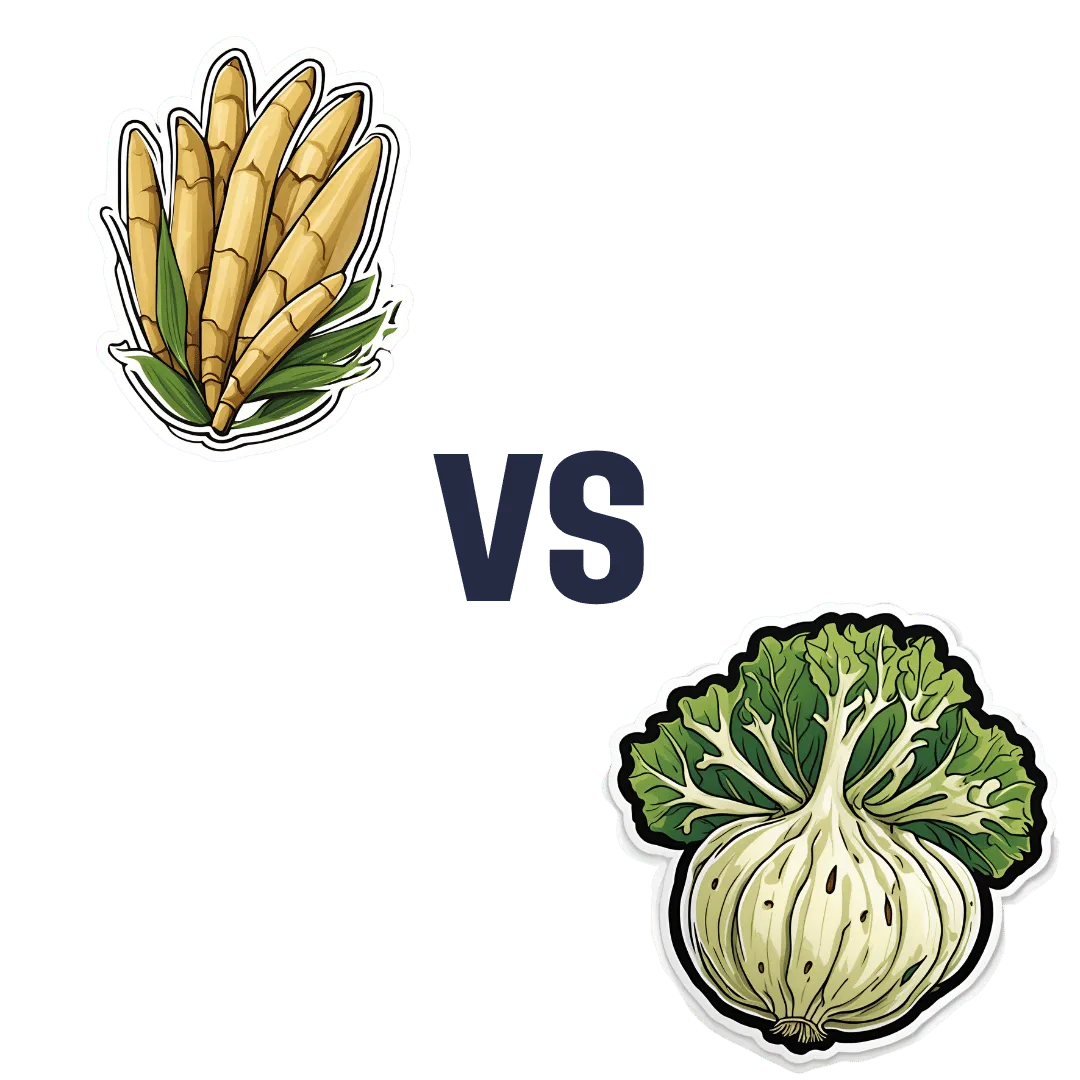
Bamboo Shoots vs Celeriac – Which is Healthier?
10almonds is reader-supported. We may, at no cost to you, receive a portion of sales if you purchase a product through a link in this article.
Our Verdict
When comparing bamboo shoots to celeriac, we picked the bamboo.
Why?
In terms of macros, bamboo has more fiber and protein, while celeriac has more carbs; an easy first-round win for bamboo.
In the category of vitamins, bamboo has more of vitamins A, B1, B2, B6, E, and celeriac has more of vitamins B3, B5, B9, C, and K, for a 5:5 tie in this round.
Looking at minerals, bamboo has more copper, manganese, potassium, selenium, and zinc, while celeriac has more calcium, iron, magnesium, and phosphorus, giving bamboo a modest 5:4 win in this round.
Adding up the sections makes for a clear overall win for bamboo, but by all means do enjoy either or both, as diversity is best!
Want to learn more?
You might like:
Don’t Be Bamboozled By Bamboo! ← including how to eat bamboo, for those unfamiliar with such, as we have been asked about it 🙂
Enjoy!
Don’t Forget…
Did you arrive here from our newsletter? Don’t forget to return to the email to continue learning!
Recommended
Learn to Age Gracefully
Join the 98k+ American women taking control of their health & aging with our 100% free (and fun!) daily emails:
-
The Snooze-Button Controversy
10almonds is reader-supported. We may, at no cost to you, receive a portion of sales if you purchase a product through a link in this article.
To Snooze Or Not To Snooze? (Science Has Answers)
This is Dr. Jennifer Kanaan. She’s a medical doctor with a focus on pulmonary critical care, sleep disorders, and sleep medicine.
What does she want to tell us?
She wants us to be wary of the many news articles that have jumped on a certain recent sleep study, such as:
- Is hitting the snooze button really a bad idea? Study sheds light on the impact of morning alarms on sleep and cognition
- Hitting Snooze May Help You Feel Less Sleepy and More Alert, Research Says
- Is it okay to press the snooze button?
- Hitting Snooze May Help You Feel Less Sleepy and More Alert, Research Says
- Hitting the snooze button on your alarm doesn’t make you more tired
For the curious, here is the paper itself, by Dr. Tina Sundelin et al. It’s actually two studies, by the way, but one paper:
The authors of this study concluded:
❝There were no clear effects of snoozing on the cortisol awakening response, morning sleepiness, mood, or overnight sleep architecture.
A brief snooze period may thus help alleviate sleep inertia, without substantially disturbing sleep, for late chronotypes and those with morning drowsiness.❞
Notably, people tend to snooze because an alarm clock will, if not “smart” about it, wake us up mid sleep-cycle more often than not, and that will produce a short “sleep hangover”. By snoozing, we are basically re-rolling the dice on being woken up between sleep cycles, and thus feeling more refreshed.
What’s Dr. Kanaan’s counterpoint?
Dr. Kanaan says:
❝If you’re coming in and out of sleep for 30 minutes, after the alarm goes off the first time, you’re costing yourself 30 minutes of uninterrupted, quality, restorative sleep. This study doesn’t change that fact.❞
She advises that rather than snoozing, we should prioritize getting good sleep in the first place, and once we do wake up, mid sleep-cycle or not, get sunlight. That way, our brain will start promptly scrubbing melatonin and producing the appropriate wakefulness hormones instead. That means serotonin, and also a spike of cortisol.
Remember: cortisol is only bad when it’s chronically elevated. It’s fine, and even beneficial, to have a short spike of cortisol. We make it for a reason!
If you’d like to hear more from Dr. Kanaan, you might like this interview with her at the University of Connecticut:
Want the best of both worlds?
A great option to avoid getting woken in the middle of a sleep cycle, and also not needing to hit snooze, is a sunrise alarm clock. Specifics of these devices vary, but for example, the kind this writer has starts gently glowing an hour before the set alarm time,and gradually gets brighter and lighter over the course of the hour.
We don’t sell them, but here’s an example sunrise alarm clock on Amazon, for your convenience
Share This Post
-
Your Health Audit, From Head To Toe
10almonds is reader-supported. We may, at no cost to you, receive a portion of sales if you purchase a product through a link in this article.
Health Audit Time
Here at 10almonds, we often cover quite specific things, ranging from “the effect of sodium on organs other than your heart” to “make this one small change to save your knees while driving”.
But, we’re each a whole person, and we need to take care of the whole organism that makes up the wonderful being that we each are. If we let one part of it drop in health too much, the others will soon follow suit because of the knock-on effects.
So, let’s do a quick self-check-up, and see what can be done for each! How’s your…
Mental Health
We’re doing this audit head-to-to, so let’s start it here, because mental health is also just health, and it’s difficult to tackle the others without having this one at least under control!
Are you experiencing chronic stress? Anxiety? Depression? Joy?
If you answered “no” to “joy” but also “no” to “depression”, you might want to rethink your answer to “depression”, by the way. Life should be a joyous thing!
Some resources to address your mental health:
Brain Health
Your brain is a big, powerful organ. It uses more of your daily energy (in the physiological sense of the word, we’re talking calories and mitochondria and ATP) than any other organ, by far.
And when it comes to organ failure, if your brain fails, then having the best joints in the world won’t help you, for example.
Some resources to address your brain health:
- Brain Food? The Eyes Have It
- How To Reduce Your Alzheimer’s Risk
- The 6 Dimensions Of Sleep (And Why They Matter)
Heart Health
Everything depends on your heart, head to toe. Tirelessly pumping blood with oxygen, nutrients, and agents of your immune system all around your body, all day every day for your entire life.
What’s your resting heart rate like? How about your blood pressure? And while we’re on the topic of blood… how’s your blood sugar health?
These are all important things to a) know about and b) keep on top of!
Some resources to address your heart health:
- 1-Minute Heart Health Check-Up Tips
- A Five-Point Plan For Heart Health
- High Blood Pressure? Try These!
Gut Health
By cell count, we’re about 10% human and 90% bacteria. By gene count, also. Pretty important, therefore, that we look after our trillions of tiny friends that keep our organism working.
Most people in N. America, for example, get vastly under the recommended daily amount of fiber, and that’s just the most basic courtesy we could do for these bugs that keep us alive (they need that fiber to live, and their process of consuming it is beneficial to us in a stack of ways).
Some resources to address your gut health:
- Making Friends With Your Gut (You Can Thank Us Later)
- The Surprising Link Between Gut Health And Serotonin
- The Vagus Nerve: The Brain-Gut Highway!
Hormonal Health
Hormones are weird and wonderful and affect so much more than the obvious sex-related functions (but yes, those too). A lot of people don’t realize it, but having our hormones in good order or not can make the difference between abject misery and a happy, fulfilling life.
Some resources to address your hormonal health:
- What Does “Balance Your Hormones” Even Mean?
- Healthy Hormones And How To Hack Them
- Too Much Or Too Little Testosterone?
Bone/Joint Health
Fear nothing! For you are a ghost operating a skeleton clad in flesh. But also, you know, look after that skeleton; you only get one! Being animals, we’re all about movement, and being humans, we’ve ended up with some lifestyle situations that aren’t great for that mobility. We sit too much; we walk too little; we cramp ourselves into weird positions (driving, anyone?), and we forget the range of motion we’re supposed to have. But let’s remember…
Some resources to address your bone/joint health:
- Collagen’s benefits are more than skin deep
- Cool As A Cucumber (Move Over, Glucosamine + Chondroitin)
- 5 Best Bodyweight Exercises For Incredible Mobility
Lastly…
While it’s good to do a little self-audit like this every now and again, it’s even better to get a professional check-up!
As engineers say: if you don’t schedule time for maintenance, your equipment will schedule it for you.
Share This Post
-
5 Movements You’ll Wish You’d Known Sooner
10almonds is reader-supported. We may, at no cost to you, receive a portion of sales if you purchase a product through a link in this article.
Alisa Szyman, mobility coach, shows us why:
Best for mobility, best against pain
These movements are what’s needed for good mobility (range of motion, flexibility, strength, stability) while also being a top-tier way of combatting pain, due to what they do for the body’s natural functions.
Specifically, the exercises are intended to build on one another, beginning with neck stability, then restoring upper-back rotation, activating your glutes, improving hip control, and finally reducing hamstring and posterior-chain tightness:
- Chin tucks: stand tall, bring your chin slightly forwards, then push it straight back to create a double chin while keeping your head level, and follow with slow shoulder shrugs by lifting your shoulders towards your ears and lowering them under control.
- Quadruped thoracic rotations: start on all fours with one hand on the floor and the other extended to the side, rotate through your upper back to lift the arm towards the ceiling while following it with your eyes, then return to the start position.
- Glute bridges: lie on your back with your knees bent and feet flat, squeeze your glutes before lifting your hips, hold briefly at the top, then lower slowly while keeping the effort in your glutes rather than your lower back.
- Hip CARs (controlled articular rotations): stand or kneel, lift one knee and slowly move your hip through its fullest circular range while keeping your spine and upper body still, then repeat in both directions on each side.
- Sciatic nerve flossing: lie on your back with one knee bent and your foot flat on the floor, raise the other leg towards the ceiling, then gently flex and point your foot or make slow ankle circles, to glide the sciatic nerve through its range of motion.
For more on all of this plus visual demonstrations, enjoy:
Click Here If The Embedded Video Doesn’t Load Automatically!
Want to learn more?
You might also like:
Best Mobility Drills For Posture & Pain Relief
Take care!
Share This Post
Related Posts
-
Dandelion Greens vs Kale – Which is Healthier?
10almonds is reader-supported. We may, at no cost to you, receive a portion of sales if you purchase a product through a link in this article.
Our Verdict
When comparing dandelion greens to kale, we picked the kale.
Why?
Both are great, and…
Long-time 10almonds readers with a good memory may now be wondering: wait a minute, how is this possible; didn’t dandelion greens beat collard greens which beat kale?
And yes, those are all true claims; there’s a sort of rock-paper-scissors thing going on here.
While at first glance this seems like a paradox, it’s actually because of how we look at the different categories (macros, vitamins, minerals, other) and tot up the scores within those sections to see which wins each section, and add up the section wins to declare a winner. This means that if one option is higher in some vitamins but lower in others, the question of which ones it’s better or worse in won’t change the score, but can make a big difference to whether it beats something else, which may or may not be stronger or weaker in those specific vitamins. And so on for each category.
And this, dear reader, is another reason why it’s important to get not just a nutrient-dense diet, but also a varied one! You can’t just eat the top 3 healthiest things and consider your diet optimized; it doesn’t work like that.
With all that now in mind, let’s get on to the details of today’s comparison:
In terms of macros, the only difference is that kale has a touch more protein; the numbers are small, because well, it’s leaves, but this is a slender nominal win for kale, or else a tie in this category.
In the category of vitamins, dandelion greens have more of vitamins B1, B2, and E, while kale has more of vitamins B3, B5, B6, B7, B9, and C, scoring an easy second-round win.
Looking at minerals, dandelion greens have more calcium and iron, while kale has more copper, magnesium, manganese, phosphorus, potassium, selenium, and zinc, sweeping this round as well.
In other consideration, both are very abundant in polyphenols, and we must consider this category a tie.
Adding up the sections makes for a clear overall win for kale, but by all means do enjoy either or both as, it bears repeating, diversity really is best!
Want to learn more?
You might like:
What’s Your Plant Diversity Score? ← another reason (different from the above reason) that it’s good to mix things up rather than just using the same ingredients out of habit!
Enjoy!
Don’t Forget…
Did you arrive here from our newsletter? Don’t forget to return to the email to continue learning!
Learn to Age Gracefully
Join the 98k+ American women taking control of their health & aging with our 100% free (and fun!) daily emails:
-
Cut The Pain Of Fibromyalgia By 1/3
10almonds is reader-supported. We may, at no cost to you, receive a portion of sales if you purchase a product through a link in this article.
First of all, let’s make one important note about fibromyalgia: fibromyalgia is less of a useful diagnosis and more of a rubber stamp, much like the role historically often fulfilled by “heart failure” as an official cause of death (because certainly, that heart sure did stop beating). It’s a way of answering the question without answering the question.
It’s what doctors write down when they’ve ruled out possible causes they’re aware of, and don’t want to admit they don’t know why your body is doing what it is.
It’s saying “I diagnose you with tired hurty syndrome, good luck, that’ll be [astonishing sum of dollars for the privilege of receiving this nothingburger answer] thank you”.
To be clear, while we are disparaging fibromyalgia as a useful diagnosis, we’re not dismissing the actual effect it has on people.
So while fibromyalgia has some potential use as a placeholder descriptor, it’s not an actionable answer, and it means that if that’s the diagnosis you’re handed, it can be beneficial to keep looking for the cause (because fibromyalgia is a result, not a cause).
For more on that, see: Why Fibromyalgia Is Not An Acceptable Diagnosis (and what to look for instead)
That covered, let’s move on to a new option for managing the symptoms:
A first-in-class, non-opioid approach
We’ll get straight to it: Tonmya (cyclobenzaprine hydrochloride), a once-daily sublingual tablet, received FDA approval all so recently, becoming the first new FDA-approved fibromyalgia medication in more than 15 years (the only others before that being pregabalin, duloxetine, and milnacipran, all of which have their faults and none of which produce great results*), and is now available in US pharmacies.
*In a survey of 800 patients with fibromyalgia, 70% reported using one of those medications as prescribed by their doctor, but only 19% reported being very satisfied with their current treatment (source)
Importantly, this new drug works independently of opioid pathways by modulating 5-HT2A, α1, H1, and M1 receptors*; as such, it improves sleep quality as well as central pain processing, addressing both pain and nonrestorative sleep—which are both very common, very serious problems associated with fibromyalgia, and certainly both things make the other hard to deal with, so having a medication that addresses both is truly a big deal.
*For more detail/clarity, we’ll quote from a paper on the topic:
❝Cyclobenzaprine antagonizes serotonin 2A (5-HT2A), 5-HT2B, and 5-HT2C; histamine 1 (H1); α1A-, α1B-, α2B-, and α2C-adrenergic; and muscarinic 1 (M1) acetylcholine receptors, as well as relatively weakly inhibits activity at the norepinephrine transporter (NET) and serotonin transporter (SERT)❞
Read in full: Efficacy and Safety of Sublingual Cyclobenzaprine for the Treatment of Fibromyalgia: Results From a Randomized, Double-Blind, Placebo-Controlled Trial ← this is actually a very interesting read in its entirety, by the way, so if you have the time, we recommend it!
The most recent trials, with nearly 1,000 participants, showed statistically significant reductions in daily pain; most achieved at least a 30% pain improvement or greater, after three months.
Now, the very most recent paper hasn’t been officially published yet so we can’t link it at this time, but you can read the press release here:
Want to learn more?
You might like this book that we reviewed a while back:
What Your Doctor May Not Tell You About Fibromyalgia – by Dr. R. Paul St Amand
We’ve also written quite a bit about pain management, including:
- Before You Reach For That Tylenol…
- How To Stop Pain Spreading
- How To Dial Down Your Pain
- Managing Chronic Pain (Realistically!)
- Get The Right Help For Your Pain
- The 7 Approaches To Pain Management
- Science-Based Alternative Pain Relief (When Painkillers Aren’t Helping, These Things Might)
Take care!
Don’t Forget…
Did you arrive here from our newsletter? Don’t forget to return to the email to continue learning!
Learn to Age Gracefully
Join the 98k+ American women taking control of their health & aging with our 100% free (and fun!) daily emails:
-
These shoes are best for hip and knee arthritis, according to science
10almonds is reader-supported. We may, at no cost to you, receive a portion of sales if you purchase a product through a link in this article.
People with hip and knee osteoarthritis are advised to wear “appropriate footwear” to minimise their pain.
Does that mean heels are out? Does it matter if you wear runners or something a little stiffer? How about using insoles?
Our research, including our latest clinical trial published today in Annals of Internal Medicine, provides some answers.
We show that stable, more supportive shoes aren’t necessarily the best option, despite what you might have heard.
Francisco Emilio Diaz/Pexels What is osteoarthritis?
Osteoarthritis is a condition that affects the tissues in and around a joint, including bone, cartilage, ligaments and muscles. It is more common in older people, and people with excess body weight. It causes joint pain and stiffness, and can lead to disability.
About 2.35 million Australians have osteoarthritis and this number is predicted to increase as the population ages and obesity rates rise.
Osteoarthritis commonly affects the hip and knee joints, making it difficult to walk. There is no cure, so self-management is important.
That includes wearing the right type of shoes.
How can shoes affect symptoms?
There are many causes of osteoarthritis, but excessive force inside the joint when someone is walking is thought to play a role. Excessive joint forces can also increase the chance of osteoarthritis worsening over time.
Shoes are our connection to the ground and can influence how forces are transmitted up the leg during every step. Some shoe features are particularly important.
Shoes with higher heels increase joint forces. For example, shoes with six-centimetre heels increase knee forces by an average 23% compared to walking barefoot.
Some shoes come with supportive features, such as insoles that support the arches. Other supportive features include being made with a stiffer material in the sole or heel.
Many people, and clinicians, think these stable and supportive shoe features are best for people with osteoarthritis.
But biomechanical research shows shoes with these supportive features actually increase knee force by up to 15% compared to shoes without them. Arch-supporting insoles also increase knee force by up to 6% when added to shoes.
So, are flatter, flexible shoes without stable supportive features – such as ballet flats – better for knee and hip osteoarthritis?
Not necessarily. We also need to look at people’s pain.
What we found
Our biomechanical research from 2017 in people with knee osteoarthritis showed flat flexible shoes reduced knee forces by an average 9% compared to stable supportive shoe styles.
This suggests flat flexible shoes could be better for osteoarthritis. To find out, we conducted two clinical trials to look at people’s pain levels.
Our new clinical trial involved 120 people with hip osteoarthritis.
They were randomised to wear different types of flat flexible shoes, such as flexible ballet flats, or different types of stable supportive shoes, such as supportive runners. People were asked to wear their shoes for at least six hours a day. After six months we measured the change in hip pain when they walked.
We found flat flexible shoes were no better than stable supportive shoes for reducing hip pain.
These findings differ to those from our 2021 clinical trial in 164 people with knee osteoarthritis. In that trial, we found wearing stable supportive shoes for six months reduced knee pain when walking by an average 63% more than wearing flat flexible shoes.
It’s unclear why findings differed between the knee and hip. But it might be because joint forces are higher in knee compared to hip osteoarthritis, and so there may be greater potential for stable supportive shoes to reduce knee forces, and therefore knee pain.
In both trials, more complications, such as foot pain, were reported by people who wore flat flexible shoes. This might be because these shoe styles provide less protection for the feet.
So which shoes should I wear?
For people with knee osteoarthritis, stable supportive shoes are likely to be more beneficial than flat flexible ones.
For people with hip osteoarthritis, neither shoe type is better than the other for improving hip pain.
But for all older people – including those with hip and knee osteoarthritis – it is sensible to avoid ill-fitting shoes, as well as shoes with high or narrow heels, due to an increased risk of falls.
For younger people with knee or hip osteoarthritis but who are not at risk of falls, it may still be advisable to avoid high heels given their potential to increase joint forces.
Who should you talk to?
If you are concerned about your hip or knee osteoarthritis, talk to your GP or other health-care provider, such as a podiatrist or physiotherapist.
Other non-surgical treatments, such as exercise, weight management, nutrition and some pain medicines can help.
Kade Paterson, Associate Professor of Musculoskeletal Health, The University of Melbourne and Rana Hinman, Professor in Physiotherapy, The University of Melbourne
This article is republished from The Conversation under a Creative Commons license. Read the original article.
Don’t Forget…
Did you arrive here from our newsletter? Don’t forget to return to the email to continue learning!
Learn to Age Gracefully
Join the 98k+ American women taking control of their health & aging with our 100% free (and fun!) daily emails:


