

Hitting the beach? Here are some dangers to watch out for – plus 10 essentials for your first aid kit
10almonds is reader-supported. We may, at no cost to you, receive a portion of sales if you purchase a product through a link in this article.
Summer is here and for many that means going to the beach. You grab your swimmers, beach towel and sunscreen then maybe check the weather forecast. Did you think to grab a first aid kit?
The vast majority of trips to the beach will be uneventful. However, if trouble strikes, being prepared can make a huge difference to you, a loved one or a stranger.
So, what exactly should you be prepared for?
Knowing the dangers
The first step in being prepared for the beach is to learn about where you are going and associated levels of risk.
In Broome, you are more likely to be bitten by a dog at the beach than stung by an Irukandji jellyfish.
In Byron Bay, you are more likely to come across a brown snake than a shark.
In the summer of 2023–24, Surf Life Saving Australia reported more than 14 million Australian adults visited beaches. Surf lifesavers, lifeguards and lifesaving services performed 49,331 first aid treatments across 117 local government areas around Australia. Surveys of beach goers found perceptions of common beach hazards include rips, tropical stingers, sun exposure, crocodiles, sharks, rocky platforms and waves.
Sun and heat exposure are likely the most common beach hazard. The Cancer Council has reported that almost 1.5 million Australians surveyed during summer had experienced sunburn during the previous week. Without adequate fluid intake, heat stroke can also occur.
Lacerations and abrasions are a further common hazard. While surfboards, rocks, shells and litter might seem more dangerous, the humble beach umbrella has been implicated in thousands of injuries.
Sprains and fractures are also associated with beach activities. A 2022 study linked data from hospital, ambulance and Surf Life Saving cases on the Sunshine Coast over six years and found 79 of 574 (13.8%) cervical spine injuries occurred at the beach. Surfing, smaller wave heights and shallow water diving were the main risks.
Rips and rough waves present a higher risk at areas of unpatrolled beach, including away from surf lifesaving flags. Out of 150 coastal drowning deaths around Australia in 2023–24, nearly half were during summer. Of those deaths:
- 56% occurred at the beach
- 31% were rip-related
- 86% were male, and
- 100% occurred away from patrolled areas.
People who had lived in Australia for less than two years were more worried about the dangers, but also more likely to be caught in a rip.

Knowing your DR ABCs
So, beach accidents can vary by type, severity and impact. How you respond will depend on your level of first aid knowledge, ability and what’s in your first aid kit.
A first aid training company survey of just over 1,000 Australians indicated 80% of people agree cardiopulmonary resuscitation (CPR) is the most important skill to learn, but nearly half reported feeling intimidated by the prospect.
CPR training covers an established checklist for emergency situations. Using the acronym “DR ABC” means checking for:
- Danger
- Response
- Airway
- Breathing
- Circulation
A complete first aid course will provide a range of skills to build confidence and be accredited by the national regulator, the Australian Skills Quality Authority.
What to bring – 10 first aid essentials
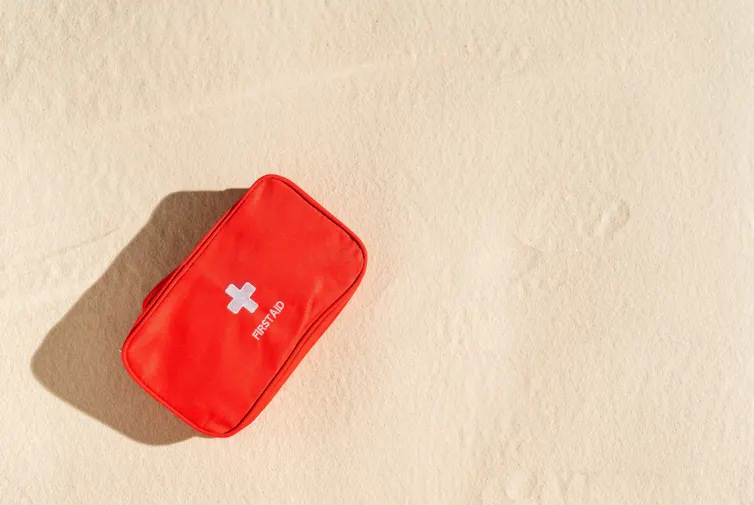
Whether you buy a first aid kit or put together you own, it should include ten essential items in a watertight, sealable container:
- Band-Aids for small cuts and abrasions
- sterile gauze pads
- bandages (one small one for children, one medium crepe to hold on a dressing or support strains or sprains, and one large compression bandage for a limb)
- large fabric for sling
- a tourniquet bandage or belt to restrict blood flow
- non-latex disposable gloves
- scissors and tweezers
- medical tape
- thermal or foil blanket
- CPR shield or breathing mask.
Before you leave for the beach, check the expiry dates of any sunscreen, solutions or potions you choose to add.
If you’re further from help
If you are travelling to a remote or unpatrolled beach, your kit should also contain:
- sterile saline solution to flush wounds or rinse eyes
- hydrogel or sunburn gel
- an instant cool pack
- paracetamol and antihistamine medication
- insect repellent.
Make sure you carry any “as-required” medications, such as a Ventolin puffer for asthma or an EpiPen for severe allergy.
Vinegar is no longer recommended for most jellyfish stings, including Blue Bottles. Hot water is advised instead.
In remote areas, also look out for Emergency Response Beacons. Located in high-risk spots, these allow bystanders to instantly activate the surf emergency response system.
If you have your mobile phone or a smart watch with GPS function, make sure it is charged and switched on and that you know how to use it to make emergency calls.
First aid kits suitable for the beach range in price from $35 to over $120. Buy these from certified first aid organisations such as Surf Lifesaving Australia, Australian Red Cross, St John Ambulance or Royal Life Saving. Kits that come with a waterproof sealable bag are recommended.
Be prepared this summer for your trip to the beach and pack your first aid kit. Take care and have fun in the sun.
Andrew Woods, Lecturer, Nursing, Faculty of Health, Southern Cross University and Willa Maguire, Associate Lecturer in Nursing, Southern Cross University
This article is republished from The Conversation under a Creative Commons license. Read the original article.
Don’t Forget…
Did you arrive here from our newsletter? Don’t forget to return to the email to continue learning!
Recommended
Learn to Age Gracefully
Join the 98k+ American women taking control of their health & aging with our 100% free (and fun!) daily emails:
-
What Happens To Your Body When You Plank 1 Minute Every Day
10almonds is reader-supported. We may, at no cost to you, receive a portion of sales if you purchase a product through a link in this article.
Planks improve strength, flexibility, balance, posture, reduce chronic back pain, lower blood pressure, and enhance physique. But can we really get benefits from just 1 minute per day?
To the core
The benefits that can be expected, according to the science cited in this video, include:
- Within 2–3 weeks, daily planking of just 1 minute per day activates deep core muscles, enhancing balance, which helps in everyday tasks and prevents muscle imbalances.
- Strengthening core muscles through planks also helps alleviate lower back pain, with research supporting its effectiveness within 3 weeks.
- Posture is important for good health, and planks align the spine and hips, improving posture naturally, which also helps alleviate back issues. So, there’s a good kind of synergy to this exercise.
- Of course, many people exercising have the goal of a more toned body; regular planking leads to a toned core, sculpted shoulders, and leaner legs.
- For those who care more about mobility, though, planking enhances flexibility in hamstrings, feet, and toes within 4–6 weeks.
- Anything else? Yes, isometric exercises like planks are highly effective at reducing blood pressure, and, counterintuitively, more so than aerobic exercises.
The video also looks at a study in which participants did 20 minutes per day instead of 1, which predictably also significantly improved strength, endurance, flexibility, and reduced body fat.
However, another study cited gives the stats for just 1 minute daily, and that was not even a whole minute, so much as 30 seconds hold, 1 minute rest, 30 seconds hold—and still showed very good improvements.
For more on all this, plus links to three studies mentioned in the video, enjoy:
Click Here If The Embedded Video Doesn’t Load Automatically!
Want to learn more?
You might also like to read:
Isometric Exercises That Are Good If You Have Osteoporosis (or if you don’t, but the point is, they are safe and beneficial for people with osteoporosis)
Take care!
Share This Post
-
Little Treatments, Big Effects – by Dr. Jessica Schleider
10almonds is reader-supported. We may, at no cost to you, receive a portion of sales if you purchase a product through a link in this article.
The author, a clinical psychologist, discusses how mental healthcare has come a very long way, yet still has a long way to go. While advocating for top-down reforms, she does have a stopgap solution:
Find ways to significantly improve people’s mental health in a single-session intervention.
This seems like a tall order, but her method is based on good science, and also, most people will agree from experience that big changes can happen to someone in the space of moments, at pivotal turning points in life—they just have to be the right moments.
Dr. Schleider recommends that therapists train in (and then offer) this method, but she does also give comprehensive advice for self-therapy of this kind too.
These self-therapy directions, ways to induce those life-pivoting moments for the better, are perhaps the greatest value that the book gives us.
Bottom line: if you’d like a lot of the benefits of therapy without getting therapy, this book can definitely point you in the right direction, in a manner that won’t be a drain on your time or your wallet.
Share This Post
-
Walking… Better.
10almonds is reader-supported. We may, at no cost to you, receive a portion of sales if you purchase a product through a link in this article.
Walking… Better.
We recently reviewed “52 Ways To Walk” by Annabel Streets. You asked us to share some more of our learnings from that book, and… Obviously we can’t do all 52, nor go into such detail, but here are three top tips inspired by that book…
Walk in the cold!
While cold weather is often seen as a reason to not walk, in fact, it has numerous health benefits, the most exciting of which might be:
Walking in the cold causes us to convert white and yellow fat into the healthier brown fat. If you didn’t know about this, neither did scientists until about 15 years ago.
In fact, scientists didn’t even know that adult humans could even have brown adipose tissue! It was really quite groundbreaking.
In case you missed it: The Changed Metabolic World with Human Brown Adipose Tissue: Therapeutic Visions
Work while you walk!
Obviously this is only appropriate for some kinds of work… but if in your life you have any kind of work that is chiefly thinking, a bunch of it can be done while walking.
Open your phone’s note-taking app, lock the screen and pocket your phone, and think on some problem that you need to solve. Whenever you have an “aha” moment, take out your phone and make a quick note on the go.
For that matter, if you have the money and space (or are fortunate to have an employer disposed towards facilitating such), you could even set up a treadmill desk… At worst, it wouldn’t harm your work (and it’ll be a LOT better than sitting for so long).
Walk within an hour of waking!
No, this doesn’t mean that if you don’t get out of the house within 60 minutes you say “Oh no, missed the window, guess it’s a day in today”
But it does mean: in the evening, make preparations to head out first thing in the morning. Set out your clothes and appropriate footwear, find your flask to fill with the beverage of your choice in the morning and set that with them.
Then, when morning arrives… do your morning necessaries (e.g. some manner of morning ablutions and perhaps a light breakfast), make that drink for your flask, and hit the road.
Why? We’ll tell you a secret:
You ever wondered why some people seem to be more able to keep a daylight-regulated circadian rhythm than others? It’s not just about smartphones and coffees…
This study found that getting sunlight (not electric light, not artificial sunlight, but actual sunlight, from the sun, even if filtered through partial cloud) between 08:30—09:00 resulted in higher levels of a protein called PER2. PER2 is critical for setting circadian rhythms, improving metabolism, and fortifying blood vessels.
Besides, on a more simplistic level, it’s also a wonderful and energizing start to a healthy and productive day!
Read: Beneficial effects of daytime light exposure on daily rhythms, metabolic state and affect
Share This Post
Related Posts
-
Three Surprising Ways Microplastics Can Enter Your Body
10almonds is reader-supported. We may, at no cost to you, receive a portion of sales if you purchase a product through a link in this article.
How many are you and your family subject to?
The wrong plasticity
We’ll not keep the three ways a mystery; they are:
- Inhalation: breathing in airborne microplastics from indoor and urban environments where particles are suspended in the air
- Ingestion: consuming plastics through food and drink, especially from packaging, bottled water, and contaminated seafood especially
- Absorption: absorbing tiny particles and associated chemicals through your skin from cosmetics, personal care products, and more
This is a problem, because nanoplastics are small enough to cross cell membranes and accumulate in tissues like your liver, brain, and lungs, where your immune system triggers inflammation but cannot fully remove them.
The futile immune response then becomes a problem of its own, as repeated immune responses mean chronic inflammation, which is a recipe for disaster in more ways than we have room to list here, but the gist is: your body will get cumulatively rundown over time.
Another way it causes harm is that many such plastics release endocrine-disrupting chemicals like BPA, phthalates, and PFAS, which are well-documented to affect hormones and metabolism in humans (spoiler: the effects are not good effects).
The science of microplastics is (for obvious reasons) young and ongoing, for example, there’s a lot that still unknown about such things as:
- direct disease causation: while it certainly appears that microplastics cause specific diseases like cancer, dementia, and diabetes in humans, the causality has not technically been proven yet.
- dose-response effects: scientists don’t yet know how much exposure (if any) is “safe” over a lifetime in humans
- organ-specific damage: plastics have been found in organs (including the brain), but the the full list exact health consequences of that accumulation are still being investigated. We know it is strongly associated with increased aggregation of tau proteins, amyloid-beta, alpha-synuclein, and so forth, though, amongst other things (see the “learn more” for more on this).
- relative importance of sources: it’s still uncertain which exposure sources (air vs food vs products) contribute most to long-term health risk.
- long-term human outcomes: the strongest current evidence comes from in vitro or non-human animal studies, while long-term human data is still limited and evolving (simply, mouse autopsies stack up more quickly than human ones).
For more on all of this, enjoy:
Click Here If The Embedded Video Doesn’t Load Automatically!
Want to learn more?
You might also like:
Microplastics Now, Alzheimer’s/Parkinson’s Later?
Take care!
Don’t Forget…
Did you arrive here from our newsletter? Don’t forget to return to the email to continue learning!
Learn to Age Gracefully
Join the 98k+ American women taking control of their health & aging with our 100% free (and fun!) daily emails:
-
What Do The Different Kinds Of Fiber Do? 30 Foods That Rank Highest
10almonds is reader-supported. We may, at no cost to you, receive a portion of sales if you purchase a product through a link in this article.
We’ve talked before about how important fiber is:
Why You’re Probably Not Getting Enough Fiber (And How To Fix It)
And even how it’s arguably the most important dietary factor when it comes to avoiding heart disease:
What Matters Most For Your Heart? Eat More (Of This) For Lower Blood Pressure ← Spoiler: it’s fiber
And yes, that’s even when considered alongside other (also laudable) dietary interventions such as lowering intake of sodium, various kinds of saturated fat, and red meat.
So, what should we know about fiber, aside from “aim to get nearer 40g/day instead of the US average 16g/day”?
Soluble vs Insoluble
The first main way that dietary fibers can be categorized is soluble vs insoluble. Part of the difference is obvious, but bear with us, because there’s more to know about each:
- Soluble fiber dissolves (what a surprise) in water and, which part is important, forms a gel. This slows down things going through your intestines, which is important for proper digestion and absorption of nutrients (as well as avoiding diarrhea). Yes, you heard right: getting enough of the right kind of fiber helps you avoid diarrhea.
- Insoluble fiber does not dissolve (how shocking) in water and thus mostly passes through undigested by us (some will actually be digested by gut microbes who subsist on this, and in return for us feeding them daily, they make useful chemicals for us). This kind of fiber is also critical for healthy bowel movements, because without it, constipation can ensue.
Both kinds of fiber improve just about every metric related to blood, including improving triglycerides and improving insulin sensitivity and blood glucose levels. Thus, they help guard against various kinds of cardiovascular disease, diabetes, and metabolic disease in general. Do note that because whatever’s good for your heart/blood is good for your brain (which requires a healthy heart and bloodstream to nourish it and take away waste), likely this also has a knock-on effect against cognitive decline, but we don’t have hard science for that claim so we’re going to leave that last item as a “likely”.
However, one thing’s for sure: if you want a healthy gut, heart, and brain, you need a good balance of soluble and insoluble fibers.
10 of the best for soluble fiber
Food Soluble Fiber Type(s) Soluble Fiber (g per serving) Insoluble Fiber Type(s) Insoluble Fiber (g per serving) Total Fiber (g per serving) Kidney beans (1 cup cooked) Pectin, Resistant Starch 1.5–2 Hemicellulose, Cellulose 6 8 Lentils (1 cup cooked) Pectin, Resistant Starch 1.5–2 Cellulose 6 7.5 Barley (1 cup cooked) Beta-glucan 3–4 Hemicellulose 2 6 Brussels sprouts (1 cup cooked) Pectin 1–1.5 Cellulose, Hemicellulose 2 3.5 Oats (1 cup cooked) Beta-glucan 2–3 Cellulose 1 3 Apples (1 medium) Pectin 1–2 Cellulose, Hemicellulose 2 3 Carrots (1 cup raw) Pectin 1–1.5 Cellulose, Hemicellulose 2 3 Citrus fruits (orange, 1 medium) Pectin 1–1.5 Cellulose 1 2.5 Flaxseeds (2 tbsp) Mucilage, Lignin 1–1.5 Cellulose 1 2.5 Psyllium husk (1 tbsp) Mucilage 3–4 Trace amounts 0 3–4 10 of the best for insoluble fiber
Food Soluble Fiber Type(s) Soluble Fiber (g per serving) Insoluble Fiber Type(s) Insoluble Fiber (g per serving) Total Fiber (g per serving) Wheat bran (1 cup) Trace amounts 0 Cellulose, Lignin 6–8 6–8 Black beans (1 cup cooked) Pectin, Resistant Starch 1.5 Cellulose 6 7.5 Brown rice (1 cup cooked) Trace amounts 0.5 Hemicellulose, Lignin 2–3 2.5–3.5 Popcorn (3 cups popped) Trace amounts 0.5 Hemicellulose 3 3.5 Broccoli (1 cup cooked) Pectin 1 Cellulose, Hemicellulose 4 5 Green beans (1 cup cooked) Trace amounts 0.5 Cellulose, Hemicellulose 3 3.5 Sweet potatoes (1 cup cooked) Pectin 1–1.5 Cellulose 3 4.5 Whole wheat bread (1 slice) Trace amounts 0.5 Cellulose, Hemicellulose 1 1.5 Pears (1 medium) Pectin 1 Cellulose, Hemicellulose 4 5 Almonds (1 oz) Trace amounts 0.5 Cellulose, Hemicellulose 2 2.5 10 of the best for a balance of both
Food Soluble Fiber Type(s) Soluble Fiber (g per serving) Insoluble Fiber Type(s) Insoluble Fiber (g per serving) Total Fiber (g per serving) Raspberries (1 cup) Pectin 1 Cellulose 5 6 Edamame (1 cup cooked) Pectin 1 Cellulose 5 6 Chia seeds (2 tbsp) Mucilage, Pectin 2–3 Lignin, Cellulose 3 5.5 Artichokes (1 medium) Inulin 1 Cellulose, Hemicellulose 5 6 Avocado (1 medium) Pectin ~2 Cellulose 4 6 Black beans (1 cup cooked) Pectin, Resistant Starch 1.5 Cellulose 6 7.5 Quinoa (1 cup cooked) Pectin, Saponins 1 Cellulose, Hemicellulose 3 4 Spinach (1 cup cooked) Pectin 0.5 Cellulose, Lignin 3 3.5 Prunes (1/2 cup) Pectin, Sorbitol 2 Cellulose 4 6 Figs (3 medium) Pectin 1 Cellulose 2 3 You’ll notice that the above “balance” is not equal; that’s ok; we need greater quantities of insoluble than soluble anyway, so it is as well that nature provides such.
This is the same kind of balance when we talk about “balanced hormones” (does not mean all hormones are in equal amounts; means they are in the right proportions) or “balanced microbiome” (does not mean that pathogens and friendly bacteria are in equal numbers), etc.
Some notes on the above:
About those fiber types, some of the most important soluble ones to aim for are:
- Beta-glucan: found in oats and barley, it supports heart health.
- Pectin: found in fruits like apples, citrus, and pears, it helps with cholesterol control.
- Inulin: a type of prebiotic fiber found in artichokes.
- Lignin: found in seeds and wheat bran, it has antioxidant properties.
- Resistant starch: found in beans and lentils, it acts as a prebiotic for gut health.
See also: When Is A Fiber Not A Fiber? The Food Additive You Do Want
One fiber to rule them all
Well, not entirely (we still need the others) but there is a best all-rounder:
The Best Kind Of Fiber For Overall Health?
Enjoy!
Don’t Forget…
Did you arrive here from our newsletter? Don’t forget to return to the email to continue learning!
Learn to Age Gracefully
Join the 98k+ American women taking control of their health & aging with our 100% free (and fun!) daily emails:
-
Remedies To Reduce Varicose Veins (Or Avoid Them Entirely)
10almonds is reader-supported. We may, at no cost to you, receive a portion of sales if you purchase a product through a link in this article.
It’s Q&A Day at 10almonds!
Have a question or a request? We love to hear from you!
In cases where we’ve already covered something, we might link to what we wrote before, but will always be happy to revisit any of our topics again in the future too—there’s always more to say!
As ever: if the question/request can be answered briefly, we’ll do it here in our Q&A Thursday edition. If not, we’ll make a main feature of it shortly afterwards!
So, no question/request too big or small 😎
❝what to do about varicose veins, anything other than com,pression socks?❞
So, first of all, we did do an article a while back that has some overlap:
DVT Risk Management Beyond The Socks
Now, it’s worth noting that deep vein thrombosis (DVT) and varicose veins do have some important dissimilarities:
- DVT is, as the full name suggests, about thrombotic risk, i.e. blood clots
- Varicose veins are, as the name suggests (Latin varix = dilated) about dilated veins, i.e. more like the opposite problem
…which means that while circulation is an important factor in both, some medications/supplements/strategies will only be appropriate for one or the other.
Also,
- DVT, being about thrombotic risk, can kill you
- Varicose veins are usually considered harmless in and of themselves (although they sometimes may be a symptom of something else, and the something else can sometimes be more serious, sometimes not, so it’s still worth getting checked out).
Lastly, before we carry on, let’s note that varicose veins are not the same thing as “thread veins” or “spider veins”:
- Thread/Spider veins are usually small veins or even capillaries near the skin, and can be blue or red depending on oxygenation (including: depending on direction of travel), often appearing purple if moderately oxygenated or the red/blue are plumbed next to each other and you are effectively viewing both at once. They do not caused raised textures, and are merely visible.
- Varicose veins are, by definition, larger swollen veins (dilating made them larger, and the pressure of blood swells them) that have lost tension, thus often appear twisted, and because of their size, are very often palpable (producing raised textures that can be felt easily with the hand).
Now, onto the topic of management…
What can be done?
Firstly: if they are not causing you discomfort, and a doctor has confirmed to your satisfaction that they’re not a symptom of something more serious, you can just ignore them.
However, it’s probably best to try to treat them regardless, as something ignored now could potentially cause problems later, and it’d be nicer to avoid that later discomfort by treating them now.
Home remedies are plentiful and many are effective:
- Compression stockings: these effectively replace the tension that the veins were supposed to have—but it’s worth noting that this means they treat the symptom, not the cause. See also:
- Loose clothing: paradoxically, can help too. The thing here is that certain tight clothing—like “shapewear” designed to give a conventionally attractive outline between one’s waist and thighs—can essentially be similar to having applied a tourniquet in several places, which thus can cause circulatory problems, and is not the same same thing as compression stockings’ much more evenly-applied pressure. See also:
- Put your feet up: literally, elevating your feet makes the circulation’s job easier. Of course, this is a temporary relief, as for most people it will be impractical to spend all hours with one’s feet elevated. A good use of this one is to compensate for extended periods of standing, during which time (if circulation is not excellent) blood can pool somewhat from the bottom up, contributing to varicose veins. See also:
- Keep moving: paradoxically again, can help too. Cardio exercise is great for the circulation, as is movement in general (even without breaking a sweat). Again, this is important for breaking up periods of standing or sitting. See also:
- Diet: especially, enjoy lots of fruit and vegetables. Fiber, especially rutin, is important for circulatory health, as are polyphenols, especially flavonoids. See also:
- Electrolyte balance: to help the body’s natural process of homeostasis (by which, amongst many other things, it maintains blood pressure), many people would benefit from consuming less sodium (increases water retention and blood pressure) and more potassium (reduces water retention and blood pressure). See also:
- Lose weight if you can healthily do so: simply, more weight puts more pressure on the circulatory system, so losing weight can alleviate that. However, being underweight is not beneficial either, nor are overly restrictive diets, so please do be moderate in any use of this one. See also:
There are also herbal remedies, but we were not able to find any reliable evidence to support them, aside from insofar as many plants (and thus, their phytochemicals) do support good circulation, as we covered above under “diet”.
Failing all that, doctors have an array of surgical options at their disposal, mostly various methods of sealing and sometimes removing the veins in question. None seem pleasant and all surgeries carry at least some risk, but that’s a discussion for you and your doctor.
Take care!
Don’t Forget…
Did you arrive here from our newsletter? Don’t forget to return to the email to continue learning!
Learn to Age Gracefully
Join the 98k+ American women taking control of their health & aging with our 100% free (and fun!) daily emails:


