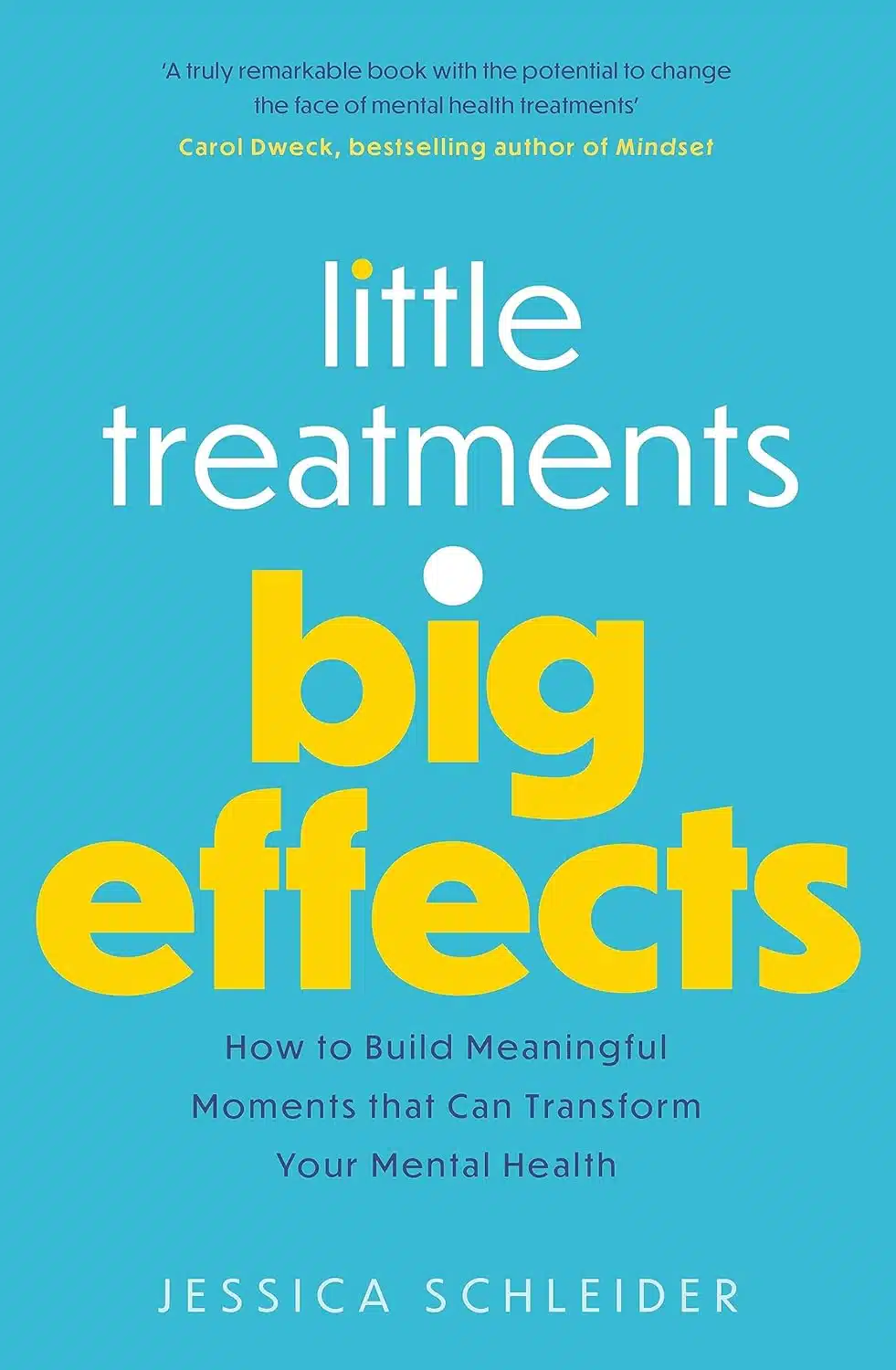
Little Treatments, Big Effects – by Dr. Jessica Schleider

10almonds is reader-supported. We may, at no cost to you, receive a portion of sales if you purchase a product through a link in this article.

The author, a clinical psychologist, discusses how mental healthcare has come a very long way, yet still has a long way to go. While advocating for top-down reforms, she does have a stopgap solution:

Find ways to significantly improve people’s mental health in a single-session intervention.

This seems like a tall order, but her method is based on good science, and also, most people will agree from experience that big changes can happen to someone in the space of moments, at pivotal turning points in life—they just have to be the right moments.

Dr. Schleider recommends that therapists train in (and then offer) this method, but she does also give comprehensive advice for self-therapy of this kind too.

These self-therapy directions, ways to induce those life-pivoting moments for the better, are perhaps the greatest value that the book gives us.

Bottom line: if you’d like a lot of the benefits of therapy without getting therapy, this book can definitely point you in the right direction, in a manner that won’t be a drain on your time or your wallet.

Click here to check out Little Treatments, Big Effects, and see what a difference you can make for yourself!

Don’t Forget…

Did you arrive here from our newsletter? Don’t forget to return to the email to continue learning!

Learn to Age Gracefully

Join the 98k+ American women taking control of their health & aging with our 100% free (and fun!) daily emails:

  • 7 Tips To Burn Fat & Build Muscle At The Same Time

    10almonds is reader-supported. We may, at no cost to you, receive a portion of sales if you purchase a product through a link in this article.

    Cori Lefkowith, of “Redefining Strength” and “Strong At Any Age” fame, has her formula to share:

    Know your priorities

    We’ll not keep the 7 tips a mystery; they are:

    1. Determine your primary goal: decide whether your main focus is losing fat while building muscle or building muscle while trimming up. This choice will influence your calorie intake, macros, and cardio approach.
    2. Start tracking: spend 7–14 days logging your current food intake, including calories, protein, carbs, and fats, without taking any particular action to change them yet. Understanding your baseline will help tailor your diet and exercise plan.
    3. Prioritize strength training: focus on strength work over cardio to build muscle. Avoid turning strength sessions into cardio by rushing between sets—allow adequate rest for muscle progression.
    4. Center your meals on protein: adjust your protein intake based on your primary goal. For fat loss while gaining muscle, aim for 40-45% of calories from protein. For building muscle while losing fat, aim for 30-40% protein, with attention to maintaining sufficient carbs.
    5. Set your calories: after adjusting protein, fine-tune your calorie intake. However, make only small changes (e.g. 100 calories up or down) and reassess every 2–3 weeks to avoid extreme deficits or surpluses.
    6. Adjust your cardio: prioritize strength training but use walking as low-impact cardio. Avoid excessive cardio that may hinder muscle gains, and use strategic HIIT sessions if needed.
    7. Ditch the scale: avoid using the scale as your sole measure of progress. Instead, rely on measurements, progress photos, and how your clothes fit to track body recomposition effectively.

    For more on all of these, enjoy:

    Click Here If The Embedded Video Doesn’t Load Automatically!

    Want to learn more?

    You might also like to read:

    Can You Gain Muscle & Lose Fat At The Same Time? ← we got this question in our Q&A day not long back, and here was our answer. We went for a less numbers-based approach, and a more principles-based approach. Both ways work, so by all means pick whichever method you personally find better suits how you like to do things!

    Take care!

    Share This Post

  • Potatoes & Anxiety

    10almonds is reader-supported. We may, at no cost to you, receive a portion of sales if you purchase a product through a link in this article.

    It’s Q&A Day at 10almonds!

    Have a question or a request? You can always hit “reply” to any of our emails, or use the feedback widget at the bottom!

    In cases where we’ve already covered something, we might link to what we wrote before, but will always be happy to revisit any of our topics again in the future too—there’s always more to say!

    As ever: if the question/request can be answered briefly, we’ll do it here in our Q&A Thursday edition. If not, we’ll make a main feature of it shortly afterwards!

    So, no question/request too big or small

    ❝My other half considers potatoes a wonder food, except when fried. I don’t. I find, when I am eating potatoes I put on weight; and, when I’m not eating them, I lose it. Also, although I can’t swear to it, potatoes also make me feel a little anxious (someone once told me it could have something to do with where they are on the “glycemic index”). What does the science say?❞

    The glycemic index of potatoes depends on the kind of potato (obviously) and also, less obviously, how it’s prepared. For a given white potato, boiling (which removes a lot of starch) might produce a GI of around 60, while instant mash (basically: potato starch) can be more like 80. For reference, pure glucose is 100. And you probably wouldn’t take that in the same quantity you’d take potato, and expect to feel good!

    So: as for anxiety, it could be, since spiked blood sugars can cause mood swings, including anxiety.

    Outside of the matter of blood sugars, the only reference we could find for potatoes causing anxiety was fried potatoes specifically:

    ❝frequent fried food consumption, especially fried potato consumption, is strongly associated with 12% and 7% higher risk of anxiety and depression, respectively❞

    Source: High fried food consumption impacts anxiety and depression due to lipid metabolism disturbance and neuroinflammation

    …which heavily puts the blame not on the potatoes themselves, but on acrylamide (the orange/brown stuff that is made by the Maillard reaction of cooking starches in the absence of water, e.g. by frying, roasting, etc).

    Here’s a very good overview of that, by the way:

    A Review on Acrylamide in Food: Occurrence, Toxicity, and Mitigation Strategies

    Back on the core topic of potatoes and GI and blood sugar spikes and anxiety, you might benefit from a few tweaks that will allow you to enjoy potatoes without spiking blood sugars:

    10 Ways To Balance Blood Sugars

    Enjoy!

    Share This Post

  • GLP-1 Drugs: Safe For Pregnancy Or Not?

    10almonds is reader-supported. We may, at no cost to you, receive a portion of sales if you purchase a product through a link in this article.

    …and other items from this week’s health news:

    Beyond “Ozempic babies”

    Briefly heralded as a potential boon to fertility (and advised against because of potential risks), GLP-1 receptor agonists have been re-examined in the context of pregnancy.

    In this most recent study of 10,781 women, 232 pregnancies occurred within six months of starting treatment. Being on contraception reduced the risk of pregnancy by 40%, which is also the approximate percentage of pregnancies overall that were unplanned (though doubtlessly it is not a perfect overlap).

    In terms of safety: animal studies show risks like fetal growth restriction, while limited human data (including a 2024 study of 938 pregnancies) found no higher risk of major birth defects compared with insulin (bearing in mind, GLP-1 RAs were initially most widely prescribed for the treatment of type 2 diabetes, before truly taking off as weight loss drugs).

    Read in full: Are GLP-1 drugs safe for women planning pregnancy?

    Related: What are “Ozempic babies”? Can the drug really increase your chance of pregnancy?

    When the temperature goes up, so does sugar consumption

    It’s not about food! No, not even about ice creams (mostly, anyway).

    Rather, hot weather especially drives consumption of chilled, sugary drinks, which in turn raises risks of obesity, diabetes, cardiovascular disease, and certain cancers.

    This most recent research analyzed food purchase data from 60,000 US households between 2004–2019 to measure added sugar intake in relation to weather conditions over time.

    What they found: added sugar intake rises as temperatures increase, especially between 12–30℃ (54–86℉). After that, sugar intake still continues to rise with temperature rises, but the rise becomes less sharp. Outdoor workers were most affected, and higher-income groups were less affected, possibly due to access to air-conditioned environments.

    Read in full: Climate change is fueling unhealthy sugar consumption in the US

    Related: 4 surprising ways climate change is hurting your lungs

    Fast food making a fast exit?

    In recent years, one-third of US adults ate fast food on any given day. Which sounds like a lot, and it is, but 11.7% of daily calories came from fast food, which is a reduction from the 14.1% of the previous decade.

    But, this wasn’t the same across of the population as whole, because intake fell most sharply in younger adults (19.0% in 2013–14 to 15.2% in 2021–23), whereas there was negligible change in the numbers for older age brackets.

    And when it comes to body types, there were differences, but perhaps not so big as many might imagine: adults in the “obesity” category of BMI consumed 13.7% of daily calories from fast food, compared with 10.8% in the “overweight” category and 9.8% in the “normal” category.

    Now, BMI’s a woeful system and it’s likely that BMI’s many flaws will have confounded that data somewhat, but the overall picture is not unreasonable (and the age-related data was unaffected by this).

    Read in full: Fast food’s grip on American diets weakens as younger adults cut back

    Related: How Likely Is It That Ultra-Processed Foods (UPFs) Will Kill You?

    Take care!

    Share This Post

  • Bitter Melon vs Winter Melon – Which is Healthier?

    10almonds is reader-supported. We may, at no cost to you, receive a portion of sales if you purchase a product through a link in this article.

    Our Verdict

    When comparing bitter melon to winter melon, we picked the bitter.

    Why?

    Did you remember the “bitter is better” dictum that goes for most plant-based foods? It certainly stands in this case!

    A note on nomenclature before we begin: these two fruits are also known as the bitter gourd and the wax gourd, respectively (amongst many other names for each), but we went with what seems to be their most common names.

    In terms of macros, the bitter melon has more than 13x the protein (and actually adding up to a meaningful amount, at 5.3g/100g), as well as more fiber for the same carbs, making it the better choice all around.

    When it comes to vitamins, the bitter melon has a lot more of vitamins A, B1, B2, B3, B6, B7, B9, and C, while the winter melon boasts only more vitamin B5. As in, the vitamin that’s in all foods (even its scientific name means “from everywhere”) and in which it’s pretty much impossible to be deficient unless literally starving. All in all, an easy and clear win for bitter melon.

    In the category of minerals, we see a similar story: the bitter melon has very much more calcium, copper, iron, magnesium, manganese, phosphorus, potassium, and selenium, while the winter melon has a modest double-dose of zinc—hardly comparable to, say, bitter melon having over 100x the potassium content, and indeed, in all minerals except zinc, bitter melon had 4x–100x more. Another clear and overwhelming win for the bitter melon.

    Looking up polyphenols, we see that the bitter melon also wins in that regard, shocking nobody, with an impressive polyphenolic profile, especially rich in luteolins and catechins of various kinds.

    In short, enjoy either or both, but there’s a clear winner here, and it’s the bitter melon.

    Want to learn more?

    You might like to read:

    Enjoy Bitter Foods For Your Heart & Brain

    Enjoy!

    Don’t Forget…

    Did you arrive here from our newsletter? Don’t forget to return to the email to continue learning!

    Learn to Age Gracefully

    Join the 98k+ American women taking control of their health & aging with our 100% free (and fun!) daily emails:

  • Kiwi vs Passion Fruit – Which is Healthier?

    10almonds is reader-supported. We may, at no cost to you, receive a portion of sales if you purchase a product through a link in this article.

    Our Verdict

    When comparing kiwi to passion fruit, we picked the passion fruit.

    Why?

    This fruit is so passionate about delivery nutrient-dense goodness, that at time of writing, nothing has beaten it yet!

    In terms of macros, passion fruit has a little more protein, as well as 50% more carbs, and/but more than 3x the fiber. That last stat is particularly impressive, and also results in passion fruit having a much lower glycemic index, too. In short, a clear win for passion fruit in the macros category.

    In the category of vitamins, kiwi has more of vitamins B9, C, E, and K, while passion fruit has more of vitamins A, B2, B3, and B6, making for a tie this time.

    As for minerals, kiwi has more calcium, copper, manganese, and zinc, while passion fruit has more iron, magnesium, phosphorus, potassium, and selenium, resulting in a modest, marginal win for passion fruit in this category.

    Adding up the categories gives a convincing win for passion fruit, but by all means enjoy either or both; diversity is good! And kiwi has its merits too (for example, it’s particularly high in vitamin K, appropriately enough).

    Want to learn more?

    You might like to read:

    Top 8 Fruits That Prevent & Kill Cancer

    Enjoy!

    Don’t Forget…

    Did you arrive here from our newsletter? Don’t forget to return to the email to continue learning!

    Learn to Age Gracefully

    Join the 98k+ American women taking control of their health & aging with our 100% free (and fun!) daily emails:

  • GLP-1 RAs For Weight Loss (But How Much Of That Loss Is Muscle?)

    10almonds is reader-supported. We may, at no cost to you, receive a portion of sales if you purchase a product through a link in this article.

    First introduced as a diabetes medication, GLP-1 drugs quickly took hold for off-label use as weight loss aids, even when the science was still very young.

    Here’s one of our first articles on that, back in the day: Semaglutide’s Surprisingly Big Research Gap

    As for that popularity? Check out: 1 in 5 US Women Aged 50–64 Has Used GLP-1 RAs: What We’ve Learned

    Spoiler, one of the things we’ve learned is: Most People Who Start GLP-1 RAs Quit Them Within A Year (Here’s Why)

    One of the main things in their favor is, of course, that (for most people, anyway), they work (except when they don’t: Why Intermittent Fasting (& GLP-1 Drugs!) Might Not Work For You).

    But it seems that even that comes with a drawback of its own, and in this case, it’s a drawback that keeps on giving taking.

    Wrong weight loss!

    Recent research has shown that 25–40% of the weight lost on GLP-1 drugs comes from fat-free mass (mostly muscle), compared to only 8% per decade lost naturally with age.

    As we wrote about in an older article of ours:

    Of the four studies that actually looked at the macros (unlike most studies), they found that on average, protein intake decreased by 17.1%. Which is a big deal!

    It’s an especially big deal, because while protein’s obviously important for everyone, it’s especially important for anyone trying to lose weight, because muscle mass is a major factor in metabolic base rate—which in turn is much important for fat loss/maintenance than exercise, when it comes to how many calories we burn by simply existing.

    A reasonable hypothesis, therefore, is that one of the numerous reasons people who quit GLP-1 agonists immediately put fat back on, is because they probably lost muscle mass in amongst their weight loss, meaning that their metabolic base rate will have decreased, meaning that they end up more disposed to put on fat than before.❞

    Read in full: Semaglutide’s Surprisingly Big Research Gap ← our older article that we quoted above

    And now the very latest research (by Dr. Charlotte Suetta et al.) puts even more weight behind our hypothesis that we wrote about back in the day, and adds new numbers to it.

    All incretin-based drugs (GLP-1–related therapies) tested were associated with a higher proportion of muscle loss relative to total weight loss compared with placebo or lifestyle interventions.

    As for the numbers: the median proportion of weight loss from muscle-related tissue was 34.9%, with 68% of studies exceeding the 25% benchmark.

    Since, as we said, muscle plays a key role in metabolism, glucose regulation, energy expenditure, and immune function, this becomes quite dire, because its loss can keep on self-perpetuating down the line as metabolic health worsens.

    In the words of Dr. Suetta herself:

    Treatment success should not be defined by kilograms lost alone. This is particularly true in older adults and in patients with low muscle reserve or functional limitations.

    The question is no longer whether incretin-based therapies reduce body weight; the question now is whether we can ensure that the weight lost is predominantly fat while preserving the muscle needed for metabolic health, physical function and healthy aging.❞

    You can find her paper itself, here: Beyond Weight Loss: Preserving Muscle in the Era of Incretin Therapy

    As well as a systematic review that found the same: Effect of Incretin-Based and Nonpharmacologic Weight Loss on Body Composition: A Systematic Review

    And if you’d prefer to do better, then consider: The 5 Training Rules To Build Your Metabolism (Not Just Lose Weight)

    And if you like books, then we highly recommend: Strong: The Definitive Guide To Active Ageing – by Jacqueline HootonThe author, herself in her 60s, knows her stuff when it comes to fitness (female fitness in particular) and aging (or: ageing, as you’ll see in this book, with its British English).

    Want to learn more?

    You might also like this one that we reviewed a little while back:

    Magic Pill: The Extraordinary Benefits and Disturbing Risks of the New Weight-Loss Drugs – by Johann Hari

    Take care!

    Don’t Forget…

    Did you arrive here from our newsletter? Don’t forget to return to the email to continue learning!

    Learn to Age Gracefully

    Join the 98k+ American women taking control of their health & aging with our 100% free (and fun!) daily emails: