
What is retinol? And will it make my acne flare? 3 experts unpack this trendy skincare ingredient
10almonds is reader-supported. We may, at no cost to you, receive a portion of sales if you purchase a product through a link in this article.
Retinol skincare products suddenly seem to be everywhere, promising clear, radiant and “youthful” skin.
But what’s the science behind these claims? And are there any risks?
You may have also heard retinol can increase your risk of sunburn and even make acne worse.
For some people, retinol may help reduce the appearance of fine lines. But it won’t be suitable for everyone. Here’s what you need to know.
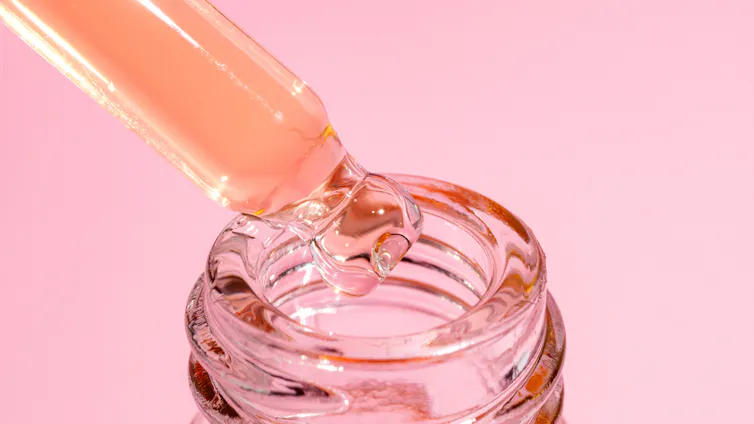
What is retinol?
Retinol is part of a family of chemical compounds called retinoids. These are derived from or related to Vitamin A, a nutrient essential for healthy skin, vision and immune function.
All retinoids work because enzymes in our skin convert them into their “active” form, retinoic acid.
You can buy retinol in creams and other topical products over the counter.
These are often promoted as “anti-ageing” because retinol can help reduce the appearance of fine lines, wrinkles and even out skin tone (for example, sun spots or acne scars).
It also has an exfoliating effect, meaning it can help unclog pores.
Stronger retinoid treatments that target acne will require a prescription because they contain retinoic acid, which is regulated as a drug in the United States, European Union, United Kingdom and Australia.
How is retinol used in skincare?
One of the most common claims about retinol is that it helps to reduce visible signs of ageing.
How does this work?
With age, the skin’s barrier becomes weaker, making it more prone to dryness, injury and irritation.
Retinol can help counteract this natural thinning by stimulating the proliferation of keratinocytes – cells that form the outer skin layer and protect against damage and water loss.
Retinol also stimulates the production of collagen (a key protein that creates a scaffolding that keeps skin firm and elastic) and fibroblasts (cells that produce collagen and support skin structure).
It also increases how fast the skin sheds old cells and replaces them with new ones.
Over time, these processes help reduce fine lines, fade dark spots and even out skin tone. It can also make skin appear clearer.
While effective, this doesn’t happen overnight.
You may have also heard about a “retinol purge” – a temporary flare of acne when you first start using topical retinoids.
Studies have found the skin may become irritated and acne temporarily worsen in some cases. But more research needs to be done to understand this link.

So, is retinol safe?
At typical skincare concentrations (0.1–0.3%), side effects tend to be mild.
Most people who experience irritation (such as redness, dryness, or peeling) when starting retinol are able to build tolerance over time. This process is often called “retinisation”.
However, retinol increases the skin’s sensitivity to UV radiation (known as photosensitivity). This heightened reactivity can lead to sunburn, irritation and an increased risk of hyperpigmentation (spots or patches of darker colour).
For this reason, daily use of broad-spectrum sunscreen (SPF30 or higher) is strongly recommended while using retinol products.
Who should avoid retinol?
Teenagers and children generally don’t need retinol unless specifically prescribed by a doctor, for example, for acne treatment.
People with sensitive skin or conditions such as eczema (dry, itchy and inflamed skin) and rosacea (chronic redness and sensitivity) may find retinol too irritating.
Using retinol products alongside other skincare treatments, such as alpha-hydroxy acids, can over-exfoliate your skin and damage it.
Importantly, the active form of retinol, retinoic acid, is teratogenic (meaning it can cause birth defects). Over-the-counter retinol products are also not recommended during pregnancy or breastfeeding.
Choose and store retinol products wisely
Since retinol is classified as a cosmetic ingredient, companies are not required to disclose its concentration in their products.
The European Union is expected to introduce new regulations that will cap the concentration of retinol in cosmetic facial products to 0.3%.
These are precautionary measures aimed to limit exposure for vulnerable groups, such as pregnant women, given the risk of birth defects.
It’s therefore recommended to use products that clearly state the retinol concentration is between 0.1% and 0.3%.
Retinol is also a notoriously unstable molecule that degrades with exposure to air, light or heat.
Choosing a product with airtight, light-protective packaging will help with potential degradation problems that could lead to inactivity or harm.
What’s the safest way to try retinol?
The key is to go low and slow: a pea-sized amount of a low-concentration product (0.1%) once or twice a week, preferably at night (to avoid UV exposure), and then the frequency and concentration can be increased (to a maximum of 0.3%) as the skin adjusts.
Using a moisturiser after retinol helps to reduce dryness and irritation.
Wearing sunscreen every day is a must when using retinol to avoid the photosensitivity.
If you experience persistent redness, burning, or peeling, it’s better to stop using the product and consult your doctor or a dermatologist for personalised advice.
Laurence Orlando, Senior Lecturer, Product Formulation and Development, Analytical Methods, Monash University; Zanfina Ademi, Professor of Health Economics, Monash University, and Zoe Porter, Lecturer, Pharmacy and Pharmaceutical Science, Monash University
This article is republished from The Conversation under a Creative Commons license. Read the original article.
Don’t Forget…
Did you arrive here from our newsletter? Don’t forget to return to the email to continue learning!

Recommended
Learn to Age Gracefully
Join the 98k+ American women taking control of their health & aging with our 100% free (and fun!) daily emails:
-
The Philosophy Gym – by Dr. Stephen Law
10almonds is reader-supported. We may, at no cost to you, receive a portion of sales if you purchase a product through a link in this article.
If you’d like to give those “little gray cells” an extra workout, this book is a great starting place.
Dr. Stephen Law is Director of Philosophy at the Department of Continuing Education, University of Oxford. As such, he’s no stranger to providing education that’s both attainable and yet challenging. Here, he lays out important philosophical questions, and challenges the reader to get to grips with them in a systematic fashion.
Each of the 25 questions/problems has a chapter devoted to it, and is ranked:
- Warm-up
- Moderate
- More Challenging
But, he doesn’t leave us to our own devices, nor does he do like a caricature of a philosopher and ask us endless rhetorical questions. Instead, he looks at various approaches taken by other philosophers over time, and invites the reader to try out those methods.
The real gain of this book is not the mere enjoyment of reading, but rather in taking those thinking skills and applying them in life… because most if not all of them do have real-world applications and/or implications too.
The book’s strongest point? That it doesn’t assume prior knowledge (and yet also doesn’t patronize the reader). Philosophy can be difficult to dip one’s toes into without a guide, because philosophers writing about philosophy can at first be like finding yourself at a party where you know nobody, but they all know each other.
In contrast, Law excels at giving quick, to-the-point ground-up summaries of key ideas and their progenitors.
In short: a wonderful way to get your brain doing things it might not have tried before!
Share This Post
-
Gut Feelings – by Dr Will Cole
10almonds is reader-supported. We may, at no cost to you, receive a portion of sales if you purchase a product through a link in this article.
More and more, science is uncovering links between our gut health and the rest of our health—including our mental health! We all know “get some fiber and consider probiotics”, but what else is there that we can do?
Quite a lot, actually. And part of it, which Dr. Cole also explores, is the fact that the gut-brain highway is a two-way street!
The book looks a lot especially at the particular relationship between shame and eating. The shame need not initially be about eating, though it can certainly end up that way too. But any kind of shame—be it relating to one’s body, work, relationship, or anything else, can not only have a direct effect on the gut, but indirect too:
Once our “eating our feelings” instinct kicks in, things can spiral from there, after all.
So, Dr. Cole walks us through tackling this from both sides—nutrition and psychology. With chapters full of tips and tricks, plus a 21-day plan (not a diet plan, a habit integration plan), this book hits shame (and inflammation, incidentally) hard and leads us into much healthier habits and cycles.
In short: if you’d like to have a better relationship with your food, improve your gut health, and/or reduce inflammation, this is definitely a book for you!
Share This Post
-
The Body Fat That Can Help Against Diabetes?
10almonds is reader-supported. We may, at no cost to you, receive a portion of sales if you purchase a product through a link in this article.
When it comes to type 2 diabetes and pre-diabetes, one of the first things doctors will typically advise most people is to lose weight.
There is logic to this—it is known that body fat can reduce insulin sensitivity (spoiler: there’s nuance to this, though—more on this later!).
However, in many cases of advising people to lose weight, the first and foremost reason is a more a matter of Fat’s Real Barriers To Health.
So what’s this fat that can help?
We’ll get to that shortly.
First, let’s talk about the fat that really doesn’t help: visceral fat
We wrote more about visceral fat, here: Visceral Belly Fat & How To Lose It ← “visceral belly fat” is actually a redundant tautology repeated more than once unnecessarily (since the only place we get it is the viscera of the abdominal cavity), but including both terms makes the article easier to find when using our website’s search function 😉
Metabolically, it’s very different from subcutaneous fat. Now, we do need some! Those organs do need cushioning, after all. But it’s all-too-easy to have too much of a good thing, in which case, it becomes a very bad thing.
Researchers (Dr. Elsa Vasquez Arreola et al.) found that prediabetes can go into remission without weight loss, with about one in four people normalizing blood sugar despite no drop in body weight.
And, notably, remission without weight loss provides the same level of protection against future type 2 diabetes as remission achieved through losing weight.
This is a huge help, because focusing only on weight loss hasn’t worked well for many people, who become discouraged by being hounded to lose weight and then not being able to do so, and if they think their health is really going to be dependent on weight loss, they well just give up.
As it turns out, blood sugar improvements depend more on fat distribution than total body weight.
And why?
Let’s go back to those two types of fat we mentioned earlier:
- Visceral fat: fat stored around your internal organs increases inflammation and disrupts insulin function, raising blood sugar levels.
- Subcutaneous fat: fat stored under your skin (i.e. the fat you can reach to squish) can actively support healthy metabolism by releasing hormones that improve insulin sensitivity.
Now, with that in mind, guess what happened in the study? That’s right, people who reversed prediabetes without weight loss shifted fat away from abdominal organs towards subcutaneous stores, which explains why remission was associated with better insulin sensitivity and improved pancreatic beta-cell function.
You can read the paper in full, here: Prevention of type 2 diabetes through prediabetes remission without weight loss
What to do about it
Firstly, do see our previously-mentioned article: Visceral Belly Fat & How To Lose It for the dos and don’ts of getting healthier (which for most people means: lower) visceral fat levels.
Next up, see also: Body Fat & Pelvic Floor Problems: What Matters Most Is Where The Fat Is for the science behind “apple or pear” distributions, and how to switch it up.
You may also be wondering: Can We Do Fat Redistribution? And the answer is yes, and we are doing it all the time whether we want to or not, so we might as well know what things affect our fat distribution in various body parts. The article we just linked there shows how.
While we’re at it, one other place you really don’t want excess fat, for metabolic reasons, is your liver. So: How To Unfatty A Fatty Liver
Want to learn more?
You might like this book that we reviewed a while ago:
Why We Get Sick – by Dr. Benjamin Bikman ← this is about insulin resistance, and, importantly, the invisible insulin resistance that precedes blood sugar imbalances by many years (it goes unnoticed because the pancreas will dutifully keep cranking out more and more insulin to keep the blood sugars stable, until one day it just can’t keep up anymore, and then and only then does prediabetes get diagnosed).
Enjoy!
Share This Post
Related Posts
-
Figs vs Prunes – Which is Healthier?
10almonds is reader-supported. We may, at no cost to you, receive a portion of sales if you purchase a product through a link in this article.
Our Verdict
When comparing figs to prunes, we picked the figs.
Why?
First a quick note on variations: since figs can be purchased in various states of dehydration or not, and prunes are by definition partially-dehydrated plums, in the interests of a fair comparison, we will be talking about figs that have been dehydrated similarly to prunes, and can often be found in the same “shelf-stable produce” section of the supermarket.
With that in mind…
In terms of macros, figs have more fiber and protein, while the two fruits are equal on carbs. A clear win for figs.
In the category of vitamins, figs have more of vitamins B1, B5, B7, B9, C, and choline, while prunes have more of vitamins A, B2, B3, B6, and K. A very marginal 6:5 win for figs.
Looking at minerals, figs have more calcium, copper, iron, magnesium, manganese, phosphorus, selenium, and zinc, while prunes have more potassium. An easy win for figs.
One thing in prunes’ favor though is that prunes do have more polyphenols, so that’s a point for them here.
Nevertheless, adding up the sections makes for a clear overall win for figs, but by all means enjoy either or both; diversity is good!
Want to learn more?
You might like:
From Apples to Bees, and High-Fructose Cs: Which Sugars Are Healthier, And Which Are Just The Same?
Enjoy!
Don’t Forget…
Did you arrive here from our newsletter? Don’t forget to return to the email to continue learning!
Learn to Age Gracefully
Join the 98k+ American women taking control of their health & aging with our 100% free (and fun!) daily emails:
-
Broccoli Sprouts & Sulforaphane
10almonds is reader-supported. We may, at no cost to you, receive a portion of sales if you purchase a product through a link in this article.
It’s Q&A Day at 10almonds!
Have a question or a request? We love to hear from you!
In cases where we’ve already covered something, we might link to what we wrote before, but will always be happy to revisit any of our topics again in the future too—there’s always more to say!
As ever: if the question/request can be answered briefly, we’ll do it here in our Q&A Thursday edition. If not, we’ll make a main feature of it shortly afterwards!
So, no question/request too big or small 😎
❝How much science is there behind sulforaphane / broccoli spirits and its health claims??❞
So, first of all, what it is: sulforaphane is a compound found in Brassica oleracea, of which species broccoli is a cultivar. It’s found in the other Brassica oleracea cultivars too (e.g. cauliflower, various cabbages, Brussels sprouts, kale, etc), but for whatever reason*, most research has been on broccoli and broccoli sprouts.
*Likely the reason is: research begets research—it’s easier to get funding to expand upon previous research, than it is to break ground on researching a different plant, where for the first third of your paper you have almost no existing scientific literature to cite. So once they got started on broccoli sprouts, everything else has been broccoli sprouts too.
And for clarity on what broccoli sprouts are: this means that when broccoli seeds have been germinated and just begun to sprout, they are harvested and eaten. That’s the one-line explanation, anyway; there’s a little more to it than that, so anyone interested should check out our previous main feature:
Good Things Come In Small Packages: Sprout Your Seeds, Grains, Beans, Etc
…and for more depth than we have room for in a one-page article, check out this book we reviewed:
The Sprout Book: Tap Into The Power Of The Planet’s Most Nutritious Food – by Doug Evans
One thing that the science is clear on: sprouts of a given plant indeed have much higher general nutritional density than their “adult” siblings. And in the case of sulforaphane specifically, it’s about 100x higher in broccoli sprouts than in adult broccoli:
Broccoli or Sulforaphane: Is It the Source or Dose That Matters? ← we suggest skipping down to the section “broccoli-based clinical trials”
So, that prompts the next question: do we care?
In other words: is sulforaphane really particularly important?
Sulforaphane vs cancer
The most well-evidenced health-giving property of sulforaphane is its anticancer activity:
Brassicaceae-Derived Anticancer Agents: Towards a Green Approach to Beat Cancer
A lot of the research there is epidemiological rather than RCTs, and where there are RCTs, they are mostly small ones, like this 10-person broccoli soup study about bioavailability (rather than the effects themselves):
Bioavailability of Glucoraphanin and Sulforaphane from High-Glucoraphanin Broccoli
To get into sulforaphane’s anticancer potential in seriousness, we have to look at a lot of in-vitro studies trialling it to limit carcinogenesis, or to shrink tumors with it, or specifically targetting cancer stem cells with it, which make for quite compelling reading:
A quick aside: if you’re reading that and thinking “Why is sonic the hedgehog in here?” it’s because after the observation of the influence of certain genes that influence cuticular denticles (the growth of spikes) on fruit fly larvae (bearing in mind the fruit fly Drosophila melanogaster is used for so much first- or second-line genetic research, being either the go-to or the go-to after the nematode C. elegans) caused the whole group of genes to get called “hedgehog genes” and then it became scientific convention to name each newly researched gene in that set after a different kind of hedgehog. One of them, instead of being named after a real-world hedgehog species like the others, got named after the videogame character.
Unfortunately, this now means that because the gene is associated with a certain congenital brain disorder, sometimes a doctor has to explain to a family that the reason their baby has a brain defect is because of a mutated sonic hedgehog.
Ok, back to talking about cancer. Let’s just quickly drop a few more papers so it’s clear that this is well-established:
- Multi-targeted prevention of cancer by sulforaphane ← this shows how it works on the cellular level
- Cruciferous vegetables: dietary phytochemicals for cancer prevention ← this shows how it works on the population level
However, that’s not the only established benefit:
❝SFN has other beneficial effects in addition to cancer protection. SFN exhibits neuroprotective effects and is implemented in treating conditions such as traumatic brain injury, Alzheimer’s disease and Parkinson’s disease.❞
Source: Sulforaphane in broccoli: The green chemoprevention!! Role in cancer prevention and therapy
Now, after the extract we quoted above, the rest of the section “other health benefits of sulforaphane” includes a lot of speculation, weak science, and/or things attributable to other phytochemicals in broccoli, including various polyphenols, vitamins, and minerals.
About those broccoli spirits
Ok, we know it was a typo, but… Actually, there is something worth mentioning here, and that’s that sulforaphane is only activated when glucoraphanin (its inactive form) comes into contact with myrosinase (an enzyme that’s only released when the plant is damaged).
In other words, it’s necessary to injure the broccoli before consuming it, in order to release the
spiritsmyrosinase. Now, while very few people are out there swallowing adult broccoli plants whole, it could well happen that people might wolf down uncut broccoli sprouts, since they are only small, after all.For this reason, it’s best that broccoli, even if it’s broccoli sprouts, be cut while raw before consumption.
In terms of cooking, heat in excess of 140℃ / 284℉ will destroy the glucoraphanin, and less/no glucoraphanin means less/no sulforaphane.
So, enjoying them raw or lightly steaming them seems to be best for this purpose:
Impact of thermal processing on sulforaphane yield from broccoli (Brassica oleracea L. ssp. italica)
Just want a supplement?
Many studies (including some cited by the research reviews we cited above) deal with sulforaphane in extract form, rather than whole plants, so there’s no shame in taking it that way if you’re not a fan of broccoli.
We don’t sell it, but here for your convenience is an example product on Amazon 😎
Enjoy!
Don’t Forget…
Did you arrive here from our newsletter? Don’t forget to return to the email to continue learning!
Learn to Age Gracefully
Join the 98k+ American women taking control of their health & aging with our 100% free (and fun!) daily emails:
-
Parsley vs Watercress – Which is Healthier?
10almonds is reader-supported. We may, at no cost to you, receive a portion of sales if you purchase a product through a link in this article.
Our Verdict
When comparing parsley to watercress, we picked the parsley.
Why?
It wasn’t close:
In terms of macros, parsley has more than 6x the fiber, more than 4x the carbs, and slightly more protein, winning this round.
In the category of vitamins, parsley has much more of vitamins A, B3, B5, B7, B9, C, K, and choline, while watercress has slightly more of vitamins B2, B6, and E, making a compelling win for parsley.
Looking at minerals, parsley has more calcium, copper, iron, magnesium, potassium, and zinc, while watercress has more manganese and selenium, meaning another easy win for parsley.
In other considerations, parsley scores higher on polyphenols, winning this round too.
Adding up the sections makes for a clear overall win for parsley, but by all means enjoy either or both; diversity is good!
Want to learn more?
You might like:
What’s Your Plant Diversity Score?
Enjoy!
Don’t Forget…
Did you arrive here from our newsletter? Don’t forget to return to the email to continue learning!
Learn to Age Gracefully
Join the 98k+ American women taking control of their health & aging with our 100% free (and fun!) daily emails:


