
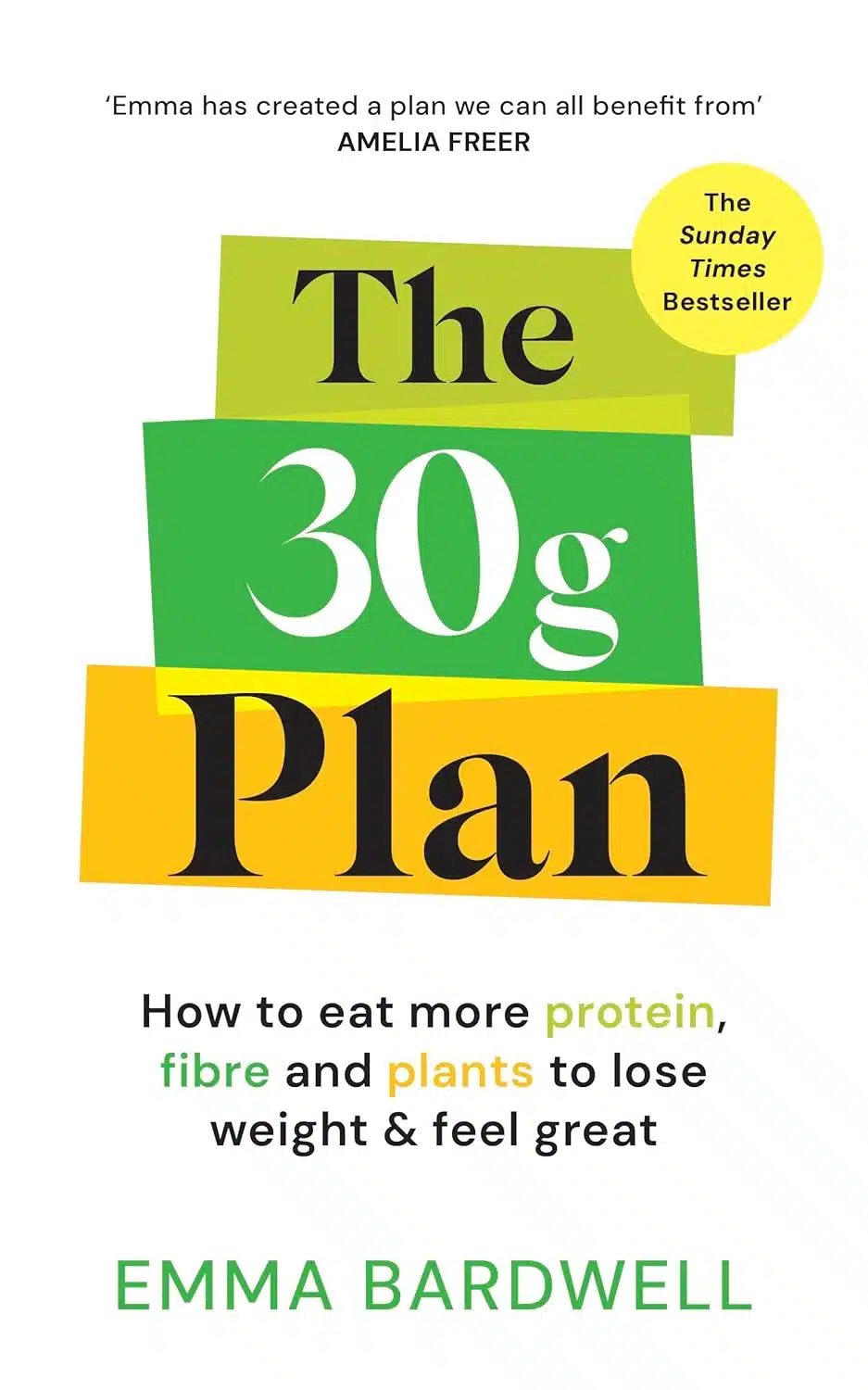
The 30g Plan – by Emma Bardwell

10almonds is reader-supported. We may, at no cost to you, receive a portion of sales if you purchase a product through a link in this article.

The author, a registered nutritionist, gives us a 30/30/30 plan:

  • 30 plants per week
  • 30g fiber per day
  • 30g protein per meal

…all of which is very consistent with the best of current science, and each of which we at 10almonds have encouraged our readers to do previously (having written main features on getting 30 plants per week, getting 30g fiber per day, and getting 1–2g/kg protein per day, so how much that means per meal depends on your size and how many meals per day you have).

Upon following this plan, she tells us that readers can expect the following results within certain timescales:

  • 24 hours: changes in mood and gut microbiome
  • 1 week: changes in digestion
  • 1–2 weeks: changes in taste buds
  • 2–3 weeks: changes in metabolic markers
  • 1 month: reduction in weight, or more specifically, body fat
  • Long-term: reduction in chronic health risks

Of course, some changes may be more slight if you’re already close to this plan in how you eat, and some changes may be more dramatic if, for example, your current body fat percentage is currently high (in which case, you’ll see fat loss sooner than others).

She covers the science of why these figures (30/30/30) were chosen, and how the plan will deliver on them, and there’s a lot of talk about portion sizes and to what extent x portion of y food will deliver z nutrient.

The recipes themselves are plants-centric without being entirely plant-based, and in terms of the scale of simplicity to complexity, strike a nice middleground comparable to that of our own recipes section here at 10almonds. For the visually-inclined, we’ll mention that there are no images in the book, though.

Bottom line: if you’d like to enjoy more plants, fiber, and protein, and meet optimal levels of all those without having juggle competing recipe books (i.e. one for plant diversity, one for high fiber, one for high protein), then this book is great for that.

Click here to check out The 30g Plan, and upgrade your daily diet!

Don’t Forget…

Did you arrive here from our newsletter? Don’t forget to return to the email to continue learning!
Learn to Age Gracefully

Join the 98k+ American women taking control of their health & aging with our 100% free (and fun!) daily emails:

  • 21 Most Beneficial Polyphenols & What Foods Have Them

    10almonds is reader-supported. We may, at no cost to you, receive a portion of sales if you purchase a product through a link in this article.

    We often write about polyphenols here at 10almonds; sometimes mentioning that a certain food is good because it has them, or else occasionally an entire article about a particular polyphenol. But what about a birds-eye view of polyphenols as a whole?

    Well, there are many, but we’ve picked 21 particularly beneficial for human health, and what foods contain them.

    We’ll be working from this fantastic database, by the way:

    ❝Phenol-Explorer is the first comprehensive database on polyphenol content in foods. The database contains more than 35,000 content values for 500 different polyphenols in over 400 foods. These data are derived from the systematic collection of more than 60,000 original content values found in more than 1,300 scientific publications. Each of these publications has been critically evaluated before inclusion in the database. The whole data on the polyphenol composition of foods is available for download.❞

    Source: Phenol-Explorer.EU | Database on polyphenol content in foods

    We use this database at least several times per week while writing 10almonds; it’s a truly invaluable resource!

    However, 500 is a lot, so here’s a rundown of 21 especially impactful ones; we’ve sorted them per the categories used in the explorer, and in some cases we’ve aggregated several very similar polyphenols typically found together in the same foods, into one item (so for example we just list “quercetin” instead of quercetin 3-O-rutinoside + quercetin 4′-O-glucoside + quercetin 3,4′-O-diglucoside, etc etc). We’ve also broadly grouped some particularly populous ones such as “anthocyanins”, “catechins”, and so forth.

    Without further ado, here’s what you ideally want to be getting plenty of in your diet:

    Flavonoids

    1. Quercetin
    2. Kaempferol
      • Foods: spinach, kale, tea (green and black), capers, brussels sprouts.
      • Benefits: antioxidant, may reduce the risk of cancer, supports cardiovascular health, and has anti-inflammatory properties.
    3. Epigallocatechin gallate (EGCG)
      • Foods: green tea, matcha.
      • Benefits: potent antioxidant, promotes weight loss, supports brain health, and may reduce the risk of heart disease.
      • See also: What Does Kaempferol Do, Anyway?
    4. Anthocyanins
      • Foods: blueberries, blackberries, raspberries, red cabbage, cherries.
      • Benefits: improve brain health, support eye health, and reduce the risk of cardiovascular diseases.
    5. Apigenin
      • Foods: parsley, celery, chamomile tea.
      • Benefits: anti-inflammatory, reduces anxiety, and supports brain and immune system health.
    6. Luteolin
      • Foods: peppers, thyme, celery, carrots.
      • Benefits: anti-inflammatory, supports brain health, and may help reduce the growth of cancer cells.
    7. Catechins (aside from EGCG)
      • Foods: green tea, dark chocolate, apples
      • Benefits: boosts metabolism, supports cardiovascular health, and reduces oxidative stress.
    8. Hesperidin
      • Foods: oranges, lemons, limes, grapefruits.
      • Benefits: supports vascular health, reduces inflammation, and may help manage diabetes.
    9. Naringenin
      • Foods: oranges, grapefruits, tomatoes.
      • Benefits: antioxidant, supports liver health, and may improve cholesterol levels.

    For more on epigallocatechin gallate and other catechins, see: Which Tea Is Best, By Science?

    Phenolic Acids

    1. Chlorogenic acid
    2. Caffeic acid
    3. Ferulic acid
      • Foods: whole grains, rice bran, oats, flaxseeds, spinach.
      • Benefits: protects skin from UV damage, reduces inflammation, and supports cardiovascular health.
    4. Gallic acid
      • Foods: green tea, berries, walnuts.
      • Benefits: antioxidant, may reduce the risk of cancer, and supports brain health.

    Stilbenes

    1. Resveratrol
      • Foods: red currants, blueberries, peanuts.
      • Benefits: anti-aging properties, supports heart health, and reduces inflammation.
      • See also: Resveratrol & Healthy Aging ← and no, you can’t usefully get it from red wine; here’s why!

    Lignans

    1. Secoisolariciresinol
      • Foods: flaxseeds, sesame seeds, whole grains.
      • Benefits: supports hormone balance, reduces the risk of hormone-related cancers, and promotes gut health.
    2. Matairesinol
      • Foods: rye, oats, barley, sesame seeds.
      • Benefits: hormonal support, antioxidant, and may reduce the risk of cardiovascular diseases.

    See also: Sprout Your Seeds, Grains, Beans, Etc ← for maximum nutritional availability!

    Tannins

    1. Ellagic acid
      • Foods: pomegranates, raspberries, walnuts.
      • Benefits: anti-cancer properties, supports skin health, and reduces inflammation.
    2. Proanthocyanidins
      • Foods: cranberries, apples, grapes, dark chocolate.
      • Benefits: supports urinary tract health, reduces inflammation, and improves blood vessel health.

    See also: Enjoy Bitter Foods For Your Heart & Brain

    Curcuminoids

    1. Curcumin

    Isoflavones

    1. Genistein
      • Foods: soybeans, chickpeas.
      • Benefits: supports bone health, reduces the risk of hormone-related cancers, and promotes heart health.
    2. Daidzein
      • Foods: soybeans, legumes.
      • Benefits: hormonal balance, supports bone health, and may help alleviate menopausal symptoms.

    See also: What Does “Balance Your Hormones” Even Mean?

    Well, that’s a lot of things to remember!

    If you want to make it easier for yourself, you can simply make sure to get at least 30 different kinds of plant into your diet per week, and by doing so, statistically, you should cover most of these!

    Read more: What’s Your Plant Diversity Score?

    Alternatively, for a middle-ground approach of targetting 16 most polyphenol delivering foods, check out this super-dense arrangement:

    Mediterranean Diet… In A Pill? ← it’s about plant extracts from 16 specific foods, and the polyphenols they deliver

    Enjoy!

    Share This Post

  • Boundary-Setting Beyond “No”

    10almonds is reader-supported. We may, at no cost to you, receive a portion of sales if you purchase a product through a link in this article.

    More Than A “No”

    A lot of people struggle with boundary-setting, and it’s not always the way you might think.

    The person who “can’t say no” to people probably comes to mind, but the problem is more far-reaching than that, and it’s rooted in not being clear over what a boundary actually is.

    For example: “Don’t bring him here again!”

    Pretty clear, right?

    And while it is indeed clear, it’s not a boundary; it’s a command. Which may or may not be obeyed, and at the end of the day, what right have we to command people in general?

    Same goes for less dramatic things like “Don’t talk to me about xyz”, which can still be important or trivial, depending on whether the topic of xyz is deeply traumatizing for you, or mildly annoying, or something else entirely.

    Why this becomes a problem

    It becomes a problem not because of any lack of clarity about your wishes, but rather, because it opens the floor for a debate. The listener may be given to wonder whether your right to not experience xyz is greater or lesser than their right to do/say/etc xyz.

    “My right to swing my fist ends where someone else’s nose begins”

    …does not help here, firstly because both sides will believe themself (or nobody) to be the injured party; for the fist-swinger, the other person’s nose made a vicious assault on their freedom. Or secondly, maybe there was some higher principle at stake; a reason why violence was justified. And then ten levels of philosophical debate. We see this a lot when it comes to freedom of expression, and vigorous debate over whether this entails freedom from social consequences of one’s words/actions.

    How a good boundary-setting works (if this, then that)

    Consider two signs:

    • No trespassing!
    • Trespassers will be shot!

    Superficially, the second just seems like a more violent rendition of the first. But in fact, the second is more informationally useful: it explains what will happen if the boundary is not respected, and allows the reader to make their own informed decision with regard to what to do with that information.

    We can employ this method (and can even do so gently, if we so wish and hopefully we mostly do wish to be gentle) when it comes to social and interpersonal boundary-setting:

    • If you bring him here again, I will refuse you entrance
    • If you bring up that topic again, I will ask you to leave
    • If you do that, I will never speak to you again
    • If you don’t stop drinking, I will divorce you

    This “if-this-then-that” model does the very first thing that any good boundary does: make itself clear.

    It doesn’t rely on moral arguments; it doesn’t invite debate. For example in that last case, it doesn’t argue that the partner doesn’t have the right to drink—it simply expresses what the speaker will exercise their own right to do, in that eventuality.

    (as an aside, the situation that occurs when one is enmeshed with someone who is dependent on a substance is a complex topic, and if you’re interested in that, check out: Codependency Isn’t What Most People Think)

    Back on track: boundary-setting is not about what’s right or good—it’s about nothing more nor less than a clear delineation between what we will and won’t accept, and how we’ll enforce that.

    We can also, in particularly personal boundary-setting (such as with sexual boundaries’ oft-claimed “gray areas”), fix an improperly-set boundary that forgot to do the above, e.g:

    “How about [proposition]?”
    “No thank you” ← casually worded answer; contextually reasonable, and yet not a clear boundary per what we discussed above
    “Come on, I think you’d like it”
    “I said no. No means no. Ask me again and I will [consequences that are appropriate and actionable]”

    What’s “appropriate and actionable” may vary a lot from one situation to another, but it’s important that it’s something you can do and are prepared to do and will do if the condition for doing it is met.

    Anything less than that is not a boundary—it’s just a request.

    Note: this does not require that we have power, by the way. If we have zero power in a situation, well, that definitely sucks, but even then we can still express what is actionable, e.g. “I will never trust you again”.

    “Price of entry”

    You may have wondered, upon reading “boundary-setting is not about what’s right or good—it’s about nothing more nor less than a clear delineation between what we will and won’t accept, and how we’ll enforce that”, can’t that be used to control and manipulate people, essentially coercing them to do or not do things with the threat of consequences (specifically: bad ones)?

    And the answer is: yes, yes it can.

    But that’s where the flipside comes into play—the other person gets to set their boundaries, too.

    For all of us, if we have any boundaries at all, there is a “price of entry” and all who want to be in our lives, or be close to us, have to decide for themselves whether that price of entry is worth it.

    • If a person says “do not talk about topic xyz to me or I will leave”, that is a price of entry for being close to them.
    • If you are passionate about talking about topic xyz to the point that you are unwilling to shelve it when in their presence, then that is the price of entry for being close to you.
    • If one or more of you is not willing to pay the price of entry, then guess what, you’re just not going to be close.

    In cases of forced proximity (e.g. workplaces or families) this is likely to get resolved by the workplace’s own rules (i.e. the price of entry that you agreed to when signing a contract to work there), and if something like that doesn’t exist (such as in families), well, that forced proximity is going to reach a breaking point, and somebody may discover it wasn’t enforceable after all.

    See also: Family Estrangement: More Common Than Most People Think

    …which also details how to fix it, where possible.

    Take care!

    Share This Post

  • 5 Hip Mobility Exercises That Change Everything

    10almonds is reader-supported. We may, at no cost to you, receive a portion of sales if you purchase a product through a link in this article.

    Marina Sarenac, mobility coach, shows what works better than just stretching:

    Seat of power

    Biomechanically speaking, your hips are pretty much central to everything else you do, so it’s no surprise that they need to be strong as well as supple.

    Here’s how to go about getting both halves of that at once:

    • Pigeon pose loaded stretch: with your front leg on a step or bench at 90°, hips square, and your back leg straight, hold a dumbbell below your shoulders, hinge forwards with your chest upright, pause at the bottom, and then return with good form.
    • Horse stance good mornings: with a wide stance and your toes slightly out, your weight between your legs, hinge at your hips without rounding your back, and then return slowly (with good form) to an upright position.
    • Lateral hinge T spine opener: with one foot elevated on box or bench, feet wide, dumbbells in hands, and your arms in T, hinge sideways towards your elevated leg, lower your opposite hand in front of your foot while your top arm reaches up, and follow your hand with your eyes (and thus, as necessary, with your face).
    • Spinal wave squat: start in a deep squat on a box, with your spine neutral and your chest open. Tuck your chin, round your spine, roll up segment by segment to standing, then reverse the process to return into a squat.
    • Goblet squat with pause: hold a kettlebell or dumbbell close to your chest, with your feet wide and toes slightly out. Squat down slowly with your elbows inside your knees, hold at the bottom, then push back up through your heels to return to the starting position.

    For more on all of this plus visual demonstrations, enjoy:

    Click Here If The Embedded Video Doesn’t Load Automatically!

    Want to learn more?

    You might also like:

    The Most Underrated Hip Mobility Exercise (Not Stretching) ← if you only want to do one thing, not five, then make this it 😎

    Take care!

    Share This Post

  • Wholewheat Bread vs Seeded White – Which is Healthier?

    10almonds is reader-supported. We may, at no cost to you, receive a portion of sales if you purchase a product through a link in this article.

    Our Verdict

    When comparing wholewheat bread to seeded bread, we picked the wholewheat.

    Why?

    First, we will acknowledge that this is a false dichotomy; it is possible to have seeded wholewheat bread. However, it is very common to have wholewheat bread that isn’t seeded, and white bread that is seeded. So, it’s important to be able to decide which is the healthier option, since very often, this false dichotomy is what’s on offer.

    We will also advise checking labels (or the baker, if getting from a bakery) to ensure that visibly brown bread is actually wholewheat, and not just dyed brown with caramel coloring or such (yes, that is a thing that some companies do).

    Now, as for why we chose the wholewheat over the seeded white…

    In terms of macronutrients, wholewheat bread has (on average; individual breads may vary of course) has 2x the protein and a lot more fiber.

    Those seeds in seeded bread? They just aren’t enough to make a big impact on the overall nutritional value of the bread in those regards. Per slice, you are getting, what, 10 seeds maybe? This is not a meaningful dietary source of much.

    Seeded bread does have proportionally more healthy fats, but the doses are still so low as to make it not worth the while; it just looks like a lot of expressed as a percentage of comparison, because of the wholewheat bread has trace amounts, and the seeded bread has several times those trace amounts, it’s still a tiny amount. So, we’d recommend looking to other sources for those healthy fats.

    Maybe dip your bread, of whatever kind, into extra virgin olive oil, for example.

    Wholewheat bread of course also has a lower glycemic index. Those seeds in seeded white bread don’t really slow it down at all, because they’re not digested until later.

    Want to learn more?

    You might like to read:

    Enjoy!

    Don’t Forget…

    Did you arrive here from our newsletter? Don’t forget to return to the email to continue learning!

    Learn to Age Gracefully

    Join the 98k+ American women taking control of their health & aging with our 100% free (and fun!) daily emails:

  • An unbroken night’s sleep is a myth. Here’s what good sleep looks like

    10almonds is reader-supported. We may, at no cost to you, receive a portion of sales if you purchase a product through a link in this article.

    What do you imagine a good night’s sleep to be?

    Often when people come into our sleep clinic seeking treatment, they share ideas about healthy sleep.

    Many think when their head hits the pillow, they should fall into a deep and restorative sleep, and emerge after about eight hours feeling refreshed. They’re in good company – many Australians hold the same belief.

    In reality, healthy sleep is cyclic across the night, as you move in and out of the different stages of sleep, often waking up several times. Some people remember one or more of these awakenings, others do not. Let’s consider what a healthy night’s sleep looks like.

    Bricolage/Shutterstock

    Sleep cycles are a roller-coaster

    As an adult, our sleep moves through different cycles and brief awakenings during the night. Sleep cycles last roughly 90 minutes each.

    We typically start the night with lighter sleep, before moving into deeper sleep stages, and rising again into rapid eye movement (REM) sleep – the stage of sleep often linked to vivid dreaming.

    If sleeping well, we get most of our deep sleep in the first half of the night, with REM sleep more common in the second half of the night.

    An older man sleeps peacefully in bed.
    Deepest sleep usually happens during the first half of the night. Verin/Shutterstock

    Adults usually move through five or six sleep cycles in a night, and it is entirely normal to wake up briefly at the end of each one. That means we might be waking up five times during the night. This can increase with older age and still be healthy. If you’re not remembering these awakenings that’s OK – they can be quite brief.

    What does getting a ‘good’ sleep actually mean?

    You’ll often hear that adults need between seven and nine hours of sleep per night. But good sleep is about more than the number of hours – it’s also about the quality.

    For most people, sleeping well means being able to fall asleep soon after getting into bed (within around 30 minutes), sleeping without waking up for long periods, and waking feeling rested and ready for the day.

    You shouldn’t be feeling excessively sleepy during the day, especially if you’re regularly getting at least seven hours of refreshing sleep a night (this is a rough rule of thumb).

    But are you noticing you’re feeling physically tired, needing to nap regularly and still not feeling refreshed? It may be worthwhile touching base with your general practitioner, as there a range of possible reasons.

    Common issues

    Sleep disorders are common. Up to 25% of adults have insomnia, a sleep disorder where it may be hard to fall or stay asleep, or you may wake earlier in the morning than you’d like.

    Rates of common sleep disorders such as insomnia and sleep apnoea – where your breathing can partially or completely stop many times during the night – also increase with age, affecting 20% of early adults and 40% of people in middle age. There are effective treatments, so asking for help is important.

    Beyond sleep disorders, our sleep can also be disrupted by chronic health conditions – such as pain – and by certain medications.

    There can also be other reasons we’re not sleeping well. Some of us are woken by children, pets or traffic noise during the night. These “forced awakenings” mean we may find it harder to get up in the morning, take longer to leave bed and feel less satisfied with our sleep. For some people, night awakenings may have no clear cause.

    A good way to tell if these awakenings are a problem for you is by thinking about how they affect you. When they cause feelings of frustration or worry, or are impacting how we feel and function during the day, it might be a sign to seek some help.

    Weary woman leans against a pole in an empty train carriage.
    If waking up in the night is interfering with your normal day-to-day activities, it may indicate a problem. BearFotos/Shutterstock

    We also may struggle to get up in the morning. This could be for a range of reasons, including not sleeping long enough, going to bed or waking up at irregular times – or even your own internal clock, which can influence the time your body prefers to sleep.

    If you’re regularly struggling to get up for work or family needs, it can be an indication you may need to seek help. Some of these factors can be explored with a sleep psychologist if they are causing concern.

    Can my smart watch help?

    It is important to remember sleep-tracking devices can vary in accuracy for looking at the different sleep stages. While they can give a rough estimate, they are not a perfect measure.

    In-laboratory polysomnography, or PSG, is the best standard measure to examine your sleep stages. A PSG examines breathing, oxygen saturation, brain waves and heart rate during sleep.

    Rather than closely examining nightly data (including sleep stages) from a sleep tracker, it may be more helpful to look at the patterns of your sleep (bed and wake times) over time.

    Understanding your sleep patterns may help identify and adjust behaviours that negatively impact your sleep, such as your bedtime routine and sleeping environment.

    And if you find viewing your sleep data is making you feel worried about your sleep, this may not be useful for you. Most importantly, if you are concerned it is important to discuss it with your GP who can refer you to the appropriate specialist sleep health provider.

    Amy Reynolds, Associate Professor in Clinical Sleep Health, Flinders University; Claire Dunbar, Research Associate, Sleep Health, Flinders University; Gorica Micic, Postdoctoral Research Fellow, Clinical Psychologist, Flinders University; Hannah Scott, Research Fellow in Sleep Health, Flinders University, and Nicole Lovato, Associate Professor, Adelaide Institute for Sleep Health, Flinders University

    This article is republished from The Conversation under a Creative Commons license. Read the original article.

    Don’t Forget…

    Did you arrive here from our newsletter? Don’t forget to return to the email to continue learning!

    Learn to Age Gracefully

    Join the 98k+ American women taking control of their health & aging with our 100% free (and fun!) daily emails:

  • Tips for Avoiding PFAs

    10almonds is reader-supported. We may, at no cost to you, receive a portion of sales if you purchase a product through a link in this article.

    It’s Q&A Day at 10almonds!

    Have a question or a request? You can always hit “reply” to any of our emails, or use the feedback widget at the bottom!

    In cases where we’ve already covered something, we might link to what we wrote before, but will always be happy to revisit any of our topics again in the future too—there’s always more to say!

    As ever: if the question/request can be answered briefly, we’ll do it here in our Q&A Thursday edition. If not, we’ll make a main feature of it shortly afterwards!

    So, no question/request too big or small

    ❝Hi, do you have anything helpful on avoiding PFAs?❞

    PFAS, or perfluoroalkyl and polyfluoroalkyl substances, are “forever chemicals” made specifically to avoid degradation of industrial and chemical products. Which is great for providing stain and water resistance, but not so great for our bodies or the environment.

    To go into all the harms they cause would take a main feature (maybe we will, one of these days), but suffice it to say, they’re not good, and range from cancer and insulin resistance to hypertension and reduced immune response.

    To answer your question in a nutshell, avoiding them completely would be almost impossible, but we can reduce our exposure a lot by avoiding single-use food/drink products that have been waterproofed, e.g. paper/bamboo straws, utensils, cups, dishes, take-out containers, etc.

    Also, anything advertised as “stain-resistant” that you suspect should be quite stainable by nature, is probably good to avoid too.

    For more detailed information than we have room for here today, here’s a helpful overview:

    Breaking down the Forever Chemicals: What are PFAS?

    Don’t Forget…

    Did you arrive here from our newsletter? Don’t forget to return to the email to continue learning!

    Learn to Age Gracefully

    Join the 98k+ American women taking control of their health & aging with our 100% free (and fun!) daily emails: