Spiced Fruit & Nut Chutney

10almonds is reader-supported. We may, at no cost to you, receive a portion of sales if you purchase a product through a link in this article.

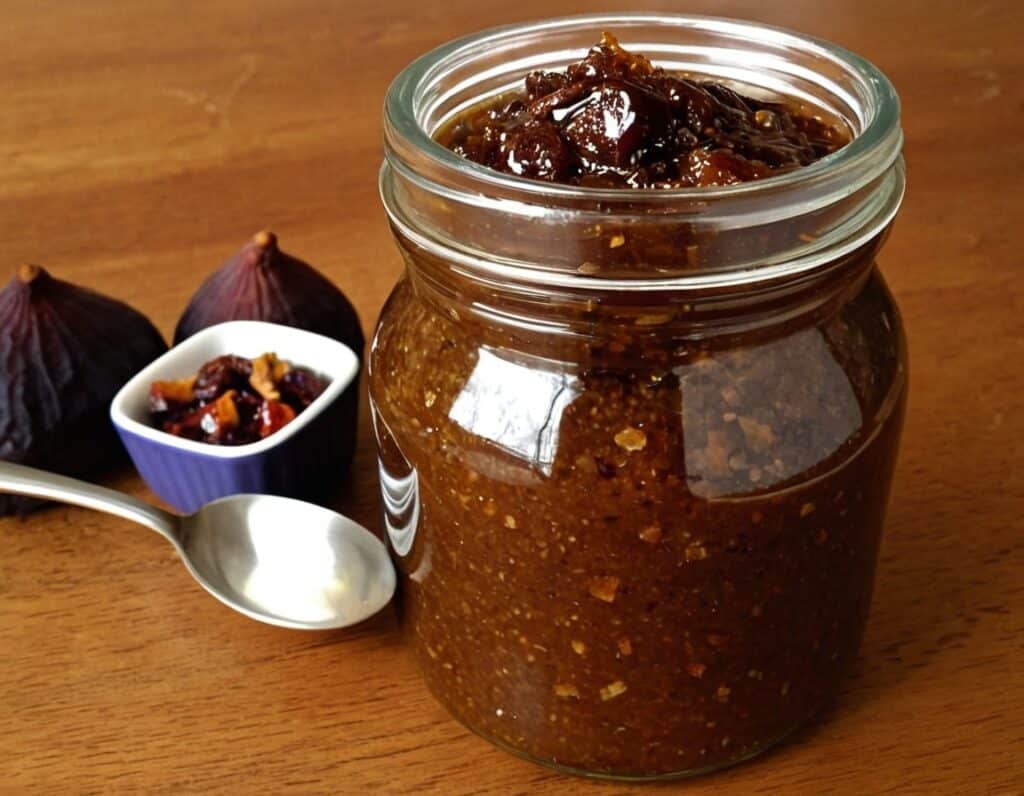
‘Tis the season to make the chutney that will then be aged chutney when you want it later! And unlike supermarket varieties with their ingredients list that goes “Sugar, spirit vinegar, inverted glucose-fructose syrup,” this one has an array of health-giving fruits and nuts (just omit the nuts if you or someone you may want to give this to has an allergy), and really nothing bad in here at all. And of course, tasty healthful spices!

You will need

  • 2 red onions, chopped
  • 1½ cups dried apricots, chopped
  • 1½ cups dried figs, chopped
  • 1 cup raisins
  • ½ cup apple cider vinegar
  • ½ cup slivered almonds
  • ½ lime, chopped and deseeded
  • ¼ bulb garlic, chopped
  • 1 hot pepper, chopped (your choice what kind; omit if you don’t like heat at all; multiply if you want more heat)
  • 2 tablespoons honey or maple syrup (omit for a less sweet chutney; there is sweetness in the dried fruits already, after all)
  • 1 tbsp freshly grated ginger
  • 2 tsp sweet cinnamon
  • 1 tsp nutmeg
  • 1 tsp black pepper
  • ½ teaspoon allspice
  • ½ MSG or 1 tsp low-sodium salt
  • Extra virgin olive oil

Method

(we suggest you read everything at least once before doing anything)

1) Heat some oil in a heavy-based pan that will be large enough for all ingredients to go into eventually. Fry the onions on a gentle heat for around 15 minutes. We don’t need to caramelize them yet (this will happen with time), but we do want them soft and sweet already.

2) Add the ginger, garlic, and chili, and stir in well.

3) When the onions start to brown, add the fruit and stir well to mix thoroughly.

4) Add the honey or maple syrup (if using), and the vinegar; add the remaining spices/seasonings, so everything is in there now except the almonds.

5) Cook gently for another 30 minutes while stirring. At some point it’ll become thick and sticky; add a little water as necessary. You don’t want to drown it, but you do want it to stay moist. It’ll probably take only a few tablespoons of added water in total, but add them one at a time and stir in before judging whether more is needed. By the end of the 30 minutes, it should be more solid, to the point it can stand up by itself.

6) Add the almonds, stir to combine, and leave to cool. Put it in jars until you need it (or perhaps give it as gifts).

Alternative method: if you don’t want to be standing at a stove stirring for about an hour in total, you can use a slow cooker / crock pot instead. Put the same ingredients in the same order, but don’t stir them, just leave them in layers (this is because of the pattern of heat distribution; it’ll be hotter at the bottom, so the things that need to be more cooked should be there, and the design means they won’t burn) for about two hours, then stir well to mix thoroughly, and leave it for another hour or two, before turning it off to let it cool. Put it in jars until you need it (or perhaps give it as gifts).
Enjoy!

Want to learn more?

For those interested in some of the science of what we have going on today:

Take care!

Don’t Forget…

Did you arrive here from our newsletter? Don’t forget to return to the email to continue learning!

Learn to Age Gracefully

Join the 98k+ American women taking control of their health & aging with our 100% free (and fun!) daily emails:

  • What To Eat, Take, & Do Before & After A Surgery

    10almonds is reader-supported. We may, at no cost to you, receive a portion of sales if you purchase a product through a link in this article.

    It’s Q&A Day at 10almonds!

    Have a question or a request? We love to hear from you!

    In cases where we’ve already covered something, we might link to what we wrote before, but will always be happy to revisit any of our topics again in the future too—there’s always more to say!

    No question/request too big or small 😎

    ❝Am about to have hip operation. Have been told to avoid various health supplements, but would be in interested to know your thoughts on what it is actually good to eat! Subject for an article, maybe? Keep up the good work!❞

    Thank you, and indeed!

    In the category of supplements, you’ve probably been warned off vitamins B7 and E, and in general supplements and/or medications that affect blood clotting (with garlic extract likely being on the list, as well as aspirin, warfarin, etc), and anti-inflammatories (be they supplements or medications). Less common specific vetoes (being generally considered under the umbrella of “things with anti-inflammatory properties”) include fish oil and glucosamine, with a similar rationale.

    You may be wondering: why don’t we want anti-inflammatories?

    And the answer is: because inflammation, annoying as it may be, is the initial part of the healing process, so we don’t want to compromise that (yet, at least; later becomes more reasonable again).

    These supplements are best avoided for at least two weeks before surgery.

    You may also have been advised to eat a “low-residual diet” for one or more days before you have to fully fast for the operation. The idea of this is to clear out your gastrointestinal tract as much as is reasonably and safely possible, because general anesthetic does not discriminate, which means various sphincters (including your esophageal sphincter and your anal sphincters*) will relax, and the surgeon doesn’t want any of the contents going where it shouldn’t (probably you don’t, either).

    *yes, anal sphincters in the plural. There’s an upper and lower, or inner and outer if you prefer, sphincter. The first is entirely autonomic, and when it opens, nerves near the lower/outer sphincter signal to your brain that it’s time to go. The second is consciously controlled, except in cases where someone has a malady that prevents such.

    Anyway, the low-residual diet can be simplified as: no dairy, and as little fiber as possible.

    So, this latter injunction results in the opposite of a lot of normal health advice, because suddenly the recommendation list is rife with such things as white bread, plain mashed potatoes, honey/syrup, etc.

    However, if you prefer, you can simply water fast beforehand if you prefer, stopping water too for the required number of hours prior to your anesthesia, of course.

    In the weeks before that

    Aside from the above considerations, a normal healthy diet should be fine until you get to the low residual diet phase.

    However, if you want to particularly optimize things, then there are several considerations:

    You want to prioritize gut health. If your gut is going to be near-emptied prior to the operation, that’s going to leave it vulnerable to pathogens. Now, the hospital will surely give you antibiotics, but those aren’t exactly great for your gut microbiome either, so prioritizing gut health (so: high fiber, consider probiotics, minimal processed food), right up until you have to switch to the low-residual diet is sensible, as it gives your gut the best chance of a swift recovery afterwards. Look at it this way: if >95% of your gut microbes are going to be nuked by antibiotics and perhaps even enemas, you want whatever’s left to have the best possible percentage of good bacteria, because that’s what’s going to be there there to repopulate.

    See also: Antibiotics? Think Thrice ← which also brings up “Four Ways Antibiotics Can Kill You”; seriously, the risks of antibiotics are not to be underestimated, including the risks associated only with them working exactly as intended—let alone if something goes wrong. Now, in the case of a surgery, antibiotics are a necessary evil, but we do want to mitigate the harm as much as possible.

    On which note, see: Minimize The Harm Of Antibiotics ← this was also in response to a question about a hip surgery, by the way

    For more on helping things work as they should, see: Stop Sabotaging Your Gut

    And we imagine regular 10almonds readers are already familiar with the more foundational: Making Friends With Your Gut (You Can Thank Us Later), but for anyone who’s not, here you go.

    You want good circulation. Healing can’t happen without it, and a hip surgery carries the risk of thrombosis. Likely your hospital will be very much on top of that, but if you want to prepare yourself to minimize your risk as much as possible, then you want to:

    After the operation

    You’ll want to skip the anti-inflammatories for at least a short while after the op, but once inflammation has occurred and healing begins, you’ll probably want to dial down the inflammation.

    If you’re picking something to start with, you might want to consider bromelain, as while it is an anti-inflammatory, its anti-inflammatory properties are unique to it, work by a different mechanism than others, and can even actually hasten healing once healing is occurring.

    For more about this paradoxical supplement, see: Bromelain vs Inflammation & Much More

    As for the rest… Rest! And get in gentle movements to rebuild your mobility. The help of a physiotherapist can work wonders in that regard.

    Lastly, we’ll leave you with: How To Heal Injuries More Quickly

    We also recommend checking out: Nobody Likes Surgery, But Here’s How To Make It Much Less Bad: The Insider’s Guide To Making Hospital As Comfortable As Possible

    …and that featured expert’s book: Calm For Surgery – by Dr Chris Bonney

    Take care, and may your op (and recovery) go smoothly!

    Share This Post

  • The AFib Cure – by Dr. John Day & Dr. Jared Bunch

    10almonds is reader-supported. We may, at no cost to you, receive a portion of sales if you purchase a product through a link in this article.

    The authors—cardiologists and AFib specialists—make the case that if you have atrial fibrillation, you do in fact have more options than “take these pills and suffer”.

    To be clear: they’re not anti-medication per se and they also acknowledge that for some people the meds may still have their place (safety first, and all), but they do fall on the side of “it would be nice to not have to, if possible, so let’s see what we can do”.

    Rather, they recommend lifestyle adjustments (no surprises there), and certain biomarker optimizations (this is where it gets more in-depth), which have a good record of reducing symptoms to the point of remission and freedom from medications.

    The book is first a primer on the topic of AFib, and then a how-to manual of fixing the problems that you now understand, by biomarker monitoring, lifestyle optimization, and if those things don’t work, ablative therapy which they argue is safer, easier, and more successful than you might think.

    The style is clear and easy to understand, with frequent scholarly citations throughout. On the downside, the tone can sometimes be a little on the pushy side for this reviewer’s tastes, but if one overlooks that, it doesn’t detract from the useful content.

    Bottom line: if you or a loved one have AFib and would like more treatment/management options than have hitherto been presented, this book will give you that.

    Click here to check out The AFib Cure, and look after your heart!

    Share This Post

  • 3 Secrets Behind The Healing Power Of Plants

    10almonds is reader-supported. We may, at no cost to you, receive a portion of sales if you purchase a product through a link in this article.

    It’s well-established that whole food plant-based diets including fruits, vegetables, beans, whole grains, nuts, and seeds can reverse chronic diseases like type 2 diabetes, hypertension, high cholesterol, obesity, and more.

    Dr. Laurie Marbas explains how it works:

    Three ways plant-based diets heal

    There’s a lot to be said for plants, from their fiber to their beneficial phytochemicals. For example:

    Reversing insulin resistance: plant-based diets help reverse insulin resistance, a major factor in type 2 diabetes, heart disease, obesity, and many other maladies. Particularly high-fiber foods like beans and oats stabilize blood sugar by slowing sugar absorption and reducing insulin spikes. These diets are also naturally low in saturated fats, which are linked to insulin resistance, and include phytonutrients from colorful fruits and vegetables that improve insulin sensitivity. Studies demonstrate that plant-based diets lower HbA1C levels (glycated hemoglobin, a measure of how sugary your blood has been on average in the past 2−3 months) and can even reverse type 2 diabetes for most* people.

    *Scientists are very reluctant to claim absolutes such as “all”, “every”, etc, since it cannot be proven that it will work for all people (there are over 8 billion of us after all, and any one of us could get in theory get type 2 diabetes and then try reversing it, so it’s hard to speak for all 8 billion-odd of us) but it is well-established that it usually does indeed reverse it, and for what it’s worth, the confidence interval in such studies is always at least 95% sure, usually higher, which multiplied by countless studies can indeed give us quite some confidence.

    Reducing chronic inflammation: chronic inflammation, linked to diseases like arthritis, heart disease, and cancer, can also be reduced through a plant-based diet. Foods rich in antioxidants, such as berries, leafy greens, and nuts, neutralize inflammation-causing free radicals. Omega-3-rich plant foods like chia seeds, flax seeds, and walnuts further balance inflammation. Additionally, fiber fosters healthy gut bacteria, which produce vital compounds that reduce systemic inflammation (and do a lot more good things besides, but we’re limiting ourselves to talking about inflammation here). Research shows that plant-based diets can significantly lower inflammation markers within weeks (almost certainly you’ll notice the difference yourself, too).

    Synergy of whole foods: perhaps the biggest power of a plant-based diet lies in the synergy of its components. Nutrients like the fiber and phytonutrients we mentioned work together to combat inflammation and remove waste products that could fuel disease. For example, magnesium, found abundantly in leafy greens (which is why most Americans are deficient in magnesium), supports over 300 enzymatic processes, including blood sugar and inflammation regulation. This holistic approach ensures the whole body receives all the tools it needs to repair, regenerate, and thrive, thus once you’re on the right track, it’s “the gift that keeps on giving” when it comes to health, as each part helps the other parts to work better, which help the other parts to work better, which… (etc)

    For more on all of this, enjoy:

    Click Here If The Embedded Video Doesn’t Load Automatically!

    Want to learn more?

    You might also like:

    What’s Your Plant Diversity Score?

    Take care!

    Share This Post

Related Posts

  • Dermatologist Shops Walmart Skincare: What To Buy & Avoid

    10almonds is reader-supported. We may, at no cost to you, receive a portion of sales if you purchase a product through a link in this article.

    Dr. Andrea Suarez takes us shopping:

    Confessions of a dermatologist

    First, before we get to the product-specific parts, some things to know:

    When it comes to handwashing in particular, regular soap works as well as antibacterial when you wash thoroughly, rinse all surfaces, and dry fully, while antibacterial soaps are usually unnecessary outside specific medical situations, and can increase irritation and antimicrobial resistance.

    However, habits do matter at least as much as product choice, because residue from hand soap left in your skin (especially under rings, or in the “webbed” part between fingers) combined with water, friction, inadequate rinsing, and incomplete drying, can promote dryness and cracking more than the soap itself.

    Now, as for product considerations: Dr. Suarez notes that soap quality varies unpredictably from ingredient lists, avoiding methylisothiazolinone can reduce allergy risk, and fragrance-free lotions are generally better for sensitive or eczema-prone skin.

    In the category of sunscreens: she advises us that sunscreen sprays require generous, multi-pass application without wind interference, tanning oils with low SPF increase UV damage risk, and fragranced after-sun products can further irritate compromised skin, none of which is great.

    If shopping for children: most children don’t need extensive skincare due to naturally well-hydrated skin. Moisturizers are mainly useful for conditions like eczema, and dandruff treatments like zinc pyrithione or selenium sulfide can help, though applying conditioner to the scalp can reduce medicated shampoo effectiveness (unless it also contains active ingredients, of course).

    For more on all of this plus brand-specific recommendations/discommendations, enjoy:

    Click Here If The Embedded Video Doesn’t Load Automatically!

    Want to learn more?

    You might also like:

    The Truth About Handwashing

    Take care!

    Don’t Forget…

    Did you arrive here from our newsletter? Don’t forget to return to the email to continue learning!

    Learn to Age Gracefully

    Join the 98k+ American women taking control of their health & aging with our 100% free (and fun!) daily emails:

  • Celery vs Lettuce – Which is Healthier?

    10almonds is reader-supported. We may, at no cost to you, receive a portion of sales if you purchase a product through a link in this article.

    Our Verdict

    When comparing celery to lettuce, we picked the lettuce.

    Why?

    Lettuce examine the macros first: lettuce has 2x the protein, but of course the numbers are tiny and probably nobody is eating this for the protein. Both of these salad items are roughly equal in terms of carbs and fiber, being both mostly water with just enough other stuff to hold their shape. Nominally this section is a slight win for lettuce on account of the protein, but in realistic practical terms, it’s a tie.

    In the category of vitamins, celery has more of vitamins B5 and E, while lettuce has more of vitamins A, B1, B2, B3, B6, B7, B9, C, and K. An easy win for lettuce here.

    Looking at minerals, celery has more calcium, copper, and potassium, while lettuce has more iron, magnesium, manganese, phosphorus, potassium, selenium, and zinc. So, a fair win for lettuce in this round.

    In other considerations, lettuce has more polyphenols, especially flavonoids and phenolic acids, and thus takes a win in this round, too.

    Adding up the sections makes for a clear overall win for lettuce, but by all means enjoy either or both, as diversity is best!

    Want to learn more?

    You might like to read:

    Are You Getting The Right Kinds Of Flavonoids?

    Take care!

    Don’t Forget…

    Did you arrive here from our newsletter? Don’t forget to return to the email to continue learning!

    Learn to Age Gracefully

    Join the 98k+ American women taking control of their health & aging with our 100% free (and fun!) daily emails:

  • Gut-Healthy Spaghetti Chermoula

    10almonds is reader-supported. We may, at no cost to you, receive a portion of sales if you purchase a product through a link in this article.

    Chermoula is a Maghreb relish/marinade (it’s used for both purposes); it’s a little like chimichurri but with distinctly N. African flavors. The gut-healthiness starts there (it’s easy to forget that olives—unless fresh—are a fermented food full of probiotic Lactobacillus sp. and thus great for the gut even beyond their fiber content), and continues in the feta, the vegetables, and the wholewheat nature of the pasta. The dish can be enjoyed at any time, but it’s perfect for warm summer evenings—perhaps dining outside, if you’ve place for that.

    You will need

    • 9oz wholewheat spaghetti (plus low-sodium salt for its water)
    • 10oz broccoli, cut into small florets
    • 3oz cilantro (unless you have the soap gene)
    • 3oz parsley (whether or not you included the cilantro)
    • 3oz green olives, pitted, rinsed
    • 1 lemon, pickled, rinsed
    • 1 bulb garlic
    • 3 tbsp pistachios, shelled
    • 2 tbsp mixed seeds
    • 1 tsp cumin
    • 1 tsp chili flakes
    • ½ cup extra virgin olive oil
    • For the garnish: 3oz feta (or plant-based equivalent), crumbled, 3oz sun-dried tomatoes, diced, 1 tsp cracked black pepper

    Note: why are we rinsing the things? It’s because while picked foods are great for the gut, the sodium can add up, so there’s no need to bring extra brine with them too. By doing it this way, there’ll be just the right amount for flavor, without overdoing it.

    Method

    (we suggest you read everything at least once before doing anything)

    1) Cook the spaghetti as you normally would, but when it’s a minute or two from being done, add the broccoli in with it. When it’s done, drain and rinse thoroughly to get rid of excess starch and salt, and also because cooling it even temporarily (as in this case) lowers its glycemic index.

    2) Put the rest of the ingredients into a food processor (except the olive oil and the garnish), and blitz thoroughly until no large coarse bits remain. When that’s done, add the olive oil, and pulse it a few times to combine. We didn’t add the olive oil previously, because blending it so thoroughly in that state would have aerated it in a way we don’t want.

    3) Put ⅔ of the chermoula you just made into the pan you used for cooking the spaghetti, and set it over a medium heat. When it starts bubbling, return the spaghetti and broccoli to the pan, mixing gently but thoroughly. If the pasta threatens to stick, you can add a little more chermoula, but go easy on it. Any leftover chermoula that you didn’t use today, can be kept in the fridge and used later as a pesto.

    4) Serve! Add the garnish as you do.

    Enjoy!

    Want to learn more?

    For those interested in some of the science of what we have going on today:

    Take care!

    Don’t Forget…

    Did you arrive here from our newsletter? Don’t forget to return to the email to continue learning!

    Learn to Age Gracefully

    Join the 98k+ American women taking control of their health & aging with our 100% free (and fun!) daily emails: