Gut-Positive Pot Noodles

10almonds is reader-supported. We may, at no cost to you, receive a portion of sales if you purchase a product through a link in this article.

Everything we consume either improves our health a little or worsens it. Pot noodles aren’t generally the healthiest foods, but these ones sure are! There’s quite a range of fiber in this, including the soluble fiber of the noodles themselves (which are, in fact, mostly fiber and water). As a bonus, the glucomannan in the noodles promotes feelings of fullness, notwithstanding its negligible carb count. Of course, the protein in the edamame beans also counts for satiety!

You will need

  • ½ cup konjac noodles (also called shirataki), tossed in 1 tsp avocado oil (or sesame oil, if you don’t have avocado)
  • 2 oz mangetout, thinly sliced
  • 1 oz edamame beans
  • ¼ carrot, grated
  • 2 baby sweetcorn, cut in half lengthways
  • 1 scallion, finely diced
  • 1 heaped tsp crunchy peanut butter (omit if allergic)
  • 1 tsp miso paste
  • 1 tsp chili oil
  • 1 tsp black pepper, coarse ground
  • 1 tsp peeled-and-grated ginger

Method

(we suggest you read everything at least once before doing anything)

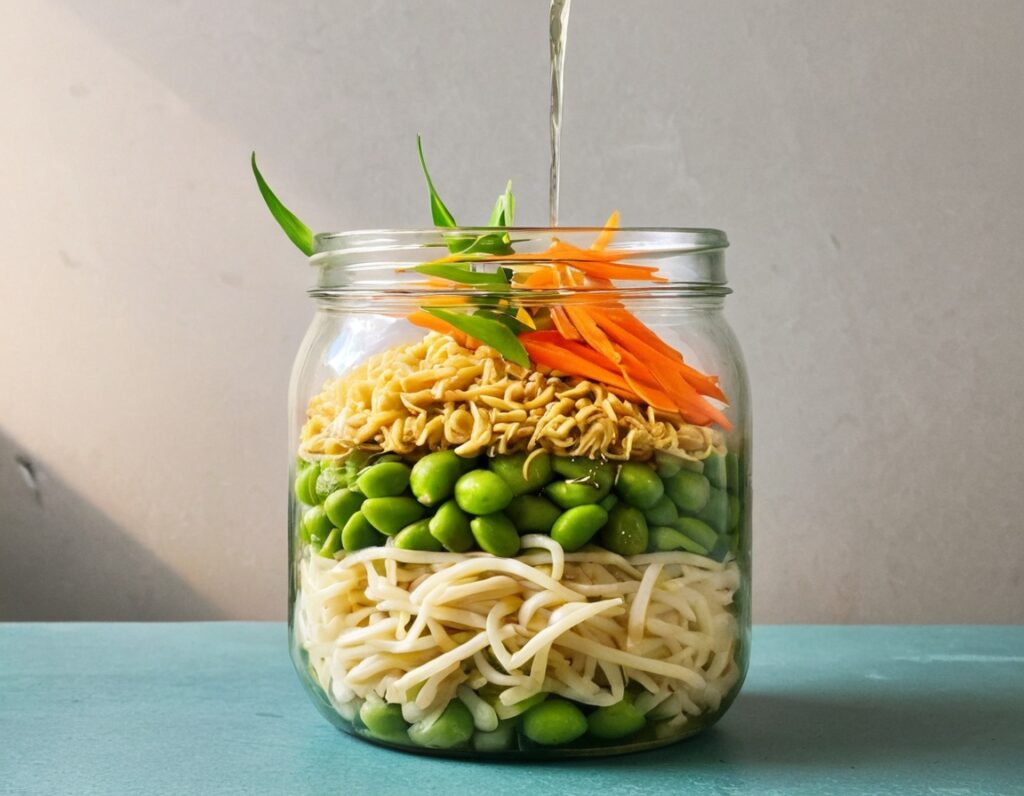
1) Layer a heat-resistant jar (mason jars are usually quite resistant to temperature changes) with the noodles and vegetables.

2) Combine the peanut butter, miso paste, and chili oil, black pepper, and ginger in a small bowl. Pour this dressing over the layered vegetables and noodles, and screw the lid on. Refrigerate until needed.

3) Add hot water to the jar and stir, to serve. If you prefer the vegetables to be more cooked, you can microwave (without the lid!) for a minute or two.
Enjoy!

Want to learn more?

For those interested in some of the science of what we have going on today:

Take care!

Don’t Forget…

Did you arrive here from our newsletter? Don’t forget to return to the email to continue learning!

  • Cardio vs Weights vs Pilates – Which Is Best For Fat Loss?
    Cori Lefkowitz, of Redefining Strength, advises: The right tool for the task The argument here is that fat loss works best when weight training, sprint interval training, walking, and Pilates are combined strategically instead of treated as competing methods, with lifting as the foundation, sprints as a metabolic enhancer, walking as a recovery and fat-burning…

Learn to Age Gracefully

Join the 98k+ American women taking control of their health & aging with our 100% free (and fun!) daily emails:

  • What you need to know about xylazine

    10almonds is reader-supported. We may, at no cost to you, receive a portion of sales if you purchase a product through a link in this article.

    Xylazine is a non-opioid tranquilizer designed for veterinary use in animals. The sedative is not approved for use in people, yet it’s becoming more prevalent in the illicit drug supply.

    Sometimes called “tranq,” it’s often mixed with other drugs, such as fentanyl, a potent opioid responsible for a growing number of overdose deaths. Last year, the White House Office of National Drug Control Policy declared fentanyl mixed with xylazine an “emerging threat.”

    Read on to learn more about xylazine: what happens when people take it, what to do if an overdose is suspected, and how harm reduction tools can prevent overdose deaths.

    How are people who use drugs exposed to xylazine?

    Studies show people are exposed to xylazine—knowingly or unknowingly—when it’s mixed with other drugs like heroin, cocaine, meth, and, most frequently, fentanyl. When combined with opioids or other drugs, it increases the risk of a drug overdose.

    What happens if someone takes xylazine?

    Taking xylazine can cause drowsiness, amnesia, slow breathing, slow heart rate, dangerously low blood pressure, wounds that can become infected, and death, especially when taken in combination with other drugs.

    Why does xylazine increase the risk of overdose?

    Xylazine is a central nervous system depressant, which means that it slows down the body’s heart rate and breathing. It can also enhance the effects of other depressants, such as opioids, which may lead to suffocation.

    What are the signs of a xylazine-related overdose?

    Xylazine-related overdoses look like opioid overdoses. A person who has overdosed may exhibit a slow pulse, slow breathing, blurry vision, disorientation, drowsiness, confusion, blue skin, and loss of consciousness.

    How many people die from xylazine-related overdoses in the U.S.?

    Xylazine-related overdose deaths in the U.S. rose from 102 deaths in 2018 to 3,468 deaths in 2021. Most occurred in Delaware, the District of Columbia, Maryland, Pennsylvania, Virginia, and West Virginia. Fentanyl was the most frequently co-occurring drug involved in those deaths.

    What should I do if an overdose is suspected?

    If you suspect that a person has overdosed on any drug, call 911 and give them naloxone—sometimes sold under the brand name Narcan—a medication that can reverse an opioid overdose. You should also stay with the person who has overdosed until first responders arrive. Most states have Good Samaritan laws, which protect people who have overdosed and those assisting them from certain criminal penalties.

    While naloxone cannot reverse the effects of xylazine alone, experts recommend administering naloxone if an overdose is suspected because it’s often mixed with opioids.

    You can get naloxone for free from some nonprofit organizations and government-run programs. You can also purchase over-the-counter naloxone at pharmacies, grocery and convenience stores, and other retailers.

    Learn how to use naloxone in this short training video from the American Medical Association, or sign up for a free online training.

    How can people prevent xylazine-related overdoses?

    Harm reduction programs are community programs that prevent drug overdoses, reduce the spread of infectious diseases, and connect people to medical care. These programs provide lifesaving tools like naloxone, as well as fentanyl and xylazine test strips, which can detect the presence of these drugs in a substance and prevent overdoses. Drug test strips can also be ordered online.

    However, test strips are considered “drug paraphernalia” in some states and are not legal everywhere. Learn more about state laws around drug checking equipment from the Network for Public Health Law.

    Learn more about harm reduction from the CDC.

    This article first appeared on Public Good News and is republished here under a Creative Commons license.

    Share This Post

  • Practical Optimism – by Dr. Sue Varma

    10almonds is reader-supported. We may, at no cost to you, receive a portion of sales if you purchase a product through a link in this article.

    We’ve written before about how to get your brain onto a more positive track (without toxic positivity), but there’s a lot more to be said than we can fit into an article, so here’s a whole book packed full with usable advice.

    The subtitle claims “the art, science, and practice of…”, but mostly it’s the science of. If there’s art to be found here, then this reviewer missed it, and as for the practice of, well, that’s down to the reader, of course.

    However, it is easy to use the contents of this book to translate science into practice without difficulty.

    If you’re a fan of acronyms, initialisms, and other mnemonics (such as the rhyming “Name, Claim, Tame, and Reframe”), then you’ll love this book as they come thick and fast throughout, and they contribute to the overall ease of application of the ideas within.

    The writing style is conversational but with enough clinical content that one never forgets who is speaking—not in the egotistical way that some authors do, but rather, just, she has a lot of professional experience to share and it shows.

    Bottom line: if you’d like to be more optimistic without delving into the delusional, this book can really help a lot with that (in measurable ways, no less!).

    Click here to check out Practical Optimism, and brighten up your life!

    Share This Post

  • Make Change That Lasts – by Dr. Rangan Chatterjee

    10almonds is reader-supported. We may, at no cost to you, receive a portion of sales if you purchase a product through a link in this article.

    We’ve reviewed Dr. Chatterjee’s other books before, and now it’s time to review his latest.

    First, what this isn’t: another rehash of James Clear’s “Atomic Habits” ← which is excellent, but one version of it was enough already

    What this actually is: a very insightful and thought-provoking book about what causes us to create our bad habits in the first place, and how to (as per Dr. Chatterjee’s usual methodology) address the cause itself, rather than just the symptom.

    This is important, because oftentimes we get into habits unconsciously without realising, so it may take some unpacking later.

    He talks about the various things that we need to let go of if we want to also drop habits that aren’t serving us, and devotes a chapter to each of these (they are the 9 items mentioned in the subtitle).

    The style is personal and human (this soft-hearted reviewer cried when reading about the habits that he created while his father was dying, and what happened after that death), and yet at the same time practical and instructional; this really does give the reader the understanding and the tools to not just “break” habits, but to actually deconstruct them in such a fashion that we won’t accidentally pick them up again.

    A note on pictures: the US edition of this book has black and white pictures, and some reviewers have complained about them being unclear and confusing. Please take it from this European reviewer (it’s me, hi) who read the European edition with color pictures, that you’re not missing out on anything. The pictures are unclear and confusing in color, too. They appear to be mostly random stock images that serve no obvious purpose. They don’t detract from the great value offered by the book, though!

    Bottom line: if you sometimes find yourself stuck in a state of not improving, this book can absolutely help you to get out of that rut and moving in the direction you want to go.

    Click here to check out Make Change That Lasts, and make change that lasts!

    Share This Post

  • The Web That Has No Weaver – by Ted Kaptchuk

    10almonds is reader-supported. We may, at no cost to you, receive a portion of sales if you purchase a product through a link in this article.

    At 10almonds we have a strong “stick with the science” policy, and that means peer-reviewed studies and (where such exists) scientific consensus.

    However, in the spirit of open-minded skepticism (i.e., acknowledging what we don’t necessarily know), it can be worth looking at alternatives to popular Western medicine. Indeed, many things have made their way from Traditional Chinese Medicine (or Ayurveda, or other systems) into Western medicine in any case.

    “The Web That Has No Weaver” sounds like quite a mystical title, but the content is presented in the cold light of day, with constant “in Western terms, this works by…” notes.

    The author walks a fine line of on the one hand, looking at where TCM and Western medicine may start and end up at the same place, by a different route; and on the other hand, noting that (in a very Daoist fashion), the route is where TCM places more of the focus, in contrast to Western medicine’s focus on the start and end.

    He makes the case for TCM being more holistic, and it is, though Western medicine has been catching up in this regard since this book’s publication more than 20 years ago.

    The style of the writing is very easy to follow, and is not esoteric in either mysticism or scientific jargon. There are diagrams and other illustrations, for ease of comprehension, and chapter endnotes make sure we didn’t miss important things.

    Bottom line: if you’re curious about Traditional Chinese Medicine, this book is the US’s most popular introduction to such, and as such, is quite a seminal text.

    Click here to check out The Web That Has No Weaver, and enjoy learning about something new!

    Don’t Forget…

    Did you arrive here from our newsletter? Don’t forget to return to the email to continue learning!

    Learn to Age Gracefully

    Join the 98k+ American women taking control of their health & aging with our 100% free (and fun!) daily emails:

  • How A Doctor Starts The Day To Make Dopamine Last Long Hours

    10almonds is reader-supported. We may, at no cost to you, receive a portion of sales if you purchase a product through a link in this article.

    Dr. Zeliha Akpinar shares how she deals with her demanding life as a junior doctor in a rural emergency department, with a focus on starting the day in a way that means she doesn’t run out of steam partway through:

    Gently does it

    One of her core principles is protecting her brain’s dopamine levels, which are essential for motivation and productivity. Instead of reaching for her phone in the morning, she begins her day with simple tasks like brushing her teeth or making her bed—small actions that give her a dopamine boost without sending her along a “hedonic treadmill” in search of further crumbs of dopamine from social media etc.

    She emphasizes the importance of using tools and routines that support mental clarity and focus. Her digital planner, “Xyles”, helps manage multiple responsibilities while keeping her grounded and goal-oriented. Including a photo of her younger self in her planner reminds her to stay connected to her inner child’s dreams—a powerful motivator during her long hospital shifts. For those of us who from the thumbnail might not have assumed she was old enough to be doctor, this might seem silly (like when a child says “when I was young”), but the truth is, we all live relative to our own past, however long or short that distance might be. The take-away for us at any age is: do things as though your younger self is watching!

    Dr. Akpinar also talks about the significance of mindfulness in a hyper-connected world. She schedules screen-free meals to slow down and reconnect with the present moment, balancing the chaos of emergency medicine with moments of peace. By using tools like the “Opal” app to limit social media, she protects her focus and emotional well-being.

    In short, her advice is clear: take purposeful action, design systems that support your brain, and stay aligned with what truly matters to you!

    For more on all of this in her own words, enjoy:

    Click Here If The Embedded Video Doesn’t Load Automatically!

    Want to learn more?

    You might also like:

    The Dopamine Myth

    Take care!

    Don’t Forget…

    Did you arrive here from our newsletter? Don’t forget to return to the email to continue learning!

    Learn to Age Gracefully

    Join the 98k+ American women taking control of their health & aging with our 100% free (and fun!) daily emails:

  • Serotonin vs Dopamine (Know The Differences)

    10almonds is reader-supported. We may, at no cost to you, receive a portion of sales if you purchase a product through a link in this article.

    Of the various neurotransmitters that people confuse with each other, serotonin and dopamine are the two highest on the list (with oxytocin coming third as people often attribute its effects to serotonin). But, for all they are both “happiness molecules”, serotonin and dopamine are quite different, and are even opposites in some ways:

    More than just happiness

    Let’s break it down:

    Similarities:

    • Both are neurotransmitters, neuromodulators, and monoamines.
    • Both impact cognition, mood, energy, behavior, memory, and learning.
    • Both influence social behavior, though in different ways.

    Differences (settle in; there are many):

    • Chemical structure:
      • Dopamine: catecholamine (derived from phenylalanine and tyrosine)
      • Serotonin: indoleamine (derived from tryptophan)
    • Derivatives:
      • Dopamine → noradrenaline and adrenaline (stress and alertness)
      • Serotonin → melatonin (sleep and circadian rhythm)
    • Effects on mental state:
      • Dopamine: drives action, motivation, and impulsivity.
      • Serotonin: promotes calmness, behavioral inhibition, and cooperation.
    • Role in memory and learning:
      • Dopamine: key in attention and working memory
      • Serotonin: crucial for hippocampus activation and long-term memory

    Symptoms of imbalance:

    • Low dopamine:
      • Loss of motivation, focus, emotion, and activity
      • Linked to Parkinson’s disease and ADHD
    • Low serotonin:
      • Sadness, irritability, poor sleep, and digestive issues
      • Linked to PTSD, anxiety, and OCD
    • High dopamine:
      • Excessive drive, impulsivity, addictions, psychosis
    • High serotonin:
      • Nervousness, nausea, and in extreme cases, serotonin syndrome (which can be fatal)

    Brain networks:

    • Dopamine: four pathways controlling movement, attention, executive function, and hormones.
    • Serotonin: widely distributed across the cortex, partially overlapping with dopamine systems.

    Speed of production:

    • Dopamine: can spike and deplete quickly; fatigues faster with overuse.
    • Serotonin: more stable, releasing steadily over longer periods.

    Illustrative examples:

    • Coffee boosts dopamine but loses its effect with repeated use.
    • Sunlight helps maintain serotonin levels over time.

    If you remember nothing else, remember this:

    • Dopamine: action, motivation, and alertness.
    • Serotonin: contentment, happiness, and calmness.

    For more on all of the above, enjoy:

    Click Here If The Embedded Video Doesn’t Load Automatically!

    Want to learn more?

    You might also like to read:

    Neurotransmitter Cheatsheet

    Take care!

    Don’t Forget…

    Did you arrive here from our newsletter? Don’t forget to return to the email to continue learning!

    Learn to Age Gracefully

    Join the 98k+ American women taking control of their health & aging with our 100% free (and fun!) daily emails: