Pine Nuts vs Pecans – Which is Healthier?

10almonds is reader-supported. We may, at no cost to you, receive a portion of sales if you purchase a product through a link in this article.

Our Verdict

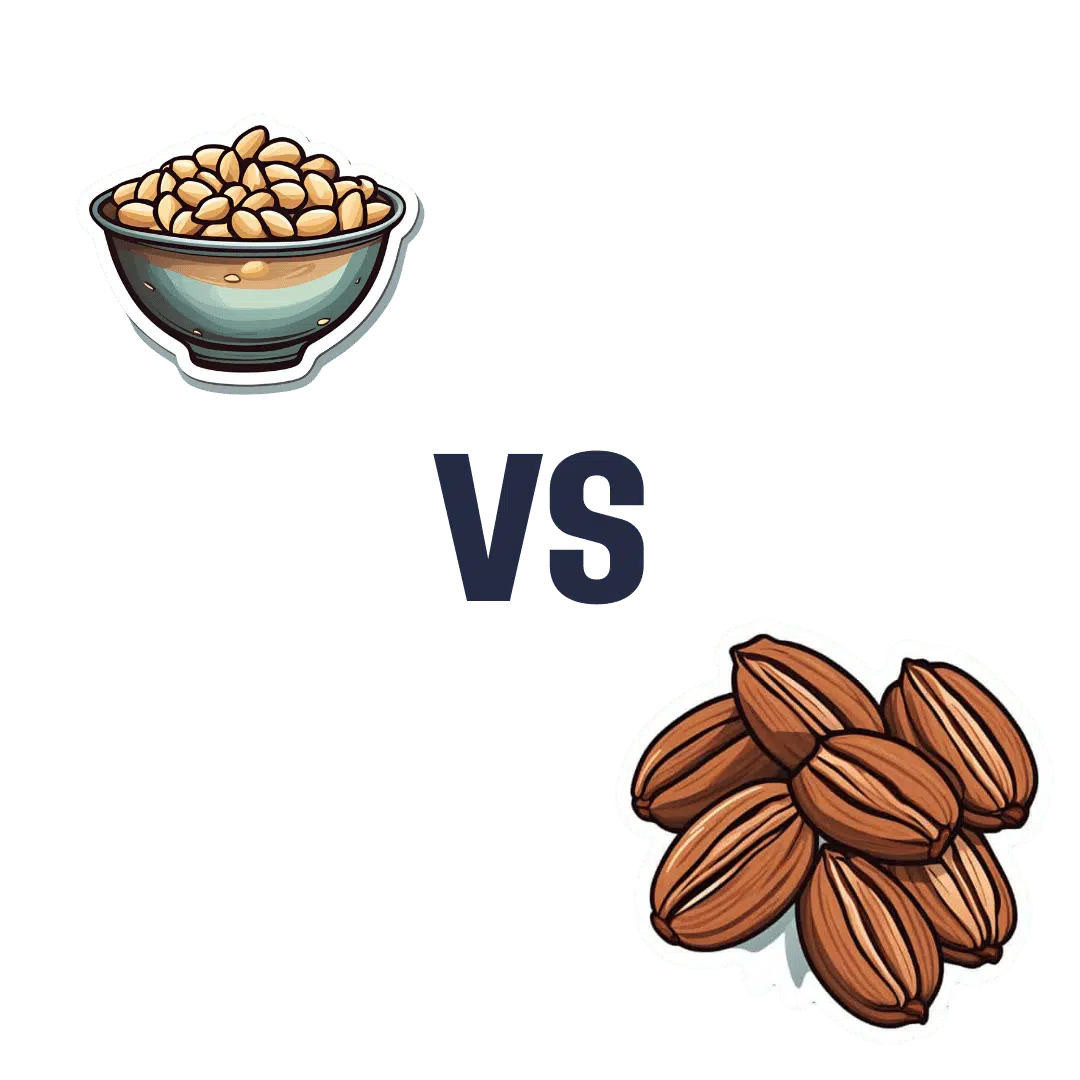
When comparing pine nuts to pecans, we picked the pine nuts.

Why?

Both have their merits!

In terms of macros, pine nuts have more protein while pecans have more fiber. They’re about equal on fats, although pine nuts have more polyunsaturated fat and pecans have more monounsaturated fat, of which, both are healthy. They’re also about equal on carbs. So really it comes down to the subjective choice between prioritizing protein and prioritizing fiber. On principle, we pick fiber, which gives the win to pecans, but your preference in this regard may differ; prioritizing the protein would give the win to pine nuts.

In the category of vitamins, pine nuts have more of vitamins B2, B3, B9, E, K, and choline, while pecans have more of vitamins A, B1, B5, B6, and C. Thus, a 6:5 marginal win for pine nuts.

Looking at the minerals, pine nuts have more copper, iron, magnesium, manganese, phosphorus, potassium, and zinc, while pecans have more calcium and selenium. An easy win for pine nuts this time.

Adding up the sections makes for a win for pine nuts, but of course, enjoy either or (preferably) both; diversity is good!

Want to learn more?

You might like to read:

Why You Should Diversify Your Nuts

Enjoy!

Don’t Forget…

Did you arrive here from our newsletter? Don’t forget to return to the email to continue learning!

Learn to Age Gracefully

Join the 98k+ American women taking control of their health & aging with our 100% free (and fun!) daily emails:

  • NAD⁺ vs Long COVID!

    10almonds is reader-supported. We may, at no cost to you, receive a portion of sales if you purchase a product through a link in this article.

    Before we get to talking about long COVID, a word on nicotinamide adenine dinucleotide (or NAD+ to its friends) itself.

    It’s most well-known in the context of healthy aging, and that’s because:

    • NAD+ levels decline with age
    • The aforementioned decline is a causal factor in aging
    • Boosting NAD+ levels can, thus, slow aging

    Learn more: Therapeutic Potential of NAD-Boosting Molecules: The In Vivo Evidence

    There are actually also other NAD-boosting molecules besides NAD itself and its precursors. For example, the liver will not produce NADᐩ unless it has aminocarboxymuconate-semialdehyde decarboxylase (or “ACMSD”, to its friends), which limits the production of NADᐩ. Why, you ask? The theory is that it is a kind of evolutionary conservativism, much like not lighting a fire without the ability to put it out. In any case, taking ACMSD-blockers will thus result in an increased endogenous production of NADᐩ.

    You can read about this here: De novo NAD+ synthesis enhances mitochondrial function and improves health

    For these reasons, NAD+ is one of Dr. Greger’s Anti-Aging Eight ← we wrote about NAD+ here

    But what about NAD+ vs long COVID?

    The latest science

    Researchers (Dr. Edmarie Guzmán-Vélez et al.) investigated how boosting NAD⁺ with nicotinamide riboside (NR) can ease long-COVID symptoms such as brain fog, fatigue, executive dysfunction, and sleep problems.

    How they tested it:

    • They gave one group 2,000 mg/day NR for 20 weeks
    • They gave the other group a placebo for 10 weeks before switching to NR for the next 10 weeks.
    • They measured NAD⁺ levels and tested fatigue, executive function, sleep, and mood at baseline, week 10, and week 20.

    As for how that went:

    ❝In post-hoc exploratory analysis, examining within-group changes during 5 and 10 weeks of NR intake by grouping all participants during the first 10 weeks of the NR phase, there were significant differences from baseline after 10 weeks of NR in executive functioning, fatigue severity, sleep quality, and symptoms of depression❞

    (specifically: the “significant differences” were significant improvements)

    Read the paper in full: Effects of nicotinamide riboside on NAD+ levels, cognition, and symptom recovery in long-COVID: a randomized controlled trial

    If you’d like to try more things like this, then consider: 12 Most Powerful Supplements and Foods to Increase Energy & Slow Down Aging

    And definitely check out: What Can Be Done About Long COVID?

    Want to try some?

    We don’t sell it, but here for your convenience is an example product on Amazon 😎

    Enjoy!

    Share This Post

  • Strong – by Jacqueline Hooton

    10almonds is reader-supported. We may, at no cost to you, receive a portion of sales if you purchase a product through a link in this article.

    The author, herself in her 60s, knows her stuff when it comes to fitness (female fitness in particular) and aging (or: ageing, as you’ll see in this book, with its British English).

    She starts by laying out the idea of comprehensive fitness, that is to say, the many ways in which this can be measured, and that some of them may be more (or less) important to use as individuals than others—but that whatever aspect(s) we choose to focus upon, we should endeavor to be at least “good” in all categories.

    So for example, when it comes to: body composition, cardiovascular fitness, flexibility, muscular endurance, strength, agility, balance, coordination, power, reaction time, and speed.

    Some of these may at first glance seem to be different words for the same thing, but she defines each of them carefully, as you read you’ll understand their distinctions.

    Then she sets about imparting the knowledge of how to improve each of those things (and more), in the context of aging, and in particular, in the context of female aging.

    The tools, of course, are diet and exercise, but these things she presents in the form of a plan, and the broad field of “exercise” also encompasses such things as rehab exercises, stretches, and so forth.

    The style is a skillful balance of professional and personal; enough (well-sourced) science to lend confidence on that side of things, and enough personal touches to also lend confidence that indeed, she speaks from experience—as a personal trainer in her 60s who began in her 40s.

    Bottom line: this is a very comprehensive and helpful book, and much better put-together than a lot of books of its kind. By this we don’t mean the binding, but rather: it’s not just advice for the sake of filling a book; it’s a carefully tailored, well-planned, customizable guide that covers more bases than many such books even acknowledge exist.

    Click here to check out Strong, and age well in all respects!

    Share This Post

  • How old’s too old to be a doctor? Why GPs and surgeons over 70 may need a health check to practise

    10almonds is reader-supported. We may, at no cost to you, receive a portion of sales if you purchase a product through a link in this article.

    A growing number of complaints against older doctors has prompted the Medical Board of Australia to announce today that it’s reviewing how doctors aged 70 or older are regulated. Two new options are on the table.

    The first would require doctors over 70 to undergo a detailed health assessment to determine their current and future “fitness to practise” in their particular area of medicine.

    The second would require only general health checks for doctors over 70.

    A third option acknowledges existing rules requiring doctors to maintain their health and competence. As part of their professional code of conduct, doctors must seek independent medical and psychological care to prevent harming themselves and their patients. So, this third option would maintain the status quo.

    PeopleImages.com – Yuri A/Shutterstock

    Haven’t we moved on from set retirement ages?

    It might be surprising that stricter oversight of older doctors’ performance is proposed now. Critics of mandatory retirement ages in other fields – for judges, for instance – have long questioned whether these rules are “still valid in a modern society”.

    However, unlike judges, doctors are already required to renew their registration annually to practise. This allows the Medical Board of Australia not only to access sound data about the prevalence and activity of older practitioners, but to assess their eligibility regularly and to conduct performance assessments if and when they are needed.

    What has prompted these proposals?

    This latest proposal identifies several emerging concerns about older doctors. These are grounded in external research about the effect of age on doctors’ competence as well as the regulator’s internal data showing surges of complaints about older doctors in recent years.

    Studies of medical competence in ageing doctors show variable results. However, the Medical Board of Australia’s consultation document emphasises studies of neurocognitive loss. It explains how physical and cognitive impairment can lead to poor record-keeping, improper prescribing, as well as disruptive behaviour.

    The other issue is the number of patient complaints against older doctors. These “notifications” have surged in recent years, as have the number of disciplinary actions against older doctors.

    In 2022–2023, the Medical Board of Australia took disciplinary action against older doctors about 1.7 times more often than for doctors under 70.

    In 2023, notifications against doctors over 70 were 81% higher than for the under 70s. In that year, patients sent 485 notifications to the Medical Board of Australia about older doctors – up from 189 in 2015.

    While older doctors make up only about 5.3% of the doctor workforce in Australia (less than 1% over 80), this only makes the high numbers of complaints more starkly disproportionate.

    It’s for these reasons that the Medical Board of Australia has determined it should take further regulatory action to safeguard the health of patients.

    So what distinguishes the two new proposed options?

    The “fitness to practise” assessment option would entail a rigorous assessment of doctors over 70 based on their specialisation. It would be required every three years after the age of 70 and every year after 80.

    Surgeons, for example, would be assessed by an independent occupational physician for dexterity, sight and the ability to give clinical instructions.

    Importantly, the results of these assessments would usually be confidential between the assessor and the doctor. Only doctors who were found to pose a substantial risk to the public, which was not being managed, would be obliged to report their health condition to the Medical Board of Australia.

    The second option would be a more general health check not linked to the doctor’s specific role. It would occur at the same intervals as the “fitness to practise” assessment. However, its purpose would be merely to promote good health-care decision-making among health practitioners. There would be no general obligation on a doctor to report the results to the Medical Board of Australia.

    In practice, both of these proposals appear to allow doctors to manage their own general health confidentially.

    Surgeons operating in theatre
    Older surgeons could be independently assessed for dexterity, sight and the ability to give clinical instructions. worradirek/Shutterstock

    The law tends to prioritise patient safety

    All state versions of the legal regime regulating doctors, known as the National Accreditation and Registration Scheme, include a “paramountcy” provision. That provision basically says patient safety is paramount and trumps all other considerations.

    As with legal regimes regulating childcare, health practitioner regulation prioritises the health and safety of the person receiving the care over the rights of the licensed professional.

    Complicating this further, is the fact that a longstanding principle of health practitioner regulation has been that doctors should not be “punished” for errors in practice.

    All of this means that reforms of this nature can be difficult to introduce and that the balance between patient safety and professional entitlements must be handled with care.

    Could these proposals amount to age discrimination?

    It is premature to analyse the legal implications of these proposals. So it’s difficult to say how these proposals interact with Commonwealth age- and other anti-discrimination laws.

    For instance, one complication is that the federal age discrimination statute includes an exemption to allow “qualifying bodies” such as the Medical Board of Australia to discriminate against older professionals who are “unable to carry out the inherent requirements of the profession, trade or occupation because of his or her age”.

    In broader terms, a licence to practise medicine is often compared to a licence to drive or pilot an aircraft. Despite claims of discrimination, New South Wales law requires older drivers to undergo a medical assessment every year; and similar requirements affect older pilots and air traffic controllers.

    Where to from here?

    When changes are proposed to health practitioner regulation, there is typically much media attention followed by a consultation and behind-the-scenes negotiation process. This issue is no different.

    How will doctors respond to the proposed changes? It’s too soon to say. If the proposals are implemented, it’s possible some older doctors might retire rather than undergo these mandatory health assessments. Some may argue that encouraging more older doctors to retire is precisely the point of these proposals. However, others have suggested this would only exacerbate shortages in the health-care workforce.

    The proposals are open for public comment until October 4.

    Christopher Rudge, Law lecturer, University of Sydney

    This article is republished from The Conversation under a Creative Commons license. Read the original article.

    Share This Post

  • How can I tell if I am lonely? What are some of the signs?

    10almonds is reader-supported. We may, at no cost to you, receive a portion of sales if you purchase a product through a link in this article.

    Without even realising it, your world sometimes gradually gets smaller: less walking, fewer days in the office, cancelling on friends. Watching plans disintegrate on the chat as friends struggle to settle on a date or place for a catch-up.

    You might start to feel a bit flat or disconnected. Subtle changes in habit and mood take hold. Could you be … lonely?

    It’s not a label many of us identify with easily, especially if you know you’ve got friends, or are in a happy relationship.

    But loneliness can happen to us all from time to time – and identifying it is the first step to fixing it.

    gremlin/Getty Images

    So, what is loneliness?

    Loneliness is the distress we feel when our relationships don’t meet our needs – in quality or quantity.

    It’s not the same as being objectively alone (otherwise known as “social isolation”).

    You can feel deeply lonely even while surrounded by friends, or totally content on your own.

    Loneliness is subjective; many people don’t realise they’re lonely until the feeling becomes persistent.

    What are some of the signs to look for?

    You may feel a physical coldness, emptiness or hollowness (I’ve heard it described as feeling like you are missing an organ). Some research shows social pain is experienced similarly in the brain to physical pain.

    Behavioural signs may include:

    • changes in routine
    • trouble getting to sleep or staying asleep
    • changed appetite (maybe you’re eating more or less than you normally would, or have less variety in your diet)
    • withdrawing from plans you would usually enjoy (perhaps you’re skipping a regular exercise class, or going to shows or sports events less often).

    Emotionally, you may feel:

    • a persistent sadness
    • tired
    • disconnected
    • like you don’t belong, even when you are with others.

    You may also feel more sensitive to rejection or criticism.

    A man walks with a paper bag on his head.
    Sometimes, your world shrinks so gradually you barely notice it – until things get quite bad. francescoch/Getty Images

    But you’re not alone and you’re not broken.

    Loneliness is a normal response to disconnection.

    The late US neuroscientist John Cacioppo described loneliness as an evolutionary alarm system.

    In the past, being separated from your tribe meant danger and risk from predators, so our brains developed a way to push us back towards connection.

    The pain of loneliness is designed to keep us connected and safe.

    Why is it often hard to recognise loneliness?

    Sadly, there’s still a lot of stigma around admitting loneliness, especially for men.

    Many people resist identifying as lonely, or feel this marks them as a “loser”.

    But this silence can make the problem worse.

    When no one talks about it, it becomes harder to break the cycle of loneliness, and the stigma remains.

    While passing loneliness is normal, chronic or persistent loneliness can hurt our health.

    Research shows chronic loneliness is associated with:

    • depression
    • anxiety
    • weakened immunity
    • heart disease
    • earlier death.

    Loneliness can also become self-reinforcing. When loneliness feels normal, it can start to shape how you see the world: you expect rejection, withdraw more and the cycle deepens.

    The earlier you notice you’re lonely, the easier it is to break.

    But I’m in a relationship, have loads of friends and a rewarding job

    Yes, but you can still be lonely.

    Most of us need different kinds of relationships to thrive. It’s not about how many people you know, but whether you feel connected and have a meaningful role in these relationships.

    You may feel lonely even with strong friendships if you are lacking deeper connection, shared identity or a sense of community.

    This doesn’t mean you’re ungrateful, or a bad friend.

    It just means you need more or different kinds of connection.

    OK, I’ve realised I am lonely. Now what?

    Start by asking yourself: what kind of connection am I missing?

    Is it one-to-one friendships? A partner? Casual social interactions? A shared purpose or community?

    Then reflect on what’s helped you feel more connected in the past. For some, it’s joining a choir, a book club or a sports group. For others, it may be volunteering or just saying “yes” to small social moments, like chatting with your local barista or learning the name of the local butcher.

    If you’re still struggling, a psychologist can help with tailored strategies for building connection.

    The structural causes of loneliness

    It’s also important to remember loneliness is often not because of personal failings or overall mental health.

    My own research shows loneliness is often shaped by structural factors, such as poor planning in our local neighbourhood environments, financial inequality, work pressures, social norms, or even long-term effects of restrictions from the COVID pandemic.

    We are also learning more about how climate change can disrupt social connection and worsen loneliness due to, for example, higher temperatures or bushfires.

    Loneliness is normal, common, human and completely solvable.

    Start by noticing it in yourself and reach out if you can.

    Let’s start talking about it more, so others can feel less alone too.

    Marlee Bower, Senior Research Fellow, Matilda Centre for Research in Mental Health and Substance Use, University of Sydney

    This article is republished from The Conversation under a Creative Commons license. Read the original article.

    Don’t Forget…

    Did you arrive here from our newsletter? Don’t forget to return to the email to continue learning!

    Learn to Age Gracefully

    Join the 98k+ American women taking control of their health & aging with our 100% free (and fun!) daily emails:

  • 21 Most Beneficial Polyphenols & What Foods Have Them

    10almonds is reader-supported. We may, at no cost to you, receive a portion of sales if you purchase a product through a link in this article.

    We often write about polyphenols here at 10almonds; sometimes mentioning that a certain food is good because it has them, or else occasionally an entire article about a particular polyphenol. But what about a birds-eye view of polyphenols as a whole?

    Well, there are many, but we’ve picked 21 particularly beneficial for human health, and what foods contain them.

    We’ll be working from this fantastic database, by the way:

    ❝Phenol-Explorer is the first comprehensive database on polyphenol content in foods. The database contains more than 35,000 content values for 500 different polyphenols in over 400 foods. These data are derived from the systematic collection of more than 60,000 original content values found in more than 1,300 scientific publications. Each of these publications has been critically evaluated before inclusion in the database. The whole data on the polyphenol composition of foods is available for download.❞

    Source: Phenol-Explorer.EU | Database on polyphenol content in foods

    We use this database at least several times per week while writing 10almonds; it’s a truly invaluable resource!

    However, 500 is a lot, so here’s a rundown of 21 especially impactful ones; we’ve sorted them per the categories used in the explorer, and in some cases we’ve aggregated several very similar polyphenols typically found together in the same foods, into one item (so for example we just list “quercetin” instead of quercetin 3-O-rutinoside + quercetin 4′-O-glucoside + quercetin 3,4′-O-diglucoside, etc etc). We’ve also broadly grouped some particularly populous ones such as “anthocyanins”, “catechins”, and so forth.

    Without further ado, here’s what you ideally want to be getting plenty of in your diet:

    Flavonoids

    1. Quercetin
    2. Kaempferol
      • Foods: spinach, kale, tea (green and black), capers, brussels sprouts.
      • Benefits: antioxidant, may reduce the risk of cancer, supports cardiovascular health, and has anti-inflammatory properties.
    3. Epigallocatechin gallate (EGCG)
      • Foods: green tea, matcha.
      • Benefits: potent antioxidant, promotes weight loss, supports brain health, and may reduce the risk of heart disease.
      • See also: What Does Kaempferol Do, Anyway?
    4. Anthocyanins
      • Foods: blueberries, blackberries, raspberries, red cabbage, cherries.
      • Benefits: improve brain health, support eye health, and reduce the risk of cardiovascular diseases.
    5. Apigenin
      • Foods: parsley, celery, chamomile tea.
      • Benefits: anti-inflammatory, reduces anxiety, and supports brain and immune system health.
    6. Luteolin
      • Foods: peppers, thyme, celery, carrots.
      • Benefits: anti-inflammatory, supports brain health, and may help reduce the growth of cancer cells.
    7. Catechins (aside from EGCG)
      • Foods: green tea, dark chocolate, apples
      • Benefits: boosts metabolism, supports cardiovascular health, and reduces oxidative stress.
    8. Hesperidin
      • Foods: oranges, lemons, limes, grapefruits.
      • Benefits: supports vascular health, reduces inflammation, and may help manage diabetes.
    9. Naringenin
      • Foods: oranges, grapefruits, tomatoes.
      • Benefits: antioxidant, supports liver health, and may improve cholesterol levels.

    For more on epigallocatechin gallate and other catechins, see: Which Tea Is Best, By Science?

    Phenolic Acids

    1. Chlorogenic acid
    2. Caffeic acid
    3. Ferulic acid
      • Foods: whole grains, rice bran, oats, flaxseeds, spinach.
      • Benefits: protects skin from UV damage, reduces inflammation, and supports cardiovascular health.
    4. Gallic acid
      • Foods: green tea, berries, walnuts.
      • Benefits: antioxidant, may reduce the risk of cancer, and supports brain health.

    Stilbenes

    1. Resveratrol
      • Foods: red currants, blueberries, peanuts.
      • Benefits: anti-aging properties, supports heart health, and reduces inflammation.
      • See also: Resveratrol & Healthy Aging ← and no, you can’t usefully get it from red wine; here’s why!

    Lignans

    1. Secoisolariciresinol
      • Foods: flaxseeds, sesame seeds, whole grains.
      • Benefits: supports hormone balance, reduces the risk of hormone-related cancers, and promotes gut health.
    2. Matairesinol
      • Foods: rye, oats, barley, sesame seeds.
      • Benefits: hormonal support, antioxidant, and may reduce the risk of cardiovascular diseases.

    See also: Sprout Your Seeds, Grains, Beans, Etc ← for maximum nutritional availability!

    Tannins

    1. Ellagic acid
      • Foods: pomegranates, raspberries, walnuts.
      • Benefits: anti-cancer properties, supports skin health, and reduces inflammation.
    2. Proanthocyanidins
      • Foods: cranberries, apples, grapes, dark chocolate.
      • Benefits: supports urinary tract health, reduces inflammation, and improves blood vessel health.

    See also: Enjoy Bitter Foods For Your Heart & Brain

    Curcuminoids

    1. Curcumin

    Isoflavones

    1. Genistein
      • Foods: soybeans, chickpeas.
      • Benefits: supports bone health, reduces the risk of hormone-related cancers, and promotes heart health.
    2. Daidzein
      • Foods: soybeans, legumes.
      • Benefits: hormonal balance, supports bone health, and may help alleviate menopausal symptoms.

    See also: What Does “Balance Your Hormones” Even Mean?

    Well, that’s a lot of things to remember!

    If you want to make it easier for yourself, you can simply make sure to get at least 30 different kinds of plant into your diet per week, and by doing so, statistically, you should cover most of these!

    Read more: What’s Your Plant Diversity Score?

    Alternatively, for a middle-ground approach of targetting 16 most polyphenol delivering foods, check out this super-dense arrangement:

    Mediterranean Diet… In A Pill? ← it’s about plant extracts from 16 specific foods, and the polyphenols they deliver

    Enjoy!

    Don’t Forget…

    Did you arrive here from our newsletter? Don’t forget to return to the email to continue learning!

    Learn to Age Gracefully

    Join the 98k+ American women taking control of their health & aging with our 100% free (and fun!) daily emails:

  • Kumquat vs Persimmon – Which is Healthier?

    10almonds is reader-supported. We may, at no cost to you, receive a portion of sales if you purchase a product through a link in this article.

    Our Verdict

    When comparing kumquat to persimmon, we picked the kumquat.

    Why?

    In terms of macros, kumquats have more protein, though like most fruits, it’s unlike anybody’s eating them for the protein content. More importantly, they have a lot more fiber, for less than half the carbs. It bears mentioning though that (again, like most fruits) persimmon isn’t bad for this either, and both fruits are low glycemic index foods.

    When it comes to vitamins, it’s not close: kumquats have more of vitamins A, B1, B2, B3, B5, B6, B9, E, and choline, while persimmon has more vitamin C. It’s worth noting that kumquats are already a very good source of vitamin C though; persimmon just has more.

    In the category of minerals, kumquats again lead with more calcium, copper, magnesium, manganese, and zinc, while persimmon has more iron, phosphorus, and potassium.

    In short, enjoy both, and/or whatever fruit you enjoy the most, but if looking for nutritional density, kumquats are bringing it.

    Want to learn more?

    You might like to read:

    Why You’re Probably Not Getting Enough Fiber (And How To Fix It)

    Take care!

    Don’t Forget…

    Did you arrive here from our newsletter? Don’t forget to return to the email to continue learning!

    Learn to Age Gracefully

    Join the 98k+ American women taking control of their health & aging with our 100% free (and fun!) daily emails: