
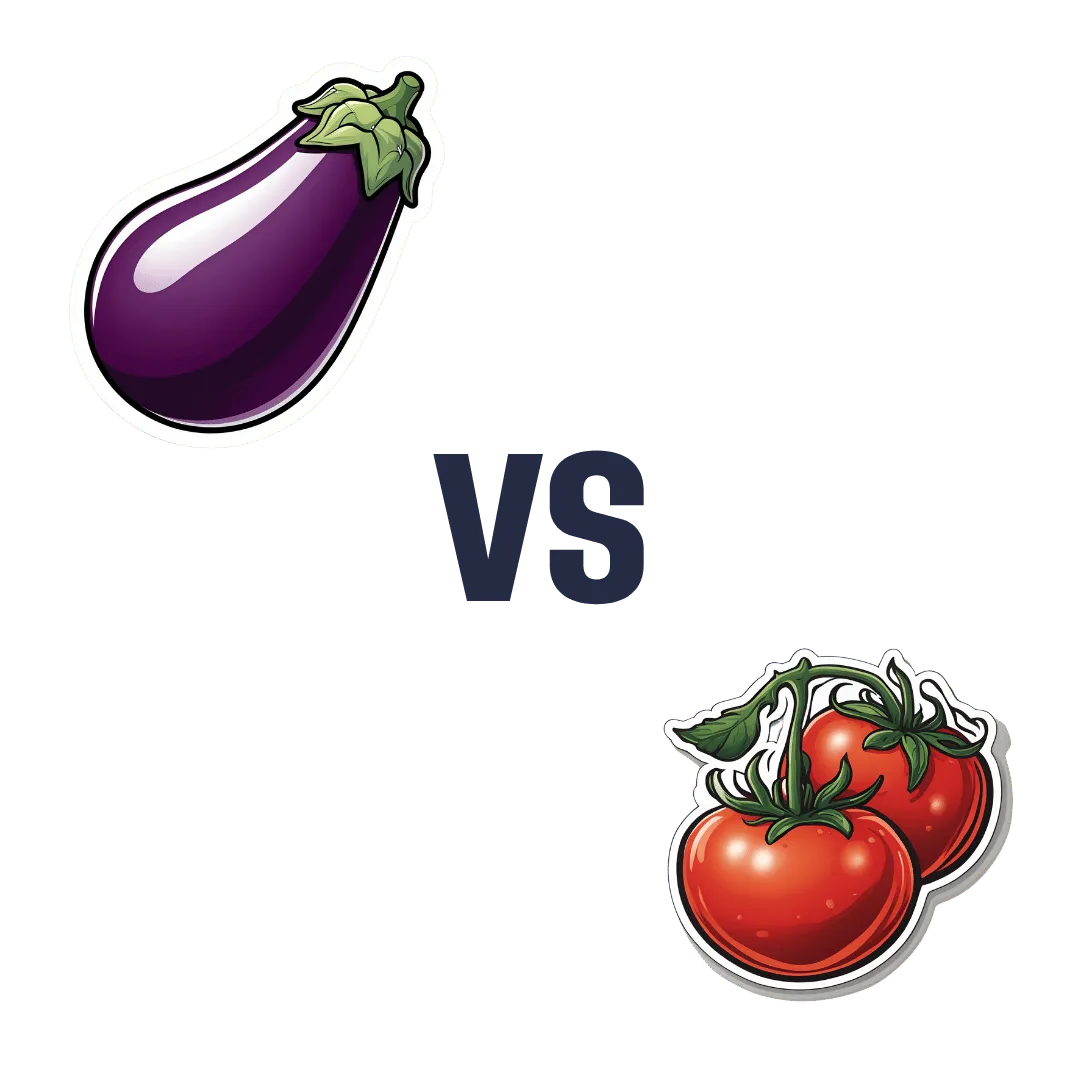
Eggplant vs Tomato – Which is Healthier?
10almonds is reader-supported. We may, at no cost to you, receive a portion of sales if you purchase a product through a link in this article.
Our Verdict
When comparing eggplant to tomato, we picked the eggplant.
Why?
Both have their merits! But…
In terms of macros, eggplant has nearly 3x the fiber, as well as slightly more carbs and protein, making it the most nutritionally dense option in the macros category.
In the category of vitamins, eggplant has more of vitamins B1, B2, B3, B5, B6, B9, and choline, while tomatoes have more of vitamins A, C, E, and K. So, very different vitamin coverage from each one, and/but by the numbers, eggplant wins.
When it comes to minerals, eggplant has more copper, magnesium, manganese, and selenium, while tomatoes have more calcium and iron. The margins of difference are very small in all cases, and they’re equal in phosphorus, potassium, and zinc. So this one’s very close, but by the numbers, eggplant scrapes a marginal victory.
Looking at phytochemicals, they’re about equal on polyphenols, though it’s worth mentioning that tomatoes are a famously good source of lycopene, which isn’t a polyphenol, but it is a very beneficial carotenoid, so we’ll say tomatoes get the win this round.
Adding up the sections, though, makes for an overall win for eggplant, but tomatoes are great too, and mostly in different ways than eggplant, which makes them extra good to enjoy together (salad, ratatouille, etc) for their very complementary health benefits!
Want to learn more?
You might like:
Lycopene’s Benefits For The Gut, Heart, Brain, & More
Enjoy!
Don’t Forget…
Did you arrive here from our newsletter? Don’t forget to return to the email to continue learning!
Recommended
Learn to Age Gracefully
Join the 98k+ American women taking control of their health & aging with our 100% free (and fun!) daily emails:
-
Water Water Everywhere, But Which Is Best To Drink?
10almonds is reader-supported. We may, at no cost to you, receive a portion of sales if you purchase a product through a link in this article.
Well Well Well…
In Tuesday’s newsletter, we asked you for your (health-related) opinion on drinking water—with the understanding that this may vary from place to place. We got the above-depicted, below-described, set of responses:
- About 65% said “Filtered is best”
- About 20% said “From the mains is best”
- About 8% said “Bottled is best”
- About 3% said “Distilled is best”
- About 3% said “Some other source is best”
Of those who said “some other source is best”, one clarified that their preferred source was well water.
So what does the science say?
Fluoridated water is bad for you: True or False?
False, assuming a normal level of consumption. Rather than take up more space today though, we’ll link to what we previously wrote on this topic:
You may be wondering: but what if my level of consumption is higher than normal?
Let’s quickly look at some stats:
- The maximum permitted safety level varies from place to place, but is (for example) 2mg/l in the US, 1.5mg/l in Canada & the UK.
- The minimum recommended amount also varies from place to place, but is (for example) 0.7mg/l in Canada and the US, and 1mg/l in the UK.
It doesn’t take grabbing a calculator to realize that if you drink twice as much water as someone else, then depending on where you are, water fluoridated to the minimum may give you more than the recommended maximum.
However… Those safety margins are set so much lower than the actual toxicity levels of fluoride, that it doesn’t make a difference.
For example: your writer here takes a medication that has the side effect of causing dryness of the mouth, and consequently she drinks at least 3l of water per day in a climate that could not be described as hot (except perhaps for about 2 weeks of the year). She weighs 72kg (that’s about 158 pounds), and the toxicity of fluoride (for ill symptoms, not death) is 0.2mg/kg. So, she’d need 14.4mg of fluoride, which even if the water fluoridation here were 2mg/l (it’s not; it’s lower here, but let’s go with the highest figure to make a point), would require drinking more than 7l of water faster than the body can process it (i.e., not “per day”, but “faster than it can go through the kidneys”; we’re talking about 7 liters at once here)
For more about the numbers, check out:
Acute Fluoride Poisoning from a Public Water System
Bottled water is the best: True or False?
False, if we consider “best” to be “healthiest”, which in turn we consider to be “most nutrients, with highest safety”.
Bottled water generally does have higher levels of minerals than most local mains supply water does. That’s good!
But you know what else is generally has? Microplastics and nanoplastics. That’s bad!
We don’t like to be alarmist in tone; it’s not what we’re about here, but the stats on bottled water are simply not good; see:
We Are Such Stuff As Bottles Are Made Of
You may be wondering: “but what about bottled water that comes in glass bottles?”
Indeed, water that comes in glass bottles can be expected to have lower levels of plastic than water that comes in plastic bottles, for obvious reasons.
However, we invite you to consider how likely you believe it to be that the water wasn’t stored in plastic while being processed, shipped and stored, before being portioned into its final store-ready glass bottles for end-consumer use.
Distilled water is the best: True or False?
False, generally, with caveats:
Distilled water is surely the safest water anywhere, because you know that you’ve removed any nasties.
However, it’s also devoid of nutrients, because you also removed any minerals it contained. Indeed, if you use a still, you’ll be accustomed to the build-up of these minerals (generally simplified and referenced as “limescale”, but it’s a whole collection of minerals).
Furthermore, that loss of nutrients can be more than just a “something good is missing”, because having removed certain ions, that water could now potentially strip minerals from your teeth. In practice, however, you’d probably have to swill it excessively to cause this damage.
Nevertheless, if you have the misfortune of living somewhere like Flint, Michigan, then a water still may be a fair necessity of life. In other places, it can simply be useful to have in case of emergency, of course.
Here’s an example product on Amazon if you’d like to invest in a water still for such cases.
PS: distilled water is also tasteless, and is generally considered bad, tastewise, for making tea and coffee. So we really don’t recommend distilling your water unless you have a good reason to do so.
Filtered water is the best: True or False?
True for most people in most places.
Let’s put it this way: it can’t logically be worse than whatever source of water you put into it…
Provided you change the filter regularly, of course.
Otherwise, after overusing a filter, at best it won’t be working, and at worst it’ll be adding in bacteria that have multiplied in the filter over however long you left it there.
You may be wondering: can water filters remove microplastics, and can they remove minerals?
The answer in both cases is: sometimes.
- For microplastics it depends on the filter size and the microplastic size (see our previous article for details on that).
- For minerals, it depends on the filter type. Check out:
The H2O Chronicles | 5 Water Filters That Remove Minerals
One other thing to think about: while most water filtration jugs are made of PFAS-free BPA-free plastics for obvious reasons, for greater peace of mind, you might consider investing in a glass filtration jug, like this one ← this is just one example product on Amazon; by all means shop around and find one you like
Take care!
Share This Post
-
What Grief Does To Your Body (And How To Manage It)
10almonds is reader-supported. We may, at no cost to you, receive a portion of sales if you purchase a product through a link in this article.
What Grief Does To The Body (And How To Manage It)
In life, we will almost all lose loved ones and suffer bereavement. For most people, this starts with grandparents, eventually moves to parents, and then people our own generation; partners, siblings, close friends. And of course, sometimes and perhaps most devastatingly, we can lose people younger than ourselves.
For something that almost everyone suffers, there is often very little in the way of preparation given beforehand, and afterwards, a condolences card is nice but can’t do a lot for our mental health.
And with mental health, our physical health can go too, if we very understandably neglect it at such a time.
So, how to survive devastating loss, and come out the other side, hopefully thriving? It seems like a tall order indeed.
First, the foundations:
You’re probably familiar with the stages of grief. In their most commonly-presented form, they are:
- Denial
- Anger
- Bargaining
- Depression
- Acceptance
You’ve probably also heard/read that we won’t always go through them in order, and also that grief is deeply personal and proceeds on its own timescale.
It is generally considered healthy to go through them.
What do they look like?
Naturally this can vary a lot from person to person, but examples in the case of bereavement could be:
- Denial: “This surely has not really happened; I’ll carry on as though it hasn’t”
- Anger: “Why didn’t I do xyz differently while I had the chance?!”
- Bargaining: “I will do such-and-such in their honor, and this will be a way of expressing the love I wish I could give them in a way they could receive”
- Depression: “What is the point of me without them? The sooner I join them, the better.”
- Acceptance: “I was so lucky that we had the time together that we did, and enriched each other’s lives while we could”
We can speedrun these or we can get stuck on one for years. We can bounce back and forth. We can think we’re at acceptance, and then a previous stage will hit us like a tonne of bricks.
What if we don’t?
Assuming that our lost loved one was indeed a loved one (as opposed to someone we are merely societally expected to mourn), then failing to process that grief will tend to have a big impact on our life—and health. These health problems can include:
As you can see, three out of five of those can result in death. The other two aren’t great either. So why isn’t this taken more seriously as a matter of health?
Death is, ironically, considered something we “just have to live with”.
But how?
Coping strategies
You’ll note that most of the stages of grief are not enjoyable per se. For this reason, it’s common to try to avoid them—hence denial usually being first.
But, that is like not getting a lump checked out because you don’t want a cancer diagnosis. The emotional reasoning is understandable, but it’s ultimately self-destructive.
First, have a plan. If a death is foreseen, you can even work out this plan together.
But even if that time has now passed, it’s “better late than never” to make a plan for looking after yourself, e.g:
- How you will try to get enough sleep (tricky, but sincerely try)
- How you will remember to eat (and ideally, healthily)
- How you will still get exercise (a walk in the park is fine; see some greenery and get some sunlight)
- How you will avoid self-destructive urges (from indirect, e.g. drinking, to direct, e.g. suicidality)
- How you will keep up with the other things important in your life (work, friends, family)
- How you will actively work to process your grief (e.g. journaling, or perhaps grief counselling)
Some previous articles of ours that may help:
- How To Keep On Keeping On ← this is about looking after general health when motivation is low
- The Mental Health First-Aid You’ll Hopefully Never Need ← this is about managing depression
- How To Stay Alive (When You Really Don’t Want To) ← this is about managing suicidality
- Life After Death? (Your Life; A Loved One’s Death) ← this is about bereavement and romance
If it works, it works
If we are all unique, then any relationship between any two people is uniqueness squared. Little wonder, then, that our grief may be unique too. And it can be complicated further:
- Sometimes we had a complicated relationship with someone
- Sometimes the circumstances of their death were complicated
There is, for that matter, such a thing as “complicated grief”:
Read more: Complicated grief and prolonged grief disorder (Medical News Today)
We also previously reviewed a book on “ambiguous loss”, exploring grieving when we cannot grieve in the normal way because someone is gone and/but/maybe not gone.
For example, if someone is in a long-term coma from which they may never recover, or if they are missing-presumed-dead. Those kinds of situations are complicated too.
Unusual circumstances may call for unusual coping strategies, so how can we discern what is healthy and what isn’t?
The litmus test is: is it enabling you to continue going about your life in a way that allows you to fulfil your internal personal aspirations and external social responsibilities? If so, it’s probably healthy.
Look after yourself. And if you can, tell your loved ones you love them today.
Share This Post
-
The Four Pillar Plan – by Dr. Rangan Chatterjee
10almonds is reader-supported. We may, at no cost to you, receive a portion of sales if you purchase a product through a link in this article.
Dr. Rangan Chatterjee, a medical doctor, felt frustrated with how many doctors in his field focus on treating the symptoms of disease, rather than the cause. Sometimes, of course, treating the symptom is necessary too! But neglecting the cause is a recipe for long-term woes.
What he does differently is take lifestyle as a foundation, and even that, he does differently than many authors on the topic. How so, you may wonder?
Rather than look first at exercise and diet, he starts with “relax”. His rationale is reasonable: diving straight in with marathon training or a whole new diet plan can be unsustainable without this as a foundation to fall back on.
Many sources look first at exercise (because it can be a very simple “prescription”) before diet (often more complex)… but how does one exercise well with the wrong fuel in the tank? So Dr. Chatterjee’s titular “Four Pillars” come in the following order:
- Relax
- Eat
- Move
- Sleep
He also goes for “move” rather than “exercise” as the focus here is more on minimizing time spent sitting, and thus involving a lot of much more frequent gentle activities… rather than intensive training programs and the like.
And as for sleep? Yes, that comes last because—no matter how important it is—the other things are easier to directly control. After all, one can improve conditions for sleep, but one cannot simply choose to sleep better! So with the other three things covered first, good sleep is the fourth and final thing to fall into place.
All in all, this is a great book to cut through the catch-22 problem of lifestyle factors negatively impacting each other.
Share This Post
Related Posts
-
Does Vitamin D Help Against COVID?
10almonds is reader-supported. We may, at no cost to you, receive a portion of sales if you purchase a product through a link in this article.
Vitamin D does benefit the immune system in quite a number of ways.
For example, it…
- regulates immune responses and inflammation
- influences T-cell activity and related immune balance
- modulates cytokines and inflammatory signalling
- acts more broadly on immune cells in general
All that said and done, sometimes taking vitamin D can actually create problems:
But, it can be done right, so let’s assume you do it right, and…
So how about vs COVID?
Researchers (Dr. JoAnn Manson et al.) looked into this, and specifically tested whether high-dose vitamin D3 could reduce COVID severity or prevent infections in a large randomized trial, charmingly called the VIVID study.
What they did: participants (1,747 adults with COVID, plus 277 household contacts) took vitamin D3 at 9,600 IU per day for 2 days followed by 3,200 IU per day for 4 weeks, while the control group received a placebo.
As for the results:
- Did it reduce infection? No, it didn’t lower the risk of being infected for the household members.
- Did it reduce the severity? No, it didn’t reduce the severity, nor the number of healthcare visits, hospitalizations, or deaths.
- Did it have any benefit vs COVID? Yes, somewhat, maybe, when it came to the further-down-the-line symptoms, such as fatigue, shortness of breath, brain fog, and other long COVID symptoms.
- Specifically, 21% of vitamin D users reported persistent symptoms at 8 weeks versus 25% in the placebo group.
- You might be wondering how significant that difference is. Given the same size, the difference was borderline statistically significant, meaning it could represent a real effect but the evidence isn’t strong enough yet to confirm it.
- Specifically, 21% of vitamin D users reported persistent symptoms at 8 weeks versus 25% in the placebo group.
Dr. Manson herself concluded that the trial found no benefit for acute COVID, but the long COVID symptom reduction is “promising” and should be tested in larger studies.
You can find the paper itself, here: A Randomized Trial of Vitamin D Supplementation and COVID-19 Clinical Outcomes and Long COVID: The Vitamin D for COVID-19 Trial
Want to try supplemental vitamin D3?
We don’t sell it, but here for your convenience is an example product on Amazon 😎
But watch out with the doses, if supplementing vitamin D in either form, because…
Vit D + Calcium: Too Much Of A Good Thing? ← this also talks about safe and effective doses, and what goes wrong if you take too much
Want to learn more?
Check out:
What Can Be Done About Long COVID? ← scientists have found a possible cure, a procedure known as epipharyngeal abrasive therapy, which as enjoyable as it sounds, and is not yet proven to cure it completely (although to give it its due, the science so far really is promising)
Take care!
Don’t Forget…
Did you arrive here from our newsletter? Don’t forget to return to the email to continue learning!
Learn to Age Gracefully
Join the 98k+ American women taking control of their health & aging with our 100% free (and fun!) daily emails:
-
Uric Acid’s Extensive Health Impact (And How To Lower It)
10almonds is reader-supported. We may, at no cost to you, receive a portion of sales if you purchase a product through a link in this article.
Uric Acid’s Extensive Health Impact (And How To Lower It)
This is Dr. David Perlmutter. He’s a medical doctor, and a Fellow of the American College of Nutrition. He’s a member of the Editorial Board for the Journal of Alzheimer’s Disease, and has been widely published in many other peer-reviewed journals.
What does he want us to know?
He wants us to know about the health risks of uric acid (not something popularly talked about so much!), and how to reduce it.
First: what is it? Uric acid is a substance we make in our own body. However, unlike most substances we make in our body, we have negligible use for it—it’s largely a waste product, usually excreted in urine.
However, if we get too much, it can build up (and crystallize), becoming such things as kidney stones, or causing painful inflammation if it shows up in the joints, as in gout.
More seriously (unpleasant as kidney stones and gout may be), this inflammation can have a knock-on effect triggering (or worsening) other inflammatory conditions, ranging from non-alcoholic fatty liver disease, to arthritis, to dementia, and even heart problems. See for example:
- David Perlmutter | Uric Acid and Cognitive Decline
- American Heart Association | Uric acid linked to later risk for irregular heart rhythm
- World Journal of Gastroenterology | The role of uric acid in non-alcoholic steatohepatitis development
How can we reduce our uric acid levels?
Uric acid is produced when we metabolize purine nucleotides, which are found in many kinds of food. We can therefore reduce our uric acid levels by reducing our purine intake, as well as things that mess up our liver’s ability to detoxify things. Offsetting the values for confounding variables (such as fiber content, or phytochemicals that mitigate the harm), the worst offenders include…
Liver-debilitating things:
- Alcohol (especially beer)
- High-fructose corn syrup (and other fructose-containing things that aren’t actual fruit)
- Other refined sugars
- Wheat / white flour products (this is why beer is worse than wine, for example; it’s a double-vector hit)
Purine-rich things:
- Red meats and game
- Organ meats
- Oily fish, and seafood (great for some things; not great for this)
Some beans and legumes are also high in purines, but much like real fruit has a neutral or positive effect on blood sugar health despite its fructose content, the beans and legumes that are high in purines, also contain phytochemicals that help lower uric acid levels, so have a beneficial effect.
Eggs (consumed in moderation) and tart cherries have a uric-acid lowering effect.
Water is important for all aspects of health, and doubly important for this.
Hydrate well!
Lifestyle matters beyond diet
The main key here is metabolic health, so Dr. Perlmutter advises the uncontroversial lifestyle choices of moderate exercise and good sleep, as well as (more critically) intermittent fasting. We wrote previously on other things that can benefit liver health:
…in this case, that means the liver gets a break to recuperate (something it’s very good at, but does need to get a chance to do), which means that while you’re not giving it something new to do, it can quickly catch up on any backlog, and then tackle any new things fresh, next time you start eating.
Want to know more about this from Dr. Perlmutter?
You might like his article:
An Integrated Plan for Lowering Uric Acid ← more than we had room for here; he also talks about extra things to include in your diet/supplementation regime for beneficial effects!
And/or his book:
…on which much of today’s main feature was based.
Take care!
Don’t Forget…
Did you arrive here from our newsletter? Don’t forget to return to the email to continue learning!
Learn to Age Gracefully
Join the 98k+ American women taking control of their health & aging with our 100% free (and fun!) daily emails:
-
What’s Your Vascular Dementia Risk?
10almonds is reader-supported. We may, at no cost to you, receive a portion of sales if you purchase a product through a link in this article.
We often say that “what’s good for your heart is good for your brain”, and this is because the former feeds the latter, with oxygen and nutrients, and also clears away detritus like beta-amyloid (associated with Alzheimer’s) and alpha-synuclein (associated with Parkinson’s).
For more on those, see: How To Clean Your Brain (Glymphatic Health Primer)
For this reason, there are many risk factors that apply equally cardiovascular disease (CVD), and neurodegenerative diseases like Alzheimer’s and other vascular dementias, as well as stroke risk.
The link between the two has also been studied; recently a team of scienists led by Dr. Anisa Dhana asked the question:
❝What is the association between cardiovascular health (CVH) and biomarkers of neurodegeneration, including neurofilament light chain and total tau?❞
To answer this, they looked at data from more than 10,000 Americans aged 65+; of these, they were able to get serum samples from 5,470 of them, and tested those samples for the biomarkers of neurodegeneration mentioned above.
They then tabulated the results with cardiovascular health scores based on the American Heart Association (AHA)’s “Life’s Simple 7” tool, and found, amongst other things:
- 34.6% of participants carried the APOE e4 allele, a genetic risk factor for Alzheimer’s.
- Higher CVH scores were associated with lower NfL levels, but not with t-tau concentrations.
- APOE e4 carriers with high CVH had significantly lower NfL levels.
- Race did not influence the CVH-NfL relationship.
- Higher CVH was linked to a slower annual increase in NfL levels but did not affect t-tau changes.
- Over 10 years, participants with the lowest CVH scores saw a 7.1% annual increase in NfL levels, while those with the highest CVH scores had a 5.2% annual increase.
- Better CVH is linked to lower serum NfL levels, regardless of age, sex, or race.
- CVH is particularly crucial for APOE e4 carriers
In other words: higher cardiovascular health meant lower markers of neurodegeneration, and this not only still held true for APOE e4 carriers, but also, the benefits actually even more pronounced in those participants.
You may be wondering: “but it said it helped with NfL levels, not t-tau concentrations?” And, indeed, it is so. But this means that the overall neurodegeneration risk is still inversely proportional to cardiovascular health; it just means it’s not a magical panacea and we must still do other things too.
See also: How To Reduce Your Alzheimer’s Risk
And as for the study, you can read the paper itself in full here:
Cardiovascular Health and Biomarkers of Neurodegenerative Disease in Older Adults
Life’s Simple 7
We mentioned that they used the AHA’s “Life’s Simple 7” tool to assess cardiovascular health; it is indeed simple, but important. Here it is:
Metric Poor Intermediate Ideal Current smoking Yes Former ≤12 mo Never or quit >12 mo BMI, kg/m2 ≥30 25–29.9 <25 Physical activity None 1–149 min/wk of moderate activity or 1–74 min/wk of vigorous activity or 1–149 min/wk of moderate and vigorous activity ≥150 min/wk of moderate activity or ≥75 min/wk of vigorous activity or ≥150 min/wk of moderate and vigorous activity Diet pattern score* 0–1 2–3 4–5 Total cholesterol, mg/dL ≥240 200–239 or treated to goal <200 Blood pressure, mm Hg SBP ≥140 or DBP ≥90 SBP 120–139 or DBP 80–89 or treated to goal <120/<80 Fasting plasma glucose, mg/dL ≥126 100–125 or treated to goal <100 *Each of the following 5 diet elements is given a score of 1: (1) ≥4.5 cups/day of fruits and vegetables; (2) ≥2 servings/week of fish; (3) ≥3 servings/day of whole grains; (4) no more than 36 oz/wk of sugar‐sweetened beverages; and (5) no more than 1500 mg/d of sodium.
As the AHA notes,
❝Unfortunately, 99% of the U.S. adult population has at least one of seven cardiovascular health risks: tobacco use,
poor diet, physical inactivity, unhealthy weight, high blood pressure, high cholesterol or high blood glucose.❞It then goes on to talk about the financial burden of this on employers, but this was taken from a workplace health resource, and we recognize the rest of it won’t be of pressing concern for most of our readers. In case you are interested though, here it is:
American Heart Association | Life’s Simple 7® Journey to Health™
For a more practical (if you’re just a private individual and employee healthcare is not your main concern) overview, see:
Want to know more?
Here are some very good starting points for improving each of those 7 metrics, as necessary:
- Which Addiction-Quitting Methods Work Best?
- How To Lose Weight (Healthily!)
- The Doctor Who Wants Us To Exercise Less, & Move More
- Which Diet? Top Diets Ranked By Experts
- Lower Cholesterol Naturally, Without Statins
- 10 Ways To Lower Blood Pressure Naturally
- 10 Ways To Balance Your Blood Sugars
Take care!
Don’t Forget…
Did you arrive here from our newsletter? Don’t forget to return to the email to continue learning!
Learn to Age Gracefully
Join the 98k+ American women taking control of their health & aging with our 100% free (and fun!) daily emails:


