
The Sun Exposure Dilemma

10almonds is reader-supported. We may, at no cost to you, receive a portion of sales if you purchase a product through a link in this article.

The Sun Exposure Dilemma
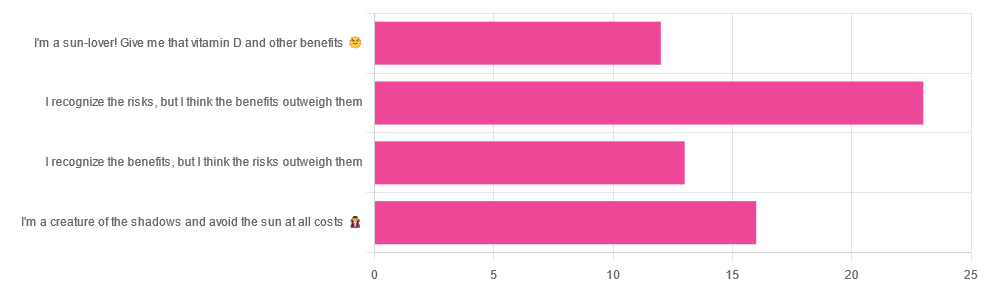
Yesterday, we asked you about your policy on sun exposure, and got the above-pictured, below-described, set of answers:

  • A little over a third of respondents chose “I recognize the risks, but I think the benefits outweigh them”
  • A quarter of respondents chose “I am a creature of the shadows and I avoid the sun at all costs‍”
  • A little over a fifth of respondents chose “I recognize the benefits, but I think the risks outweigh them”
  • A little under a fifth of respondents chose “I’m a sun-lover! Give me that vitamin D and other benefits!”

All in all, this is perhaps the most even spread of answers we’ve had for Friday mythbuster polls—though the sample size was smaller than it often is.

Of those who added comments, common themes were to mention your local climate, and the importance of sunscreen and/or taking vitamin D supplements.

One subscriber mentioned having lupus and living in Florida, which is a particularly unfortunate combination:

Lupus Foundation | Lupus & UV exposure: What you need to know

Another subscriber wrote:

❝Use a very good sunscreen with a high SPF all the time. Reapply after swimming or as needed! I also wear polarized sunglasses anytime I’m outside.❞

…which are important things to note too, and a lot of people forget!

See also: Who Screens The Sunscreens? (on fearing chemical dangers, vs the protection given)

But, onto today’s science for the topic at hand…

We need to get plenty of sun to get plenty of vitamin D: True or False?

True or False, depending on so many factors—to the point that many people get it wildly wrong in either direction.

Whether we are getting enough vitamin D depends on many circumstances, including:

  • The climate (and depending on latitude, time of year) where we live
  • Our genes, and especially (but not only) our skintone
  • The clothes we wear (or don’t)
  • Our diet (and not just “how much vitamin D do we consume”)
  • Chronic diseases that affect vitamin D metabolism and/or requirements and/or sensitivity to the sun

For a rundown on these factors and more, check out:

Should I be getting my vitamin D levels checked?

Notably, on the topic of whether you should stay in the sun for longer to get more vitamin D…

❝The body can only produce a certain amount of vitamin D at the time, so staying in the sun any longer than needed (which could be just a few minutes, in a sunny climate) is not going to help increase your vitamin D levels, while it will increase your risk of skin cancer.❞

Source: Dr. Elina Hypponen, professor of Nutritional Epidemiology, and director of the Australian Centre for Precision Health at the University of South Australia Cancer Research Institute.

In contrast, she does also note:

❝During winter, catching enough sun can be difficult, especially if you spend your days confined indoors. Typically, the required exposure increases to two to three hours per week in winter. This is because sunlight exposure can only help produce vitamin D if the UVB rays reach us at the correct angle. So in winter we should regularly spend time outside in the middle of the day to get our dose of vitamin D.❞

See also: Vitamin D & Calcium: Too Much Of A Good Thing?

We can skip the sun and get our vitamin D from diet/supplements: True or False?

True! However, vitamin D is not the only health benefit of sun exposure.

Not only is sunlight-induced serotonin production important for many things ranging from mood to circadian rhythm (which in turn affects many other aspects of health), but also…

While too much sun can cause skin cancer, too little sun could cause other kinds of cancer:

Benefits of Sunlight: A Bright Spot for Human Health

Additionally, according to new research, the circadian rhythm benefits we mentioned above may also have an impact on type 2 diabetes:

Can catching some rays help you fight off type 2 diabetes?

Which way to jump?

A lot of it depends on who you are, ranging from the factors we mentioned earlier, to even such things as “having many moles” or “having blonde hair”.

This latter item, blonde hair, is a dual thing: it’s a matter of genetic factors that align with being prone to being more sensitive to the sun, as well as being a lesser physical barrier to the sun’s rays than dark hair (that can block some UV rays).

So for example, if two people have comparably gray hair now, but one of them used to have dark hair and the other blonde, there will still be a difference in how they suffer damage, or don’t—and yes, even if their skin is visually of the same approximate skintone.

You probably already know for yourself whether you are more likely to burn or tan in the sun, and the former group are less resistant to the sun’s damage… But the latter group are more likely to spend longer in the sun, and accumulate more damage that way.

If you’d like a very comprehensive downloadable, here are the guidelines issued by the UK’s National Institute for Health and Care Excellence:

NICE Guidelines | Sunlight exposure: risks and benefits

…and skip to “At risk groups”, if you don’t want to read the whole thing; “Skin type” is also an important subsection, which also uses your hair and eye color as indicators.

Writer’s note: genetics are complicated and not everyone will fall neatly into categories, which is why it’s important to know the individual factors.

For example, I am quite light-skinned with slightly graying dark hair and gray-blue eyes, and/but also have an obscure Sámi gene that means my skin makes vitamin D easily, while simultaneously being unusually resistant to burning (I just tan). Basically: built for the midnight sun of the Arctic circle.

And yet! My hobbies include not getting skin cancer, so I tend to still be quite mindful of UV levels in different weathers and times of day, and make choices (schedule, clothing, sunscreen or not) accordingly.

Bottom line:

That big self-perpetuating nuclear explosion in the sky is responsible for many things, good and bad for our health, so be aware of your own risk factors, especially for vitamin D deficiency, and skin cancer.

  • If you have a predisposition to both, that’s unfortunate, but diet and supplementation at least can help with the vitamin D while getting modest amounts of sun at most.
  • Remember that you can only make so much vitamin D at once, so sunbathing for health benefits need only take a few minutes
  • Remember that sunlight is important for our circadian rhythm, which is important for many things.
  • That’s governed by specific photoreceptor cells, though, so we don’t need our skin to be exposed for that; we just need to be able to see sunlight.
  • If you’re going to be out in the sun, and not covered up, sunscreen is your friend, and yes, that goes for clear cold days under the winter sun too.
  • Most phone weather apps these days have a UV index score as part of the data they give. Get used to checking it as often as you’d check for rain.

Stay safe, both ways around!

Don’t Forget…

Did you arrive here from our newsletter? Don’t forget to return to the email to continue learning!
  • 10almonds Subcribers Take The Wheel!
    Did you know that spearmint can reduce testosterone levels? Or that different salts can help with different issues? We cover all that and more in this article.

Learn to Age Gracefully

Join the 98k+ American women taking control of their health & aging with our 100% free (and fun!) daily emails:

  • Black Pepper’s Impressive Anti-Cancer Arsenal

    10almonds is reader-supported. We may, at no cost to you, receive a portion of sales if you purchase a product through a link in this article.

    Black Pepper’s Impressive Anti-Cancer Arsenal (And More)

    Piperine, a compound found in Piper nigrum (black pepper, to its friends), has many health benefits. It’s included as a minor ingredient in some other supplements, because it boosts bioavailability. In its form as a kitchen spice, it’s definitely a superfood.

    What does it do?

    First, three things that generally go together:

    These things often go together for the simple reason that oxidative stress, inflammation, and cancer often go together. In each case, it’s a matter of cellular wear-and-tear, and what can mitigate that.

    For what it’s worth, there’s generally a fourth pillar: anti-aging. This is again for the same reason. That said, black pepper hasn’t (so far as we could find) been studied specifically for its anti-aging properties, so we can’t cite that here as an evidence-based claim.

    Nevertheless, it’s a reasonable inference that something that fights oxidation, inflammation, and cancer, will often also slow aging.

    Special note on the anti-cancer properties

    We noticed two very interesting things while researching piperine’s anti-cancer properties. It’s not just that it reduces cancer risk and slows tumor growth in extant cancers (as we might expect from the above-discussed properties). Let’s spotlight some studies:

    It is selectively cytotoxic (that’s a good thing)

    Piperine was found to be selectively cytotoxic to cancerous cells, while not being cytotoxic to non-cancerous cells. To this end, it’s a very promising cancer-sniper:

    Piperine as a Potential Anti-cancer Agent: A Review on Preclinical Studies

    It can reverse multi-drug resistance in cancer cells

    P-glycoprotein, found in our body, is a drug-transporter that is known for “washing out” chemotherapeutic drugs from cancer cells. To date, no drug has been approved to inhibit P-glycoprotein, but piperine has been found to do the job:

    Targeting P-glycoprotein: Investigation of piperine analogs for overcoming drug resistance in cancer

    What’s this about piperine analogs, though? Basically the researchers found a way to “tweak” piperine to make it even more effective. They called this tweaked version “Pip1”, because calling it by its chemical name,

    ((2E,4E)-5-(benzo[d][1,3]dioxol-5-yl)-1-(6,7-dimethoxy-3,4-dihydroisoquinolin-2(1 H)-yl)penta-2,4-dien-1-one)

    …got a bit unwieldy.

    The upshot is: Pip1 is better, but piperine itself is also good.

    Other benefits

    Piperine does have other benefits too, but the above is what we were most excited to talk about today. Its other benefits include:

    Enjoy!

    Share This Post

  • How To Leverage Attachment Theory In Your Relationship

    10almonds is reader-supported. We may, at no cost to you, receive a portion of sales if you purchase a product through a link in this article.

    How To Leverage Attachment Theory In Your Relationship

    Attachment theory has come to be seen in “kids nowadays”’ TikTok circles as almost a sort of astrology, but that’s not what it was intended for, and there’s really nothing esoteric about it.

    What it can be, is a (fairly simple, but) powerful tool to understand about our relationships with each other.

    To demystify it, let’s start with a little history…

    Attachment theory was conceived by developmental psychologist Mary Ainsworth, and popularized as a theory bypsychiatrist John Bowlby. The two would later become research partners.

    • Dr. Ainsworth’s initial work focused on children having different attachment styles when it came to their caregivers: secure, avoidant, or anxious.
    • Later, she would add a fourth attachment style: disorganized, and then subdivisions, such as anxious-avoidant and dismissive-avoidant.
    • Much later, the theory would be extended to attachments in (and between) adults.

    What does it all mean?

    To understand this, we must first talk about “The Strange Situation”.

    “The Strange Situation” was an experiment conducted by Dr. Ainsworth, in which a child would be observed playing, while caregivers and strangers would periodically arrive and leave, recreating a natural environment of most children’s lives. Each child’s different reactions were recorded, especially noting:

    • The child’s reaction (if any) to their caregiver’s departure
    • The child’s reaction (if any) to the stranger’s presence
    • The child’s reaction (if any) to their caregiver’s return
    • The child’s behavior on play, specifically, how much or little the child explored and played with new toys

    She observed different attachment styles, including:

    1. Secure: a securely attached child would play freely, using the caregiver as a secure base from which to explore. Will engage with the stranger when the caregiver is also present. May become upset when the caregiver leaves, and happy when they return.
    2. Avoidant: an avoidantly attached child will not explore much regardless of who is there; will not care much when the caregiver departs or returns.
    3. Anxious: an anxiously attached child may be clingy before separation, helplessly passive when the caregiver is absent, and difficult to comfort upon the caregiver’s return.
    4. Disorganized: a disorganizedly attached child may flit between the above types

    These attachment styles were generally reflective of the parenting styles of the respective caregivers:

    1. If a caregiver was reliably present (physically and emotionally), the child would learn to expect that and feel secure about it.
    2. If a caregiver was absent a lot (physically and/or emotionally), the child would learn to give up on expecting a caregiver to give care.
    3. If a caregiver was unpredictable a lot in presence (physical and/or emotional), the child would become anxious and/or confused about whether the caregiver would give care.

    What does this mean for us as adults?

    As we learn when we are children, tends to go for us in life. We can change, but we usually don’t. And while we (usually) no longer rely on caregivers per se as adults, we do rely (or not!) on our partners, friends, and so forth. Let’s look at it in terms of partners:

    1. A securely attached adult will trust that their partner loves them and will be there for them if necessary. They may miss their partner when absent, but won’t be anxious about it and will look forward to their return.
    2. An avoidantly attached adult will not assume their partner’s love, and will feel their partner might let them down at any time. To protect themself, they may try to manage their own expectations, and strive always to keep their independence, to make sure that if the worst happens, they’ll still be ok by themself.
    3. An anxiously attached adult will tend towards clinginess, and try to keep their partner’s attention and commitment by any means necessary.

    Which means…

    • When both partners have secure attachment styles, most things go swimmingly, and indeed, securely attached partners most often end up with each other.
    • A very common pairing, however, is one anxious partner dating one avoidant partner. This happens because the avoidant partner looks like a tower of strength, which the anxious partner needs. The anxious partner’s clinginess can also help the avoidant partner feel better about themself (bearing in mind, the avoidant partner almost certainly grew up feeling deeply unwanted).
    • Anxious-anxious pairings happen less because anxiously attached people don’t tend to be attracted to people who are in the same boat.
    • Avoidant-avoidant pairings happen least of all, because avoidantly attached people having nothing to bind them together. Iff they even get together in the first place, then later when trouble hits, one will propose breaking up, and the other will say “ok, bye”.

    This is fascinating, but is there a practical use for this knowledge?

    Yes! Understanding our own attachment styles, and those around us, helps us understand why we/they act a certain way, and realize what relational need is or isn’t being met, and react accordingly.

    That sometimes, an anxiously attached person just needs some reassurance:

    • “I love you”
    • “I miss you”
    • “I look forward to seeing you later”

    That sometimes, an avoidantly attached person needs exactly the right amount of space:

    • Give them too little space, and they will feel their independence slipping, and yearn to break free
    • Give them too much space, and oops, they’re gone now

    Maybe you’re reading that and thinking “won’t that make their anxious partner anxious?” and yes, yes it will. That’s why the avoidant partner needs to skip back up and remember to do the reassurance.

    It helps also when either partner is going to be away (physically or emotionally! This counts the same for if a partner will just be preoccupied for a while), that they parameter that, for example:

    • Not: “Don’t worry, I just need some space for now, that’s all” (à la “I am just going outside and may be some time“)
    • But: “I need to be undisturbed for a bit, but let’s schedule some me-and-you-time for [specific scheduled time]”.

    Want to learn more about addressing attachment issues?

    Psychology Today: Ten Ways to Heal Your Attachment Issues

    You also might enjoy such articles such as:

    Lastly, to end on a light note…

    Share This Post

  • Behavioral Activation Against Depression & Anxiety

    10almonds is reader-supported. We may, at no cost to you, receive a portion of sales if you purchase a product through a link in this article.

    Behavioral Activation Against Depression & Anxiety

    Psychologists do love making fancy new names for things.

    You thought you were merely “eating your breakfast”, but now it’s “Happiness-Oriented Basic Behavioral Intervention Therapy (HOBBIT)” or something.

    This one’s quite simple, so we’ll keep it short for today, but it is one more tool for your toolbox:

    What is Behavioral Activation?

    Behavioral Activation is about improving our mood (something we can’t directly choose) by changing our behavior (something we usually can directly choose).

    An oversimplified (and insufficient, as we will explain, but we’ll use this one to get us started) example would be “whistle a happy tune and you will be happy”.

    Behavioral Activation is not a silver bullet

    Or if it is, then it’s the kind you have to keep shooting, because one shot is not enough. However, this becomes easier than you might think, because Behavioral Activation works by…

    Creating a Positive Feedback Loop

    A lot of internal problems in depression and anxiety are created by the fact that necessary and otherwise desirable activities are being written off by the brain as:

    • Pointless (depression)
    • Dangerous (anxiety)

    The inaction that results from these aversions creates a negative feedback loop as one’s life gradually declines (as does one’s energy, and interest in life), or as the outside world seems more and more unwelcoming/scary.

    Instead, Behavioral Activation plans activities (usually with the help of a therapist, as depressed/anxious people are not the most inclined to plan activities) that will be:

    • attainable
    • rewarding

    The first part is important, because the maximum of what is “attainable” to a depressed/anxious person can often be quite a small thing. So, small goals are ideal at first.

    The second part is important, because there needs to be some way of jump-starting a healthier dopamine cycle. It also has to feel rewarding during/after doing it, not next year, so short term plans are ideal at first.

    So, what behavior should we do?

    That depends on you. Behavioral Activation calls for keeping track of our activities (bullet-journaling is fine, and there are apps* that can help you, too) and corresponding moods.

    *This writer uses the pragmatic Daylio for its nice statistical analyses of bullet-journaling data-points, and the very cute Finch for more keyword-oriented insights and suggestions. Whatever works for you, works for you, though! It could even be paper and pen.

    Sometimes the very thought of an activity fills us with dread, but the actual execution of it brings us relief. Bullet-journaling can track that sort of thing, and inform decisions about “what we should do” going forwards.

    Want a ready-made brainstorm to jump-start your creativity?

    Here’s list of activities suggested by TherapistAid (a resource hub for therapists)

    Want to know more?

    You might like:

    Take care!

    Share This Post

  • How Olives Can Help Protect Your Brain

    10almonds is reader-supported. We may, at no cost to you, receive a portion of sales if you purchase a product through a link in this article.

    Olives boast a special molecule that’s neuroprotective in several ways, as well as being structurally identical to dopamine metabolite:

    Introducing hydroxytyrosol

    Things that start with “hydroxy-” and/or end in “-ol” are often not astonishingly healthy, but this one is!

    It’s approved as safe by the FDA, EFSA, and the AESAN at typical dietary levels of up to about 51 mg per day.

    Hydroxytyrosol (HXT) is a phenolic compound (polyphenol, specifically a simple phenolic alcohol belonging to the family of secoiridoid-derived polyphenols found in olives and olive oil. It’s one of the key antioxidant compounds responsible for many of the health benefits associated with extra virgin olive oil.

    As for its established benefits: it’s antioxidant, anti-inflammatory, anti-cancer, anti-diabetic, antimicrobial, cardio-protective, neuroprotective, cognition-enhancing, and immune-modulatory.

    Most recently, a research team from Spain (Dr. Lorena Martínez-Zamora et al.), investigated specifically its neurovascular and neuroimmune effects, in other words, how it relates to the health of the brain’s blood vessels, and the brain’s clean-up crew.

    What they found:

    ❝HXT protects endothelial and neural cells by lowering oxidative stress, maintaining nitric oxide availability, stabilizing the blood-brain barrier, and improving neural connectivity. A key pathway is Keap1-Nrf2-ARE activation, which boosts mitochondrial antioxidant defences and limits oxidative DNA and protein damage. HXT also dampens brain inflammation by reducing microglial cytokine release and suppressing NF-κB/MAPK and NLRP3 inflammasome signalling—mechanisms implicated in Parkinson’s disease.❞

    Translating from sciencese:

    The cited human trials link HXT or HXT-rich olive oils to better vascular function, reduced inflammation, and improved cerebral blood flow. That’s correlation, though. In terms of causality, what’s been established is that daily intakes around 7–15 mg improve endothelial cell health, while single doses of 30–60 mg improve protection against free radicals.

    Furthermore, HXT-rich olive extracts have been shown to improve memory, psychomotor speed, and attention–memory coupling in older adults, and supported mitochondrial health.

    And where it mentioned Parkinson’s disease, that bit is because HXT is structurally identical to the dopamine metabolite DOPET, and thus helps regulate healthy dopamine levels.

    You can read about this in full, here: Novel Ingredients: Hydroxytyrosol as a Neuroprotective Agent; What Is New on the Horizon?

    Protection against stroke?

    This is the part that’s not yet proven, but looks very promising.

    Hydroxytyrosol might help protect against stroke, due to how it protects the brain’s blood vessels, most notably:

    • Boosting the body’s natural antioxidant defences through the aforementioned Nrf2 pathway, helping arteries stay flexible and resilient under stress
    • Keeping blood vessels healthy by preserving nitric oxide, which is vital for supporting healthy blood flow, and prevents the buildup of damaging plaque
    • Dialing down overactive immune responses in blood vessel walls, reducing the slow-burning inflammation that often leads to stroke

    In fewer words: hydroxytyrosol acts like a molecular shield—keeping the brain’s circulation strong, stable, and better protected against both blockages and bleeds.

    For how all this ties together, see also the closely related: What’s Your Vascular Dementia Risk? ← includes actual numbers and a risk calculator tool and things like that

    Want to learn more?

    Check out:

    Enjoy!

    Don’t Forget…

    Did you arrive here from our newsletter? Don’t forget to return to the email to continue learning!

    Learn to Age Gracefully

    Join the 98k+ American women taking control of their health & aging with our 100% free (and fun!) daily emails:

  • How Metformin Slows Aging

    10almonds is reader-supported. We may, at no cost to you, receive a portion of sales if you purchase a product through a link in this article.

    Metformin And How It Slows Down Aging

    That’s a bold claim for a title, but the scientific consensus is clear, and this Research Review Monday we’re going to take a look at exactly that!

    Metformin is a common diabetes-management drug, used to lower blood sugar levels in people who either don’t have enough insulin or the insulin isn’t being recognized well enough by the body.

    However, it also slows aging, which is a quality it’s also been studied for for more than a decade. We’ll look at some of the more recent research, though. Let’s kick off with an initial broad statement, from the paper “The Use of Metformin to Increase the Human Healthspan”, as part of the “Advances in Experimental Medicine and Biology” series:

    In recent years, more attention has been paid to the possibility of using metformin as an anti-aging drug. It was shown to significantly increase the lifespan in some model organisms and delay the onset of age-associated declines. Growing amounts of evidence from clinical trials suggest that metformin can effectively reduce the risk of many age-related diseases and conditions, including cardiometabolic disorders, neurodegeneration, chronic inflammation and frailty.

    ~ Piskovatska et al, 2020

    How does it work?

    That’s still being studied, but the scientific consensus is that it works by inducing hormesis—the process by which minor stress signals cells to start repairing themselves. How does it induce that hormesis? Again, still being studied, but it appears to do it by activating a specific enzyme; namely, the AMP-activated protein kinase:

    Read: Metformin-enhances resilience via hormesis

    It also has been found to slow aging by means of an anti-inflammatory effect, as a bonus!

    Any bad news?

    Well, firstly, in most places it’s only prescribed for diabetes management, not for healthy life extension. A lot of anti-aging enthusiasts have turned to the grey market online to get it, and we can’t recommend that.

    Secondly, it does have some limitations:

    • Its bioavailability isn’t great in tablet form (the form in which it is most commonly given)
    • It has quite a short elimination half-life (around 6 hours), which makes it great to fix transient hyperglycemia in diabetics—job done and it’s out—but presents a logistical challenge when it comes to something so pernicious as aging.
    • Some people are non-responders (a non-responder, in medicine, is someone for whom a drug simply doesn’t work, for no obvious reason)

    Want to know more? Check out:

    Metformin in aging and aging-related diseases: clinical applications and relevant mechanism

    Don’t Forget…

    Did you arrive here from our newsletter? Don’t forget to return to the email to continue learning!

    Learn to Age Gracefully

    Join the 98k+ American women taking control of their health & aging with our 100% free (and fun!) daily emails:

  • Peach vs Papaya – Which is Healthier?

    10almonds is reader-supported. We may, at no cost to you, receive a portion of sales if you purchase a product through a link in this article.

    Our Verdict

    When comparing peach to papaya, we picked the peach.

    Why?

    It was close!

    In terms of macros, there’s not much between them; they are close to identical on protein, carbs, and fiber. Technically peach has slightly more protein (+0.4g/100g) and papaya has slightly more carbs and fiber (+1.28g/100g carbs, +0.2g/100g fiber), but since the differences are so tiny, we’re calling this section a tie—bearing in mind, these numbers are based on averages, which means that when they’re very close, they’re meaningless—one could easily, for example, pick up a peach that has more fiber than a papaya, because that 0.2g/100g is well within the margin of variation. So, as we say: a tie.

    When it comes to vitamins, things are also close; peaches have more of vitamins B1, B2, B3, and E, while papaya has more of vitamins A, B6, B9, and C. This is a 4:4 tie, but since the most notable margin of difference is vitamin C (of which papayas have 9x more) while the others are much closer, we’ll call this a tie-breaker win for papaya.

    The category of minerals sets things apart more: peaches have more copper, iron, manganese, phosphorus, potassium, and zinc, while papaya has more calcium, magnesium, and selenium. That’s already a 6:3 win for peaches, before we take into account that the numbers for papaya’s calcium and selenium are tiny, so adding this to the already 6:3 win for peaches makes for a clear and easy win for peaches in this category.

    Adding up the sections is 1W/1D/1L for both fruits, but looking at the win/loss for each, it’s clear which won/lost on a tiebreaker, and which won/lost by a large margin, so peaches get the victory here.

    Of course, enjoy either or both, though! And see below for a bonus feature of peaches:

    Want to learn more?

    You might like to read:

    Top 8 Fruits That Prevent & Kill Cancer ← peaches are high on this list! They kill cancer cells while sparing healthy ones 🙂

    Take care!

    Don’t Forget…

    Did you arrive here from our newsletter? Don’t forget to return to the email to continue learning!

    Learn to Age Gracefully

    Join the 98k+ American women taking control of their health & aging with our 100% free (and fun!) daily emails: