Looking to warm up with a sauna this winter? Here are 5 tips to enjoy it safely

10almonds is reader-supported. We may, at no cost to you, receive a portion of sales if you purchase a product through a link in this article.

Sauna bathing is booming in Australia. Once considered a luxury experience or only a Nordic tradition, saunas are now part of the everyday for many Australians. They’re commonly found in gyms, hotels, leisure centres, and even in homes.

A traditional Finnish sauna is usually a wooden room heated to between 70°C and 100°C. People sit or lie inside to expose their bodies to high temperatures, typically in very low humidity. This dry heat helps prevent scalding. Sessions usually last 10–20 minutes, often with breaks in between to cool down.

Many people use saunas to relax, improve their sleep, and for supposed health benefits often promoted on social media.

People also go to saunas as a social experience.

But what does the science say about the health benefits of sauna bathing? And are there any risks?
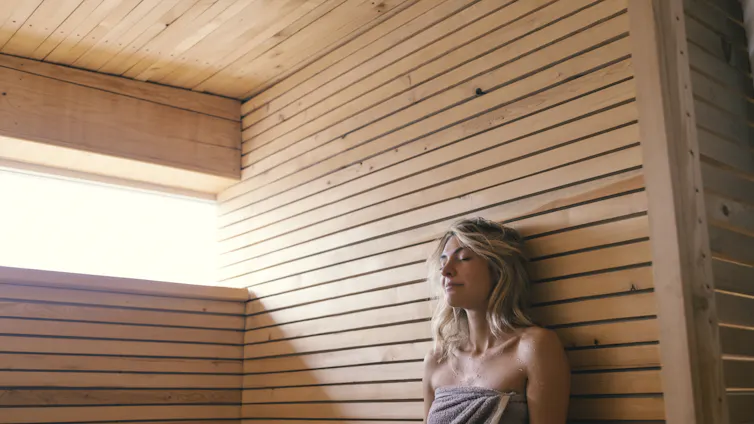
FreshSplash/Getty Images

What the evidence tells us

Saunas have been used for centuries, particularly in Finland. Now, research is beginning to confirm many of the health benefits that have long been touted.

Heart and blood pressure

When you’re in a sauna, your body reacts to the heat by increasing your heart rate and widening blood vessels near the skin surface. This process, called vasodilation, helps move warm blood to the skin so heat can escape.

As a result, the heart works harder – similar to light or moderate exercise – and blood pressure often drops slightly. Over time, sauna bathing can lead to healthier blood vessels and lower blood pressure.

A long-term study of more than 2,000 Finnish men found those who used a sauna four to seven times a week were 50% less likely to die from cardiovascular disease (such as heart attack or stroke) compared to those who only went once a week.

Lungs and immunity

The warm air in saunas may also be good for your respiratory system. Regular sauna use can help open your airways, loosen mucus, and make it easier to breathe, especially if you have asthma or chronic bronchitis.

Some studies suggest regular sauna bathing might also reduce the incidence of common colds. It’s not exactly clear how this could work, but it appears heat exposure may enhance our immune response, for example through a short-term increase in white blood cell production.

Aches and pains

The heat from a sauna helps to relax muscles and ease joint stiffness. It may also trigger the release of endorphins, the body’s natural painkillers.

This is likely why people with conditions such as arthritis and fibromyalgia often report feeling better after a sauna session.

Sleep and mood

Many people find saunas relaxing. What’s more, after a sauna, your body cools down. This drop in core temperature can help signal to the body that it’s ready for sleep. Some research has shown regular sauna use is linked to better sleep quality.

The heat may also boost mood by increasing levels of endorphins and other feel-good brain chemicals. Some studies suggest regular sauna use could help people with depression.

But there can be risks

Saunas are generally safe, but they’re not completely risk-free.

The most common issues people experience with sauna use include dizziness, fainting or nausea. These problems can be related to a sudden drop in blood pressure, and are more likely if people stay in too long or become dehydrated.

Falling asleep in a sauna can be particularly dangerous. If you lose track of time or nod off, your body temperature can climb too high, which increases the risk of heat stroke or even death.

Alcohol and drug use increase the risk of fainting, falling asleep, or not noticing signs of overheating.

In rare cases, saunas have been linked to sudden cardiac deaths. This usually occurs in people with pre-existing heart disease, especially if they were alone or intoxicated.

Who is most at risk?

Young children are at higher risk of adverse effects from sauna use as their bodies have yet to develop capacity to regulate heat as well as adults.

People with heart conditions, low blood pressure or abnormal heart rhythms may be at greater risk as well.

Some medications people with heart disease or low blood pressure take, such as diuretics or beta blockers, can make them more vulnerable by interfering with the body’s ability to manage fluid loss or heat.

5 tips for safer sauna use

1. Start slow: begin with short sessions, 5–10 minutes, and be aware of the temperature. As your body adapts, you can extend session length and tolerate higher temperatures

2. Stay hydrated: drink water before, during, and after. Avoid alcohol or heavy meals before your session

3. Cool down periodically: switch to a cool shower, bath or room between bouts of sauna use to allow your body to tolerate more total exposure

4. Listen to your body: leave if you feel dizzy, nauseated or experience tightness in your chest. Rest somewhere cool until you feel normal again and seek help if you don’t feel better after a short rest

5. Talk to your doctor: if you have heart disease, low blood pressure, diabetes, are pregnant or on medication, and get medical clearance before trying a sauna.

First-time users should take extra care and ease into sauna use gradually. The hotter the sauna and the longer the session, the more stress it puts on your body. Always adjust based on your health, experience, and how you feel at the time.

Saunas can be enjoyable and offer real health benefits. But there are risks if you push past your body’s limits.

Samuel Cornell, PhD Candidate in Public Health & Community Medicine, School of Population Health, UNSW Sydney and Jem Cheng, Postdoctoral Research Associate in the Thermal Ergonomics Laboratory, Faculty of Medicine and Health, University of Sydney

This article is republished from The Conversation under a Creative Commons license. Read the original article.

Don’t Forget…

Did you arrive here from our newsletter? Don’t forget to return to the email to continue learning!

Learn to Age Gracefully

Join the 98k+ American women taking control of their health & aging with our 100% free (and fun!) daily emails:

  • Resistance Is Useful! (Especially As We Get Older)

    10almonds is reader-supported. We may, at no cost to you, receive a portion of sales if you purchase a product through a link in this article.

    Resistance Is Useful!

    At 10almonds we talk a lot about the importance of regular moderate exercise (e.g. walking, gardening, housework, etc), and with good reason: getting in those minutes (at least 150 minutes per week, so, a little over 20 minutes per day, or 25 minutes per day with one day off) is the exericise most consistently linked to better general health outcomes and reduced mortality risk.

    We also often come back to mobility, because at the end of the day, being able to reach for something from a kitchen cabinet without doing oneself an injury is generally more important in life than being able to leg-press a car.

    Today though, we’re going to talk about resistance training.

    What is resistance training?

    It can be weight-lifting, or it can be bodyweight exercises. In those cases, what you’re resisting is gravity. It can also be exercises with resistance bands or machines. In all cases, it’s about building and/or maintaining strength.

    Why does it matter?

    Let’s say you’re not an athlete, soldier, or laborer, and the heaviest thing you have to pick up is a bag of groceries. Strength still matters, for two main reasons:

    • Muscle strength correlates to bone strength. You can’t build (or maintain) strong muscles on weak bones, so if you take care of your muscles, then your body will keep your bones strong too.
      • That’s assuming you have a good diet as well—but today’s not about that. If you’d like to know more about eating for bone health though, do check out this previous article about that!
    • Muscle strength correlates to balance and stability. You can’t keep yourself from falling over if you are physically frail.

    Both of those things matter, because falls and fractures often have terrible health outcomes (e.g., slower recovery and more complications) the older we get. So, we want to:

    • Ideally, not fall in the first place
    • If we do fall, have robust bones

    See also: Effects of Resistance Exercise on Bone Health

    How much should we do?

    Let’s go to the Journal of Strength and Conditioning Research on this one:

    ❝There is strong evidence to support the benefits of resistance exercise for countering many age-related processes of sarcopenia, muscle weakness, mobility loss, chronic disease, disability, and even premature mortality.

    In addition, this Position Statement provides specific evidence-based practice recommendations to aid in the implementation of resistance exercise programs for healthy older adults and those with special considerations.

    While there are instances where low-intensity, low-volume programs are appropriate (i.e., beginning programs for individuals with frailty or CVDs), the greatest benefits are possible with progression to moderate to higher intensity programs.❞

    ~ Fragala et al

    Read the statement in full:

    Resistance Training for Older Adults: Position Statement From the National Strength and Conditioning Association

    There’s a lot of science there and it’s well worth reading if you have the time. It’s particularly good at delineating how much is not enough vs how much is too much, and the extent to which we should (or shouldn’t) train to exhaustion.

    If you don’t fancy that, though, and/or just want to start with something accessible and work your way up, the below is a very good (and also evidence-based) start-up plan:

    Healthline’s Exercise Plan For Seniors—For Strength, Balance, & Flexibility

    (it has a weekly planner, step-by-step guides to the exercises, and very clear illustrative animations of each)

    Share This Post

  • The Web That Has No Weaver – by Ted Kaptchuk

    10almonds is reader-supported. We may, at no cost to you, receive a portion of sales if you purchase a product through a link in this article.

    At 10almonds we have a strong “stick with the science” policy, and that means peer-reviewed studies and (where such exists) scientific consensus.

    However, in the spirit of open-minded skepticism (i.e., acknowledging what we don’t necessarily know), it can be worth looking at alternatives to popular Western medicine. Indeed, many things have made their way from Traditional Chinese Medicine (or Ayurveda, or other systems) into Western medicine in any case.

    “The Web That Has No Weaver” sounds like quite a mystical title, but the content is presented in the cold light of day, with constant “in Western terms, this works by…” notes.

    The author walks a fine line of on the one hand, looking at where TCM and Western medicine may start and end up at the same place, by a different route; and on the other hand, noting that (in a very Daoist fashion), the route is where TCM places more of the focus, in contrast to Western medicine’s focus on the start and end.

    He makes the case for TCM being more holistic, and it is, though Western medicine has been catching up in this regard since this book’s publication more than 20 years ago.

    The style of the writing is very easy to follow, and is not esoteric in either mysticism or scientific jargon. There are diagrams and other illustrations, for ease of comprehension, and chapter endnotes make sure we didn’t miss important things.

    Bottom line: if you’re curious about Traditional Chinese Medicine, this book is the US’s most popular introduction to such, and as such, is quite a seminal text.

    Click here to check out The Web That Has No Weaver, and enjoy learning about something new!

    Share This Post

  • Lime-Charred Cauliflower Popcorn

    10almonds is reader-supported. We may, at no cost to you, receive a portion of sales if you purchase a product through a link in this article.

    Called “popcorn” for its appearance and tasty-snackness, this one otherwise bears little relation to the usual movie theater snack, and it’s both tastier and healthier. All that said, it can be eaten on its own as a snack (even with a movie, if you so wish), or served as one part of a many-dish banquet, or (this writer’s favorite) as a delicious appetizer that also puts down a healthy bed of fiber ready for the main course to follow it.

    You will need

    • 1 cauliflower, cut into small (popcorn-sized) florets
    • 2 tbsp extra virgin olive oil
    • 1 tbsp lime pickle
    • 1 tsp cumin seeds
    • 1 tsp smoked paprika
    • 1 tsp chili flakes
    • 1 tsp black pepper, coarse ground
    • ½ tsp ground turmeric

    Method

    (we suggest you read everything at least once before doing anything)

    1) Preheat your oven as hot as it will go

    2) Mix all the ingredients in a small bowl except the cauliflower, to form a marinade

    3) Drizzle the marinade over the cauliflower in a larger bowl (i.e. big enough for the cauliflower), and mix well until the cauliflower is entirely, or at least almost entirely, coated. Yes, it’s not a lot of marinade but unless you picked a truly huge cauliflower, the proportions we gave will be enough, and you want the end result to be crisp, not dripping.

    4) Spread the marinaded cauliflower florets out on a baking tray lined with baking paper. Put it in the oven on the middle shelf, so it doesn’t cook unevenly, but keeping the temperature as high as it goes.

    5) When it is charred and crispy golden, it’s done—this should take about 20 minutes, but we’ll say ±5 minutes depending on your oven, so do check on it periodically—and time to serve (it is best enjoyed warm).

    Enjoy!

    Want to learn more?

    For those interested in some of the science of what we have going on today:

    Take care!

    Share This Post

  • Bell Pepper vs Sweetcorn – Which is Healthier?

    10almonds is reader-supported. We may, at no cost to you, receive a portion of sales if you purchase a product through a link in this article.

    Our Verdict

    When comparing bell pepper to sweetcorn, we picked the corn.

    Why?

    If you’re thinking “but wait, which color bell pepper, don’t they have different nutritional properties?” then firstly, well-remembered, and secondly, it doesn’t matter in this case. The main things that it affects are vitamins A and C and various polyphenols, and even the weakest bell pepper for them wins on both of those vitamins (while the strongest bell peppers for them still lose on vitamins in total) and even the strongest bell pepper for them loses on polyphenols, so the results go the same with any color.

    In terms of macros, the corn has more carbs, protein, and fiber; however, both are low in glycemic index, so we’ll go with the “more food per food” option, the corn.

    In the category of vitamins, even green bell peppers (the least well-endowed) have more of vitamins A, B6, C, E, and K, while sweetcorn has more of vitamins B1, B2, B3, B5, B9, and choline, compared to even yellow or red bell peppers (which are the best peppers for vitamins). So, a moderate win for the corn.

    When it comes to minerals, bell peppers have more calcium and copper, while sweetcorn has more iron, magnesium, manganese, phosphorus, potassium, selenium, and zinc. An easy win for sweetcorn.

    Adding up the sections makes for a clear overall win for sweetcorn, but by all means enjoy either or both, as diversity is best!

    Want to learn more?

    You might like to read:

    Take care!

    Don’t Forget…

    Did you arrive here from our newsletter? Don’t forget to return to the email to continue learning!

    Learn to Age Gracefully

    Join the 98k+ American women taking control of their health & aging with our 100% free (and fun!) daily emails:

  • What Macronutrient Balance Is Right For You?

    10almonds is reader-supported. We may, at no cost to you, receive a portion of sales if you purchase a product through a link in this article.

    It’s Q&A Day at 10almonds!

    Have a question or a request? We love to hear from you!

    In cases where we’ve already covered something, we might link to what we wrote before, but will always be happy to revisit any of our topics again in the future too—there’s always more to say!

    As ever: if the question/request can be answered briefly, we’ll do it here in our Q&A Thursday edition. If not, we’ll make a main feature of it shortly afterwards!

    So, no question/request too big or small 😎

    ❝I want to learn more about macros. Can you cover that topic?❞

    That’s a little broader than we usually go for, given the amount of space we have, but let’s give it a go!

    Macronutrients, or “macros”, are the nutrients that we typically measure in grams rather than milligrams or micrograms, and are:

    In terms of how much we need of each, you can read more in the above-linked articles, but:

    • General scientific consensus is we need plenty of fiber (30 or 40g per day is good) and water (highly dependent on climate and activity), and there’s a clear minimum requisite for protein (usually put at around 1g of protein per day per 1kg of body weight).
    • There is vigorous debate in the general health community about what the best ratio of carbs to fat is.

    The reality is that humans are quite an adaptable species, and while we absolutely do need at least some of both (carbohydrates and fats), we can play around with the ratios quite a bit, provided we don’t get too extreme about it.

    While some influence is social and often centered around weight loss (see for example keto which seeks to minimize carbs, and volumetrics, which seeks maximise volume-to-calorie ratio, which de facto tends to minimize fats), some of what drives us to lean one way or the other will be genetics, too—dependent on what our ancestors ate more or less of.

    Writer’s example: my ancestors could not grow much grain (or crops in general) where they were, so they got more energy from such foods as whale and seal fat (with protein coming more from reindeer). Now, biology is not destiny, and I personally enjoy a vegan diet complete with a lot of lentils and beans, but my genes are probably why I am driven to get a lot of my daily calories from fat (of which, a lot of fatty nuts (don’t tell almonds, but I prefer walnuts and cashews) and healthy oils such as olive oil, avocado oil, and coconut oil).

    However! About that adaptability. Provided we make changes slowly, we can usually adjust our diet to whatever we want it to be, including whether we get our energy more from carbs or fats. The reason we need to make changes slowly is because our gut needs time to adjust. For example, if your vegan writer here were to eat her ancestrally-favored foods now, I’d be very ill, because my gut microbiome has no idea what to do with animal products anymore, no matter what genes I have. In contrast, if an enthusiastic enjoyer of a meat-heavy diet were to switch to my fiber-rich diet overnight, they’d be very ill.

    So: follow your natural inclinations, make any desired changes slowly, and if in doubt, it’s hard to go wrong with enjoying carbs and fats in moderation.

    Learn more: Intuitive Eating Might Not Be What You Think

    Take care!

    Don’t Forget…

    Did you arrive here from our newsletter? Don’t forget to return to the email to continue learning!

    Learn to Age Gracefully

    Join the 98k+ American women taking control of their health & aging with our 100% free (and fun!) daily emails:

  • Eating Disorders: More Varied (And Prevalent) Than People Think

    10almonds is reader-supported. We may, at no cost to you, receive a portion of sales if you purchase a product through a link in this article.

    Disordered Eating Beyond The Stereotypes

    Around 10% of Americans* have (or have had) an eating disorder. That might not seem like a high percentage, but that’s one in ten; do you know 10 people? If so, it might be a topic that’s near to you.

    *Source: Social and economic cost of eating disorders in the United States of Americ

    Our hope is that even if you yourself have never had such a problem in your life, today’s article will help arm you with knowledge. You never know who in your life might need your support.

    Very misunderstood

    Eating disorders are so widely misunderstood in so many ways that we nearly made this a Friday Mythbusting edition—but we preface those with a poll that we hope to be at least somewhat polarizing or provide a spectrum of belief. In this case, meanwhile, there’s a whole cluster of myths that cannot be summed up in one question. So, here we are doing a Psychology Sunday edition instead.

    “Eating disorders aren’t that important”

    Eating disorders are the second most deadly category of mental illness, second only to opioid addiction.

    Anorexia specifically has the highest case mortality rate of any mental illness:

    Source: National Association of Anorexia Nervosa & Associated Disorders: Eating Disorder Statistics

    So please, if someone needs help with an eating disorder (including if it’s you), help them.

    “Eating disorders are for angsty rebellious teens”

    While there’s often an element of “this is the one thing I can control” to some eating disorders (including anorexia and bulimia), eating disorders very often present in early middle-age, very often amongst busy career-driven individuals using it as a coping mechanism to have a feeling of control in their hectic lives.

    13% of women over 50 report current core eating disorder symptoms, and that is probably underreported.

    Source: as above; scroll to near the bottom!

    “Eating disorders are a female thing”

    Nope. Officially, men represent around 25% of people diagnosed with eating disorders, but women are 5x more likely to get diagnosed, so you can do the math there. Women are also 1.5% more likely to receive treatment for it.

    By the time men do get diagnosed, they’ve often done a lot more damage to their bodies because they, as well as other people, have overlooked the possibility of their eating being disordered, due to the stereotype of it being a female thing.

    Source: as above again!

    “Eating disorders are about body image”

    They can be, but that’s far from the only kind!

    Some can be about control of diet, not just for the sake of controlling one’s body, but purely for the sake of controlling the diet itself.

    Still yet others can be not about body image or control, like “Avoidant/Restrictive Food Intake Disorder”, which in lay terms sometimes gets dismissed as “being a picky eater” or simply “losing one’s appetite”, but can be serious.

    For example, a common presentation of the latter might be a person who is racked with guilt and/or anxiety, and simply stops eating, because either they don’t feel they deserve it, or “how can I eat at a time like this, when…?” but the time is an ongoing thing so their impromptu fast is too.

    Still yet even more others might be about trying to regulate emotions by (in essence) self-medicating with food—not in the healthy “so eat some fruit and veg and nuts etc” sense, but in the “Binge-Eating Disorder” sense.

    And that latter accounts for a lot of adults.

    You can read more about these things here:

    Psychology Today | Types of Eating Disorder ← it’s pop-science, but it’s a good overview

    Take care! And if you have, or think you might have, an eating disorder, know that there are organizations that can and will offer help/support in a non-judgmental fashion. Here’s the ANAD’s eating disorder help resource page, for example.

    Don’t Forget…

    Did you arrive here from our newsletter? Don’t forget to return to the email to continue learning!

    Learn to Age Gracefully

    Join the 98k+ American women taking control of their health & aging with our 100% free (and fun!) daily emails: