Deprecated: explode(): Passing null to parameter #2 ($string) of type string is deprecated in /home/10almonds/public_html/wp-includes/class-wp-duotone.php on line 1194

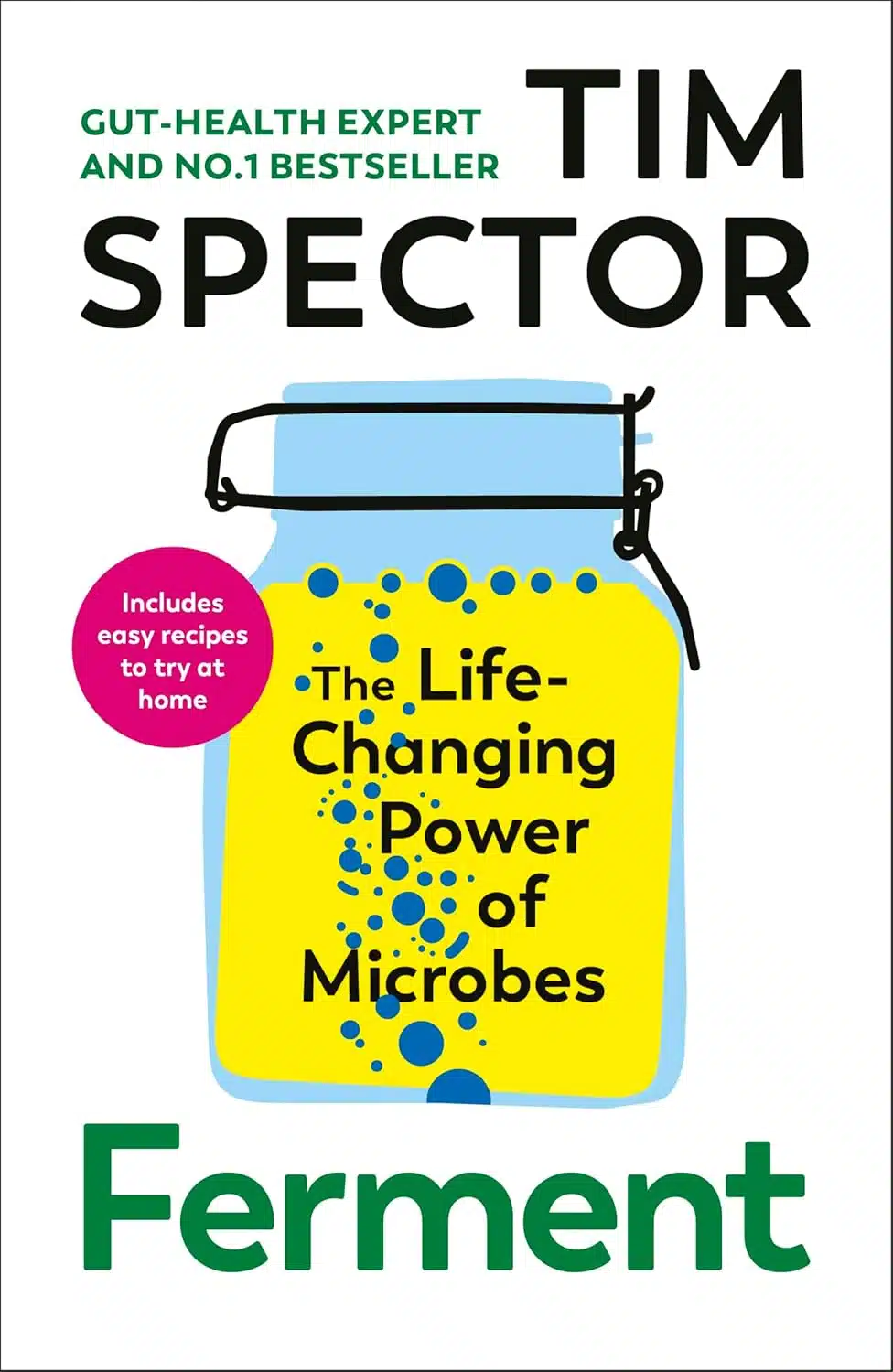
Ferment: The Life-Changing Power of Microbes – by Dr. Tim Spector

10almonds is reader-supported. We may, at no cost to you, receive a portion of sales if you purchase a product through a link in this article.

You probably know that the gut microbiome is key to a lot of aspects of health.

Dr. Tim Spector, most well-known for the huge ZOE epigenetic study which covered, amongst other things, the effect of diet on the gut microbiome, and the effect of the gut microbiome on health, explains here about the process of fermentation. But…

Unlike the usual “and then the product is fermented and ready to consume” usual end-point of such description, Dr. Spector also covers what happens in the mouth, stomach, small intestine, large intestine.

Which is important, because all of these environments have very different conditions in terms of pH, temperature, and pre-existing microbiome (which latter will partially dictate how friendly or not the environment is to any given new arrivals, on a per-species basis).

For example…

  • If you take unprotected microbes (say, in kombucha) then most will die in the stomach acid and certainly not make it to the gut. Some may make it through though, and whether they then survive and flourish in the gut becomes a numbers game.
  • Semi-protected microbes (say, in kimchi, where many may have made for themselves a home inside a piece of fermented vegetable, that allows for some temporary protection from the stomach acid, and save them long enough to get into the gut) will fare better.
  • Specialist probiotics in nice safe capsules designed to release only in the gut will usually deliver their load safely, but will tend to have less biodiversity than fermented foods.

With these things in mind, it’s clear that getting a mix of all these things is best, and this book covers many kinds of fermented products, instructions on how to make them, and appropriate recipes with your fermented products too.

In terms of style, it’s Dr. Spector’s usual very-accessible pop-science, well-referenced with a respectable bibliography.

Bottom line: if you’re curious about getting into fermenting your own products, and/or simply want to improve your gut health, this book will give you a lot of information that’s easy to apply.

Click here to check out Ferment, and get fermenting!

Don’t Forget…

Did you arrive here from our newsletter? Don’t forget to return to the email to continue learning!

Learn to Age Gracefully

Join the 98k+ American women taking control of their health & aging with our 100% free (and fun!) daily emails:

  • They Were Injured at the Super Bowl Parade. A Month Later, They Feel Forgotten.

    10almonds is reader-supported. We may, at no cost to you, receive a portion of sales if you purchase a product through a link in this article.

    KFF Health News and KCUR are following the stories of people injured during the Feb. 14 mass shooting at the Kansas City Chiefs Super Bowl celebration. Listen to how one Kansas family is coping with the trauma.

    Jason Barton didn’t want to attend the Super Bowl parade this year. He told a co-worker the night before that he worried about a mass shooting. But it was Valentine’s Day, his wife is a Kansas City Chiefs superfan, and he couldn’t afford to take her to games since ticket prices soared after the team won the championship in 2020.

    So Barton drove 50 miles from Osawatomie, Kansas, to downtown Kansas City, Missouri, with his wife, Bridget, her 13-year-old daughter, Gabriella, and Gabriella’s school friend. When they finally arrived home that night, they cleaned blood from Gabriella’s sneakers and found a bullet in Bridget’s backpack.

    Gabriella’s legs were burned by sparks from a ricocheted bullet, Bridget was trampled while shielding Gabriella in the chaos, and Jason gave chest compressions to a man injured by gunfire. He believes it was Lyndell Mays, one of two men charged with second-degree felony murder.

    “There’s never going to be a Valentine’s Day where I look back and I don’t think about it,” Gabriella said, “because that’s a day where we’re supposed to have fun and appreciate the people that we have.”

    One month after the parade in which the U.S. public health crisis that is gun violence played out on live television, the Bartons are reeling from their role at its epicenter. They were just feet from 43-year-old Lisa Lopez-Galvan, who was killed. Twenty-four other people were injured. Although the Bartons aren’t included in that official victim number, they were traumatized, physically and emotionally, and pain permeates their lives: Bridget and Jason keep canceling plans to go out, opting instead to stay home together; Gabriella plans to join a boxing club instead of the dance team.

    During this first month, Kansas City community leaders have weighed how to care for people caught in the bloody crossfire and how to divide more than $2 million donated to public funds for victims in the initial outpouring of grief.

    The questions are far-reaching: How does a city compensate people for medical bills, recovery treatments, counseling, and lost wages? And what about those who have PTSD-like symptoms that could last years? How does a community identify and care for victims often overlooked in the first flush of reporting on a mass shooting: the injured?

    The injured list could grow. Prosecutors and Kansas City police are mounting a legal case against four of the shooting suspects, and are encouraging additional victims to come forward.

    “Specifically, we’re looking for individuals who suffered wounds from their trying to escape. A stampede occurred while people were trying to flee,” said Jackson County Prosecutor Jean Peters Baker. Anyone who “in the fleeing of this event that maybe fell down, you were trampled, you sprained an ankle, you broke a bone.”

    Meanwhile, people who took charge of raising money and providing services to care for the injured are wrestling with who gets the money — and who doesn’t. Due to large donations from celebrities like Taylor Swift and Travis Kelce, some victims or their families will have access to hundreds of thousands of dollars for medical expenses. Other victims may simply have their counseling covered.

    The overall economic cost of U.S. firearm injuries is estimated by a recent Harvard Medical School study at $557 billion annually. Most of that — 88% — represented quality-of-life losses among those injured by firearms and their families. The JAMA-published study found that each nonfatal firearm injury leads to roughly $30,000 in direct health care spending per survivor in the first year alone.

    In the immediate aftermath of the shootings, as well-intentioned GoFundMe pages popped up to help victims, executives at United Way of Greater Kansas City gathered to devise a collective donation response. They came up with “three concentric circles of victims,” said Jessica Blubaugh, the United Way’s chief philanthropy officer, and launched the #KCStrong campaign.

    “There were folks that were obviously directly impacted by gunfire. Then the next circle out is folks that were impacted, not necessarily by gunshots, but by physical impact. So maybe they were trampled and maybe they tore a ligament or something because they were running away,” Blubaugh said. “Then third is folks that were just adjacent and/or bystanders that have a lot of trauma from all of this.”

    PTSD, Panic, and the Echo of Gunfire

    Bridget Barton returned to Kansas City the day after the shooting to turn in the bullet she found in her backpack and to give a statement at police headquarters. Unbeknownst to her, Mayor Quinton Lucas and the police and fire chiefs had just finished a press conference outside the building. She was mobbed by the media assembled there — interviews that are now a blur.

    “I don’t know how you guys do this every day,” she remembered telling a detective once she finally got inside.

    The Bartons have been overwhelmed by well wishes from close friends and family as they navigate the trauma, almost to the point of exhaustion. Bridget took to social media to explain she wasn’t ignoring the messages, she’s just responding as she feels able — some days she can hardly look at her phone, she said.

    A family friend bought new Barbie blankets for Gabriella and her friend after the ones they brought to the parade were lost or ruined. Bridget tried replacing the blankets herself at her local Walmart, but when she was bumped accidentally, it triggered a panic attack. She abandoned her cart and drove home.

    “I’m trying to get my anxiety under control,” Bridget said.

    That means therapy. Before the parade, she was already seeing a therapist and planning to begin eye movement desensitization and reprocessing, a form of therapy associated with treating post-traumatic stress disorder. Now the shooting is the first thing she wants to talk about in therapy.

    Since Gabriella, an eighth grader, has returned to middle school, she has dealt with the compounding immaturity of adolescence: peers telling her to get over it, pointing finger guns at her, or even saying it should have been her who was shot. But her friends are checking on her and asking how she’s doing. She wishes more people would do the same for her friend, who took off running when the shooting started and avoided injury. Gabriella feels guilty about bringing her to what turned into a horrifying experience.

    “We can tell her all day long, ‘It wasn’t your fault. She’s not your responsibility.’ Just like I can tell myself, ‘It wasn’t my fault or my responsibility,’” Bridget said. “But I still bawled on her mom’s shoulder telling her how sorry I was that I grabbed my kid first.”

    The two girls have spent a lot of time talking since the shooting, which Gabriella said helps with her own stress. So does spending time with her dog and her lizard, putting on makeup, and listening to music — Tech N9ne’s performance was a highlight of the Super Bowl celebration for her.

    In addition to the spark burns on Gabriella’s legs, when she fell to the concrete in the pandemonium she split open a burn wound on her stomach previously caused by a styling iron.

    “When I see that, I just picture my mom trying to protect me and seeing everyone run,” Gabriella said of the wound.

    It’s hard not to feel forgotten by the public, Bridget said. The shooting, especially its survivors, have largely faded from the headlines aside from court dates. Two additional high-profile shootings have occurred in the area since the parade. Doesn’t the community care, she wonders, that her family is still living with the fallout every day?

    “I’m going to put this as plainly as possible. I’m f—ing pissed because my family went through something traumatic,” Bridget vented in a recent social media post. “I don’t really want anything other [than], ‘Your story matters, too, and we want to know how you’re doing.’ Have we gotten that? Abso-f—lutely not.”

    ‘What Is the Landscape of Need?’

    Helped in part by celebrities like Swift and Kelce, donations for the family of Lopez-Galvan, the lone fatality, and other victims poured in immediately after the shootings. Swift and Kelce donated $100,000 each. With the help of an initial $200,000 donation from the Kansas City Chiefs, the United Way’s #KCStrong campaign took off, reaching $1 million in the first two weeks and sitting at $1.2 million now.

    Six verified GoFundMe funds were established. One solely for the Lopez-Galvan family has collected over $406,000. Smaller ones were started by a local college student and Swift fans. Churches have also stepped up, and one local coalition had raised $183,000, money set aside for Lopez-Galvan’s funeral, counseling services for five victims, and other medical bills from Children’s Mercy Kansas City hospital, said Ray Jarrett, executive director of Unite KC.

    Money for Victims Rolls In

    Donations poured in for those injured at the Super Bowl Parade in Kansas City after the Feb. 14 shootings. The largest, starting with a $200,000 donation from the Kansas City Chiefs, is at the United Way of Greater Kansas City. Six GoFundMe sites also popped up, due in part to $100,000 donations each from Taylor Swift and Travis Kelce. Here’s a look at the totals as of March 12.United Way#KCStrong: $1.2 million.Six Verified GoFundMe AccountsLisa Lopez-Galvan GoFundMe (Taylor Swift donated): $406,142Reyes Family GoFundMe (Travis Kelce donated): $207,035Samuel Arellano GoFundMe: $11,896Emily Tavis GoFundMe: $9,518Cristian Martinez’s GoFundMe for United Way: $2,967Swifties’ GoFundMe for Children’s Mercy hospital: $1,060ChurchesResurrection (Methodist) “Victims of Violence Fund”: $53,358‘The Church Loves Kansas City’: $183,000 

    Meanwhile, those leading the efforts found models in other cities. The United Way’s Blubaugh called counterparts who’d responded to their own mass shootings in Orlando, Florida; Buffalo, New York; and Newtown, Connecticut.

    “The unfortunate reality is we have a cadre of communities across the country who have already faced tragedies like this,” Blubaugh said. “So there is an unfortunate protocol that is, sort of, already in place.”

    #KCStrong monies could start being paid out by the end of March, Blubaugh said. Hundreds of people called the nonprofit’s 211 line, and the United Way is consulting with hospitals and law enforcement to verify victims and then offer services they may need, she said.

    The range of needs is staggering — several people are still recovering at home, some are seeking counseling, and many weren’t even counted in the beginning. For instance, a plainclothes police officer was injured in the melee but is doing fine now, said Police Chief Stacey Graves.

    Determining who is eligible for assistance was one of the first conversations United Way officials had when creating the fund. They prioritized three areas of focus: first were the wounded victims and their families, second was collaborating with organizations already helping victims in violence intervention and prevention and mental health services, and third were the first responders.

    Specifically, the funds will be steered to cover medical bills, or lost wages for those who haven’t been able to work since the shootings, Blubaugh said. The goal is to work quickly to help people, she said, but also to spend the money in a judicious, strategic way.

    “We don’t have a clear sightline of the entire landscape that we’re dealing with,” Blubaugh said. “Not only of how much money do we have to work with, but also, what is the landscape of need? And we need both of those things to be able to make those decisions.”

    Firsthand Experience of Daily Kansas City Violence

    Jason used his lone remaining sick day to stay home with Bridget and Gabriella. An overnight automation technician, he is the family’s primary breadwinner.

    “I can’t take off work, you know?” he said. “It happened. It sucked. But it’s time to move on.”

    “He’s a guy’s guy,” Bridget interjected.

    On Jason’s first night back at work, the sudden sound of falling dishes startled Bridget and Gabriella, sending them into each other’s arms crying.

    “It’s just those moments of flashbacks that are kicking our butts,” Bridget said.

    Tell Us About Your Experience

    We are continuing to report on the effects of the parade shooting on the people who were injured and the community as a whole. Do you have an experience you want to tell us about, or a question you think we should look into? Message KCUR’s text line at (816) 601-4777. Your information will not be used in an article without your permission.

    In a way, the shooting has brought the family closer. They’ve been through a lot recently. Jason survived a heart attack and cancer last year. Raising a teenager is never easy.

    Bridget can appreciate that the bullet lodged in her backpack, narrowly missing her, and that Gabriella’s legs were burned by sparks but she wasn’t shot.

    Jason is grateful for another reason: It wasn’t a terrorist attack, as he initially feared. Instead, it fits into the type of gun violence he’d become accustomed to growing up in Kansas City, which recorded its deadliest year last year, although he’d never been this close to it before.

    “This crap happens every single day,” he said. “The only difference is we were here for it.”

    KFF Health News is a national newsroom that produces in-depth journalism about health issues and is one of the core operating programs at KFF—an independent source of health policy research, polling, and journalism. Learn more about KFF.

    Subscribe to KFF Health News’ free Morning Briefing.

    Share This Post

  • Behaving During the Holidays

    10almonds is reader-supported. We may, at no cost to you, receive a portion of sales if you purchase a product through a link in this article.

    It’s Q&A Day at 10almonds!

    Have a question or a request? You can always hit “reply” to any of our emails, or use the feedback widget at the bottom!

    In cases where we’ve already covered something, we might link to what we wrote before, but will always be happy to revisit any of our topics again in the future too—there’s always more to say!

    As ever: if the question/request can be answered briefly, we’ll do it here in our Q&A Thursday edition. If not, we’ll make a main feature of it shortly afterwards!

    So, no question/request too big or small

    ❝It’s hard to “behave” when it comes to holiday indulging…I’m on a low sodium, sugar restricted regimen from my doctor. Trying to get interested in bell peppers as a snack…wish me luck!❞

    Good luck! Other low sodium, low sugar snacks include:

    • Nuts! Unsalted, of course. We’re biased towards almonds 😉
    • Air-popped popcorn (you can season it, just not with salt/sugar!)
    • Fruit (but not fruit juice; it has to be in solid form)
    • Peas (not a classic snack food, we know, but they can be enjoyed many ways)
      • Seriously, try them frozen or raw! Frozen/raw peas are a great sweet snack.
      • Chickpeas are great dried/roasted, by the way, and give much of the same pleasure as a salty snack without being salty! Obviously, this means cooking them without salt, but that’s fine, or if using tinned, choose “in water” rather than “in brine”
    • Hummus is also a great healthy snack (check the ingredients for salt if not making it yourself, though) and can be enjoyed as a dip using raw vegetables (celery, carrot sticks, cruciferous vegetables, whatever you prefer)

    Enjoy!

    Share This Post

  • Cavolo Nero & Sweet Potato Hash

    10almonds is reader-supported. We may, at no cost to you, receive a portion of sales if you purchase a product through a link in this article.

    🎶 Sweet potato hash? It’s a seasonal smash… Catches on in a flash… Let’s do the hash 🎶

    You will need

    • 6 oz cavolo nero, tough stems removed, chopped
    • 1 large sweet potato, diced
    • 1 large red onion, finely chopped
    • 1 parsnip, grated
    • 1 small red pepper, chopped
    • 4 oz baby portobello mushrooms, chopped
    • ½ cup fresh or thawed peas
    • ¼ bulb garlic, thinly sliced
    • 1 tbsp nutritional yeast
    • 2 tsp black pepper, coarse ground
    • 1 tsp dried rosemary
    • 1 tsp dried thyme (dried for convenience; fresh is also fine if you have it)
    • 1 tsp red chili flakes (dried for convenience; fresh is also fine if you have it)
    • 1 tsp ground turmeric
    • ½ tsp MSG or 1 tsp low-sodium salt
    • Extra virgin olive oil

    Method

    (we suggest you read everything at least once before doing anything)

    1) Preheat the oven to 425℉ / 220℃.

    2) Toss the diced sweet potato in 1 tbsp olive oil, as well as the nutritional yeast, ground turmeric, black pepper, and MSG/salt, ensuring an even distribution. Roast in the oven on a lined baking tray, for 30 minutes, turning at least once to get all sides of the potato. When it is done, remove from the oven and set aside.

    3) Heat a little oil in a sauté pan or large skillet (either is fine; we’re not adding liquids today), and fry the onion, parsnip, and pepper until softened, which should take about 5 minutes (this is one reason why we grated the parsnip; the other is for the variation in texture).

    4) Add the garlic, mushrooms, herbs, and chili flakes, and cook for a further 1 minute, while stirring.

    5) Add the cavolo nero and peas, stir until the cavolo nero begins to wilt, and then…

    6) Add the roasted sweet potato; cook for about 5 more minutes, pressing down with the spatula here and there to mash the ingredients together.

    7) Turn the hash over when it begins to brown on the bottom, to lightly brown the other side too.

    8) Serve hot.

    Enjoy!

    Want to learn more?

    For those interested in some of the science of what we have going on today:

    Take care!

    Share This Post

  • “Recovery is possible when we replace judgment with compassion”: How this mother turned pain into service for others

    10almonds is reader-supported. We may, at no cost to you, receive a portion of sales if you purchase a product through a link in this article.

    This is the second installment in a series about Pennsylvanians in recovery from substance use disorder and how stigma affected their recovery. The series is a collaboration between Public Good News, Centro Integral de la Mujer Madre Tierra, and Life Unites Us. If you’d like to share your story, contact us at mailto:[email protected]

    [Editor’s note: The contents of this interview have been edited for length and clarity. This interview was originally conducted in Spanish.]

    Carmen Albrecht, 58

    Outreach bilingual coordinator at Peace and Harmony House in Berks County 
    Reading, Pennsylvania

    I am a mother of five children. I have 22 grandchildren, six great-grandchildren, and I have been married for 16 years. I came to the United States from Puerto Rico in 1979, when my parents separated. My father struggled a lot with alcohol and was abusive toward my mother.

    I stayed in the United States with my father, and during that time, I decided to start a family at a very young age. By the age of 21, I already had five children. Very shortly after having my children, I was introduced to cocaine. Less than a year later, I was completely addicted.

    By 1996, I had lost my five children to social services because I had become consumed by my addiction.

    It controlled me completely—not only mentally, but also physically and emotionally. It numbed so much of the sadness, pain, and loneliness I had back then as a single mother.

    There were many times I tried to leave it behind because people wanted me to change so I could get my children back and move forward. I was a young person, only 27 years old. With addiction, I didn’t just lose my dignity—I lost my pride and my faith.

    There were many blows along the way because my own people looked at me differently and no one respected me anymore. The stigma crushed me completely, and I kept going with that pain.

    I was treated badly. People called me “drug addict,” “dirty,” and told me I was worthless. They said, “They took your children away because you deserved it,” and, “Your family will never accept you like that.” There was a time in 2002 when I sought help, and my children were returned to me—but about a year and a half later, or less, I lost them again.

    This is something I wrote:

    “During the struggle with addiction for more than 10 years, one of the deepest wounds did not come only from the drugs, but from the stigma that surrounded me. People who called me an ‘addict’ looked at me with contempt, as if I were less than human. Over time, those words began to feel like the truth. I felt useless. I felt worthless, convinced that this was the only future waiting for me. Stigma doesn’t just hurt—it completely crushes you. It makes you believe you don’t deserve help. It makes you hide from people, hide like a worm all tangled up, making you think there is no way out. And when you are already at your lowest point, that judgment can push you even deeper—and it does. It wasn’t until I went through many jails and institutions that I was able to slow down enough to see what I could do and realize that there was hope for me. There, I received structure and support and the opportunity to begin to rebuild myself.”

    When I left prison, I had already met someone—and that person did not judge me for who I was. That person supported me. I remember thinking, “That can’t be real because nobody loves me.” But he was the only one who stayed there, standing strong with me. That’s how my recovery began.

    A man and a woman pose for a picture in front of a large banner that has logos for two organizations: Hope Rescue Mission and Lighthouse. There are gold, black and grey balloons hanging around the banner. The man and the woman are wearing formal clothes.
    Carmen with her husband. Courtesy of Carmen Albrecht.

    I had to go to court, see the judge, report to parole, deal with social services, take care of my mental health, keep a job, and maintain a home—and for me, that was overwhelming. But with the support of the person who is now my husband, and the support of the job I had, I was able to complete all those programs in 18 months.

    Then I said to myself, “I have to make a change in my life. I have to help those who are where I once was.” If I don’t help them, they won’t find a way out because this is incredibly hard.

    So I set aside all the things that hurt me so much. Those names people called me and the ways they hurt me, that was the addiction, that wasn’t who I truly was. I am different. I am a strong person, and I can do this. Little by little, I kept going. I started studying and went back to school. I earned my GED. I completed an 18-month program in drug and alcohol counseling and got my first job serving people with mental health needs. By 2008, I was working as an assistant to social workers in a halfway house.

    I had a deep hunger to keep moving forward and to keep learning more about what drugs do to people, about the damage I had done to myself, and how I was able to overcome the stigma of how people treated me and how they saw me. I had to learn to walk with my head held high, not look back, and give myself the pride of knowing that I am not that person anymore. I had to look at myself in the mirror every morning and say, “Wow, I am beautiful.”

    So I kept studying. I also graduated as a Certified Recovery Specialist. I have a diploma in drug and alcohol counseling, and I also have more than 200 certificates related to working with addiction, alcohol, mental health, and homelessness because I went through all of that myself.

    Until recently, I worked at the Hope Rescue Mission with people struggling with addiction, homelessness, and mental health. And now I am working as a bilingual community outreach coordinator at Peace and Harmony House in Berks County.

    Even at the age I am now, I want to keep going forward. I want to help in every way I can. I have been able to help thousands and thousands of people, and I have helped send many people to rehabilitation centers who trust me deeply. I have a family that loves me unconditionally. My grandchildren love me. And by the grace of God, today I have been sober for 21 years.

    I have spent 18 years working in the field of addiction, walking alongside people who are living what I once lived. Every day I see how stigma continues to be a huge barrier for those seeking help. That’s why I speak about this because no one should be defined by their worst moments. Recovery is possible when we replace judgment with compassion.

    If you or anyone you know is considering suicide or self-harm or is anxious, depressed, upset, or needs to talk, call the Suicide & Crisis Lifeline at 988 or text the Crisis Text Line at 741-741. For international resources, here is a good place to begin.

    If you’re looking for substance use disorder or mental health help in Pennsylvania, find a list of resources here.

    This article first appeared on Public Good News and is republished here under a Creative Commons Attribution-NoDerivatives 4.0 International License.

    Don’t Forget…

    Did you arrive here from our newsletter? Don’t forget to return to the email to continue learning!

    Learn to Age Gracefully

    Join the 98k+ American women taking control of their health & aging with our 100% free (and fun!) daily emails:

  • Never Too Old?

    10almonds is reader-supported. We may, at no cost to you, receive a portion of sales if you purchase a product through a link in this article.

    Age Limits On Exercise?

    In Tuesday’s newsletter, we asked you your opinion on whether we should exercise less as we get older, and got the above-depicted, below-described, set of responses:

    • About 42% said “No, we must keep pushing ourselves, to keep our youth“
    • About 29% said “Only to the extent necessary due to chronic conditions etc”
    • About 29% said “Yes, we should keep gently moving but otherwise take it easier”

    One subscriber who voted for “No, we must keep pushing ourselves, to keep our youth“ wrote to add:

    ❝I’m 71 and I push myself. I’m not as fast or strong as I used to be but, I feel great when I push myself instead of going through the motions. I listen to my body!❞

    ~ 10almonds subscriber

    One subscriber who voted for “Only to the extent necessary due to chronic conditions etc” wrote to add:

    ❝It’s never too late to get stronger. Important to keep your strength and balance. I am a Silver Sneakers instructor and I see first hand how helpful regular exercise is for seniors.❞

    ~ 10almonds subscriber

    One subscriber who voted to say “Yes, we should keep gently moving but otherwise take it easier” wrote to add:

    ❝Keep moving but be considerate and respectful of your aging body. It’s a time to find balance in life and not put yourself into a positon to damage youself by competing with decades younger folks (unless you want to) – it will take much longer to bounce back.❞

    ~ 10almonds subscriber

    These will be important, because we’ll come back to them at the end.

    So what does the science say?

    Endurance exercise is for young people only: True or False?

    False! With proper training, age is no barrier to serious endurance exercise.

    Here’s a study that looked at marathon-runners of various ages, and found that…

    • the majority of middle-aged and elderly athletes have training histories of less than seven years of running
    • there are virtually no relevant running time differences (p<0.01) per age in marathon finishers from 20 to 55 years
    • after 55 years, running times did increase on average, but not consistently (i.e. there were still older runners with comparable times to the younger age bracket)

    See: Performance, training and lifestyle parameters of marathon runners aged 20–80 years: results of the PACE-study

    The researchers took this as evidence of aging being indeed a biological process that can be sped up or slowed down by various lifestyle factors.

    See also:

    Age & Aging: What Can (And Can’t) We Do About It?

    this covers the many aspects of biological aging (it’s not one number, but many!) and how our various different biological ages are often not in sync with each other, and how we can optimize each of them that can be optimized

    Resistance training is for young people only: True or False?

    False! In fact, it’s not only possible for older people, but is also associated with a reduction in all-cause mortality.

    Specifically, those who reported strength-training at least once per week enjoyed longer lives than those who did not.

    You may be thinking “is this just the horse-riding thing again, where correlation is not causation and it’s just that healthier people (for other reasons) were able to do strength-training more, rather than the other way around?“

    …which is a good think to think of, so well-spotted if you were thinking that!

    But in this case no; the benefits remained when other things were controlled for:

    ❝Adjusted for demographic variables, health behaviors and health conditions, a statistically significant effect on mortality remained.

    Although the effects on cardiac and cancer mortality were no longer statistically significant, the data still pointed to a benefit.

    Importantly, after the physical activity level was controlled for, people who reported strength exercises appeared to see a greater mortality benefit than those who reported physical activity alone.❞

    ~ Dr. Jennifer Kraschnewski

    See the study: Is strength training associated with mortality benefits? A 15 year cohort study of US older adults

    And a pop-sci article about it: Strength training helps older adults live longer

    Closing thoughts

    As it happens… All three of the subscribers we quoted all had excellent points!

    Because in this case it’s less a matter of “should”, and more a selection of options:

    • We (most of us, at least) can gain/regain/maintain the kind of strength and fitness associated with much younger people, and we need not be afraid of exercising accordingly (assuming having worked up to such, not just going straight from couch to marathon, say).
    • We must nevertheless be mindful of chronic conditions or even passing illnesses/injuries, but that goes for people of any age
    • We also can’t argue against a “safety first” cautious approach to exercise. After all, sure, maybe we can run marathons at any age, but that doesn’t mean we have to. And sure, maybe we can train to lift heavy weights, but if we’re content to be able to carry the groceries or perhaps take our partner’s weight in the dance hall (or the bedroom!), then (if we’re also at least maintaining our bones and muscles at a healthy level) that’s good enough already.

    Which prompts the question, what do you want to be able to do, now and years from now? What’s important to you?

    For inspiration, check out: Train For The Event Of Your Life!

    Take care!

    Don’t Forget…

    Did you arrive here from our newsletter? Don’t forget to return to the email to continue learning!

    Learn to Age Gracefully

    Join the 98k+ American women taking control of their health & aging with our 100% free (and fun!) daily emails:

  • How Much Difference Can Short Bursts Of Exercise Make, Long-Term?

    10almonds is reader-supported. We may, at no cost to you, receive a portion of sales if you purchase a product through a link in this article.

    “Exercise is good for the health” is not breaking news, and you don’t need a health science publication to tell you that.

    But, most people do not do as much exercise as we’d like (even if we have the energy, often daily life gets in the way!), so, it’s reasonable to make sure that the exercise we do have time and energy to do, counts for as much good as possible!

    So, here’s the science of doing just that:

    What matters more, duration or intensity?

    That’s the question that a team of researchers (Dr. Minxue Shen et al.) set out to answer, and found that indeed it’s not just total movement that matters—how intensely you move plays a major role in disease prevention.

    Dr. Shen and her team looked at device-measured data (from wrist-worn fitness trackers) from 96,408 participants (of whom, 56.3% women, average age 62), over the course of 7 years.

    What they found, in few words: participants who regularly engaged in short bursts of vigorous activity enjoyed significantly reduced risks of cardiovascular disease, atrial fibrillation, type 2 diabetes, inflammatory diseases, liver disease, respiratory disease, kidney disease, and dementia.

    In particular, higher levels of vigorous activity were linked to:

    • 63% lower risk of dementia
    • 60% lower risk of type 2 diabetes
    • 46% lower risk of death

    As for the “which is best” question, intensity had a stronger protective effect than total activity for most diseases, especially inflammatory conditions and brain-related conditions.

    There several main mechanisms of action that the researchers considered foremost:

    • Short bursts of vigorous activity reduce inflammation, helping explain stronger effects on arthritis and psoriasis.
    • Short bursts of intense activity stimulates protective brain chemicals and improve oxygen use, supporting lower dementia risk.

    You may be wondering how little you can get away with. Per this study, a few minutes daily, adding up to 15–20 minutes per week, was already sufficient to deliver meaningful benefits.

    See also: How Useful Is “Exercise Snacking”, Really?

    The researchers also noted that short bursts like climbing stairs quickly, rushing for a bus, or brisk walking between tasks count too—it doesn’t have to be an intentional exercise session!

    Writer’s anecdote: I remember one time my fitness tracker congratulated me on my good workout, and encouraged me to keep going, while I was changing my bedsheets!

    You can read the paper in full, here: Volume vs intensity of physical activity and risk of cardiovascular and non-cardiovascular chronic diseases

    If you’d like to get started, a good place to begin is: How To Do HIIT (Without Wrecking Your Body) ← important, because the “high-intensity” part can cause problems for some people, if not undertaken attentively!

    Want to learn more?

    You might like this book we reviewed a while back:

    I Will Make You Passionate About Exercise – by Bevan Eyles

    What this isn’t: a “just do it!” motivational pep-talk.

    What this is: a compassionate and thoughtful approach to help non-exercisers become regular exercisers, by looking at the real life factors of what holds people back (learning from his own early failures as a coach, by paying attention now to things he inadvertently neglected back then), both in the material/practical and in the psychological/emotional.

    Enjoy!

    Don’t Forget…

    Did you arrive here from our newsletter? Don’t forget to return to the email to continue learning!

    Learn to Age Gracefully

    Join the 98k+ American women taking control of their health & aging with our 100% free (and fun!) daily emails: