
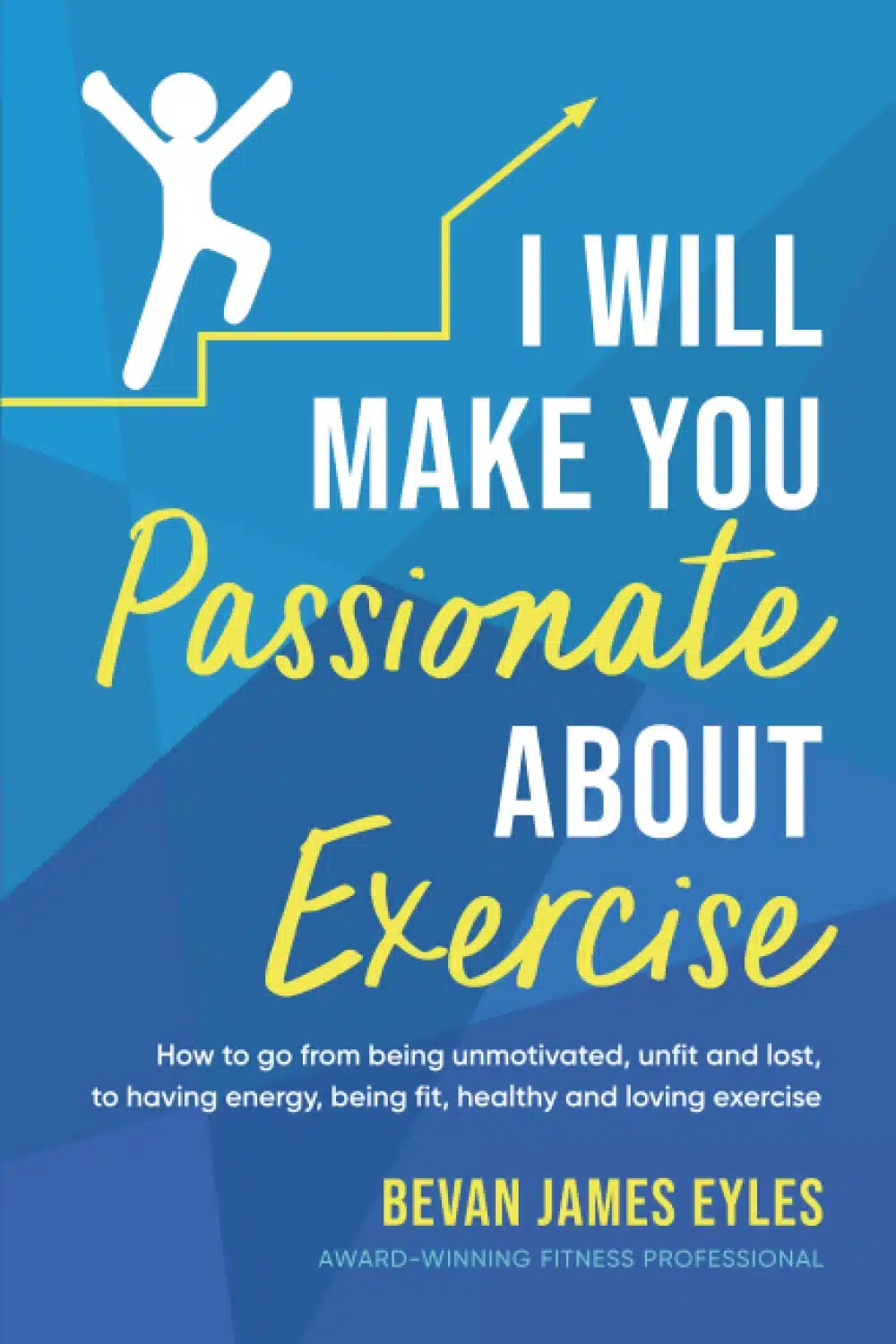
I Will Make You Passionate About Exercise – by Bevan Eyles
10almonds is reader-supported. We may, at no cost to you, receive a portion of sales if you purchase a product through a link in this article.
What this isn’t: a “just do it!” motivational pep-talk.
What this is:a compassionate and thoughtful approach to help non-exercisers become regular exercisers, by looking at the real life factors of what holds people back (learning from his own early failures as a coach, by paying attention now to things he inadvertently neglected back then), both in the material/practical and in the psychological/emotional.
Further, he gives a 10-step method, for those who would like to be walked through it by the hand, making the transition to exercising regularly (and as a leisure habit, rather than as a chore) as frictionless as possible.
The style is friendly and energetic, and very easy-reading throughout.
Bottom line: if you are someone who finds exercising to be a chore, this book can definitely help you “get from here to there” in terms of finding joy in it, and finding exercise even easier than not exercising. Yes, really.
Don’t Forget…
Did you arrive here from our newsletter? Don’t forget to return to the email to continue learning!
Recommended
Learn to Age Gracefully
Join the 98k+ American women taking control of their health & aging with our 100% free (and fun!) daily emails:
-
Should I break up with my GP? 4 signs it may be time
10almonds is reader-supported. We may, at no cost to you, receive a portion of sales if you purchase a product through a link in this article.
A long-term relationship with a GP – one who knows you and your history – improves your health and even reduces your chance of dying prematurely.
This type of trusted relationship is particularly important if you have a serious or chronic (long-term) condition or multiple conditions. It is also important for trauma survivors, who should not need to retell their story over and over.
However, there are times when you may feel uncomfortable with your current GP. The first step is understanding why, then knowing what to do about it. Here are some reasons you might consider finding another one.
sturti/Getty 1. Your needs have changed
It is common to change GPs at pivotal times in your life. You may feel uncomfortable discussing your sexual health needs with the “family GP” who has known you since you were a child, or who still sees your parents.
If your family is having children, you may prefer a GP who does antenatal care, or sees a lot of children, so they can more readily empathise with your needs as a young parent. Perhaps your current GP doesn’t share your ideas about health care and parenting, or the practice isn’t particularly child friendly.
You may have appreciated your GP’s practical, straightforward and efficient consultation style for past sports injuries, but find this approach unhelpful when struggling with your mental health.
So you may look for a GP who better meets your current needs.
2. You want another GP who is expert in your illness
Good GPs can get “up to speed” on a variety of conditions, while still keeping the whole person in view. But sometimes, you will have a very specific need that leads to seeking a GP who is expert in that area. An example may be a GP who specialises in skin checks, or a GP who is expert in ADHD (attention deficit hyperactivity disorder).
However, you still need a generalist GP who looks at your other health-care needs. This generalist GP may well be the one who picks up early Parkinson’s disease or bowel cancer while your other GP is focused on your reproductive system or mental health.
3. You want a GP who is more aligned with your values
People differ in the type of relationship they want with their GP. You might be seeking a true partnership, where you both bring your expertise into decision making and you have the final decision. At the other end of the spectrum, you may feel more comfortable with your GP taking a more assertive role. Your needs and preferences may change over time.
Sometimes, your GP doesn’t seem to accept your views on health care. You might feel uncomfortable discussing the role of complementary medicine, or preventive health care, or your decisions to accept or reject certain treatments.
So you may seek a GP who is more aligned with your attitudes and practices.
However, GPs have their limits when it comes to accommodating your preferences. They cannot always supply your preferred medication, referral or other service, for professional, regulatory, legal or other reasons.
4. There has been a fracture of trust or confidence
Everyone makes mistakes. Sometimes, those mistakes are so serious you cannot go back to that doctor. However, there are errors where the relationship can be repaired.
A good GP will explain why an error happened, show how they (and the practice) will rectify the error, and what systems are now in place to make sure it doesn’t happen again. A sincere apology and equally sincere desire to make things right can strengthen a relationship and restore trust.
Sometimes you can feel unheard during a consultation, or the GP can seem distracted. The GP may sincerely apologise, and explain why. They are human, and can be unwell, exhausted by an untenable workload, or simply recovering from a particularly challenging consultation earlier in the day.
However, if there is a pattern of feeling the GP doesn’t hear you, makes frequent minor errors, or simply doesn’t seem to be providing the sort of professional service you expect, you may lose trust. If you feel uneasy or judged, you may need to step away from that GP.
How to break up with your GP
Good GPs understand a partnership with you is important. If you cannot maintain a relationship with them that is open, honest and safe, it is time to move on.
If your needs have changed, but you still value the GP for their care, you can send a thank you card and explain you have chosen to transfer to another doctor. The practice staff can forward your records to a new practice, for which there may be a small administrative fee.
If there has been a rupture in trust or confidence, and the issue is relatively minor, the practice manager will be able to advise how to make a written complaint to the practice.
If the problem is more serious, and you wish to make a formal complaint about a breach of trust that has implications for patient safety, you can report this to the Australian Health Practitioner Regulation Agency.
If the problem is about the GP practice, you can report it to the relevant health-care ombudsman or commission in your state or territory.
Louise Stone, Professor of General Practice, University of Adelaide
This article is republished from The Conversation under a Creative Commons license. Read the original article.
Share This Post
-
How Sprinting Changes Your Body (Once Per Week Is Sufficient)
10almonds is reader-supported. We may, at no cost to you, receive a portion of sales if you purchase a product through a link in this article.
Sprinting is often thought of as a pursuit of the young, but it can bring particularly important health benefits in later life:
And… Go!
Sprinting once per week can drastically improve health and fitness as we age. Specifically, it offers benefits some of which are unique to sprinting:
- Enhances range of motion and resilience.
- Burns 200 kcal in 2.5 minutes
- Boosts daily calorie burn by up to 950 kcal*
- Reduces cognitive decline and supports brain health.
- Builds bone density, especially in the tibia, but everywhere upwards from the tibia too.
*this is specific to sprinting, be it a running sprint or other kind of sprint (e.g. cycling, swimming, etc), and is a topic we’ve explored a lot in the category of high-intensity interval training (HIIT). In short, HIIT “confuses” the heart in a good way, which results in a sustained metabolic increase to meet the perceived needs (i.e. the body thinks “we might have to suddenly sprint again any minute, so let’s stay ready for that”), instead of the post-exercise metabolic compensatory slump that occurs after longer exercise sessions (e.g. endurance training). Note that if you sprint, once, that’s basically just a single interval of HIIT, and has the same benefits as such. Of course, if you do more intervals, you’ll get more benefits, but the point is that one interval is already doing your body good.
For more on all of this plus illustrative examples, enjoy:
Click Here If The Embedded Video Doesn’t Load Automatically!
Want to learn more?
You might also like:
How To Do HIIT (Without Wrecking Your Body)
Take care!
Share This Post
-
Common Sense Labs: Blood Labs Demystified – by Dr. Ken Berry & Kim Howerton
10almonds is reader-supported. We may, at no cost to you, receive a portion of sales if you purchase a product through a link in this article.
Most people, if given their test results as a set of numbers, will have no idea what they mean.
And a doctor or nurse saying “this is good”, “this is a bit low”, “this is very high” etc isn’t that much more informative, as it doesn’t really give a true feel for the information.
Dr. Berry produced this book to bridge that knowledge gap, and in his words, “put the power of health back in the hands of the people”. The book also covers what blood tests to recommend annually (finding common recommendations insufficient), and how to go about asking for those if your doctor might be keen to brush you off.
This is a short book (weighing in at a lithe 78 pages), but the information contained therein is very dense, and very convenient to have it all in one place.
As one Amazon reviewer wrote,
❝Someone said you can find the information on the Internet, but I would say good luck with that. It will be many many many hours compiling the gold that is in this book.❞
Writer’s anecdote: indeed, I recently had 14 blood tests done as part of a regular checkup (I’m pleased to report I could not be in better health), and while interpreting the results, I had to look up a lot of things (which were often in the wrong units*), and if I’d had this book already, it would have been a breeze, as it covers everything I had done!
*On which note, this book does provide results in US and International units, so you won’t be left wondering how to convert mmol/mol into mmol/L or mg/dL or such.
Bottom line: if you are a person who has blood, this book will at some point be of immense value to you, if not immediately!
Click here to check out Common Sense Labs, and understand what your blood is saying!
Share This Post
Related Posts
-
Next-Level Headache Hacks
10almonds is reader-supported. We may, at no cost to you, receive a portion of sales if you purchase a product through a link in this article.
A Muscle With A Lot Of Therapeutic Value
First, a quick anatomy primer, so that the rest makes sense. We’re going to be talking about your sternocleidomastoid (SCM) muscle today.
To find it, there are two easy ways:
- look in a mirror, turn your head to one side and it’ll stick out on the opposite side of your neck
- look at this diagram
(we’re going to talk about it in the singular, but you have one on each side)
This muscle is interesting for very many reasons, but what we’re going to focus on today is that massaging/stretching it (correctly!) can benefit several things that are right next to it and/or behind it, namely:
- The tenth cranial nerve
- The eleventh cranial nerve
- The carotid artery
Why do we care about these?
Well, we would die quickly without the first and last of those. However, more practically, massaging each has benefits:
The tenth cranial nerve
This one is also known by its superhero alter-ego name:
The Vagus Nerve (And How You Can Make Use Of It)
The eleventh cranial nerve
This one’s not nearly so critical to life, but it does facilitate most of the motor functions in that general part of the body—including some mechanics of speech production, and maintaining posture of the shoulders/neck/head (which in turn strongly affects presence/absence of certain kinds of headaches).
The carotid artery
We suspect you know what this one does already; it supplies the brain (and the rest of your head, for that matter) with oxygenated blood.
What is useful to know today, is that it can be massaged, via the SCM, in a way that brings about a gentler version of this “one weird trick” to cure a lot of kinds of headaches:
Curing Headaches At Home With Actual Science
How (And Why) To Massage Your SCM
…to relieve many kinds of headache, migraine, eye-ache, and tension or pain the jaw. It’s not a magical cure all so this comes with no promises, but it can and will help with a lot of things.
In few words: turn your ahead away from the side where it hurts (if both, just pick one and then repeat for the other side), and slightly downwards. When your SCM sticks out a bit on the other side, gently pinch and rub it, working from the bottom to the top.
If you prefer videos, here is a demonstration:
How (And Why) To Stretch Your SCM
The above already includes a little stretch, but you can stretch it in a way that specifically stimulates your vagus nerve (this is good for many things).
In few words: stand (or sit) up straight, and interlace your fingers together. Put your hands on the back of your neck, thumbs-downwards, and (keeping your face forward) look to one side with your eyes only, and hold that until you feel the urge to yawn (it’ll probably take between about 3 seconds and 30 seconds). Then repeat on the other side.
If you prefer videos, this one is a very slight variation of what we just described but works the same way:
Take care!
Don’t Forget…
Did you arrive here from our newsletter? Don’t forget to return to the email to continue learning!
Learn to Age Gracefully
Join the 98k+ American women taking control of their health & aging with our 100% free (and fun!) daily emails:
-
How Does Extreme Heat Affect Your Body?
10almonds is reader-supported. We may, at no cost to you, receive a portion of sales if you purchase a product through a link in this article.
Dr. Carolyn Beans talks us through it:
Are we cooked?
A couple of years ago, it was predicted that by 2050, many mid-latitude regions could experience extreme heat for 90–180 days per year, with tropical regions facing even more, making heat-related disruptions a routine part of life.
There’s a limit to how much of this we are physically able to take.
The reason is that when temperatures rise, your hypothalamus signals blood vessels near your skin to widen, increasing heat loss, while sweat glands produce sweat that cools your body through evaporation. However, sweat only cools you if it can evaporate, and high humidity reduces or even stops the required evaporation of sweat, making it harder for your body to shed heat.
Because of this, a wet-bulb temperature of about 35°C is generally considered the upper limit of human survival because sweating can no longer adequately cool the body, and continued exposure can lead to heat exhaustion and heat stroke, a medical emergency in which body temperature exceeds 40°C.
It’s also worth remembering that children, older adults, pregnant people, and those with existing health conditions face elevated risks during extreme heat, and these demographics are foremost in the numbers when heat waves increase emergency calls and hospital visits for heat illness, as well as heart, kidney, and lung conditions, amongst others (heat exhaustion can cause organ failure and death; heat stroke can cause the same plus, as the name suggests, stroke), potentially overwhelming entire healthcare systems as well as people.
To compound matters, widespread air-conditioner use (which on a global scale also contributes to this planet-warming climate change) increases electricity demand, which can overload power grids and trigger large-scale blackouts, at which point not even your desk fan can help you.
For more on all of this… Well, we usually say “enjoy”, but in this case, perhaps simply, see:
Click Here If The Embedded Video Doesn’t Load Automatically!
Want to learn more?
You might also like:
Sun, Sea, And Sudden Killers To Avoid
Take care!
Don’t Forget…
Did you arrive here from our newsletter? Don’t forget to return to the email to continue learning!
Learn to Age Gracefully
Join the 98k+ American women taking control of their health & aging with our 100% free (and fun!) daily emails:
-
Artichoke vs Beetroot – Which is Healthier?
10almonds is reader-supported. We may, at no cost to you, receive a portion of sales if you purchase a product through a link in this article.
Our Verdict
When comparing artichoke to beetroot, we picked the artichoke.
Why?
We’ll not be surprised if most readers picked beetroot, and if that’s you, then it’s good that you know beetroot has some very healthful properties! The thing is, while those properties are great and cannot be described as overhyped… It’s often the case that a food’s “boring” nutritional properties go underhyped.
So, let’s hype it up for artichoke:
In terms of macros, artichoke has nearly 2x the fiber, approximately the same carbs, and more than 2x the protein, winning easily in this category.
In the category of vitamins, artichoke has more of vitamins B1, B2, B3, B5, B6, B7, C, E, and K, while beetroot has more of vitamins A and B9, giving artichoke a 9:2 victory in this round.
Looking at minerals, artichoke has more calcium, copper, iron, magnesium, phosphorus, potassium, and zinc, while beetroot has more manganese and selenium, yielding artichoke another convincing win, 7:2 win this time.
In other considerations, artichoke has a lot more polyphenols (especially flavonoids and phenolic acids), while beetroot has betalains, especially betanin, and plenty of benefits therefrom. So we’ll call this round a tie.
Adding up the sections makes for a clear overall win for artichoke, but by all means enjoy either or both, as diversity is good!
Want to learn more?
You might like:
Enjoy!
Don’t Forget…
Did you arrive here from our newsletter? Don’t forget to return to the email to continue learning!
Learn to Age Gracefully
Join the 98k+ American women taking control of their health & aging with our 100% free (and fun!) daily emails:


