
Butter vs Margarine
10almonds is reader-supported. We may, at no cost to you, receive a portion of sales if you purchase a product through a link in this article.
Butter vs Margarine
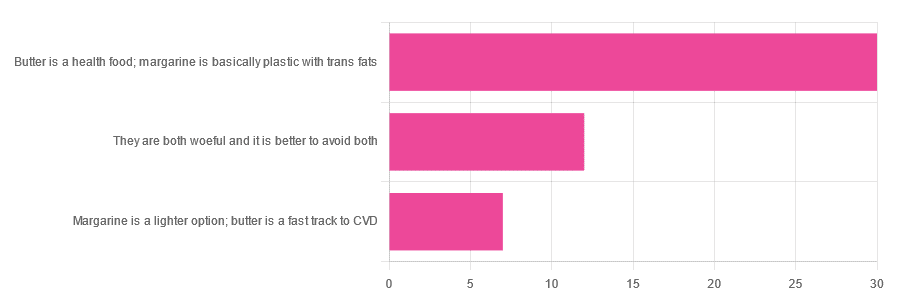
Yesterday, we asked you for your (health-related) opinion on butter vs margarine, and got the above-depicted, below-described, set of responses:
- A little over 60% said butter is a health food and margarine is basically plastic with trans fats
- A little over 20% said that both are woeful and it’s better to avoid both
- A little over 10% said that margarine is a lighter option, and butter is a fast track to cardiovascular disease.
Comments included (we will summarize/paraphrase, for space):
- “…in moderation, though”
- “I’m vegan so I use vegan butter but I know it’s not great, so I use it sparingly”
- “butter is healthy if and only if it’s grass-fed”
- “margarine has unpronounceable ingredients”
To address those quickly:
- “…in moderation” is a stipulation with which one can rarely go too far wrong
- Same! Speaking for myself (your writer here, hi) and not for the company
- Grass-fed is indeed better; alas that so little of it is grass-fed, in the US!
- Butter contains eicosatrienoic acid, linolelaidic acid, and more*. Sometimes big words don’t mean that something is worse for the health, though!
So, what does the science say?
Butter is a health food: True or False?
True or False, depending on amount! Moderation is definitely key, but we’ll return to that (and why not to have more than a small amount of butter) later. But it is a rich source of many nutrients, iff it’s grass-fed, anyway.
The nutritional profile of something isn’t a thing that’s too contentious, so rather than take too much time on it, in this case we’ll point you back up to the scientific paper we linked above, or if you prefer a pop-science rendering, here’s a nice quick rundown:
7 Reasons to Switch to Grass-Fed Butter
Margarine is basically plastic with trans fats: True or False?
False and usually False now, respectively, contingently.
On the first part: chemically, it’s simply not “basically plastic” and everything in it is digestible
On the second part: it depends on the margarine, and here’s where it pays to read labels. Historically, margarines all used to be high in trans fats (which are indeed woeful for the health). Nowadays, since trans fats have such a (well-earned) bad press, there are increasingly many margarines with low (or no) trans fats, and depending on your country, it may be that all margarines no longer have such:
❝It’s a public health success story. Consumers no longer have to worry about reading product nutritional labels to see if they contain hydrogenated oils and trans fats. They can just know that they no longer do❞
Source: Margarines now nutritionally better than butter after hydrogenated oil ban
So this is one where the science is clear (trans fats are unequivocally bad), but the consumer information is not always (it may be necessary to read labels, to know whether a margarine is conforming to the new guidelines).
Butter is a fast track to cardiovascular disease: True or False?
True or False depending on amount. In moderation, predictably it’s not a big deal.
But for example, the World Health Organization recommends that saturated fats (of which butter is a generous source) make up no more than 10% of our calorie intake:
Source: Saturated fatty acid and trans-fatty acid intake for adults and children: WHO guideline
So if you have a 2000 kcal daily intake, that would mean consuming not more than 200 kcal from butter, which is approximately two tablespoons.
If you’d like a deeper look into the complexities of saturated fats (for and against), you might like our previous main feature specifically about such:
Can Saturated Fats Be Healthy?
Enjoy!
Don’t Forget…
Did you arrive here from our newsletter? Don’t forget to return to the email to continue learning!
Recommended
Learn to Age Gracefully
Join the 98k+ American women taking control of their health & aging with our 100% free (and fun!) daily emails:
-
Cabbage vs Eggplant – Which is Healthier?
10almonds is reader-supported. We may, at no cost to you, receive a portion of sales if you purchase a product through a link in this article.
Our Verdict
When comparing cabbage to eggplant, we picked the cabbage.
Why?
In terms of macros, cabbage has slightly more protein while eggplant has slightly more fiber and carbs, but the numbers are so close in all cases that it’s fairest to call this first round a tie.
In the category of vitamins, cabbage has more of vitamins A, B1, B2, B6, B7, B9, C, and K, while eggplant has more of vitamins B3, B5, and E, yielding an 8:3 win to cabbage.
Looking at minerals, cabbage has more calcium, phosphorus, iron, and zinc, while eggplant has more copper, magnesium, manganese, and potassium, for a 4:4 tie here.
In other considerations, cabbage has more polyphenols (yes, eggplants are purple and that purple color does come from anthocyanins, but that’s literally skin-deep and doesn’t affect the per 100g total much at all) so that’s another point for cabbage.
Adding up the sections makes for an overall win for cabbage, but by all means do enjoy either or both, as diversity is best!
Want to learn more?
You might like:
21 Most Beneficial Polyphenols & What Foods Have Them
Enjoy!
Share This Post
-
Can exercise reduce period pain? And what kind is best?
10almonds is reader-supported. We may, at no cost to you, receive a portion of sales if you purchase a product through a link in this article.
Having your period can be a painful experience.
Period pain, also known as dysmenorrhea, is a very common condition with around nine in ten young women aged 13 to 25 in Australia having regular period pain.
For many women, period pain can make exercise seem like an impossible task.
So should you avoid exercise if you have period pain? Or could exercising actually help?
Olha Dobosh/Getty Images What causes period pain?
There are two main types of period pain.
The most common is primary dysmenorrhea. This usually means painful cramps in the lower abdomen.
Research suggests this kind of period pain is caused by an increased number of prostaglandins. The body releases these hormone-like molecules when the lining of the uterus breaks down during the period. Prostaglandins can cause many different symptoms including period cramps, back or leg pain and loose bowels, also known as period poops.
The other type of period pain is secondary dysmenorrhea, which refers to pain caused by physical changes in the pelvis. One of the most common causes is endometriosis, a condition where tissue resembling uterine tissue grows in other parts of the body, leading to severe pain and fertility problems.
Can exercise reduce period pain?
Unfortunately, period pain is often difficult to treat. Many women don’t respond well to standard period pain treatments. These include non-steroidal anti-inflammatory medications such as ibuprofen or mefenamic acid, also known as Ponstan.
This has led researchers to examine exercise as a way to reduce period pain symptoms. And there is some evidence suggesting that regular physical activity can reduce how severe period pain is, and how long it lasts.
Imagine you have a period pain scale from zero to ten, where zero means no pain and ten indicates the worst pain. Research from 2019 suggests exercise can reduce the severity of period pain by an average of 2.5 points. This makes exercise more effective than other self-treatment methods, such as using a heat pack.
However, we have only one 2017 study which directly compares the effects of exercise and non-steroidal anti-inflammatory medications on period pain. This means it’s hard to make any clear recommendations. But this study suggests regular exercise is at least as helpful as taking mefenamic acid.
Exercise may also reduce how long period pain lasts. One study from 2025 found aerobic exercise, which aims to increase your breathing and heart rate, can shorten the duration of period pain by more than 12 hours.
Many women experience the worst pain in the first 48 hours of their period, so a potential 25% cut in the duration of period pain is significant.
What kinds of exercise are best?
Most of the evidence examining exercise and period pain focuses on aerobic exercise. This includes cycling, swimming and jogging. A handful of studies look at strength training, yoga and relaxation exercises such as gentle stretching.
There is some evidence to suggest strength training relieves period pain more than other kinds of exercise. However, researchers generally study a specific kind of strength training known as isometric exercises. These involve holding muscles in a static position, such as doing a plank.
Other studies show exercises such as progressive muscle relaxation, which involves tensing and then relaxing particular muscles, can also be very effective. A 2024 study found women who did relaxation-based exercises, combined with self-massage, experienced the greatest reduction in pain. And because they’re simple to do, participants were more likely to stick with relaxation-based exercises compared to other kinds of physical activity.
But most of this research focuses on primary dysmenorrhea. So for those whose period pain may be caused by an underlying condition, it may be best to start with gentler forms of exercise such as yoga. You can also speak to an exercise physiologist to get personalised advice. This is because we don’t fully understand if more intense exercise has the same effect on period pain caused by other conditions, such as endometriosis.
When and how often should I exercise?
There isn’t much research looking at the effects of exercising specifically during the period. But a 2025 review of existing studies suggests exercising two to three times a week can reduce period pain.
This review found participants who did strength training for at least 30 minutes at a time, over a minimum of eight weeks, experienced the greatest reduction in pain. However, existing research suggests you may start seeing some improvements in both pain intensity and duration in as few as four weeks.
The research is less clear when it comes to aerobic exercise. A 2025 review suggests shorter and less intense sessions of aerobic exercise may be most effective for managing period pain.
So doing at least 90 minutes of exercise a week, for at least eight weeks, may be the best exercise-based way to reduce period pain. This seems to be the case whether you exercise during your period or not. But if you experience any negative symptoms after exercising, such as pain below your belly button when you’re not menstruating, it’s best to speak to a doctor.
The bottom line
Overall, exercise is one way women can manage period pain. Current research suggests any kind of exercise, ranging from yoga to more intense aerobic workouts, can reduce the severity and duration of period pain. So everyone can benefit from exercise, regardless what time of the month it is.
Mike Armour, Associate Professor at NICM Health Research Institute, Western Sydney University
This article is republished from The Conversation under a Creative Commons license. Read the original article.
Share This Post
-
Beyond Guarding Against Dementia
10almonds is reader-supported. We may, at no cost to you, receive a portion of sales if you purchase a product through a link in this article.
When Age’s Brain-Changes Come Knocking
This is Dr. Amy Friday. She’s a psychologist, specializing in geropsychology and neuropsychological assessments.
In other words, she helps people optimize their aging experience, particularly in the context of brain changes as we get older.
What does she want us to know?
First: be not afraid
Ominous first words, but the fact is, there’s a lot to find scary about the prospect of memory loss, dementia, and death.
However, as she points out:
- Death will come for us all sooner or later, barring technology as yet unknown
- Dementia can be avoided, or at least stalled, or at least worked around
- Memory loss, as per the above, can be avoided/stalled/managed
We’ve written a little on these topics too:
…or if the death is not yours:
As for avoiding dementia, the below-linked feature is about Alzheimer’s in particular (which accounts for more than half of all cases of dementia), but the advice goes for most of the other kinds too:
How To Reduce Your Alzheimer’s Risk
And finally, about memory loss specifically:
How To Boost Your Memory Immediately (Without Supplements)
this one is especially about cementing into one’s brain the kinds of memories that people most fear losing with age. People don’t worry about forgetting their PIN codes; they worry about forgetting their cherished memories with loved ones. So, if that’s important to you, do consider checking out this one!
What is that about managing or working around the symptoms?
If we’re missing a limb, we (usually) get a prosthetic, and/or learn how to operate without that limb.
If we’re missing sight or hearing, partially or fully, there are disability aids for those kinds of things too (glasses are a disability aid! Something being very common does not make it not a disability; you literally have less of an ability—in this case, the ability to see), and/or we learn how to operate with our different (or missing) sense.
Dr. Friday makes the case for this being the same with memory loss, dementia, and other age-related symptoms (reduced focus, increased mental fatigue, etc):
❝We are all screwed up. Here’s my flavor … what’s yours? This is a favorite saying of mine, because we ARE all screwed up in one way or another, and when we acknowledge it we can feel closer in our screwed-up-edness.
We are all experiencing “normal aging,” so that tip-of-the-tongue phenomenon that starts in our thirties and slowly gets worse is REAL. But what if you’re having more problems than normal aging? Is it time to throw in the towel and hide? I’m hoping that there is a group of people who say HELL NO to that idea.
Let’s use lessons from research and clinical practice to help all of us work around our weaknesses, and capitalize on our strengths. ❞
Examples of this might include:
- Writing down the things most important to you (a short list of information and/or statements that you feel define you and what matters most to you), so that you can read it later
- Making sure you have support (partner, family, friends, etc) who are on the same page about this topic—and thus will actually support you and advocate for you, instead of arguing about what is in your best interest without consulting you.
- Labelling stuff around the house, so that you get less confused about what is what and where it is
- Having a named go-to advocate that you can call / ask to be called, if you are in trouble somewhere and need help that you can rely on
- Getting a specialized, simpler bank account; hiring an accountant if relevant and practicable.
The thing is, we all want to keep control. Sometimes we can do that! Sometimes we can’t, and if we’re going to lose some aspect of control, it’ll generally go a lot better if we do it on our own terms, so that we ourselves can look out for future-us in our planning.
Want to know more?
You might enjoy her blog, which includes also links to her many videos on the topic, including such items as:
- Neuroplasticity – #1 Way To Increase Brain Health
- Which Diet PREVENTS Alzheimer’s? | Best Brain Health Diet
- Stop Anxiety About Dementia & Do I Have Dementia?
For the rest, see:
This Beautiful Brain | The Science Of Brain Health
Enjoy!
Share This Post
Related Posts
-
The Myth of Normal – by Dr. Gabor Maté and Daniel Maté
10almonds is reader-supported. We may, at no cost to you, receive a portion of sales if you purchase a product through a link in this article.
A lot of popular beliefs (and books!) start with the assumption that everyone is, broadly speaking, “normal”. That major diversions from “normal” happen only to other people… And that minor diversions from “normal” are just something to suck up and get over—magically effecting a return to “normalcy”.
Dr. Maté, however, will have none of these unhelpful brush-offs, and observes that in fact most if not all of us have been battered by the fates one way or another. We just:
- note that we have more similarities than differences, and
- tend to hide our own differences (to be accepted) or overlook other people’s (to make them more acceptable).
How is this more helpful? Well, the above approach isn’t always, but Mate has an improvement to offer:
We must see flawed humans (including ourselves) as the product of our environments… and/but see this a reason to look at improving those environments!
Beyond that…
The final nine chapters of the books he devotes to “pathways to wholeness” and, in a nutshell, recovery. Recovery from whatever it was for you. And if you’ve had a life free from anything that needs recovering from, then congratulations! You doubtlessly have at least one loved one who wasn’t so lucky, though, so this book still makes for excellent reading.
Dr. Maté was awarded the Order of Canada for his medical work and writing. His work has mostly been about addiction, trauma, stress, and childhood development. He co-wrote this book with his son, Daniel.
Don’t Forget…
Did you arrive here from our newsletter? Don’t forget to return to the email to continue learning!
Learn to Age Gracefully
Join the 98k+ American women taking control of their health & aging with our 100% free (and fun!) daily emails:
-
How Healthy Are Afternoon Naps?
10almonds is reader-supported. We may, at no cost to you, receive a portion of sales if you purchase a product through a link in this article.
It’s Q&A Day at 10almonds!
Have a question or a request? We love to hear from you!
In cases where we’ve already covered something, we might link to what we wrote before, but will always be happy to revisit any of our topics again in the future too—there’s always more to say!
No question/request too big or small 😎
❝Is it good for the health to take afternoon naps? Or is it better to just sleep at night?❞
It depends on you! There are potential benefits to napping, for example:
- Increased alertness
- Helps with learning
- Improved memory
- Boost to immunity
- Enhance athletic performance
Generally considered best is simply the famous 7–9 hours at night (yes, including at older ages): Why You Probably Need More Sleep
…and sleep efficiency does matter too: Why 7 Hours Sleep Is Not Enough
…which in turn, is influenced by factors other than just length and depth: The 6 Dimensions Of Sleep (And Why They Matter)
However, as we’ve said before elsewhere, often what is best is not necessarily what is attainable, so if you struggle to get the aforementioned sleep quantity and quality, then you might want to consider: How To Nap Like A Pro (No More “Sleep Hangovers”!)
There are more considerations, though, for example:
- How Regularity Of Sleep Can Be Even More Important Than Duration ← here’s why you should still get up at the same regular (and ideally, early) hour, even if you didn’t sleep well
- Early Bird Or Night Owl? Genes vs Environment ← and here’s why that regular hour should ideally be early, even if it’s not your genetic predisposition to be a “morning lark”; see also the study linked there that mentions “Gene distinguishes early birds from night owls and helps predict time of death”
One important thing to bear in mind: naps are not special
By this we mean: it might feel special to you at the time, taking a little slice of time for yourself, but scientifically speaking, it’s no more special than longer sleep, and in fact, it’s often less restorative, minute for minute, if you don’t time it perfectly.
The reason we mention this is because there is a sizeable (albeit revolving door) subculture of enthusiasts of polyphasic sleeping (i.e. sleeping more than once per day, by napping one or more times) with the goal of sleeping fewer hours in total by making sleep more efficient.
It does not work, except insofar as it can allow you to survive a crisis that is stopping you from sleeping properly. But this is sleep’s equivalent of “fight or flight”, it’s the body’s admittedly very impressive “emergency mode” that is not good to use on a daily basis!
(if you want to know just how bad it is… the top-listed “similar article” is entitled “Suicidal Ideation”)
For more on the woes of trying to force one’s body into polyphasic sleeping in order to sleep less in total, we covered this some years ago: Polyphasic Sleep… Super-Schedule Or An Idea Best Put To Rest?
One last thing: if you’re finding you need to nap a lot, then:
- You probably should indeed nap
- That is probably something you should get checked out, though
For example, researchers (Dr. Ruixue Cai et al.) tracked 1,338 older adults (aged 56+) for up to 19 years using wearable devices to objectively measure daytime napping patterns, and found that longer naps, more frequent naps, and naps taken in the morning were all linked to higher all-cause mortality in later life.
Specifically, each extra hour of daytime napping was associated with a 13% higher mortality risk, each additional daily nap with a 7% increase, and morning nappers had a 30% higher risk compared to afternoon nappers.
Now, these findings show correlation, not causation, meaning excessive napping likely reflects underlying issues such as neurodegeneration, cardiovascular disease, or circadian rhythm disruption, rather than being a case of the naps being the culprit causing death.
So to recap the main point of this last bit: if you’re finding you have to nap a lot, you should probably get that checked out, because while not itself dangerous so far as best current science can say, it may be a sign that “something wrong is not right”.
You can read this paper here: Objectively Measured Daytime Napping Patterns and All-Cause Mortality in Older Adults
Want to learn more?
This is the book on sleep:
Why We Sleep – by Dr. Matthew Walker
Enjoy!
Don’t Forget…
Did you arrive here from our newsletter? Don’t forget to return to the email to continue learning!
Learn to Age Gracefully
Join the 98k+ American women taking control of their health & aging with our 100% free (and fun!) daily emails:
-
Cannabis & Heart Attacks
10almonds is reader-supported. We may, at no cost to you, receive a portion of sales if you purchase a product through a link in this article.
For many, cannabis use has taken the place that alcohol used to have when it comes to wanting a “downer”, that is to say, a drug that relaxes us as opposed to stimulating us.
Indeed, it is generally considered safer than alcohol ← however this is not a strong claim, because alcohol is much more dangerous than one would think given its ubiquity and (in many places, at least) social acceptability.
We’ve talked a bit about cannabis use before, in its various forms, for example:
Cannabis Myths vs Reality ← a very good starting point for the curious
And one specifically about the use of THC gummies (THC is the psychoactive compound in cannabis, i.e. it’s the chemical that gets people high, as opposed to CBD, which is not psychoactive) as a sleep aid:
Sweet Dreams Are Made of THC (Or Are They?)
And for those skipping the THC, we’ve also written about CBD use, including:
CBD Oil: What Does The Science Say? and Do CBD Gummies Work?
So, about cannabis and heart attacks
Alcohol is a relaxant, and yet it can contribute to heart disease (amongst many other things, of course):
Can We Drink To Good Health? ← this is mostly about red wine’s putative heart health benefits, how the idea got popularized, and how it doesn’t stand up to scrutiny when actually looking at the evidence.
And cannabis, another relaxant? Not so good either!
New research has shown that cannabis users have a higher risk of heart attacks, even among younger and otherwise healthy individuals. This is based on analyzing data from 4,636,628 relatively healthy adults.
Specifically, the data showed that even young healthy cannabis users get:
- Sixfold increased risk of heart attack
- Fourfold increased risk of ischemic stroke
- Threefold increased risk of cardiovascular death, heart attack, or stroke
We mention the otherwise “relatively healthy” nature of the participants, because it’s important to note that less healthy people (who were perhaps using cannabis to self-medicate for some serious condition) were not included in the dataset, as it’d skew the data unhelpfully and it’d make the risk look a lot higher than the risk levels we mentioned above.
The mechanisms by which cannabis affects heart health are not fully understood, but hypotheses include:
- Disrupting heart rhythm regulation
- Increasing oxygen demand in the heart muscle
- Causing endothelial dysfunction, which affects blood vessel function
Further, heart attack risk peaked one hour after cannabis use, and while this doesn’t prove causality, it certainly doesn’t make cannabis look safe.
You can read the paper in its entirety here:
Want a safer way to relax?
We recommend:
- No-Frills, Evidence-Based Mindfulness
- Meditation Games That You’ll Actually Enjoy
- Which Style Of Yoga Is Best For You?
- 7 Kinds Of Rest When Sleep Is Not Enough
- Better Sex = Longer Life (Here’s How)
Enjoy!
Don’t Forget…
Did you arrive here from our newsletter? Don’t forget to return to the email to continue learning!
Learn to Age Gracefully
Join the 98k+ American women taking control of their health & aging with our 100% free (and fun!) daily emails:


