
A ketamine nasal spray will be subsidised for treatment-resistant depression. Here’s what you need to know about Spravato

10almonds is reader-supported. We may, at no cost to you, receive a portion of sales if you purchase a product through a link in this article.

An antidepressant containing a form of the drug ketamine has been added to the Pharmaceutical Benefits Scheme (PBS), making it much cheaper for the estimated 30,000 Australians with treatment-resistant depression. This is when a patient has tried multiple forms of treatment for major depression – usually at least two antidepressant medications – without any improvement.

From May 1, a dose of Spravato (also known as esketamine hydrochloride) will cost $A31.60 and $7.70 for concession card holders.

However, unlike oral antidepressants, Spravato can’t be taken at home. Here’s how it works, and who it’s expected to help.
WPixz/Shutterstock

What is Spravato?

The chemical ketamine is used as an anaesthetic. In this formulation it combines both the right-handed (designated “R”) and left-handed (called “S”) forms of the molecule.

This means they are mirror images of each other, similar to how your left hand is a mirror image of your right hand. The left- and right-hand forms can have different effects in the body.

Spravato contains only the left-handed version, giving the drug its generic name esketamine.

Spravato works by increasing the levels of glutamate in the brain. Glutamate is a key chemical messenger molecule that excites brain nerve cells, lifting and improving mood. It also plays a role in learning and forming memories.

How is it taken?

Spravato cannot be taken at home.

A patient can self-administer, but it must be done at a registered treatment facility, such as a hospital, under the supervision of medical staff so they can look out for blood pressure changes and monitor potential side effects.

The drug is provided as a single-use nasal spray. This application means it’s absorbed directly through the nasal lining into the brain, so it starts to work within minutes.

Spravato must also be taken alongside an oral antidepressant. This will be a new one the patient hasn’t tried before. In clinical trials, it was usually an SNRI or SSRI medication.

When a patient first starts on Spravato, they are given the spray twice a week in the first month. It is then administered once a week for the second month, and then weekly or fortnightly after that.

Once there are signs the medicine is working, treatment is continued for at least six months.
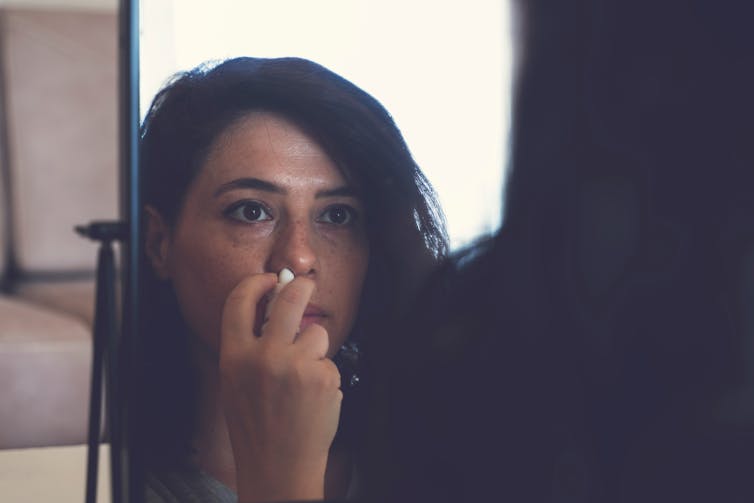
Woman looks in the mirror while spraying her nose
You can use the spray yourself but it must be under medical supervision in a registered facility. Scarc/Shutterstock

How effective is it?

Spravato was approved for sale in Australia based on clinical trial data from more than 1,600 patients who were administered the drug for a period of four weeks. Each was given either Spravato, or a nasal placebo, and an oral antidepressant.

Patients were given a starting dose of either 28 or 56mg, which could be then increased up to 84mg by their doctor.

By the end of the four weeks, a greater percentage of patients who were given Spravato were found to have had a meaningful response to the treatment when compared with patients who received the placebo. Patients who were taking Spravato were also found to relapse at a lower rate. For those who did relapse, it took the Spravato patients longer to relapse when compared with patients who took the placebo.

It is expected Spravato will benefit a wide range of patients. The clinical trials demonstrated effectiveness for men and women, people aged 18 to 64, and those from a range of different ethnic backgrounds.

Potential side effects

As with any medicine, Spravato may cause side effects, some of which can be serious. The most common include:

  • dissociation (feeling disconnected from yourself or what is around you)
  • dizziness
  • nausea and vomiting
  • drowsiness
  • headache
  • change in taste
  • vertigo.

Because Spravato can potentially increase blood pressure, medical staff will monitor a patient before and after it is administered.

Usually, blood pressure spikes around 40 minutes after taking the drug, so a reading is taken around this time. After taking Spravato, if their blood pressure has stayed low, or it’s dropping, the patient is given the all-clear to go home.

Due to the potential for this and other serious side effects, Spravato carries a black triangle warning. This means medical staff are encouraged to report any problem or side effect to the Therapeutic Goods Administration. A black triangle warning is generally used for new medicines or medicines that are being used in a new way.

Who will be eligible?

To be eligible for a prescription, a patient will need to have been diagnosed with treatment-resistant depression. In practice, this means they will have unsuccessfully tried at least two other antidepressant drugs first.

Australia’s Therapeutic Goods Administration approved Spravato for use in Australia in 2021, meaning it was available but not subsidised. Since then, the sponsoring company, Janssen-Cilag (an Australian subsidiary of the multinational Johnson & Johnson), applied to have it added to the PBS four times.

In December 2024, the Pharmaceutical Benefits Advisory Committee recommended a PBS listing.

The new PBS listing, capping the price of a single treatment at $31.60, is a significant price drop. In 2023, single doses of branded Spravato were reported to cost anywhere between $500 and $900.

However, patients may still have to pay hundreds of dollars for appointments at private clinics where Spravato can be administered. Public places are available but limited.

Spravato may be suitable for you if you’ve tried different antidepressants without success. If it is suitable for you, then your doctor can discuss the next steps.

If this article has raised issues for you, or if you’re concerned about someone you know, call Lifeline on 13 11 14.

Nial Wheate, Professor, School of Natural Sciences, Macquarie University and Shoohb Alassadi, Associate Lecturer and Registered Pharmacist, University of Sydney

This article is republished from The Conversation under a Creative Commons license. Read the original article.

Don’t Forget…

Did you arrive here from our newsletter? Don’t forget to return to the email to continue learning!

Learn to Age Gracefully

Join the 98k+ American women taking control of their health & aging with our 100% free (and fun!) daily emails:

  • Head Over Hips

    10almonds is reader-supported. We may, at no cost to you, receive a portion of sales if you purchase a product through a link in this article.

    We’ve written before about managing osteoarthritis (or ideally: avoiding it, but that’s not always an option on the table, of course), so here’s a primer/refresher before we get into the meat of today’s article:

    Avoiding/Managing Osteoarthritis

    When the head gets in the way

    Research shows that the problem with recovery in cases of osteoarthritis of the hip is in fact often not the hip itself, but rather, the head:

    ❝In fact, the stronger your muscles are, the more protected your joint is, and the less pain you will experience.

    Our research has shown that people with hip osteoarthritis were unable to activate their muscles as efficiently, irrespective of strength.

    Basically, people with hip arthritis are unable to activate their muscles properly because the brain is actively putting on the brake to stop them from using the muscle.❞

    ~ Dr. Myles Murphy

    See: People with hip osteoarthritis have reduced quadriceps voluntary activation and altered motor cortex function

    This is a case of a short-term protective response being unhelpful in the long-term. If you injure yourself, your brain will try to inhibit you from exacerbating that injury, such as by (for example) disobliging you from putting weight on an injured joint.

    This is great if you merely twisted an ankle and just need to sit back and relax while your body works its healing magic, but it’s counterproductive if it’s a chronic issue like osteoarthritis. In such (i.e. chronic) cases, avoidance of use of the joint will simply cause atrophy of the surrounding muscle and other tissues, leading to more of the very wear-and-tear that led to the osteoarthritis in the first place.

    So… How to deal with that?

    You probably can exercise

    It’s easy to get caught between the dichotomy of “exercise and inflame your joints” vs “rest and your joints seize up”, which is not pleasant.

    However, the trick lies in how you exercise, per joint type:

    When Bad Joints Stop You From Exercising (5 Things To Change)

    …which to be clear, isn’t a case of “avoid using the joint that’s bad”, but is rather “use it in this specific way, so that it gets stronger without doing it more damage in the process”.

    Which is exactly what is needed!

    Further resources

    For those who like learning from short videos, here’s a trio of helpers (along with our own text-based overview for each):

    And for those who prefer just reading, here’s a book we reviewed on the topic:

    11 Minutes to Pain-Free Hips – by Melinda Wright

    Take care!

    Share This Post

  • When You Lose Weight, Here’s How Your Body Fights To Regain It For You

    10almonds is reader-supported. We may, at no cost to you, receive a portion of sales if you purchase a product through a link in this article.

    It’s well-known that intentional weight loss is often regained quickly, but it’s not always clear why.

    Sometimes it is clear! For example, we wrote previously about how a person who has been on GLP-1 RAs may afterwards be even more inclined to put on fat than before:

    Of the four studies that actually looked at the macros (unlike most studies), they found that on average, protein intake decreased by 17.1%. Which is a big deal!

    It’s an especially big deal, because while protein’s obviously important for everyone, it’s especially important for anyone trying to lose weight, because muscle mass is a major factor in metabolic base rate—which in turn is much important for fat loss/maintenance than exercise, when it comes to how many calories we burn by simply existing.

    A reasonable hypothesis, therefore, is that one of the numerous reasons people who quit GLP-1 agonists immediately put fat back on, is because they probably lost muscle mass in amongst their weight loss, meaning that their metabolic base rate will have decreased, meaning that they end up more disposed to put on fat than before.

    And, that’s just a hypothesis and it’s a hypothesis based on very few studies, so it’s not something to necessarily take as any kind of definitive proof of anything, but it is to say—as the researchers of this review do loudly say—more research needs to be done into this, because this has been a major gap in research so far!❞

    Read in full: Semaglutide’s Surprisingly Unexamined Effects

    But that’s about GLP-1 receptor agonist drugs; what about dietary weight loss?

    It can be quite different in terms of its mechanism, for example: The 3 Phases Of Fat Loss (& How To Do It Right!)

    But new science sheds a light on where these things meet:

    Of mice and menus

    Researchers (Dr. Frankie Heyward et al.) did a mouse study showing that after weight loss, the body often continues generating persistent hunger signals for weeks, increasing the drive to regain lost weight.

    The way that this happened suggests that the body is likely to biologically defend a previously higher weight, creating sustained pressure to return to that elevated weight rather than comfortably maintaining the lower one.

    Notably, only mice whose food intake remained permanently restricted to match lean controls maintained their weight loss, suggesting that reaching a lower weight didn’t erase the physiological drive to regain. This suggests that the draconian methods discussed in our article “What Are The “Bright Lines” Of Bright Line Eating?” may work, at least for long-term weight loss, if not necessarily for happiness*.

    *For health and happiness, we would suggest almost the opposite, per: Intuitive Eating Might Not Be What You Think and What Flexible Dieting Really Means 😎

    Back to the recent study: mice who gained weight the most quickly during their first four weeks on a high-fat diet were more likely to regain more weight later, which means early weight-gain responsiveness appears to predict long-term vulnerability.

    Because both mice and humans share the same relevant pathways in this case, this has implications for GLP-1 receptor agonist use too, because while GLP-1 RAs can effectively reduce body weight, these findings suggest that underlying hunger biology will still persist and contribute to regain when treatment or calorie restriction stops.

    You can read the new paper itself, here: Evidence of persistent hunger following dietary weight loss in mice

    Want to learn more?

    You might like these main features on getting your body just the way you want it, sustainably and healthily:

    1. How To Lose Weight (Healthily!)
    2. How To Build Muscle (Healthily!)
    3. How To Gain Weight (Healthily!) ← this one’s specifically about gaining healthy levels of fat, for any who want/need that

    And also:

    Can We Do Fat Redistribution? ← yes we can, but there are caveats

    Take care!

    Share This Post

  • Sun, Sea, And Sudden Killers To Avoid

    10almonds is reader-supported. We may, at no cost to you, receive a portion of sales if you purchase a product through a link in this article.

    Stay Safe From Heat Exhaustion & Heatstroke!

    For most of us, summer is upon us now. Which can be lovely… and also bring new, different health risks. Today we’re going to talk about heat exhaustion and heatstroke.

    What’s the difference?

    Heat exhaustion is a milder form of heatstroke, but the former can turn into the latter very quickly if left untreated.

    Symptoms of heat exhaustion include:

    • Headache
    • Nausea
    • Cold sweats
    • Light-headedness

    Symptoms of heatstroke include the above and also:

    • Red/flushed-looking skin
    • High body temperature (104ºF / 40ºC)
    • Disorientation/confusion
    • Accelerated heart rate

    Click here for a handy downloadable infographic you can keep on your phone

    What should we do about it?

    In the case of heatstroke, call 911 or the equivalent emergency number for the country where you are.

    Hopefully we can avoid it getting that far, though:

    Prevention first

    Here are some top tips to avoid heat exhaustion and thus also avoid heatstroke. Many are common sense, but it’s easy to forget things—especially in the moment, on a hot sunny day!

    • Hydrate, hydrate, hydrate
      • (Non-sugary) iced teas, fruit infusions, that sort of thing are more hydrating than water alone
      • Avoid alcohol
        • If you really want to imbibe, rehydrate between each alcoholic drink
    • Time your exercise with the heat in mind
      • In other words, make any exercise session early or late in the day, not during the hottest period
    • Use sunscreen
      • This isn’t just for skin health (though it is important for that); it will also help keep you cooler, as it blocks the UV rays that literally cook your cells
    • Keep your environment cool
      • Shade is good, air conditioning / cooling fans can help.
      • A wide-brimmed hat is portable shade just for you
    • Wear loose, breathable clothing
      • We write about health, not fashion, but: light breathable clothes that cover more of your body are generally better healthwise in this context, than minimal clothes that don’t, if you’re in the sun.
    • Be aware of any medications you’re taking that will increase your sensitivity to heat.
      • This includes medications that are dehydrating, and includes most anti-depressants, many anti-nausea medications, some anti-allergy medications, and more.
      • Check your labels/leaflets, look up your meds online, or ask your pharmacist.

    Treatment

    If prevention fails, treatment is next. Again, in the case of heatstroke, it’s time for an ambulance.

    If symptoms are “only” of heat exhaustion and are more mild, then:

    • Move to a cooler location
    • Rehydrate again
    • Remove clothing that’s confining or too thick
      • What does confining mean? Clothing that’s tight and may interfere with the body’s ability to lose heat.
        • For example, you might want to lose your sports bra, but there is no need to lose a bikini, for instance.
    • Use ice packs or towels soaked in cold water, applied to your body, especially wear circulation is easiest to affect, e.g. forehead, wrists, back of neck, under the arms, or groin.
    • A cool bath or shower, or a dip in the pool may help cool you down, but only do this if there’s someone else around and you’re not too dizzy.
      • This isn’t a good moment to go in the sea, no matter how refreshing it would be. You do not want to avoid heatstroke by drowning instead.

    If full recovery doesn’t occur within a couple of hours, seek medical help.

    Stay safe and have fun!

    Share This Post

  • Semaglutide’s Surprisingly Unexamined Effects

    10almonds is reader-supported. We may, at no cost to you, receive a portion of sales if you purchase a product through a link in this article.

    Semaglutide’s Surprisingly Big Research Gap

    GLP-1 receptor agonists like Ozempic, Wegovy, and other semaglutide drugs. are fast becoming a health industry standard go-to tool in the weight loss toolbox. When it comes to recommending that patients lose weight, “Have you considered Ozempic?” is the common refrain.

    Sometimes, this may be a mere case of kicking the can down the road with regard to some other treatment that it can be argued (sometimes even truthfully) would go better after some weight loss:

    How weight bias in health care can harm patients with obesity: Research

    …which we also covered in fewer words in the second-to-last item here:

    Shedding Some Obesity Myths

    But GLP-1 agonists work, right?

    Yes, albeit there’s a litany of caveats, top of which are usually:

    • there are often adverse gastrointestinal side effects
    • if you stop taking them, weight regain generally ensues promptly

    For more details on these and more, see:

    Semaglutide For Weight Loss?

    …but now there’s another thing that’s come to light:

    The dark side of semaglutide’s weight loss

    In academia, “dark” is often used to describe “stuff we don’t have much (or in some cases, any) direct empirical evidence of, but for reasons of surrounding things, we know it’s there”.

    Well-known examples include “dark matter” in physics and the Dark Ages in (European) history.

    In the case of semaglutide and weight loss, a review by a team of researchers (Drs. Sandra Christenen, Katie Robinson, Sara Thomas, and Dominique Williams) has discovered how little research has been done into a certain aspect of GLP-1 agonist’s weight loss effects, namely…

    Dietary changes!

    There’s been a lot of popular talk about “people taking semaglutide eat less”, but it’s mostly anecdotal and/or presumed based on parts of the mechanism of action (increasing insulin production, reducing glucagon secretions, modulating dietary cravings).

    Where studies have looked at dietary changes, it’s almost exclusively been a matter of looking at caloric intake (which has been found to be a 16–39% reduction), and observations-in-passing that patients reported reduction in cravings for fatty and sweet foods.

    This reduction in caloric intake, by the way, is not significantly different to the reduction brought about by counselling alone (head-to-head studies have been done; these are also discussed in the research review).

    However! It gets worse. Very few studies of good quality have been done, even fewer (two studies) actually had a registered dietitian nutritionist on the team, and only one of them used the “gold standard” of nutritional research, the 24-hour dietary recall test. Which, in case you’re curious, you can read about what that is here:

    Dietary Assessment Methods: What Is A 24-Hour Recall?

    Of the four studies that actually looked at the macros (unlike most studies), they found that on average, protein intake decreased by 17.1%. Which is a big deal!

    It’s an especially big deal, because while protein’s obviously important for everyone, it’s especially important for anyone trying to lose weight, because muscle mass is a major factor in metabolic base rate—which in turn is much important for fat loss/maintenance than exercise, when it comes to how many calories we burn by simply existing.

    A reasonable hypothesis, therefore, is that one of the numerous reasons people who quit GLP-1 agonists immediately put fat back on, is because they probably lost muscle mass in amongst their weight loss, meaning that their metabolic base rate will have decreased, meaning that they end up more disposed to put on fat than before.

    And, that’s just a hypothesis and it’s a hypothesis based on very few studies, so it’s not something to necessarily take as any kind of definitive proof of anything, but it is to say—as the researchers of this review do loudly say—more research needs to be done into this, because this has been a major gap in research so far!

    Any other bad news?

    While we’re talking research gaps, guess how many studies looked into micronutrient intake changes in people taking GLP-1 agonists?

    If you guessed zero, you guessed correctly.

    You can find the paper itself here:

    Dietary intake by patients taking GLP-1 and dual GIP/GLP-1 receptor agonists: A narrative review and discussion of research needs

    What’s the main take-away here?

    On a broad, scoping level: we need more research!

    On a “what this means for individuals who want to lose weight” level: maybe we should be more wary of this still relatively new (less than 10 years old) “wonder drug”. And for most of those 10 years it’s only been for diabetics, with weight loss use really being in just the past few years (2021 onwards).

    In other words: not necessarily any need to panic, but caution is probably not a bad idea, and natural weight loss methods remain very reasonable options for most people.

    See also: How To Lose Weight (Healthily!)

    Take care!

    Don’t Forget…

    Did you arrive here from our newsletter? Don’t forget to return to the email to continue learning!

    Learn to Age Gracefully

    Join the 98k+ American women taking control of their health & aging with our 100% free (and fun!) daily emails:

  • Burnout Isn’t About How Much You Do

    10almonds is reader-supported. We may, at no cost to you, receive a portion of sales if you purchase a product through a link in this article.

    It’s more about what you don’t do:

    Firebreak

    Foresters tending forests sometimes cut firebreaks between sections of the forest, This means that if there’s a fire, the whole thing won’t burn down. The size of the forest doesn’t make a difference to its combustibility risk, but the presence (or absence) of breaks sure does.

    So it is with us, too. Lest that seem overly simplistic, let’s be clear we’re talking about physiological cause-and-effect here: burnout doesn’t come only from doing too much, it comes from sustained effort while feeling unable to stop, which keeps your nervous system in a constant state of demand.

    In other words: it’s not the workload itself but your psychological relationship to it that determines whether effort energizes you or drains you.

    This is important, since many people give their body a break but never allow their nervous system to downshift, so exhaustion is paused rather than resolved.

    Notably, not everything that people think is rest, is actually rest. For example, scrolling, binge-watching, and constant input keep your brain reacting and comparing, which means your system remains alert rather than recovering.

    So, just like the firebreaks we mentioned up top, hard stops matter: waiting to rest until everything is finished fuels burnout, so we must create a daily, intentional stopping point even when tasks remain incomplete.

    In particular, it’s important to get:

    • Physical rest: sleep, lying down, and gentle movement—which things restore your body but are only one part of full recovery.
    • Mental rest: real mental rest means no planning, problem-solving, or consuming content, such as sitting quietly outside or walking without a podcast while letting thoughts pass without engagement.
    • Nervous system rest: this occurs when there are no demands, urgency, expectations, or productivity goals, and although it may feel uncomfortable at first, it’s essential for preventing burnout.

    As for how to implement this, the video advises us to…

    • Rest daily: delaying rest until a future milestone keeps your system in survival mode, so short, genuine daily rest periods act like small charges that prevent shutdown.
    • Rest without a goal: once rest has an outcome or optimization target, it stops being restorative and becomes another demand.
    • Have a weekly zero-demand block: scheduling one period each week with no plans, obligations, or improvement goals helps reset your system more deeply than sleep alone.

    If you take nothing else away from this today, then at the very least remember: rest isn’t something we earn through productivity, it’s a basic biological requirement that protects us from burnout.

    For more on all of this, enjoy:

    Click Here If The Embedded Video Doesn’t Load Automatically!

    Want to learn more?

    You might also like:

    7 Kinds Of Rest When Sleep Is Not Enough

    Take care!

    Don’t Forget…

    Did you arrive here from our newsletter? Don’t forget to return to the email to continue learning!

    Learn to Age Gracefully

    Join the 98k+ American women taking control of their health & aging with our 100% free (and fun!) daily emails:

  • Alcohol vs THC

    10almonds is reader-supported. We may, at no cost to you, receive a portion of sales if you purchase a product through a link in this article.

    It’s Q&A Day at 10almonds!

    Have a question or a request? We love to hear from you!

    In cases where we’ve already covered something, we might link to what we wrote before, but will always be happy to revisit any of our topics again in the future too—there’s always more to say!

    As ever: if the question/request can be answered briefly, we’ll do it here in our Q&A Thursday edition. If not, we’ll make a main feature of it shortly afterwards!

    So, no question/request too big or small 😎

    ❝Can you do the pros and cons of thc vs alcohol?❞

    We can!

    First let’s note: this is certainly a case of “the lesser evil”, as both come with health risks.

    As for the benefits, for both the main reason people take them is for relaxation—or to frame it the other way around: for relief from stress, anxiety, or other psychological woes. In more overt cases of self-medication, it can be in pursuit of alleviating physical pain.

    Taking the “pros” in isolation, it’s reasonable to say that THC is, for most people, the winner. Enjoying the positive effects requires much smaller doses than alcohol, as it’s much more potent, mg for mg.

    It’s also worth noting that for some people (such as those in great pain), it may well be that the benefits subjectively outweigh the risks, and in a subset of those people (such as those with terminal illness and a life expectancy being measured in weeks or days), the benefits may outweigh any risks.

    Writer’s anecdote: once upon a very long time ago, my grandfather was dying—in hospital, and the prognosis was “it’s going to be today or maybe tomorrow”. He (a lifelong lover of Scotch whisky) wanted a Scotch; the hospital staff forbade it. There is a kind of logic there—if it made him sick, they could be blamed for making his last hours miserable and I’m sure they imagined headlines of being blamed for making a dying man sick with strong alcohol. Nevertheless, some Scotch was smuggled in for him by a member of his family. Was he fine? Well, no, he died. But that was already expected, and respecting his choice was deemed more important by the family. Was it the right choice? Who’s to say? But it was certainly an understandable, and contextually rational one, in a “what’s the worst that can happen” setting.

    All this to say, for some people the pros may subjectively outweigh any potential cons.

    See also: Science-Based Alternative Pain Relief: When Painkillers Aren’t Helping, These Things Might

    The other “pros” of THC are more a matter of “it’s less bad than alcohol”, so let’s look at the cons:

    The lesser evil?

    There is a wealth of scientific evidence that alcohol is very bad for pretty much everything. Yes, even for heart health, yes, even the famous “small glass of red”: Can We Drink To Good Health?

    For how that myth got started, see French biochemist Jessie Inchauspé’s explanation: Are You Making This Alcohol Mistake?

    Alcohol also increases all-cause mortality at any dose (even “low-risk drinking”): Alcohol Consumption Patterns and Mortality Among Older Adults

    …and the World Health Organization has declared that the only safe amount of alcohol is zero: WHO: No level of alcohol consumption is safe for our health

    But what of alcohol and cancer? According to the American Association of Cancer Research’s latest report, more than half of Americans do not know that alcohol increases the risk of cancer, which you can read more about here: How Much Alcohol Does It Take To Increase Cancer Risk?

    Meanwhile, there is a paucity of high-quality evidence for THC (good or bad). That’s not to say that the science hasn’t been done at all, but it is to say that while decades of “the war on drugs” might have done nothing to curtail drug use, the illegality of such in many places (especially the US) really slowed down scientific research to a crawl. So, we have to make do with much weaker evidence, and a lot of unanswered questions.

    One thing we can say is that the risk of developing a substance use disorder is much lower for THC than for alcohol:

    See: Prevalence of Marijuana Use Disorders in the United States Between 2001–2002 and 2012–2013

    If you prefer just the stats without the science, here’s the CDC’s rendering of that: Addiction (Marijuana or Cannabis Use Disorder)

    So, that’s a point in THC’s favor.

    What about heart health? Both substances are popularly considered relaxing, and as such, by “common sense”, good for the heart. We’ve shown above how the opposite is true in the case of alcohol, so how does THC stack up?

    We discussed, a little while back, new research that showed that cannabis users have a higher risk of heart attacks, even among younger and otherwise healthy individuals. This is based on analyzing data from 4,636,628 relatively healthy adults.

    Specifically, the data showed that even young healthy cannabis users get:

    • Sixfold increased risk of heart attack
    • Fourfold increased risk of ischemic stroke
    • Threefold increased risk of cardiovascular death, heart attack, or stroke

    There’s nuance to this (and none of it is favor of cannabis), and you can read about that here: Cannabis & Heart Attacks

    Nevertheless, those numbers are worse than the numbers for alcohol, so that’s a point in alcohol’s favor.

    How about brain health? Well, neither are fabulous in the long-run, but putting them head-to-head in this category is essentially a matter of “it destroys neurons” (alcohol) vs “cannabis use disorder can cause problems especially if for example someone is already prone to psychosis, but occasional use is not* significantly associated with such problems” (THC).

    *On a big data level, anyway. Of course anything can happen for an individual, and science rarely speaks in absolutes in this regard.

    Learn more about each of these: How Does Alcohol Cause Blackouts? vs Cannabis & Mental Health: Good Or Bad?

    So that’s another point in THC’s favor.

    How do they compare for sleep disruption? Since both are used by many people to help get to sleep, but both disrupt the quality of that sleep once there, this can be an important consideration.

    The short version is: alcohol is bad for all aspects of sleep, while THC increases delta-wave deep sleep (restorative rest), but does this at the cost of REM sleep: Sweet Dreams Are Made of THC (Or Are They?)

    So, given that’s “all bad” for alcohol and “mixed bag” for THC, we’re going to say THC wins on this one.

    Yes, there’s a lesser evil:

    On balance, this means that for most people, THC has somewhat more potent benefits, and relatively fewer/lesser risks, than alcohol.

    If you’d like to quit alcohol, check out: How To Reduce Or Quit Alcohol

    If you’d like a reassuring timeline of how long it takes for various body parts/systems to recover from alcohol, see: What Happens To Your Body When You Stop Drinking Alcohol

    Finally, before you take up the use of THC, if you haven’t already, you might want to swing by: Cannabis Myths vs Reality

    …for some important considerations not covered above as they didn’t change the head-to-head comparison.

    Take care!

    Don’t Forget…

    Did you arrive here from our newsletter? Don’t forget to return to the email to continue learning!

    Learn to Age Gracefully

    Join the 98k+ American women taking control of their health & aging with our 100% free (and fun!) daily emails: