
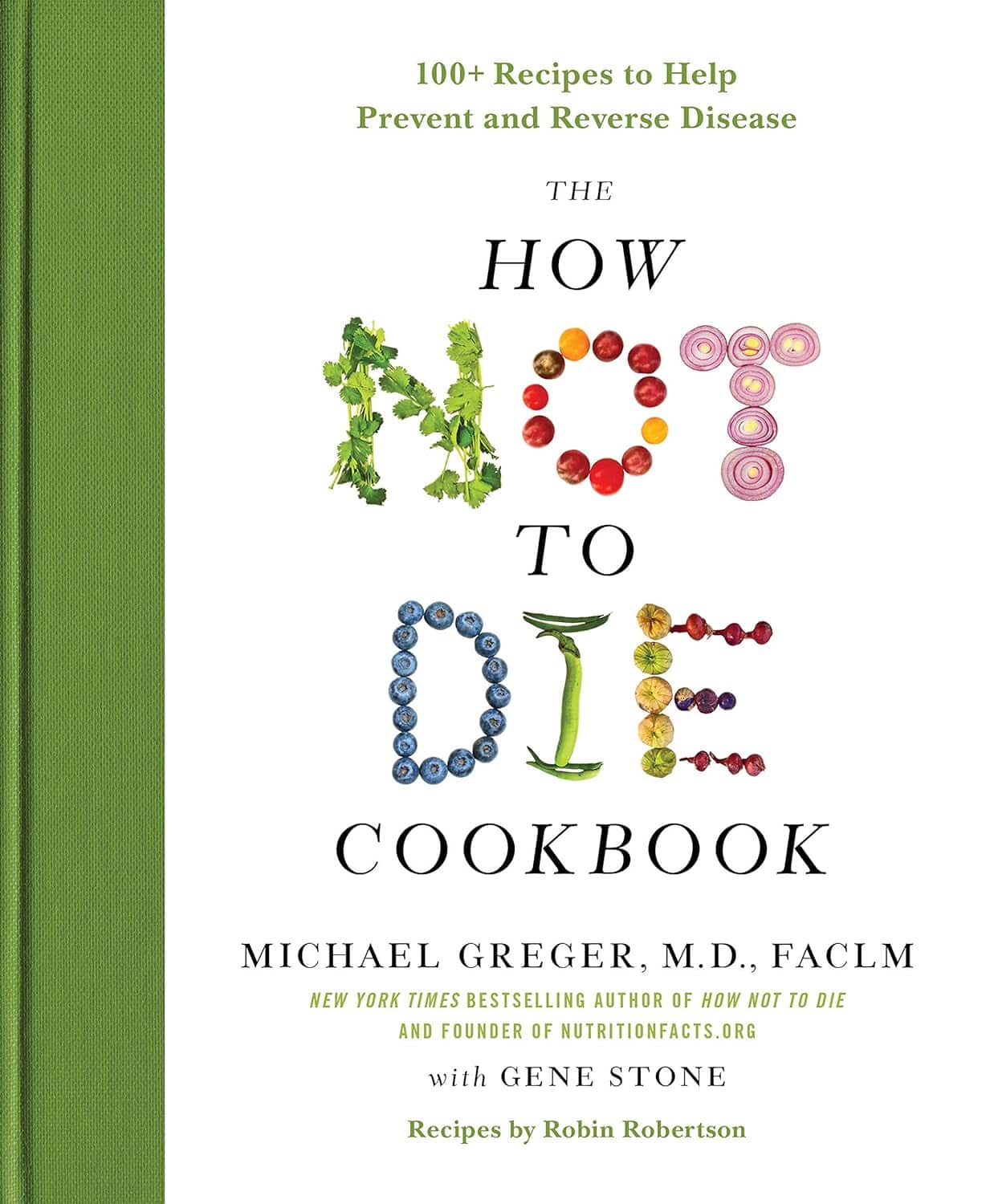
The How Not to Die Cookbook – by Dr. Michael Greger
10almonds is reader-supported. We may, at no cost to you, receive a portion of sales if you purchase a product through a link in this article.
We’ve previously reviewed Dr. Greger’s “How Not To Die”, which is excellent and/but very science-dense.
This book is different, in that the science is referenced and explained throughout, but the focus is the recipes, and how to prepare delicious healthy food in accordance with the principles laid out in How Not To Die.
It also follows “Dr Greger’s Daily Dozen“, that is to say, the 12 specific things he advises we make sure to have every day, and thus helps us to include them in an easy, no-fuss fashion.
The recipes themselves are by Robin Robertson, and/but with plenty of notes by Dr Greger; they clearly collaborated closely in creating them.
The ingredients are all things one can find in any well-stocked supermarket, so unless you live in a food desert, you can make these things easily.
And yes, the foods are delicious too.
Bottom line: if you’re interested in cooking according to perhaps the most science-based dietary system out there, then this book is a top-tier choice.
Click here to check out The How Not To Die Cookbook, and live well!
Don’t Forget…
Did you arrive here from our newsletter? Don’t forget to return to the email to continue learning!
Recommended
Learn to Age Gracefully
Join the 98k+ American women taking control of their health & aging with our 100% free (and fun!) daily emails:
-
The Plant-Based Diet Revolution – by Dr. Alan Desomond
10almonds is reader-supported. We may, at no cost to you, receive a portion of sales if you purchase a product through a link in this article.
Is this just another gut-healthy cooking guide? Not entirely…
For a start, it’s not just about giving you a healthy gut; it also covers a healthy heart and a healthy brain. There’s lots of science in here!
It’s also aimed as a transitional guide to eating more plants and fewer animal products, if you so choose. And if you don’t so choose, at least having the flexibility to cook both ways.
The recipes themselves (organized into basics, breakfasts, lunches, mains, desserts) are clear and easy while also being calculated to please readers (and their families) who are used to eating more meat. There are, for instance, plenty of healthy proteins, healthy fats, and comfort foods.
The “28 days” of the title refers to a meal plan using the recipes from the book; it’s not a big feature of the book though, so use it or don’t, but the cooking advice itself is more than worth the price of the book and the recipes are certainly great.
Bottom line: if you’re thinking of taking a “Meatless Mondays” approach to making your diet healthier, this book can help you do that in style!
Click here to check out The Plant-Based Diet Revolution, and upgrade your culinary repertoire!
Share This Post
-
Constipation increases your risk of a heart attack, new study finds – and not just on the toilet
10almonds is reader-supported. We may, at no cost to you, receive a portion of sales if you purchase a product through a link in this article.
If you Google the terms “constipation” and “heart attack” it’s not long before the name Elvis Presley crops up. Elvis had a longstanding history of chronic constipation and it’s believed he was straining very hard to poo, which then led to a fatal heart attack.
We don’t know what really happened to the so-called King of Rock “n” Roll back in 1977. There were likely several contributing factors to his death, and this theory is one of many.
But after this famous case researchers took a strong interest in the link between constipation and the risk of a heart attack.
This includes a recent study led by Australian researchers involving data from thousands of people.
Elvis Presley was said to have died of a heart attack while straining on the toilet. But is that true? Kraft74/Shutterstock Are constipation and heart attacks linked?
Large population studies show constipation is linked to an increased risk of heart attacks.
For example, an Australian study involved more than 540,000 people over 60 in hospital for a range of conditions. It found constipated patients had a higher risk of high blood pressure, heart attacks and strokes compared to non-constipated patients of the same age.
A Danish study of more than 900,000 people from hospitals and hospital outpatient clinics also found that people who were constipated had an increased risk of heart attacks and strokes.
It was unclear, however, if this relationship between constipation and an increased risk of heart attacks and strokes would hold true for healthy people outside hospital.
These Australian and Danish studies also did not factor in the effects of drugs used to treat high blood pressure (hypertension), which can make you constipated.
Researchers have studied thousands of people to see if there’s a link between constipation and heart attacks. fongbeerredhot/Shutterstock How about this new study?
The recent international study led by Monash University researchers found a connection between constipation and an increased risk of heart attacks, strokes and heart failure in a general population.
The researchers analysed data from the UK Biobank, a database of health-related information from about half a million people in the United Kingdom.
The researchers identified more than 23,000 cases of constipation and accounted for the effect of drugs to treat high blood pressure, which can lead to constipation.
People with constipation (identified through medical records or via a questionnaire) were twice as likely to have a heart attack, stroke or heart failure as those without constipation.
The researchers found a strong link between high blood pressure and constipation. Individuals with hypertension who were also constipated had a 34% increased risk of a major heart event compared to those with just hypertension.
The study only looked at the data from people of European ancestry. However, there is good reason to believe the link between constipation and heart attacks applies to other populations.
A Japanese study looked at more than 45,000 men and women in the general population. It found people passing a bowel motion once every two to three days had a higher risk of dying from heart disease compared with ones who passed at least one bowel motion a day.
How might constipation cause a heart attack?
Chronic constipation can lead to straining when passing a stool. This can result in laboured breathing and can lead to a rise in blood pressure.
In one Japanese study including ten elderly people, blood pressure was high just before passing a bowel motion and continued to rise during the bowel motion. This increase in blood pressure lasted for an hour afterwards, a pattern not seen in younger Japanese people.
One theory is that older people have stiffer blood vessels due to atherosclerosis (thickening or hardening of the arteries caused by a build-up of plaque) and other age-related changes. So their high blood pressure can persist for some time after straining. But the blood pressure of younger people returns quickly to normal as they have more elastic blood vessels.
As blood pressure rises, the risk of heart disease increases. The risk of developing heart disease doubles when systolic blood pressure (the top number in your blood pressure reading) rises permanently by 20 mmHg (millimetres of mercury, a standard measure of blood pressure).
The systolic blood pressure rise with straining in passing a stool has been reported to be as high as 70 mmHg. This rise is only temporary but with persistent straining in chronic constipation this could lead to an increased risk of heart attacks.
High blood pressure from straining on the toilet can last after pooing, especially in older people. Andrey_Popov/Shutterstock Some people with chronic constipation may have an impaired function of their vagus nerve, which controls various bodily functions, including digestion, heart rate and breathing.
This impaired function can result in abnormalities of heart rate and over-activation of the flight-fight response. This can, in turn, lead to elevated blood pressure.
Another intriguing avenue of research examines the imbalance in gut bacteria in people with constipation.
This imbalance, known as dysbiosis, can result in microbes and other substances leaking through the gut barrier into the bloodstream and triggering an immune response. This, in turn, can lead to low-grade inflammation in the blood circulation and arteries becoming stiffer, increasing the risk of a heart attack.
This latest study also explored genetic links between constipation and heart disease. The researchers found shared genetic factors that underlie both constipation and heart disease.
What can we do about this?
Constipation affects around 19% of the global population aged 60 and older. So there is a substantial portion of the population at an increased risk of heart disease due to their bowel health.
Managing chronic constipation through dietary changes (particularly increased dietary fibre), increased physical activity, ensuring adequate hydration and using medications, if necessary, are all important ways to help improve bowel function and reduce the risk of heart disease.
Vincent Ho, Associate Professor and clinical academic gastroenterologist, Western Sydney University
This article is republished from The Conversation under a Creative Commons license. Read the original article.
Share This Post
-
Celery vs Chard – Which is Healthier?
10almonds is reader-supported. We may, at no cost to you, receive a portion of sales if you purchase a product through a link in this article.
Our Verdict
When comparing celery to chard, we picked the chard.
Why?
In terms of macros, chard has more fiber, carbs, and protein, making it the more nutrient-dense option and thus the winner of the macros category.
In the category of vitamins, celery has more of vitamins B5 and B9, while chard has more of vitamins A, B1, B2, B3, B6, C, E, K, and choline—another win for chard.
When it comes to minerals, celery is not higher in any minerals, while chard has more calcium, copper, iron, magnesium, manganese, phosphorus, potassium, selenium, and zinc. One more very clear win for chard!
Looking at polyphenols, celery has very little to boast, about 3mg/100g furanocoumarins and nothing else, while chard has an impressive array of polyphenols, with 9mg/100g kaempferol and 7.5mg/100g quercetin atop the list of 12 polyphenols. Yet another win for chard.
Adding up the sections is not difficult arithmetic today: chard sweeps every category. But by all means enjoy either or both; diversity is good!
Want to learn more?
You might like:
Dr. Greger’s Daily Dozen ← the “dozen” in question includes getting a good amount of of leafy greens per day
Enjoy!
Share This Post
Related Posts
-
Metformin For Weight-Loss & More
10almonds is reader-supported. We may, at no cost to you, receive a portion of sales if you purchase a product through a link in this article.
Metformin Without Diabetes?
Metformin is a diabetes drug; it works by:
- decreasing glucose absorption from the gut
- decreasing glucose production in the liver
- increasing insulin sensitivity
It doesn’t change how much insulin is secreted, and is unlikely to cause hypoglycemia, making it relatively safe as diabetes drugs go.
It’s a biguanide drug, and/but so far as science knows (so far), its mechanism of action is unique (i.e. no other drug works the same way that metformin does).
Today we’ll examine its off-label uses and see what the science says!
A note on terms: “off-label” = when a drug is prescribed to treat something other than the main purpose(s) for which the drug was approved.
Other examples include modafinil against depression, and beta-blockers against anxiety.
Why take it if not diabetic?
There are many reasons people take it, including just general health and life extension:
However, its use was originally expanded (still “off-label”, but widely prescribed) past “just for diabetes” when it showed efficacy in treating pre-diabetes. Here for example is a longitudinal study that found metformin use performed similarly to lifestyle interventions (e.g. diet, exercise, etc). In their words:
❝ Lifestyle intervention or metformin significantly reduced diabetes development over 15 years. There were no overall differences in the aggregate microvascular outcome between treatment groups❞
But, it seems it does more, as this more recent review found:
❝Long-term weight loss was also seen in both [metformin and intensive lifestyle intervention] groups, with better maintenance under metformin.
Subgroup analyses from the DPP/DPPOS have shed important light on the actions of metformin, including a greater effect in women with prior gestational diabetes, and a reduction in coronary artery calcium in men that might suggest a cardioprotective effect.
Long-term diabetes prevention with metformin is feasible and is supported in influential guidelines for selected groups of subjects.❞
Source: Metformin for diabetes prevention: update of the evidence base
We were wondering about that cardioprotective effect, so…
Cardioprotective effect
In short, another review (published a few months after the above one) confirmed the previous findings, and also added:
❝Patients with BMI > 35 showed an association between metformin use and lower incidence of CVD, including African Americans older than age 65. The data suggest that morbidly obese patients with prediabetes may benefit from the use of metformin as recommended by the ADA.❞
We wondered about the weight loss implications of this, and…
For weight loss
The short version is, it works:
- Effectiveness of metformin on weight loss in non-diabetic individuals with obesity
- Metformin for weight reduction in non-diabetic patients: a systematic review and meta-analysis
- Metformin induces weight loss associated with gut microbiota alteration in non-diabetic obese women
…and many many more where those came from. As a point of interest, it has also been compared and contrasted to GLP-1 agonists.
Compared/contrasted with GLP-1 agonists
It’s not quite as effective for weight loss, and/but it’s a lot cheaper, is tablets rather than injections, has fewer side effects (for most people), and doesn’t result in dramatic yoyo-ing if there’s an interruption to taking it:
Or if you prefer a reader-friendly pop-science version:
Ozempic vs Metformin: Comparing The Two Diabetes Medications
Is it safe?
For most people yes, but there are a stack of contraindications, so it’s best to speak with your doctor. However, particular things to be aware of include:
- Usually contraindicated if you have kidney problems of any kind
- Usually contraindicated if you have liver problems of any kind
- May be contraindicated if you have issues with B12 levels
See also: Metformin: Is it a drug for all reasons and diseases?
Where can I get it?
As it’s a prescription-controlled drug, we can’t give you a handy Amazon link for this one.
However, many physicians are willing to prescribe it for off-label use (i.e., for reasons other than diabetes), so speak with yours (telehealth options may also be available).
If you do plan to speak with your doctor and you’re not sure they’ll be agreeable, you might want to get this paper and print it to take it with you:
Off-label indications of Metformin – Review of Literature
Take care!
Don’t Forget…
Did you arrive here from our newsletter? Don’t forget to return to the email to continue learning!
Learn to Age Gracefully
Join the 98k+ American women taking control of their health & aging with our 100% free (and fun!) daily emails:
-
Blackberries vs Passion Fruit – Which is Healthier?
10almonds is reader-supported. We may, at no cost to you, receive a portion of sales if you purchase a product through a link in this article.
Our Verdict
When comparing blackberries to passion fruit, we picked the passion fruit.
Why?
Both are great! But…
In terms of macros, passion fruit has 2x the fiber, as well as more carbs and protein, making it the more macronutrient-dense option and scoring it an easy first-round victory.
In the category of vitamins, blackberries have more of vitamins B9, E, and K, while passion fruit has more of vitamins A, B2, B3, B6, and C, for a modest yet clear win in this round.
Looking at minerals, blackberries have more calcium, copper, and zinc, while passion fruit has more iron, magnesium, phosphorus, potassium, and selenium, winning it its third round in a row.
In other considerations, blackberries do have more polyphenols, so that’s a round to blackberries.
Adding up the sections makes for a clear overall win for passion fruit, but by all means do enjoy either or both, as diversity is best!
Want to learn more?
You might like:
Are You Getting The Right Kinds Of Flavonoids?
Enjoy!
Don’t Forget…
Did you arrive here from our newsletter? Don’t forget to return to the email to continue learning!
Learn to Age Gracefully
Join the 98k+ American women taking control of their health & aging with our 100% free (and fun!) daily emails:
-
7 Tips To Start Back In The Gym After A Break
10almonds is reader-supported. We may, at no cost to you, receive a portion of sales if you purchase a product through a link in this article.
Whether we had an injury or illness, or life just got in the way, we’ve all had breaks from dedicated exercise sometimes. So, how to restart best?
Slow and steady
The way to do it is easier than you might think:
- Work up to everything: don’t jump back in at your previous level—rebuild from the basics, reestablish form, and focus on gradual progression.
- Do less than you think you need: avoid doing too much too soon; start small so that you don’t overdo it in your optimism and then need to take another break to recover.
- Don’t add weights first: progress through other methods like range of motion, tempo, or reps before increasing resistance; this allows your body time to adapt safely.
- Focus on what you feel working: prioritize mind-muscle connection to activate the correct muscles and improve movement quality; this is more important than external factors like how much weight you used.
- Prioritize your warm-up: include foam rolling, dynamic stretching, and activation exercises; they really do help improve the quality of the rest of your workout.
- Move in every direction: incorporate exercises across multiple planes of motion to improve mobility, stability, and functional strength, without leaving gaps in development (which invite injury).
- Stay consistent: follow a focused plan and avoid jumping between programs; repetition and routine are the keys to progress.
For more on each of these, enjoy:
Click Here If The Embedded Video Doesn’t Load Automatically!
Want to learn more?
You might also like:
Take care!
Don’t Forget…
Did you arrive here from our newsletter? Don’t forget to return to the email to continue learning!
Learn to Age Gracefully
Join the 98k+ American women taking control of their health & aging with our 100% free (and fun!) daily emails:


