

People are getting costly stem cell injections for knee osteoarthritis. But we don’t know if they work

10almonds is reader-supported. We may, at no cost to you, receive a portion of sales if you purchase a product through a link in this article.

More than 500 million people around the world live with osteoarthritis. The knee is affected more often than any other joint, with symptoms (such as pain, stiffness and reduced movement) affecting work, sleep, sport and daily activities.

Knee osteoarthritis is often thought of as thinning of the protective layer of cartilage within the joint. But we now understand it affects all the structures of the joint, including the bones, muscles and nerve endings.

While there are things that can be done to manage the symptoms of knee osteoarthritis, there is no cure, and many people experience persistent pain. As a result, an opportunity exists for as yet unproven treatments to enter the market, often before regulatory safeguards can be put in place.

Stem cell injections are one such treatment. A new review my colleagues and I published this week finds that evidence of their benefits and harms remains elusive.
Marinesea/Shutterstock

Stem cell treatments

Stem cells are already established as treatments for some diseases – mostly disorders of the blood, bone marrow or immune system – which has led to suggestions they could be used for a much wider array of conditions.

Stem cells have been touted as promising treatments for osteoarthritis because they have special properties which allow them to replicate and develop into the mature healthy cells that make up our body’s organs and other tissues, including cartilage.

Stem cell treatments for osteoarthritis generally involve taking a sample of tissue from a site that is rich in stem cells (such as bone marrow or fat), treating it to increase the number of stem cells, then injecting it into the joint.

The hope is that if the right type of stem cells can be introduced into an osteoarthritic joint in the right way and at the right time, they may help to repair damaged structures in the joint, or have other effects such as reducing inflammation.

But no matter how convincing the theory, we need good evidence for effectiveness and safety before a new therapy is adopted into practice.
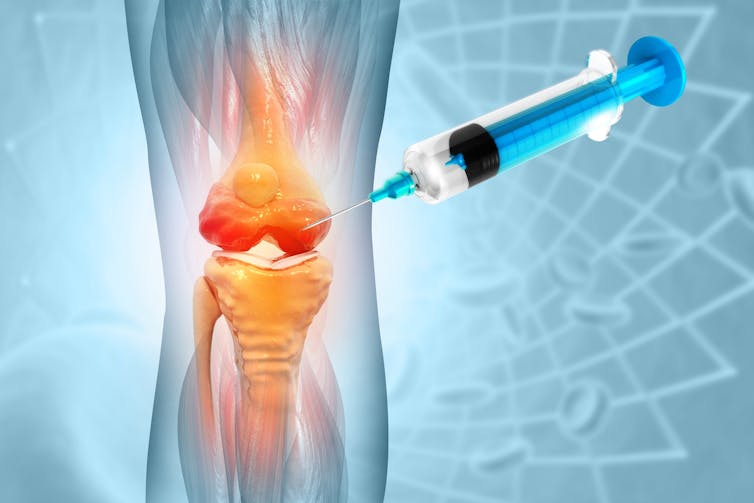
An illustration of an injection and a knee joint.
Stem cells have been touted as promising treatments for osteoarthritis. But what does the evidence say? crystal light/Shutterstock

Stem cell injections have not been approved by Australia’s Therapeutic Goods Administration for the treatment of osteoarthritis. Nonetheless, some clinics in Australia and around the world still offer them.

Because of the regulatory restrictions, we don’t have reliable numbers on how many procedures are being done.

They’re not covered by Medicare, so the procedure can cost the consumer thousands of dollars.

And, as with any invasive procedure, both the harvest of stem cells and the joint injection procedure may carry the potential for harm, such as infection.

What we found

Our new review, published by the independent, international group the Cochrane Collaboration, looks at all 25 randomised trials of stem cell injections for knee osteoarthritis that have been conducted worldwide to date. Collectively, these studies involved 1,341 participants.

We found stem cell injections may slightly improve pain and function compared with a placebo injection, but the size of the improvement may be too small for the patient to notice.

The evidence isn’t strong enough to determine whether there is any improvement in quality of life following a stem cell injection, whether cartilage regrows, or to estimate the risk of harm.

This means we can’t confidently say yet whether any improvement that might follow a stem cell injection is worth the risk (or the cost).
A woman sitting outside clutching her knee in pain.
Osteoarthritis of the knee is the most common type of osteoarthritis. michaelheim/Shutterstock

Hope or hype?

It’s not surprising we invest hope in finding a transformative treatment for such a common and disabling condition. Belief in the benefits of stem cells is widespread – more than three-quarters of Americans believe stem cells can relieve arthritis pain and more than half believe this treatment to be curative.

But what happens if a new treatment is introduced to practice before it has been clearly proven to be safe and effective?

The use of an unproven, invasive therapy is not just associated with the risks of the intervention itself. Even if the treatment were harmless, there is the risk of unnecessary cost, inconvenience, and a missed opportunity for the patient to use existing therapies that are known to be effective.

What’s more, if we need to play catch-up to try to establish an evidence base for a treatment that’s already in practice, we risk diverting scarce research resources towards a therapy that may not prove to be effective, simply because the genie is out of the bottle.
A senior man lying down while a physiotherapist examines his knee.
There are some ways to manage the symptoms of knee osteoarthritis. PeopleImages.com – Yuri A/Shutterstock

Working towards a clearer answer

Several more large clinical trials are currently underway, and should increase our understanding of whether stem cell injections are safe and effective for knee osteoarthritis.

Our review incorporates “living evidence”. This means we will continue to add the results of new trials as soon as they’re published, so the review is always up to date, and offers a comprehensive and trustworthy summary to help people with osteoarthritis and their health-care providers to make informed decisions.

In the meantime, there are a number of evidence-based treatment options. Non-drug treatments such as physiotherapy, regular exercise, maintaining a healthy weight, and cognitive behavioural therapy can be more effective than you think. Anti-inflammatory and pain medications can also play a supporting role.

Importantly, it’s not inevitable that osteoarthritic joints get worse with time. So, even though joint replacement surgery is often highly effective, it’s the last resort and fortunately, many people never need to take this step.

Samuel Whittle, ANZMUSC Practitioner Fellow, Monash University

This article is republished from The Conversation under a Creative Commons license. Read the original article.

Don’t Forget…

Did you arrive here from our newsletter? Don’t forget to return to the email to continue learning!

  • Acupuncture vs Massage, For Jaw Release!
    It’s Q&A Day at 10almonds! Have a question or a request? We love to hear from you! In cases where we’ve already covered something, we might link to what we wrote before, but will always be happy to revisit any of our topics again in the future too—there’s always more to say! No question/request too…

Learn to Age Gracefully

Join the 98k+ American women taking control of their health & aging with our 100% free (and fun!) daily emails:

  • Beat Food Addictions!

    10almonds is reader-supported. We may, at no cost to you, receive a portion of sales if you purchase a product through a link in this article.

    When It’s More Than “Just” Cravings

    This is Dr. Nicole Avena. She’s a research neuroscientist who also teaches at Mount Sinai School of Medicine, as well as at Princeton. She’s done a lot of groundbreaking research in the field of nutrition, diet, and addition, with a special focus on women’s health and sugar intake specifically.

    What does she want us to know?

    Firstly, that food addictions are real addictions.

    We know it can sound silly, like the famous line from Mad Max:

    ❝Do not, my friends, become addicted to water. It will take hold of you and you will resent its absence!❞

    ~ “Immortan Joe”

    As an aside, it is actually possible to become addicted to water; if one drinks it excessively (we are talking gallons every day) it does change the structure of the brain (no surprise; the brain is not supposed to have that much water!) causing structural damage that then results in dependency, and headaches upon withdrawal. It’s called psychogenic polydipsia:

    Primary polydipsia: Update

    But back onto today’s more specific topic, and by a different mechanism of addiction…

    Food addictions are dopaminergic addictions (as is cocaine)

    If you are addicted to a certain food (often sugar, but other refined carbs such as potato products, and also especially refined flour products, are also potential addictive substances), then when you think about the food in question, your brain lights up with more dopamine than it should, and you are strongly motivated to seek and consume the substance in question.

    Remember, dopamine functions by expectation, not by result. So until your brain’s dopamine-gremlin is sated, it will keep flooding you with motivational dopamine; that’s why the first bite tastes best, then you wolf down the rest before your brain can change its mind, and afterwards you may be left thinking/feeling “was that worth it?”.

    Much like with other addictions (especially alcohol), shame and regret often feature strongly afterwards, even accompanied by notions of “never again”.

    But, binge-eating is as difficult to escape as binge-drinking.

    You can break free, but you will probably have to take it seriously

    Dr. Avena recommends treating a food addiction like any other addiction, which means:

    1. Know why you want to quit (make a list of the reasons, and this will help you stay on track later!)
    2. Make a conscious decision to genuinely quit
    3. Learn about the nature of the specific addiction (know thy enemy!)
    4. Choose a strategy (e.g. wean off vs cold turkey, and decide what replacements, if any, you will use)
    5. Get support (especially from those around you, and/but the support of others facing, or who have successfully faced, the same challenge is very helpful too)
    6. Keep track of your success (build and maintain a streak!)
    7. Lean into how you will better enjoy life without addiction to the substance (it never really made you happy anyway, so enjoy your newfound freedom and good health!)

    Want more from Dr. Avena?

    You can check out her column at Psychology Today here:

    Psychology Today | Food Junkie ← it has a lot of posts about sugar addiction in particular, and gives a lot of information and practical advice

    You can also read her book, which could be a great help if you are thinking of quitting a sugar addiction:

    Sugarless: A 7-Step Plan to Uncover Hidden Sugars, Curb Your Cravings, and Conquer Your Addiction

    Enjoy!

    Share This Post

  • 8 Signs Of Hypothyroidism Beyond Tiredness & Weight Gain

    10almonds is reader-supported. We may, at no cost to you, receive a portion of sales if you purchase a product through a link in this article.

    When it comes to hypothyroidism, most people know to look out for tiredness and weight gain, and possibly menstrual disturbances in those who menstruate. But those symptoms could be caused by very many things, so what more specific signs and symptoms of hypothyroidism should we look out for?

    Dr. James O’Donovan shows us in this short video:

    The lesser-known signs

    Dr. O’Donovan discusses:

    1. Asteatotic eczema (also called: eczema craquelé): dry, cracked skin with a “crazy paving” appearance, leading to fissures. It’s common on the lower legs, back, torso, and arms, especially in older patients and especially in winter.
    2. Cold peripheries with pale, dry, coarse skin: cold hands and feet, along with dryness due to decreased sweating; these invariably come together, though the exact link is unclear.
    3. Yellowish hue to the skin (carotenoderma): yellow-orange discoloration from elevated beta-carotene levels. This can easily be mistaken for jaundice and also occurs in diabetes, liver, and kidney diseases.
    4. Thin, brittle hair: the hair on one’s head may become dry, coarse, and fall out in handfuls.
    5. Loss of hair on the outer third of eyebrows: thinning or disappearance of hair in this very specific area.
    6. Slow-growing, rigid, brittle nails: slowed nail growth due to decreased cell turnover rate. Ridges may form as keratin cells accumulate.
    7. Myxedema: puffy face, eyelids, legs, and feet caused by tissue swelling from cutaneous deposition.
    8. Delayed wound healing: is what it sounds like; a slower healing process.

    10almonds note: this video, like much of medical literature as well, does focus on what things are like for white people. Black people with hypothyroidism are more likely to see a lightening of hair pigmentation, and, in contrast, hyperpigmentation of the skin, usually in patches. We couldn’t find data for other ethnicities or skintones, but it does seem that most of the signs and symptoms (unrelated to pigmentation) should be the same for most people.

    Meanwhile, for more on the above 8 signs, with visuals, enjoy:

    Click Here If The Embedded Video Doesn’t Load Automatically!

    Want to learn more?

    You might also like to read:

    The Three Rs To Boost Thyroid-Related Energy Levels

    Take care!

    Share This Post

  • The Gut Bacteria That Improve Your General Decision-Making In Life

    10almonds is reader-supported. We may, at no cost to you, receive a portion of sales if you purchase a product through a link in this article.

    As one YouTube commenter said, “Trust your gut, but make sure you have a trustworthy gut first”!

    Dr. Tracey Marks, psychiatrist, explains how:

    Gut feelings and more

    As you probably know, the gut and brain communicate via the vagus nerve, making gut bacteria highly influential.

    How influential? Here are some key points from the video:

    • Healthier gut bacteria are linked to more cautious risk-taking and future-oriented decisions.
    • Gut bacteria influence serotonin (95% produced in the gut), dopamine, and neurotransmitters essential for decision-making.
    • People with good gut health prioritize fairness in decision-making.
    • The gut influences decision-making via neurotransmitter production, vagus nerve signaling, and inflammation control.

    Gut bacteria produce metabolites (beyond the neurotransmitters mentioned above!) that affect nerve circuits for emotion and executive function. These postbiotics (postbiotics = byproducts of gut bacteria fermenting prebiotics) play a crucial role in brain health. Examples of things they make include short-chain fatty acids (butyrate), enzymes, peptides, and vitamins, which between them strengthen gut lining, reduce inflammation, regulate serotonin, and support immune function. Scientists are even exploring postbiotics for treating metabolic and inflammatory diseases.

    Timeline of brain-gut axis health improvements

    • Days 4–14: gut bacterial composition starts changing (you probably won’t notice anything brainwise, but you may get gas; this is normal and temporary)
    • Weeks 2–6: mood and mental clarity improve (you’ll start feeling it here, most likely first in an abstract “life seems more beautiful” sort of way, plus less brain fog)
    • Months 2–3: long-term neural adaptations form (this is where the decision-making improvements come in, so you’ll need some patience about this, but the mood boost you’ve now had since weeks 2–6 should make the next bit even easier).

    Dr. Marks’ suggestions, to make the most of this:

    1. Diversify diet: aim for 30* different plant-based foods per week!
    2. Try fermented foods: start with small amounts of kimchi, kefir, etc.
    3. Increase fiber intake: add chia seeds or flaxseeds to meals!
    4. Limit artificial sweeteners: many of them disrupt gut bacteria.
    5. Maintain regular meal times: supports bacterial circadian rhythms.
    6. Don’t rely solely on supplements; whole foods are more effective!

    *this is not a random number out of a hat; there is science behind the number! Here’s the science.

    For more on all of this, enjoy:

    Click Here If The Embedded Video Doesn’t Load Automatically!

    Want to learn more?

    You might also like:

    Genius Gut: 10 New Gut-Brain Hacks to Revolutionise Your Energy, Mood, and Brainpower – by Dr. Emily Leeming

    Take care!

    Share This Post

Related Posts

  • Cross That Bridge – by Samuel J. Lucas

    10almonds is reader-supported. We may, at no cost to you, receive a portion of sales if you purchase a product through a link in this article.

    Books of this genre usually have several chapters of fluff before getting to the point. You know the sort:

    1. Let me tell you about some cherry-picked celebrity stories that overlook survivorship bias
    2. Let me tell you my life story, the bad parts
    3. My life story continued, the good parts now
    4. What this book can do for you, an imaginative pep talk that keeps circling back to me

    …then there will be two or three chapters of the actual advertised content, and then a closing chapter that’s another pep talk.

    This book, in contrast, throws that out of the window. Instead, Lucas provides a ground-up structure… within which, he makes a point of giving value in each section:

    • exercises
    • summaries
    • actionable advice

    For those who like outlines, lists, and overviews (as we do!), this is perfect. There are also plenty of exercises to do, so for those who like exercises, this book will be great too!

    Caveat: occasionally, the book’s actionable advices are direct but unclear, for example:

    • Use the potential and power of tea, to solve problems

    Context: there was no context. This was a bullet-pointed item, with no explanation. It was not a callback to anything earlier; this is the first (and only) reference to tea.

    However! The book as a whole is a treasure trove of genuine tips, tools, and voice-of-experience wisdom. Occasional comments may leave you scratching your head, but if you take value from the rest, then the book was already more than worth its while.

    Get Your Copy of Cross That Bridge on Amazon Today!

    Don’t Forget…

    Did you arrive here from our newsletter? Don’t forget to return to the email to continue learning!

    Learn to Age Gracefully

    Join the 98k+ American women taking control of their health & aging with our 100% free (and fun!) daily emails:

  • Have You Tried Cannabis Terpenes (not THC or CBD!) vs Pain?

    10almonds is reader-supported. We may, at no cost to you, receive a portion of sales if you purchase a product through a link in this article.

    We’ve previously covered such topics as Do CBD Gummies Work? and How Effective Is THC Against Chronic Pain?, as well as more general perspectives along the lines of Do “Natural” Painkillers Really Work?, but what of these newly-examined cannabis compounds that are neither CBD nor THC, but may well work against pain, including fibromyalgia pain that often quite little will touch?

    Fibromyalgia is generally a good test of whether a pain relief method will work, independent of treating the cause—precisely because fibromyalgia is, when we look at it through a more critical lens, basically “pain that the doctors weren’t able to attribute to anything else”.

    In this way, yes, that does also mean that fibromyalgia is less of a useful diagnosis and more of a rubber stamp, much like the role historically often fulfilled by “heart failure” as an official cause of death (because certainly, that heart sure did stop beating). It’s a way of answering the question without answering the question.

    It’s what doctors write down when they’ve ruled out possible causes they’re aware of, and don’t want to admit they don’t know why your body is doing what it is.

    It’s saying “I diagnose you with tired hurty syndrome, good luck, that’ll be [astonishing sum of dollars for the privilege of receiving this nothingburger answer] thank you”.

    To be clear, while we are disparaging fibromyalgia as a useful diagnosis, we’re not dismissing the actual effect it has on people.

    So while fibromyalgia has some potential use as a placeholder descriptor, it’s not an actionable answer, and it means that if that’s the diagnosis you’re handed, it can be beneficial to keep looking for the cause (because fibromyalgia is a result, not a cause).

    For more on that, see: Why Fibromyalgia Is Not An Acceptable Diagnosis (and what to look for instead)

    With that in mind, let’s get on to…

    Terpenes, pain, & you

    Researchers (Dr. Alyssa Welborn et al.) found that four cannabis-derived terpenes* reduced post-surgical pain and fibromyalgia pain without relying on THC, the main psychoactive component of cannabis, or for that matter, CBD.

    *Namely:

    • geraniol
    • linalool
    • β-caryophyllene
    • α-humulene

    How they appear to work: the pain-relieving effects were blocked by istradefylline, a drug that blocks the adenosine A2A receptor, indicating that activation of this receptor is likely the mechanism of action for the terpenes’ effects.

    You may be wondering: what actually are terpenes? Terpenes are aromatic compounds found in cannabis and many other plants, that contribute to their smell and flavor, and no, they don’t produce the “high” associated with THC.

    So, this is all sounding pretty good so far.

    Any downsides?

    In a mouse model experiment, the terpenes didn’t reduce responses in a hot-plate test that measures acute pain, supporting the researchers’ earlier conclusion that terpenes appear more effective for chronic or pathological pain than for immediate injury-related pain.

    However, even that isn’t entirely a downside. After all, we’ve evolved acute pain responses for a reason, and that reason is to keep us safe. Where our evolutionary responses go screwy is when it comes to chronic pain, in which case it’s often a matter of our pain pathways misfiring and/or getting caught in an unhelpful feedback loop.

    You can read the latest paper in full, here: Select terpenes from Cannabis sativa are antinociceptive in mouse models of post-operative pain and fibromyalgia via adenosine A2a receptors

    Want to learn more?

    We’ve written quite a bit about pain management, including:

    Take care!

    Don’t Forget…

    Did you arrive here from our newsletter? Don’t forget to return to the email to continue learning!

    Learn to Age Gracefully

    Join the 98k+ American women taking control of their health & aging with our 100% free (and fun!) daily emails:

  • What Happens When You Break A Bone?

    10almonds is reader-supported. We may, at no cost to you, receive a portion of sales if you purchase a product through a link in this article.

    Drs. Gurpreet Baht and Natalie Pang give us the insider info:

    To the bone

    About half of all people will break at least one bone during their lifetime, and the body’s 200+* bones come in several categories including short bones, long bones, flat bones, and irregular bones.

    *You may have heard different numbers. Popular numbers in the public consciousness include 215 (thanks to a famous line in the movie Terminator II: Judgment Day), and 206 which is a very popular reckoning with rather sounder reasoning, but 200 is the baseline unless you’re missing some. The reason for the variation is that humans start with 270–300 bones, but many of these fuse together in infancy (for example, much of the skull and coccyx, most of which fusing is done around ages 1–2 years), resulting in a smaller total number. Another reason for variation in total number is that some people have some extra bones, which is usually a case of a harmless copying error.

    Of these, long bones tend to fracture more frequently because they usually absorb the main force of impacts such as falls. However, in the case of somebody more frail than average (so, a lot of older people, for example), hips become quite common candidates, because upon falling: a) they’re often not falling from a great height than their own, so they didn’t break a leg b) they weren’t quick enough to put an arm out to try to break their fall, which means, if falling sideways, which there’s a 50% chance of being the case, the hip hits the floor full-force.

    Some quick notes on the physiology going on here:

    • On why it hurts quite so much: bones contain blood vessels and nerves that transmit intense pain signals during fractures, though scientists still don’t fully understand why broken bones hurt so much because these nerves are encased in hard tissue and difficult to study.
    • On how healing gets going: when a bone breaks the internal blood vessels rupture, causing bleeding and inflammation that begin the healing process.

    That process is a several-stage affair:

    1. Inflammatory phase: during roughly the first week immune cells clear damaged tissue and release signalling molecules that recruit stem cells to the injury site.
    2. Cartilage callus formation: recruited stem cells become chondrocytes that use the blood clot at the fracture site as a scaffold to quickly build a temporary cartilage callus.
    3. Bony callus formation and remodeling: some chondrocytes and stem cells become osteoblasts that create a stronger bony callus, after which specialized cells gradually reshape the bone over several months while osteoblasts lay down new bone tissue.
    4. Treatment and healing variability: healing time depends on factors such as diet, rest, and fracture severity, with clean breaks often treated using casts or splints while severe or displaced fractures may require surgery with pins, plates, or screws.
    5. Misaligned healing and final outcome: if a bone heals incorrectly surgeons may need to refracture and realign it, and although a small bump may remain temporarily after healing the bone typically becomes as strong as it was before.

    For more on all of this, plus some visual illustrations, enjoy:

    Click Here If The Embedded Video Doesn’t Load Automatically!

    Want to learn more?

    You might also like:

    5 Hip Exercises To Strengthen Bones & Improve Balance (Osteoporosis-Friendly)

    Take care!

    Don’t Forget…

    Did you arrive here from our newsletter? Don’t forget to return to the email to continue learning!

    Learn to Age Gracefully

    Join the 98k+ American women taking control of their health & aging with our 100% free (and fun!) daily emails: