
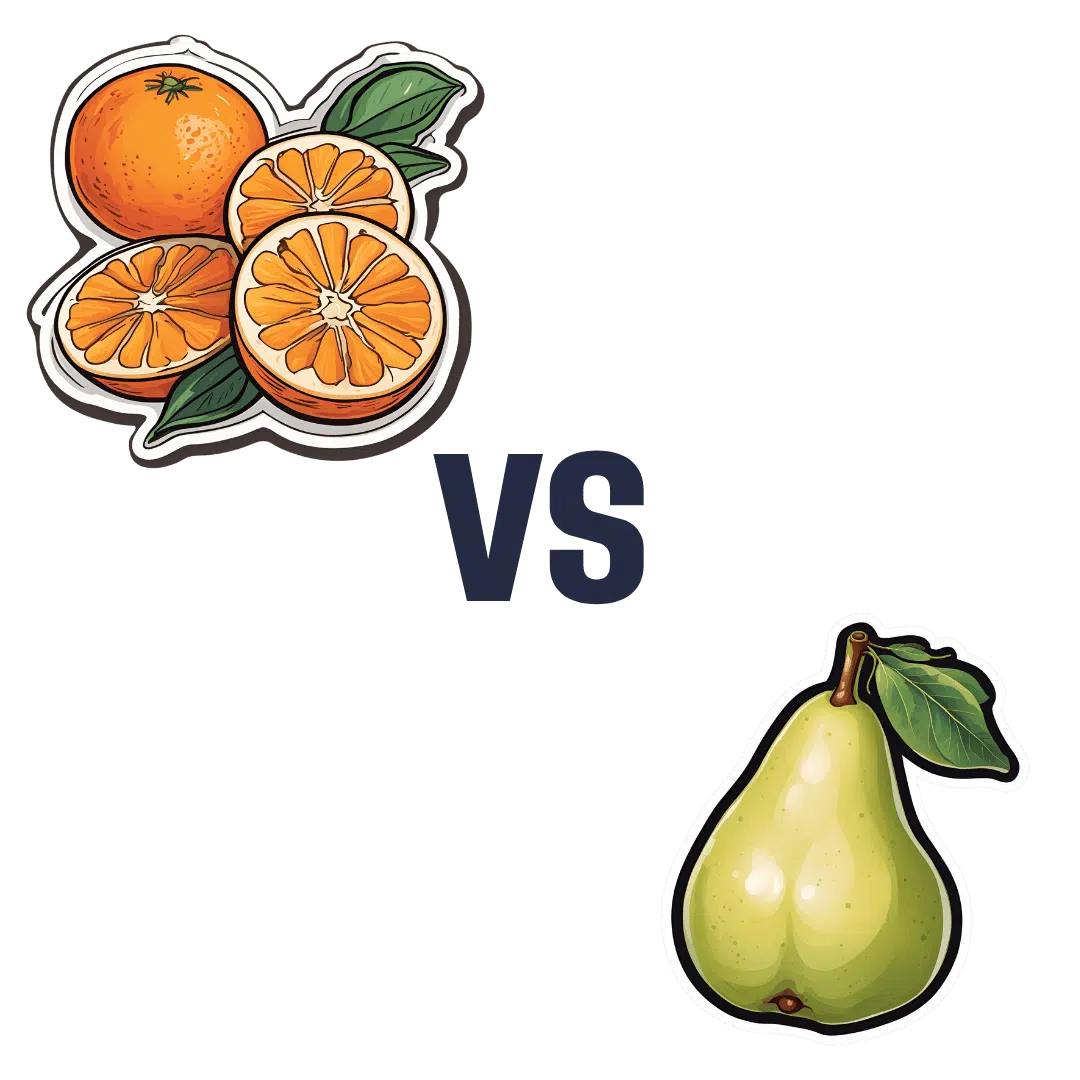
Orange vs Pear – Which is Healthier?
10almonds is reader-supported. We may, at no cost to you, receive a portion of sales if you purchase a product through a link in this article.
Our Verdict
When comparing orange to pear, we picked the orange.
Why?
In terms of macros, the numbers are too close to call, to the point that having slightly different rain or soil could swing it either way, so we’re calling this round a tie, and let’s simply note that they’re both good sources of fiber.
In the category of vitamins, however, oranges have more of vitamins A, B1, B2, B3, B5, B6, B7, B9, C, and E, while pears have more of vitamin K, so that’s an easy win for oranges.
Looking at minerals, oranges have more calcium, magnesium, phosphorus, potassium, and selenium, while pears have more copper, iron, manganese, and zinc, yielding to oranges a more marginal 5:4 win here.
In other considerations, oranges are higher in polyphenols, especially flavonoids, so that’s another point in oranges’ favor.
Adding up the sections makes for a clear overall win for oranges, but by all means do enjoy either or both, as diversity is good!
Want to learn more?
You might like:
Are You Getting The Right Kinds Of Flavonoids?
Enjoy!
Don’t Forget…
Did you arrive here from our newsletter? Don’t forget to return to the email to continue learning!
Recommended
Learn to Age Gracefully
Join the 98k+ American women taking control of their health & aging with our 100% free (and fun!) daily emails:
-
How to Find Happiness In Yourself – by Michelle Mann
10almonds is reader-supported. We may, at no cost to you, receive a portion of sales if you purchase a product through a link in this article.
A lot of books about happiness tell you what to pursue, generally. What things to focus on, and that’s good, but incomplete. This book does cover those things too (complete with academic sources to back up what really works), but also goes further:
Michelle Mann gives 25 key habits that will cumulatively build happiness, which is what it’s really about. After all:
- If you watch your favourite movie, you’ll be happy for 90 minutes (or 9 hours if it’s The Lord of the Rings).
- If you build daily habits that add happiness to you, your surroundings, and those around you, you’ll be happy for life.
They do also cover happiness while going through difficult times, such as divorce, job loss, illness, or bereavement.
Sometimes, knowing what we “should” do in theory is the easy part. Where Mann excels here is in providing explanations of each habit. This means that rather than it being some platitude, the principles underlying it are truly understood… and thus motivate us to actually apply the advice and build the habits into our life.
While the explanations are therefore the greatest value of the book, we do recommend copying out the 25 habits (which are effectively subchapter headings) and putting them somewhere to read often.
Bottom line: we recommend getting yourself (and/or your loved ones!) a copy of this book. You (and/or they) will be happy you did!
Share This Post
-
Darwin’s Bed Rest: Worthwhile Idea?
10almonds is reader-supported. We may, at no cost to you, receive a portion of sales if you purchase a product through a link in this article.
It’s Q&A Day at 10almonds!
Have a question or a request? You can always hit “reply” to any of our emails, or use the feedback widget at the bottom!
In cases where we’ve already covered something, we might link to what we wrote before, but will always be happy to revisit any of our topics again in the future too—there’s always more to say!
As ever: if the question/request can be answered briefly, we’ll do it here in our Q&A Thursday edition. If not, we’ll make a main feature of it shortly afterwards!
So, no question/request too big or small
❝I recall that Charles Darwin (of Evolution fame) used to spend a day a month in bed in order to maintain his physical and psychological equilibrium. Do you see merit in the idea?❞
Well, it certainly sounds wonderful! Granted, it may depend on what you do in bed :p
Descartes did a lot of his work from bed (and also a surprising amount of it while hiding in an oven, but that’s another story), which was probably not so good for the health.
As for Darwin, his health was terrible in quite a lot of ways, so he may not be a great model.
However! Certainly taking a break is well-established as an important and healthful practice:
How To Rest More Efficiently (Yes, Really)
❝I don’t like to admit it but I am getting old. Recently, I had my first “fall” (ominous word!) I was walking across some wet decking and, before I knew what had happened, my feet were shooting forwards, and I crashed to the ground. Luckily I wasn’t seriously damaged. But I was wondering whether you can give us some advice about how best to fall. Maybe there are some good videos on the subject? I would like to be able to practice falling so that it doesn’t come as such a shock when it happens!❞
This writer has totally done the same! You might like our recent main feature on the topic:
…if you’ll pardon the pun
Enjoy!
Share This Post
-
Genius Foods – by Max Lugavere
10almonds is reader-supported. We may, at no cost to you, receive a portion of sales if you purchase a product through a link in this article.
There is a lot of seemingly conflicting (or sometimes: actually conflicting!) information out there with regard to nutrition and various aspects of health. Why, for example, are we told:
- Be sure to get plenty of good healthy fats from nuts and seeds, for metabolic health and brain health too!
- But these terrible nut and seed oils lead to heart disease and dementia! Avoid them at all costs!
Max Lugavere demystifies this and more.
His science-led approach is primarily focused on avoiding dementia, and/but is at least not bad when it comes to other areas of health too.
He takes us on a tour of different parts of our nutrition, including:
- Perhaps the clearest explanation of “healthy” vs “unhealthy” fats this reviewer has read
- Managing carbs (simple and complex) for healthy glucose management—essential for good brain health
- What foods to improve or reduce—a lot you might guess, but this is a comprehensive guide to brain health so it’d be remiss to skip it
- The role that intermittent fasting can play as a bonus extra
While the main thrust of the book is about avoiding cognitive impairment in the long-term (including later-life dementia), he makes good, evidence-based arguments for how this same dietary plan improves cognitive function in the short-term, too.
Speaking of that dietary plan: he does give a step-by-step guide in a “make this change first, then this, then this” fashion, and offers some sample recipes too. This is by no means a recipe book though—most of the book is taking us through the science, not the kitchen.
Bottom line: this is the book for getting unconfused with regard to diet and brain health, making a lot of good science easy to understand. Which we love!
Click here to check out “Genius Foods” on Amazon today, give your brain a boost!
Share This Post
Related Posts
-
“Slugging” Skin Care Routine (Tips From A Dermatologist)
10almonds is reader-supported. We may, at no cost to you, receive a portion of sales if you purchase a product through a link in this article.
Dermatologist Dr. Jenny Liu weighs in with advice!
Sometimes simplest is best
Slugging is a skincare trend involving applying petrolatum (e.g. Vaseline) as the final step to lock in hydration and repair the skin barrier. It’s particularly useful for dry, sensitive, or eczema-prone skin, and/or damaged skin barriers from overuse of actives or harsh conditions.
How it works: the waterproof layer reduces water loss (up to 99%) and facilitates repair the skin barrier. Thus, it indirectly hydrates the skin, supports natural exfoliation, and reduces fine lines. Best of all, it’s non-irritating, non-comedogenic, and safe for all skin types.
How to do it:
- Cleanse thoroughly to remove makeup and impurities.
- Apply a moisturizer or serum with humectants (e.g. glycerin, hyaluronic acid).
- Seal with petrolatum (e.g. Vaseline or similar).
- Skip areas with stronger active ingredients (e.g. retinoids) and active acne areas.
- Apply 30–60 minutes before bed to reduce product transfer.
- Use a gentle cleanser in the morning to remove residue.
For more on all of this, enjoy:
Click Here If The Embedded Video Doesn’t Load Automatically!
Want to learn more?
You might also like to read:
Castor Oil: All-Purpose Life-Changer, Or Snake Oil? ← skincare is one of the things it definitely does work well for, and can be used for slugging also.
Take care!
Don’t Forget…
Did you arrive here from our newsletter? Don’t forget to return to the email to continue learning!
Learn to Age Gracefully
Join the 98k+ American women taking control of their health & aging with our 100% free (and fun!) daily emails:
-
How Do DNA Repair Enzymes Actually Help?
10almonds is reader-supported. We may, at no cost to you, receive a portion of sales if you purchase a product through a link in this article.
Dr. Andrea Suarez explains:
Are They Worth It?
DNA repair enzymes are what they sound like: enzymes that repair damage to DNA.
They’re derived from bacteria and plants and can function in human cells to fix UV- and oxidation-induced DNA damage.
How they get where they need to be: the enzymes are encapsulated in liposomes, which mimic cell membranes and allow penetration through the stratum corneum. Once inside keratinocytes, the liposomes dissolve and release the enzymes that then reach the nucleus to repair the DNA.
Does it work? The evidence is strong for some claims, not so much for others:
- Sunscreen plus DNA repair enzymes reduced markers of DNA damage and precancerous actinic keratoses more than sunscreen alone.
- Evidence for reducing wrinkles, reducing hyperpigmentation, or improving elasticity is limited and not yet convincing.
Is it safe? Human and animal studies—including in people with xeroderma pigmentosum—show excellent safety, even with long-term use. Rare issues include mild irritation or burning if you get it in your eyes, so maybe don’t put it there.
In few words: while it’s not yet a scientifically sound choice for beauty considerations, it does augment the protective power of sunscreen, on a cellular level, reducing sun-induced DNA damage that not only ages your skin, but also could turn cancerous if left unchecked.
For more on all of this, enjoy:
Click Here If The Embedded Video Doesn’t Load Automatically!
Want to try some?
We don’t sell it, but here for your convenience is an example product on Amazon 😎
Be warned, it is pricier than it looks!
Don’t Forget…
Did you arrive here from our newsletter? Don’t forget to return to the email to continue learning!
Learn to Age Gracefully
Join the 98k+ American women taking control of their health & aging with our 100% free (and fun!) daily emails:
-
The Pain-Free Mindset – by Dr. Deepak Ravindran
10almonds is reader-supported. We may, at no cost to you, receive a portion of sales if you purchase a product through a link in this article.
First: please ignore the terrible title. This is not the medical equivalent of “think and grow rich”. A better title would have been something like “The Pain-Free Plan”.
Attentive subscribers may notice that this author was our featured expert yesterday, so you can learn about his “seven steps” described in our article there, without us repeating that in our review here.
This book’s greatest strength is also potentially its greatest weakness, depending on the reader: it contains a lot of detailed medical information.
This is good or bad depending on whether you like lots of detailed medical information. Dr. Ravindran doesn’t assume prior knowledge, so everything is explained as we go. However, this means that after his well-referenced clinical explanations, high quality medical diagrams, etc, you may come out of this book feeling like you’ve just done a semester at medical school.
Knowledge is power, though, so understanding the underlying processes of pain and pain management really does help the reader become a more informed expert on your own pain—and options for reducing that pain.
Bottom line: this, disguised by its cover as a “think healing thoughts” book, is actually a science-centric, information-dense, well-sourced, comprehensive guide to pain management from one of the leading lights in the field.
Click here to check out The Pain-Free Mindset, and manage yours more comfortably!
Don’t Forget…
Did you arrive here from our newsletter? Don’t forget to return to the email to continue learning!
Learn to Age Gracefully
Join the 98k+ American women taking control of their health & aging with our 100% free (and fun!) daily emails:


