
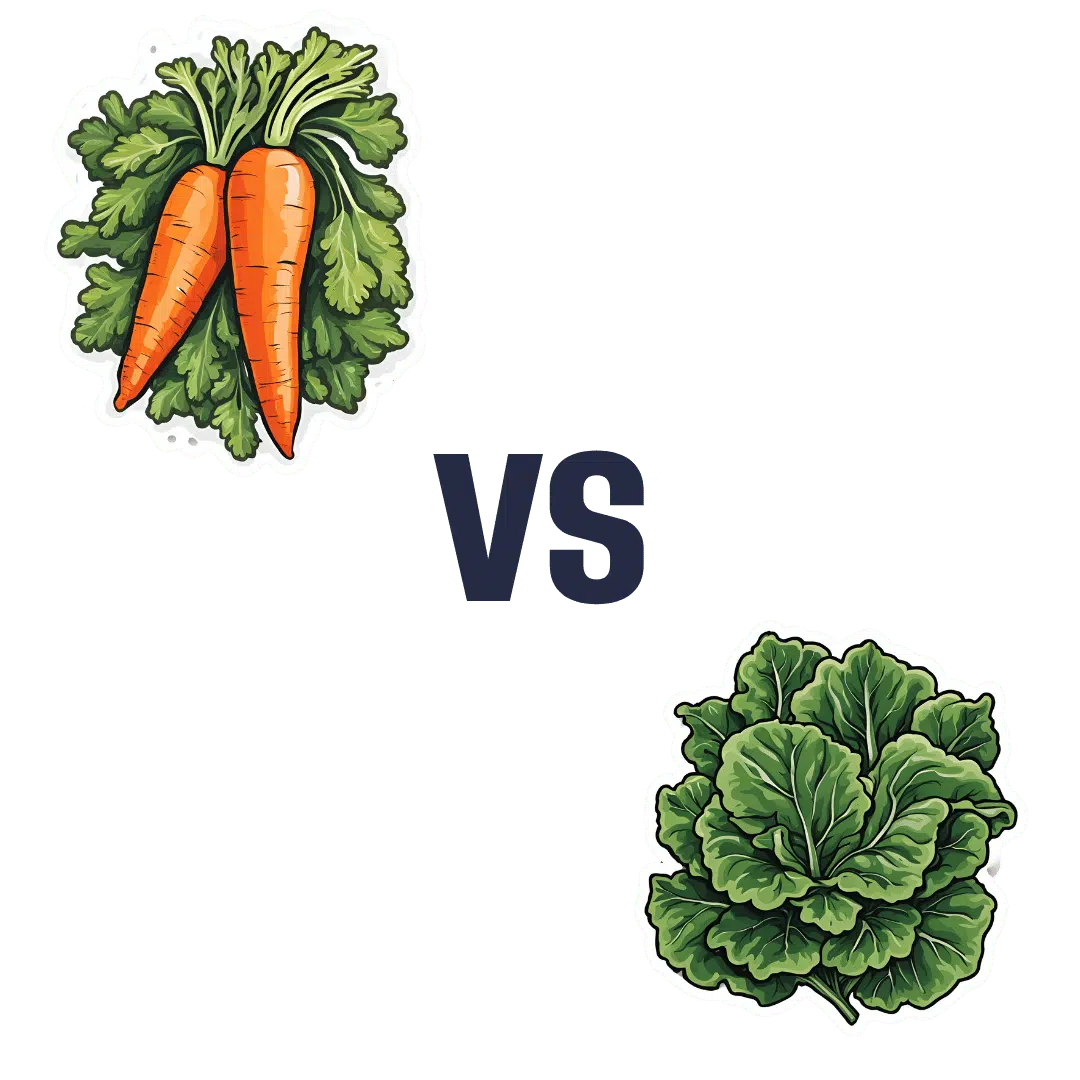
Carrots vs Kale – Which is Healthier?
10almonds is reader-supported. We may, at no cost to you, receive a portion of sales if you purchase a product through a link in this article.
Our Verdict
When comparing carrots to kale, we picked the kale.
Why?
Not entirely a like-for-like comparison here (root vegetable vs leafy greens), but these are both well-known as carotene-containing heavyweights, and kale emerges victorious:
In terms of macros, carrots have more carbs while kale has more protein and fiber. An easy first-round win here for kale.
In the category of vitamins, both are great! But, carrots contain more of vitamins A and B5, whereas kale contains more of vitamins B1, B2, B3, B6, B7, B9, C, E, and K. And while carrot’s strongest point is vitamin A, a cup of carrots contains around 10x the recommended daily dose of vitamin A, whereas a cup of kale contains “only” 6x the recommended daily dose of vitamin A. So, did we really need the extra in carrots? Probably not. And vitamin B5 is in almost all foods (its name, pantothenic acid, literally means “from everywhere”), so it’s very hard to be deficient in that unless literally starving to death. In any case, kale already won on overall vitamin coverage, by a long way.
Looking at minerals, kale again sweeps. On the one hand, carrots contain more sodium. On the other hand, kale contains a lot more calcium, copper, iron, magnesium, manganese, phosphorus, potassium, selenium, and zinc. Not a tricky choice!
In other considerations, kale also has more polyphenols, most notably flavonols such as kaempferol and quercetin. So that’s another point in kale’s favor.
But don’t be fooled: carrots really are a nutritional powerhouse and a great food. Kale is just better—nutritionally speaking, in any case. If you’re making a carrot cake, please don’t try substituting kale; it will not work 😉
In any case, adding up the sections makes for a clear overall win for kale, but by all means do enjoy either or both; diversity is good!
Want to learn more?
You might like to read:
- Brain Food? The Eyes Have It!
- What Does Kaempferol Do, Anyway?
- Fight Inflammation & Protect Your Brain, With Quercetin
Take care!
Don’t Forget…
Did you arrive here from our newsletter? Don’t forget to return to the email to continue learning!
Recommended
Learn to Age Gracefully
Join the 98k+ American women taking control of their health & aging with our 100% free (and fun!) daily emails:
-
Why Telomeres Shorten, & What Can Be Done About It
10almonds is reader-supported. We may, at no cost to you, receive a portion of sales if you purchase a product through a link in this article.
Telomeres are protective caps at the ends of our DNA, similar to the plastic tips on shoelaces (there’s a repeated “junk DNA” string, TTAGGG in humans, kept safe in a sheathe, which made of shelterin, a protein complex).
They prevent our genetic material from becoming damaged or tangled. However, each time a cell divides, telomeres get a little shorter because the copying process isn’t perfect (DNA polymerase can’t replicate everything inside the sheathe, because it is too well-protected).
So, how do we deal with this?
Lacing up for long life
An enzyme called telomerase (discovered as recently as 2009 by Nobel Prize-winning scientists Dr. Elizabeth Blackburn et al.) can rebuild telomeres. It has two main parts: one part1 that makes new DNA and another part2 that acts as a guide. Most cells don’t produce enough telomerase, so telomeres still tend to shrink over time.
1 TERT (Telomerase Reverse Transcriptase), which synthesizes telomeric DNA
2 TERC (Telomerase RNA Component), which serves as a templateWhen telomeres become too short, cells stop dividing. Some cells may enter a damaged state (e.g. senescent “zombie” cells) or die. In some cases, cells bypass this limit by reactivating telomerase, which can lead to cancer.
Studies on mice show that when telomerase is missing, they age more quickly and struggle to repair tissues. When telomerase is restored, aging effects are reversed. Human research also links short telomeres to age-related diseases like immune system decline and organ damage.
Researchers have already found some ways to slow aging by:
- Activating telomerase (e.g. with small molecules like TA-65).
- Gene therapy to transiently express telomerase.
- Stabilizing TERC RNA component to prevent degradation.
However, increasing telomerase too much could raise the risk of cancer. So, it’s a bit of a juggling act yet.
For more on all of this, enjoy:
Click Here If The Embedded Video Doesn’t Load Automatically!
Want to learn more?
You might also like:
Fisetin: The Anti-Aging Assassin ← kills senescent cells, meaning newer cells are copied rather than older ones, resulting in copied cells with less DNA damage
Take care!
Share This Post
-
Laugh Often, To Laugh Longest!
10almonds is reader-supported. We may, at no cost to you, receive a portion of sales if you purchase a product through a link in this article.
Putting The Abs Into Absurdity
We’ve talked before about the health benefits of a broadly positive outlook on life:
Optimism Seriously Increases Longevity!
…and we’re very serious about it, but that’s about optimistic life views in general, and today we’re about not just keeping good humor in questionable circumstances, but actively finding good humor in the those moments—even when the moments in question might not be generally described as good!
After all, laughter really can be the best medicine, for example:
From the roots
First a quick recap on de-toothing the psychological aspect of threats, no matter how menacing they may be:
Hello, Emotions: Time For Radical Acceptance!
…which we can then take a step further:
What’s The Worst That Could Happen?
Choose your frame
Do you remember when that hacker hacked and publicized the US Federal no-fly list, after already hacking a nationwide cloud-based security camera company, getting access to more than 150,000 companies’ and private individuals’ security cameras, amongst various other cyber crimes, mostly various kinds of fraud and data theft?
Imagine how she (age 21) must have felt, when being indicted. What do you suppose this hacker had to say for itself under such circumstances?
❝congress is investigating now 🙂
but i stay silly :3 ❞
…the latter half of which, usually rendered “but I stay silly” or “but we stay silly” has since entered popular Gen-Z parlance, usually after expressing some negative thing, often in a state of powerlessness.
Which is an important life skill if powerlessness is something that is often likely.
It’s important for many Gen-Zs with negligible life prospects economically; it’s equally important for 60-somethings getting cancer diagnoses (statistically the most likely decade to find out one has cancer, by the way), and many other kinds of people younger, older, and in between.
Because at the end of the day, we all start powerless and we all end powerless.
Learned helplessness (two kinds)
In psychology, “learned helplessness” occurs when a person or creature gives up after learning that all and any attempts to resist a Bad Thing™ fail, perhaps even badly. A lab rat may just shut down and sit there getting electroshocked, for example. A person subjected to abuse may stop trying to improve their situation, and just go with the path of least resistance.
But, there’s another kind, wherein someone in a position of absolute powerlessness not only makes their peace with that, but also, decides that the one thing the outside world can’t control, is how they take it. Like the hacker we mentioned earlier.
Sometimes the gallows humor is even more literal, laughing at one’s own impending death. Not as a matter of bravado, but genuinely seeing the funny side.
But how?
Unfortunately, fortunately
The trick here is to “find a silver lining” that is nowhere near enough to compensate for the bad thing—and it may even be worse! But that’s fine:
“Unfortunately, I didn’t have time to do the dishes before leaving for my vacation. Fortunately, I also forgot to turn the oven off, so the house burning down covered up my messy kitchen”
Writer’s personal less drastic example: today I set my espresso machine to press me an espresso; it doesn’t have an auto-off and I got distracted and it overflowed everywhere; my immediate reaction was “Oh! I have been blessed with an abundance of coffee!”
This kind of silly little thing, on a daily basis, builds a very solid habit for life that allows one to see the funny side in even the most absurd situations, even matters of life and death (can confirm: been there enough times personally—so far so good, still alive to find the remembered absurdity silly).
The point is not to genuinely value the “silver lining”, because half the time it isn’t even one, really, and it is useless to pretend, in seriousness.
But to pretend in silliness? Now we’re onto something, and the real benefit is in the laughs we had along the way.
Because those worst moments? Are probably when we need it the most, so it’s good to get some practice in!
Want more ways to find the funny and make it a life habit?
We reviewed a good book recently:
The Humor Habit: Rewire Your Brain To Stress Less, Laugh More, And Achieve More’er – by Paul Osincup
Stay silly!
Share This Post
-
The Longevity Code – by Dr. Kris Verburgh
10almonds is reader-supported. We may, at no cost to you, receive a portion of sales if you purchase a product through a link in this article.
Notwithstanding the subtitle claim of “secrets from the leading edge of science”, we’ll note up front that this book was published in 2015, and what was new then, isn’t now. However, what was new then is still important now, so we think the book merits attention just the same.
The book examines why certain creatures (like humans) seem programmed to grow old and die, and why others (few others, but enough to make a list) either simply do not age, or else do age but can become younger when they hit a certain point. If this is the first you’re hearing of biologically immortal creatures, we’ll mention: they can and do die, just, their cause of death is usually by being eaten. But on a cellular and structural level, they don’t age. They grow to maturity and then just stay that way until one day they get eaten (or fall to some similar external circumstance).
Tackling the question of “why do we age?” (not as a philosophical question, but rather as an engineering question) is important to tackle the critical question of “…and could we not?”, and that’s what much of this book is about.
The real reason that compared to other mammals, humans live (for example) slightly longer than bats but not as long as naked mole rats, comes down mostly to genes, which makes it sound like things are set in stone, but rather, even without outright gene-editing technologies like CRISPR, gene expression is often quite modifiable, and often modifiable not just by drugs, but also by supplements, and indeed by nutraceuticals, which means also by diet, plus diet-adjacent things like fasting.
While this is mostly an explanatory book rather than a how-to, there’s enough to make practical use of, and even a recipes section.
The style is very gripping pop-science—or at least, if you’re anything like this reviewer, you’ll find it a page-turner. While being light on citations as we go (not like some authors who will mark several citations per page, or in the extreme, for every declarative sentence made), there is a reassuring bibliography at the back.
Bottom line: if you’re interested in the “under the hood” of aging, then you will love this book.
Click here to check out The Longevity Code, and slow down the aging process to live well for longer!
Share This Post
Related Posts
-
Night School – by Dr. Richard Wiseman
10almonds is reader-supported. We may, at no cost to you, receive a portion of sales if you purchase a product through a link in this article.
Sleep is a largely neglected part of health for most people. Compared to factors like food and exercise, it’s something that experientially we’re mostly not present for! Little wonder then that we also often feel like it’s outside of our control.
While Dr. Wiseman does cover the usual advices with regard to getting good sleep, this book has a lot more than that.
Assuming that they go beyond the above, resources about sleep can usually be divided into one of two categories:
- Hard science: lots about brainwaves, sleep phases, circadian rhythms, melatonin production, etc… But nothing very inspiring!
- Fantastical whimsy: lots about dreams, spiritualism, and not a scientific source to be found… Nothing very concrete!
This book does better.
We get the science and the wonder. When it comes to lucid dreaming, sleep-learning, sleep hypnosis, or a miraculously reduced need for sleep, everything comes with copious scientific sources or not at all. Dr. Wiseman is well-known in his field for brining scientific skepticism to paranormal claims, by the way—so it’s nice to read how he can do this without losing his sense of wonder. Think of him as the Carl Sagan of sleep, perhaps.
Style-wise, the book is pop-science and easy-reading. Unsurprising, for a professional public educator and science-popularizer.
Structurally, the main part of the book is divided into lessons. Each of these come with background science and principles first, then a problem that we might want to solve, then exercises to do, to get the thing we want. It’s at once a textbook and an instruction manual.
Bottom line: this is a very inspiring book with a lot of science. Whether you’re looking to measurably boost your working memory or heal trauma through dreams, this book has everything.
Click here to check out Night School and learn what your brain can do!
Don’t Forget…
Did you arrive here from our newsletter? Don’t forget to return to the email to continue learning!
Learn to Age Gracefully
Join the 98k+ American women taking control of their health & aging with our 100% free (and fun!) daily emails:
-
How To Rebuild Your Cartilage
10almonds is reader-supported. We may, at no cost to you, receive a portion of sales if you purchase a product through a link in this article.
We’ve covered before the topic of wear-and-tear on joints such as:
Avoiding/Managing Osteoarthritis
But what of cartilage, in particular? A common belief is “once it’s gone, it’s gone”, but that’s not quite right.
Cartilage is living tissue (metabolically active, with living cells). Within this tissue, specialist cells called chondrocytes produce extracellular cartilage matrix and collagen fibers, which provide smooth joint gliding as well as shock absorption.
Is exercise good or bad for cartilage?
Yes, yes it is. Exercise is good or bad for cartilage depending on the details:
- High-impact exercise e.g. running, jumping) places stress on cartilage, which is broadly bad
- However, impact loading strengthens the subchondral bone plate (layer under cartilage)
Strengthening this bone layer can help in long-term adaptation for high-impact sports.
See also: Resistance Is Useful! (Especially As We Get Older)
So, how to do that without wiping out your cartilage first?
Building up
A gradual process is what’s called-for here:
- Start with cyclic, non-impact moderate resistance exercises (e.g. cycling, rowing, swimming).
- Gradually add soft-impact loading (e.g. fast walking, soft jogging).
- Incorporate strength training to improve overall joint stability (e.g. leg press, for lower body joints)
- Slowly transition to running and jumping over a long period to allow tissues to adapt.
How exactly you go about that is a matter of personal taste, but here are some illustrative examples:
- Indoor* cycling
- Cross trainer
- Leg press machine
- Tennis
*Why indoor? It’s so that you can control the resistance level at the twist of a knob, and get on and off when you want.
See also: Treadmill vs Road ← for similar considerations when it comes to walking/running. Outdoor definitely has its advantages, but so does indoor!
And the very related: How To Do HIIT (Without Wrecking Your Body)
Note that HIIT is High Intensity Interval Training, not High Impact Interval Training!
Strength from the inside
One of the most important things for cartilage is collagen. You can supplement that, or if you’re vegetarian/vegan, you can take its constituent parts to improve your own synthesis of it.
See: Collagen For Your Skin, Joints, & Bones: We Are Such Stuff As Fish Are Made Of
Another supplement that can be helpful is glucosamine & chondroitin, which is best taken alongside a good omega-3 intake:
Want to know more?
This book is technically about (re)building strength and mobility in the case of arthritis specifically, but if your joints have more wear than you’d like, you may find this one an invaluable resource:
Take care!
Don’t Forget…
Did you arrive here from our newsletter? Don’t forget to return to the email to continue learning!
Learn to Age Gracefully
Join the 98k+ American women taking control of their health & aging with our 100% free (and fun!) daily emails:
-
One in twenty people has no sense of smell – here’s how they might get it back
10almonds is reader-supported. We may, at no cost to you, receive a portion of sales if you purchase a product through a link in this article.
During the pandemic, a lost sense of smell was quickly identified as one of the key symptoms of COVID. Nearly four years later, one in five people in the UK is living with a decreased or distorted sense of smell, and one in twenty have anosmia – the total loss of the ability to perceive any odours at all. Smell training is one of the few treatment options for recovering a lost sense of smell – but can we make it more effective?
Smell training is a therapy that is recommended by experts for recovering a lost sense of smell. It is a simple process that involves sniffing a set of different odours – usually essential oils, or herbs and spices – every day.
The olfactory system has a unique ability to regenerate sensory neurons (nerve cells). So, just like physiotherapy where exercise helps to restore movement and function following an injury, repeated exposure to odours helps to recover the sense of smell following an infection, or other cause of smell loss (for example, traumatic head injury).
Several studies have demonstrated the effectiveness of smell training under laboratory conditions. But recent findings have suggested that the real-world results might be disappointing.
One reason for this is that smell training is a long-term therapy. It can take months before patients detect anything, and some people may not get any benefit at all.
In one study, researchers found that after three months of smell training, participation dropped to 88%, and further declined to 56% after six months. The reason given was that these people did not feel as though they noticed any improvement in their ability to smell.
Cross-modal associations
To remedy this, researchers are now investigating how smell training can be improved. One interesting idea is that information from our other senses, or “cross-modal associations”, can be applied to smell training to promote odour perception and improve the results.
Cross-modal associations are described as the tendency for sensory cues from different sensory systems to be matched. For example, brightness tends to be associated with loudness. Pitch is related to size. Colours are linked to temperature, and softness is matched with round shapes, while spiky shapes feel more rough. In previous studies, these associations have been shown to have a considerable influence on how sensory information is processed. Especially when it comes to olfaction.
Recent research has shown that the sense of smell is influenced by a combination of different sensory inputs – not just odours. Sensory cues such as colour, shape, and pitch are believed to play a role in the ability to correctly identify and name odours, and can influence perceptions of odour pleasantness and intensity.
In one study, participants were asked to complete a test that measured their ability to discriminate between different odours while they were presented with the colour red or yellow, an outline drawing of a strawberry or a lemon, or a combination of these colours and shapes. The results suggested that corresponding odour and colour associations (for example, the colour red and strawberry) were linked to increased olfactory performance compared with odours and colours that were not associated (for example, the colour yellow and strawberry).
People who associated strawberries with the colour red performed better on smell tests. GCapture/Shutterstock While projects focusing on harnessing these cross-modal associations to improve treatments for smell loss are underway, research has already started to deliver some promising results.
In a recent study that aimed to investigate whether the effects of smell training could be improved with the addition of cross-modal associations, participants watched a guidance video containing sounds that matched the odours that they were training with. The results suggest that cross-modal interactions plus smell training improved olfactory function compared to smell training alone.
The results reported in recent studies have been promising and offer new insights into the field of olfactory science. It is hoped that this will soon lead to the development of more effective treatment options for smell recovery.
In the meantime, smell training is one of the best things you can do for a lost sense of smell, so patients are encouraged to stick with it so that they give themselves the best chance at recovery.
Emily Spencer, PhD Candidate, Olfaction, Edinburgh Napier University
This article is republished from The Conversation under a Creative Commons license. Read the original article.
Don’t Forget…
Did you arrive here from our newsletter? Don’t forget to return to the email to continue learning!
Learn to Age Gracefully
Join the 98k+ American women taking control of their health & aging with our 100% free (and fun!) daily emails:


