
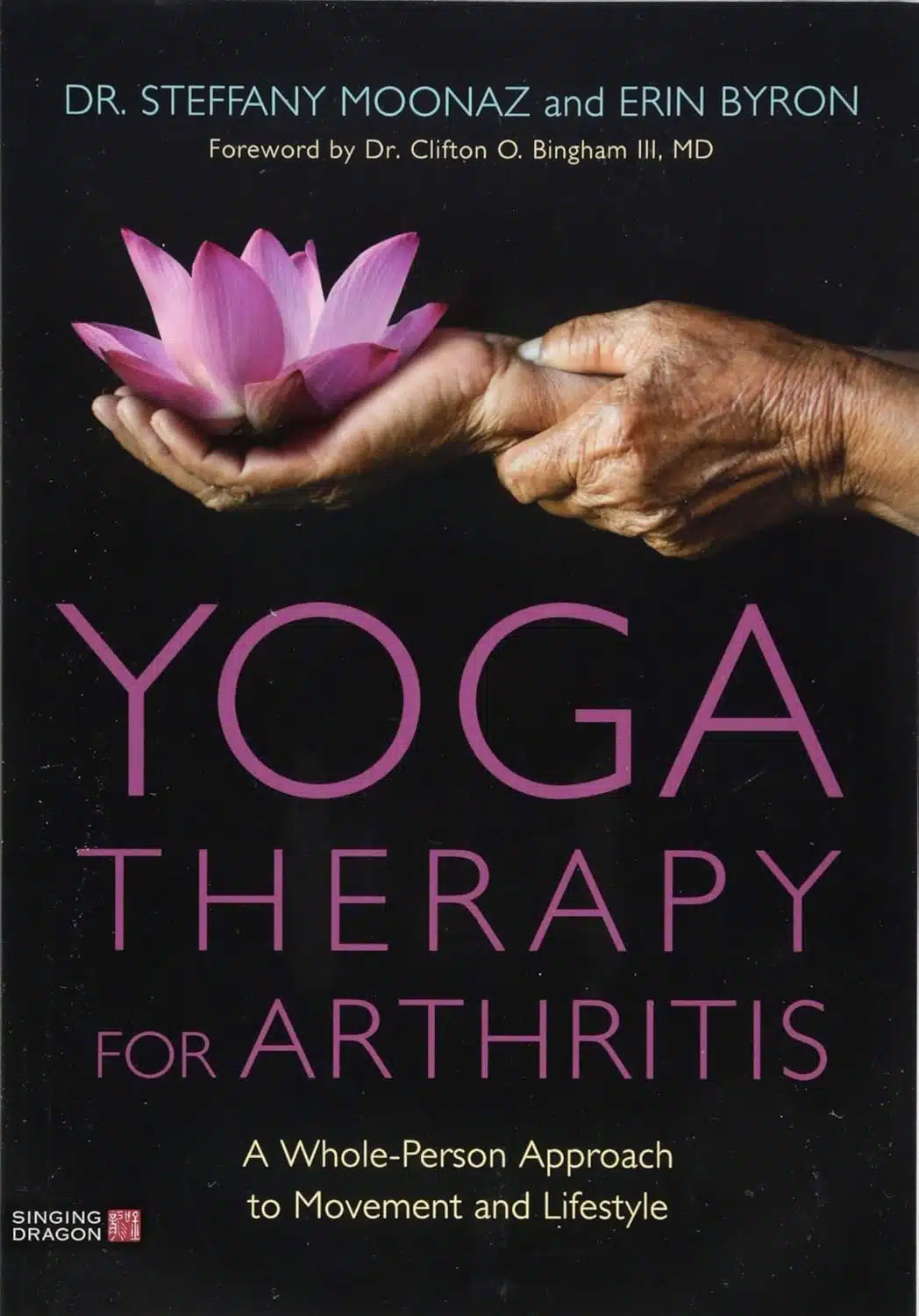
Yoga Therapy for Arthritis – by Dr. Steffany Moonaz & Erin Byron
10almonds is reader-supported. We may, at no cost to you, receive a portion of sales if you purchase a product through a link in this article.
Two quick notes to start with:
- One of the problems with arthritis and exercise is that arthritis can often impede exercise.
- Another of the problems with arthritis and exercise is that some kinds of exercise can exacerbate arthritis.
This book deals with both of those issues, by providing yoga specifically tailored to living with arthritis. Indeed, the first-listed author’s PhD in public health was the result of 8 years of study developing an evidence-based yoga program for people with arthritis, including osteoarthritis and rheumatoid arthritis.
The authors take the view that arthritis is a whole-person disease (i.e. it affects all parts of you), and so addressing it requires a whole-person approach, which is what this book delivers.
As such, this is not just a book of asana (yoga postures). It does provide that, of course (as well as breathing exercises), but also its 328 pages additionally cover a lot of conscious work from the inside out, including attention to the brain, energy levels, pain, and so forth, and that the practice of yoga should not merely directly improve the joints via gentle physical exercise, but also should help to heal the whole person, including reducing stress levels, reducing physical tension, and with those two things, reducing inflammation also—and also, due to both that and the asana side of practice, better-functioning organs, which is always a bonus.
The style is interesting, as it refers to both science (8 pages of hard-science bibliography) and yogic principles (enough esoterica to put off, say, James Randi or Penn & Teller). This reviewer is very comfortable with both, and so if you, dear reader, are comfortable with both too, then you will surely enjoy this book.
Bottom line: if you or a loved one has arthritis, you’ll wish you got this book sooner.
Click here to check out Yoga Therapy For Arthritis, and live better!
Don’t Forget…
Did you arrive here from our newsletter? Don’t forget to return to the email to continue learning!
Recommended
Learn to Age Gracefully
Join the 98k+ American women taking control of their health & aging with our 100% free (and fun!) daily emails:
-
Pain Doesn’t Belong on a Scale of Zero to 10
10almonds is reader-supported. We may, at no cost to you, receive a portion of sales if you purchase a product through a link in this article.
Over the past two years, a simple but baffling request has preceded most of my encounters with medical professionals: “Rate your pain on a scale of zero to 10.”
I trained as a physician and have asked patients the very same question thousands of times, so I think hard about how to quantify the sum of the sore hips, the prickly thighs, and the numbing, itchy pain near my left shoulder blade. I pause and then, mostly arbitrarily, choose a number. “Three or four?” I venture, knowing the real answer is long, complicated, and not measurable in this one-dimensional way.
Pain is a squirrely thing. It’s sometimes burning, sometimes drilling, sometimes a deep-in-the-muscles clenching ache. Mine can depend on my mood or how much attention I afford it and can recede nearly entirely if I’m engrossed in a film or a task. Pain can also be disabling enough to cancel vacations, or so overwhelming that it leads people to opioid addiction. Even 10+ pain can be bearable when it’s endured for good reason, like giving birth to a child. But what’s the purpose of the pains I have now, the lingering effects of a head injury?
The concept of reducing these shades of pain to a single number dates to the 1970s. But the zero-to-10 scale is ubiquitous today because of what was called a “pain revolution” in the ’90s, when intense new attention to addressing pain — primarily with opioids — was framed as progress. Doctors today have a fuller understanding of treating pain, as well as the terrible consequences of prescribing opioids so readily. What they are learning only now is how to better measure pain and treat its many forms.
About 30 years ago, physicians who championed the use of opioids gave robust new life to what had been a niche specialty: pain management. They started pushing the idea that pain should be measured at every appointment as a “fifth vital sign.” The American Pain Society went as far as copyrighting the phrase. But unlike the other vital signs — blood pressure, temperature, heart rate, and breathing rate — pain had no objective scale. How to measure the unmeasurable? The society encouraged doctors and nurses to use the zero-to-10 rating system. Around that time, the FDA approved OxyContin, a slow-release opioid painkiller made by Purdue Pharma. The drugmaker itself encouraged doctors to routinely record and treat pain, and aggressively marketed opioids as an obvious solution.
To be fair, in an era when pain was too often ignored or undertreated, the zero-to-10 rating system could be regarded as an advance. Morphine pumps were not available for those cancer patients I saw in the ’80s, even those in agonizing pain from cancer in their bones; doctors regarded pain as an inevitable part of disease. In the emergency room where I practiced in the early ’90s, prescribing even a few opioid pills was a hassle: It required asking the head nurse to unlock a special prescription pad and making a copy for the state agency that tracked prescribing patterns. Regulators (rightly) worried that handing out narcotics would lead to addiction. As a result, some patients in need of relief likely went without.
After pain doctors and opioid manufacturers campaigned for broader use of opioids — claiming that newer forms were not addictive, or much less so than previous incarnations — prescribing the drugs became far easier and were promoted for all kinds of pain, whether from knee arthritis or back problems. As a young doctor joining the “pain revolution,” I probably asked patients thousands of times to rate their pain on a scale of zero to 10 and wrote many scripts each week for pain medication, as monitoring “the fifth vital sign” quickly became routine in the medical system. In time, a zero-to-10 pain measurement became a necessary box to fill in electronic medical records. The Joint Commission on the Accreditation of Healthcare Organizations made regularly assessing pain a prerequisite for medical centers receiving federal health care dollars. Medical groups added treatment of pain to their list of patient rights, and satisfaction with pain treatment became a component of post-visit patient surveys. (A poor showing could mean lower reimbursement from some insurers.)
But this approach to pain management had clear drawbacks. Studies accumulated showing that measuring patients’ pain didn’t result in better pain control. Doctors showed little interest in or didn’t know how to respond to the recorded answer. And patients’ satisfaction with their doctors’ discussion of pain didn’t necessarily mean they got adequate treatment. At the same time, the drugs were fueling the growing opioid epidemic. Research showed that an estimated 3% to 19% of people who received a prescription for pain medication from a doctor developed an addiction.
Doctors who wanted to treat pain had few other options, though. “We had a good sense that these drugs weren’t the only way to manage pain,” Linda Porter, director of the National Institutes of Health’s Office of Pain Policy and Planning, told me. “But we didn’t have a good understanding of the complexity or alternatives.” The enthusiasm for narcotics left many varietals of pain underexplored and undertreated for years. Only in 2018, a year when nearly 50,000 Americans died of an overdose, did Congress start funding a program — the Early Phase Pain Investigation Clinical Network, or EPPIC-Net — designed to explore types of pain and find better solutions. The network connects specialists at 12 academic specialized clinical centers and is meant to jump-start new research in the field and find bespoke solutions for different kinds of pain.
A zero-to-10 scale may make sense in certain situations, such as when a nurse uses it to adjust a medication dose for a patient hospitalized after surgery or an accident. And researchers and pain specialists have tried to create better rating tools — dozens, in fact, none of which was adequate to capture pain’s complexity, a European panel of experts concluded. The Veterans Health Administration, for instance, created one that had supplemental questions and visual prompts: A rating of 5 correlated with a frown and a pain level that “interrupts some activities.” The survey took much longer to administer and produced results that were no better than the zero-to-10 system. By the 2010s, many medical organizations, including the American Medical Association and the American Academy of Family Physicians, were rejecting not just the zero-to-10 scale but the entire notion that pain could be meaningfully self-reported numerically by a patient.
In the years that opioids had dominated pain remedies, a few drugs — such as gabapentin and pregabalin for neuropathy, and lidocaine patches and creams for musculoskeletal aches — had become available. “There was a growing awareness of the incredible complexity of pain — that you would have to find the right drugs for the right patients,” Rebecca Hommer, EPPIC-Net’s interim director, told me. Researchers are now looking for biomarkers associated with different kinds of pain so that drug studies can use more objective measures to assess the medications’ effect. A better understanding of the neural pathways and neurotransmitters that create different types of pain could also help researchers design drugs to interrupt and tame them.
Any treatments that come out of this research are unlikely to be blockbusters like opioids; by design, they will be useful to fewer people. That also makes them less appealing prospects to drug companies. So EPPIC-Net is helping small drug companies, academics, and even individual doctors design and conduct early-stage trials to test the safety and efficacy of promising pain-taming molecules. That information will be handed over to drug manufacturers for late-stage trials, all with the aim of getting new drugs approved by the FDA more quickly.
The first EPPIC-Net trials are just getting underway. Finding better treatments will be no easy task, because the nervous system is a largely unexplored universe of molecules, cells, and electronic connections that interact in countless ways. The 2021 Nobel Prize in Physiology or Medicine went to scientists who discovered the mechanisms that allow us to feel the most basic sensations: cold and hot. In comparison, pain is a hydra. A simple number might feel definitive. But it’s not helping anyone make the pain go away.
KFF Health News is a national newsroom that produces in-depth journalism about health issues and is one of the core operating programs at KFF—an independent source of health policy research, polling, and journalism. Learn more about KFF.
Subscribe to KFF Health News’ free Morning Briefing.
Share This Post
-
Is it anxiety or OCD? 2 psychology experts explain the difference
10almonds is reader-supported. We may, at no cost to you, receive a portion of sales if you purchase a product through a link in this article.
Anxiety itself is not a mental illness. It’s a normal, adaptive emotion that helps us respond to perceived threats.
Anxiety is the automatic reaction that makes you jump back when you think you’ve seen a snake while bushwalking – before realising it’s a stick.
It’s also (inconveniently) the sweaty palms and shaky voice you notice before a presentation or a first date, or the circling thoughts that keep you awake at 3am.
Most of us have ways to cope with anxious thoughts and feelings that can give us more of a sense of control. This could be checking and double-checking we’ve got the room right for our presentation, or seeking reassurance from someone we love.
But when might these behaviours fit a diagnosis of an anxiety disorder? And when could they actually be a sign of obsessive compulsive disorder (OCD)?
As clinical psychologists, we find these questions come up a lot, perhaps spurred by a recent surge of interest in OCD on social media. So what’s the difference between anxiety and OCD? And how are they treated?
Social media is full of content ‘diagnosing’ OCD and explaining how it’s different to anxiety. TikTok apomares/Getty When is anxiety something more serious?
“Normal” anxiety can become an anxiety disorder when fears or worry are persistent, intense and start interfering with everyday life.
About one in three people will experience an anxiety disorder at some point in their lifetime.
Among the most common are social anxiety disorder (fear in social situations), panic disorder (frequent panic attacks, and fears you’ll have another) and generalised anxiety disorder (persistent and excessive worry).
These disorders have slightly different symptoms. But all share excessive and persistent fear or worry that causes distress or leads people to avoid important parts of life including work, study or social activities.
So, what about OCD?
Although OCD involves anxiety, it is actually considered a separate disorder in the diagnostic manual used by mental health professionals.
It is possible to have both – around half to three-quarters of individuals with OCD also meet criteria for one or more anxiety disorders as well.
OCD involves obsessions, compulsions, or both. These cause significant distress or interfere with daily functioning.
Obsessions are intrusive, unwanted thoughts, images or urges. This could mean an intense fear your food is contaminated, suddenly visualising hurting someone, or a feeling that keeps entering your mind that you’ve made a serious mistake.
Compulsions are the repetitive behaviours (or mental rituals) people feel driven to perform to ease that distress, such as checking, repeating phrases, excessive hand-washing or seeking reassurance.
Many of us will occasionally experience unwanted thoughts or go back to check the oven is actually off. Keeping things tidy or being particular about routines can simply be habits that don’t cause distress.
But what makes OCD different is its severity and impact.
If obsessions or compulsions take up large amounts of time, cause you significant distress, or interfere with daily life, it may be a sign of OCD.
You can’t “spot” OCD from behaviour alone. OCD can also be invisible because many compulsions happen mentally, such as repeating phrases or counting. People with OCD may also try to hide their symptoms out of shame.
Are OCD and anxiety treated differently?
While anxiety disorders and OCD share some similarities, including repetitive distressing thoughts, the patterns and beliefs driving them are different. This means the way they’re treated will also differ.
Cognitive behavioural therapy (CBT) is one of the most effective treatments for both anxiety disorders and OCD.
For OCD, treatment often involves a specialised form of CBT called exposure and response prevention (ERP). It involves gradually facing situations that trigger distressing thoughts while resisting the urge to perform compulsions.
For example, someone with contamination fears might gradually reduce the number of times they wash their hands before eating. Over time, people learn the feared outcome does not occur, that they can tolerate their discomfort without the ritual, and that the anxiety passes on its own.
Treatment for anxiety disorders focuses on the specific fear. For generalised anxiety, for example, it involves understanding patterns of worry, challenging beliefs that keep worries going, and developing more helpful ways to respond to problems, such as brainstorming solutions and taking small actions.
Antidepressant medication (particularly selective serotonin re-uptake inhibitors, or SSRIs) can be an effective component of treatment for both anxiety disorders and OCD. A combined treatment approach of medication (SSRIs) and therapy (CBT) often leads to the best treatment outcomes, especially for severe OCD.
A final note
While it’s great mental health is being discussed more openly online and stigma is reducing, social media can also blur the line between personal experience and evidence-based information.
If something you’ve seen online has sparked curiosity about your mental health, the best next step is to talk with a qualified professional who can help you understand what you’re experiencing and what support might help.
For more information and resources about anxiety and OCD, visit the Black Dog Institute or Beyond Blue, and ReachOut or Headspace for young people.
There are lots of evidence-based online treatment programs for anxiety disorders and OCD you can access for free or low-cost, such as This Way Up, MyNewWay or Mindspot.
There are also online treatments for kids and teens with OCD and anxiety.
You can also ask your GP about a Mental Health Care Plan for Medicare-rebated psychology sessions.
Emily Upton, PhD Candidate in Psychology, UNSW Sydney; Black Dog Institute and Kayla Steele, Postdoctoral Research Fellow and Clinical Psychologist, UNSW Sydney
This article is republished from The Conversation under a Creative Commons license. Read the original article.
Share This Post
-
How Useful Is Hydrotherapy?
10almonds is reader-supported. We may, at no cost to you, receive a portion of sales if you purchase a product through a link in this article.
Hyyyyyyydromatic…
Hydrotherapy is a very broad term, and refers to any (external) use of water as part of a physical therapy. Today we’re going to look at some of the top ways this can be beneficial—maybe you’ll know them all already, but maybe there’s something you hadn’t thought about or done decently; let’s find out!
Notwithstanding the vague nature of the umbrella term, some brave researchers have done a lot of work to bring us lots of information about what works and what doesn’t, so we’ll be using this to guide us today. For example:
Scientific Evidence-Based Effects of Hydrotherapy on Various Systems of the Body
Swimming (and similar)
An obvious one, this can for most people be a very good full-body exercise, that’s exactly as strenuous (or not) as you want/need it to be.
It can be cardio, it can be resistance, it can be endurance, it can be high-intensity interval training, it can be mobility work, it can be just support for an aching body that gets to enjoy being in the closest to zero-gravity we can get without being in freefall or in space.
See also: How To Do HIIT (Without Wrecking Your Body)
Depending on what’s available for you locally (pool with a shallow area, for example), it can also be a place to do some exercises normally performed on land, but with your weight being partially supported (and as a counterpoint, a little resistance added to movement), and no meaningful risk of falling.
Tip: check out your local facilities, to see if they offer water aerobics classes; because the water necessitates slow movement, this can look a lot like tai chi to watch, but it’s great for mobility and balance.
Water circuit therapy
This isn’t circuit training! Rather, it’s a mixture of thermo- and cryotherapy, that is to say, alternating warm and cold water immersion. This can also be interspersed with the use of a sauna, of course.
See also:
- Ice Baths: To Dip Or Not To Dip?
- Saunas: Health Benefits (& Caveats)
- The Stress Prescription (Against Aging!)
this last one is about thermal shock-mediated hormesis, which sounds drastic, but it’s what we’re doing here with the hot and cold, and it’s good for most people!
Pain relief
Most of the research for this has to do with childbirth pain rather than, for example, back pain, but the science is promising:
Post-exercise recovery
It can be tempting to sink into a hot bath, or at least enjoy a good hot shower, after strenuous exercise. But does it help recovery too? The answer is probably yes:
Effect of hot water immersion on acute physiological responses following resistance exercise
For more on that (and other means of improving post-exercise recovery), check out our previous main feature:
How To Speed Up Recovery After A Workout (According To Actual Science)
Take care!
Share This Post
Related Posts
-
5 Exercises You’ll Regret Ignoring In 10 Years!
10almonds is reader-supported. We may, at no cost to you, receive a portion of sales if you purchase a product through a link in this article.
Later, you’ll wish you’d started sooner. So, today’s a great day to learn these exercises and get the ball rolling:
Use It Or Lose It
The “alive five”:
- Handstands and wall variations: not about looking cool, but rather about building shoulder mobility, core engagement, wrist strength, and body awareness under pressure; teaches control, fear management, and structural alignment starting from the ground up.
- Crawling patterns, ground flow, and squat transitions: retrains coordination, rhythm, and spatial awareness by reconnecting the brain to the body; essential for core integration, joint cooperation, and real-world strength like standing up from the floor without hands.
- Single leg balance and other unilateral strength work: critical for injury prevention and joint stability; develops foot, knee, and hip control while revealing imbalances and improving strength on each side of the body independently.
- Dynamic backbends and spinal extension: counters modern posture issues by reopening the spine and chest; important for breathing, posture, spinal decompression, and reclaiming mobility lost through years of sitting and slouching.
- Rolling patterns and spinal reset: teaches the body to move with grace, not tension; helps the spine move fluidly, reconnects breath with movement, and restores nervous system softness and control.
For more on each of these plus visual demonstrations, enjoy:
Click Here If The Embedded Video Doesn’t Load Automatically!
Want to learn more?
You might also like:
Mobility For Now & For Later: Train For The Marathon That Is Your Life!
Take care!
Don’t Forget…
Did you arrive here from our newsletter? Don’t forget to return to the email to continue learning!
Learn to Age Gracefully
Join the 98k+ American women taking control of their health & aging with our 100% free (and fun!) daily emails:
-
What is ‘cognitive shuffling’ and does it really help you get to sleep? Two sleep scientists explain
10almonds is reader-supported. We may, at no cost to you, receive a portion of sales if you purchase a product through a link in this article.
If you’ve been on social media lately – perhaps scrolling in the middle of the night, when you know you shouldn’t but you just can’t sleep – you might have seen those videos promoting a get-to-sleep technique called “cognitive shuffling”.
The idea, proponents say, is to engage your mind with random ideas and images via a special formula:
- pick a random word (such as “cake”)
- focus on the first letter of the word (in this case, C) and list a bunch of words starting with that letter: cat, carrot, calendar and so on
- visualise each word as you go along
- when you feel ready, move onto the next letter (A) and repeat the process
- continue with each letter of the original word (so, in this case, K and then E) until you feel ready to switch to a new word or until you drift off to sleep.
It’s popular on Instagram and TikTok, but does “cognitive shuffling” have any basis in science?
Ursula Ferrara/Shutterstock Where did this idea come from?
The cognitive shuffling technique was made famous by Canada-based researcher Luc P. Beaudoin more than a decade ago, when he published a paper about how what he called “serial diverse imagining” could help with sleep.
One of Beaudoin’s hypothetical examples involved a woman thinking of the word “blanket”, then thinking bicycle (and imagining a bicycle), buying (imagining buying shoes), banana (visualising a banana tree) and so on.
Soon, Beaudoin writes, she moves onto the letter L, thinking about her friend Larry, the word “like” (imagining her son hugging his dog). She soon transitions to the letter A, thinking of the word “Amsterdam”:
and she might very vaguely imagine the large hand of a sailor gesturing for another order of fries in an Amsterdam pub while a rancid accordion plays in the background.
Sleep soon ensues. The goal, according to Beaudoin, is to think briefly about:
a neutral or pleasant target and frequently [switch] to unrelated targets (normally every 5-15 seconds).
Don’t try to relate one word with another or find a link between the words; resist the mind’s natural tendency toward sense-making.
While the research into this technique is still in its infancy, the idea is grounded in science. That’s because we know from other research good sleepers tend to have different kinds of thoughts in bed to bad sleepers.
People with insomnia are more focused on worries, problems, or noises in the environment, and are often preoccupied with not sleeping.
Good sleepers, on the other hand, typically have dream-like, hallucinatory, less ordered thoughts before nodding off.
Good sleepers typically have dream-like, hallucinatory, less ordered thoughts before nodding off. fran_kie/Shutterstock Sorting the pro-somnolent wheat from the insomnolent chaff
Cognitive shuffling attempts to mimic the thinking patterns of good sleepers by simulating the dream-like and random thought patterns they generally have before drifting off to sleep.
In particular, Beaudoin’s research describes two types of sleep-related thoughts: insomnolent (or anti-sleep) and pro-somnolent (sleep-promoting) thoughts.
Insomnolent thoughts include things such as worrying, planning, rehearsing, and ruminating on perceived problems or failings.
Pro-somnolent thoughts on the other hand involve thoughts that can help you fall asleep, such as dream-like imagery or having a calm, relaxed state of mind.
Cognitive shuffling aims to distract from or interfere with insomnolent thought. It offers a calm, neutral path for your racing mind, and can reduce the stress associated with not sleeping.
Cognitive shuffling also helps tell your brain you are ready for sleep.
In fact, the process of “shuffling” between different thoughts is similar to the way your brain naturally drifts off to sleep. During the transition to sleep, brain activity slows. Your brain starts to generate disconnected images and fleeting scenes, known as hypnagogic hallucinations, without a conscious effort to make sense of them.
By mimicking these scattered, disconnected, and random thought patterns, cognitive shuffling may help you transition from wakefulness to sleep.
And the preliminary research into this is promising. Beaudoin and his team have found serial diverse imagining helps to lower arousal before sleep, improve sleep quality and reduce the effort involved in falling asleep.
However, with only a small number of research studies, more work is needed here.
It didn’t work. Now what?
As with every new strategy, however, practise makes perfect. Don’t be disheartened if you don’t see an improvement straight away; these things take time.
Stay consistent and be kind to yourself.
And what works for some won’t work for others. Different people benefit from different types of strategies depending on how they relate to and experience stress or stressful thoughts.
Other strategies to help create the right conditions for sleep include:
- keeping a consistent pre-bedtime routine, so your brain can wind down
- watching your thoughts, without judgement, as you lie in bed
- writing down worries or to-do lists earlier in the day so you don’t think about them at bedtime.
If, despite all your best efforts, night time thoughts continue to impact your sleep or overall wellbeing, consider seeking professional help from your doctor or a trained sleep specialist.
Melinda Jackson, Associate Professor at Turner Institute for Brain and Mental Health, School of Psychological Sciences, Monash University and Eleni Kavaliotis, Research Fellow in the Sleep, Cognition, and Mood Laboratory at Monash University, Monash University
This article is republished from The Conversation under a Creative Commons license. Read the original article.
Don’t Forget…
Did you arrive here from our newsletter? Don’t forget to return to the email to continue learning!
Learn to Age Gracefully
Join the 98k+ American women taking control of their health & aging with our 100% free (and fun!) daily emails:
-
Avocado vs Olives – Which is Healthier?
10almonds is reader-supported. We may, at no cost to you, receive a portion of sales if you purchase a product through a link in this article.
Our Verdict
When comparing avocado to olives, we picked the avocado.
Why?
Both are certainly great! And when it comes to their respective oils, olive oil wins out as it retains many micronutrients that avocado oil loses. But, in their whole form, avocado beats olive:
In terms of macros, avocado has more protein, carbs, fiber, and (healthy) fats. Simply, it’s more nationally-dense than the already nutritionally-dense food that is olives.
In the category of vitamins, olives are great but avocados really shine; avocado has more of vitamins B1, B2, B3, B5, B6, B7 B9, C, E, and K, while olives boast only more vitamin A.
Looking at minerals, things are closer to even; avocado has more magnesium, manganese, phosphorus, potassium, and zinc, while olives have more calcium, copper, iron, and selenium. Thus, a marginal victory for avocado here.
In other considerations, olives have more polyphenols, so that is a point in their favor.
Adding up the sections makes for a clear overall win for avocado, but both have their strong merits, so do by all means enjoy either or both, as diversity is good!
Want to learn more?
You might like:
Avocado Oil vs Olive Oil – Which is Healthier? ← when made into oils, olive oil wins, but avocado oil is still a good option too
Enjoy!
Don’t Forget…
Did you arrive here from our newsletter? Don’t forget to return to the email to continue learning!
Learn to Age Gracefully
Join the 98k+ American women taking control of their health & aging with our 100% free (and fun!) daily emails:


