
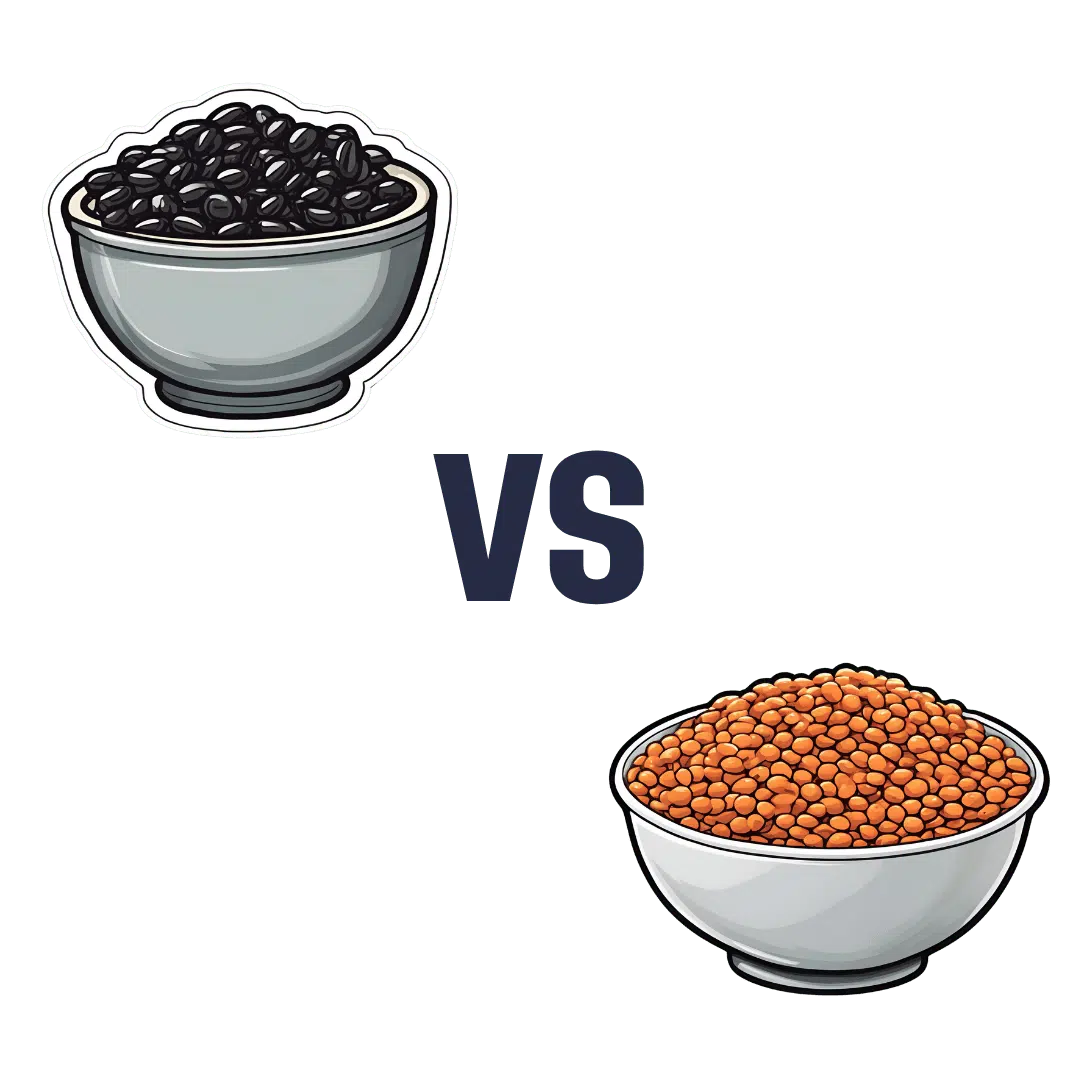
Black Beans vs Red Lentils – Which is Healthier?

10almonds is reader-supported. We may, at no cost to you, receive a portion of sales if you purchase a product through a link in this article.

Our Verdict

When comparing black beans to red lentils, we picked the lentils.

Why?

In terms of macros, black beans have slightly more fiber and carbs while red lentils have slightly more protein, so all things considered, a tie in this round.

In the category of vitamins, black beans have more of vitamins B1, E, and K, while red lentils have more of vitamins B2, B3, B5, B6, B7, B9, and C, winning.

Looking at minerals, black beans have more calcium, magnesium, and potassium, while red lentils have more iron, manganese, phosphorus, selenium, and zinc, winning.

Adding up the sections makes for an overall win for red lentils, but by all means enjoy either or both; diversity is good!

Want to learn more?

You might like:

What Do The Different Kinds Of Fiber Do? 30 Foods That Rank Highest

Enjoy!

Don’t Forget…

Did you arrive here from our newsletter? Don’t forget to return to the email to continue learning!

Learn to Age Gracefully

Join the 98k+ American women taking control of their health & aging with our 100% free (and fun!) daily emails:

  • Do Breathe – by Michael Williams

    10almonds is reader-supported. We may, at no cost to you, receive a portion of sales if you purchase a product through a link in this article.

    Have you ever felt you could get everything in your life in order, if you could just get a little breathing room first?

    Notwithstanding the title, this is mostly not a book about breathing exercises. It does cover that too, but there’s a lot more.

    The author’s advices draw from a variety of high quality sources. Well-read readers will certainly recognise sections that are straight from David Allen’s “Getting Things Done”, and Mihaly Czikszentmihalyi’s “Flow”, for example, as well as Francesco Cirillo’s “Pomodoro Technique”, and James Clear’s “Atomic Habits”.

    We also learn about how even simple yoga can help us, and good sleep, and a healthy diet.

    In short, if you’ve been reading 10almonds for a while, you might not actually learn much new! But it’s very nice to have all these things in one book, for sure, and it’s a pleasant, easy read too.

    Bottom line: if you’d like to streamline your life and not have to buy a whole stack of different books to do it, this book is a great composite that will enable you to get the job done efficiently.

    Click here to check out Do Breathe, and simplify your life!

    Share This Post

  • Black Beans vs Edamame – Which is Healthier?

    10almonds is reader-supported. We may, at no cost to you, receive a portion of sales if you purchase a product through a link in this article.

    Our Verdict

    When comparing black beans to edamame, we picked the edamame.

    Why?

    Both are very much top-tier beans!

    In terms of macros, black beans have more fiber and carbs while edamame has more protein. We’d call this either a tie, or possibly a win for black beans, depending on whether we prioritize the fiber or the protein more.

    In the category of vitamins, black beans have more of vitamins B1 and E, while edamame has more of vitamins A, B2, B3, B5, B6, B7, B9, C, K, and choline. A clear win for edamame this time.

    When it comes to minerals, black beans have more iron and selenium, while edamame has more calcium, copper, magnesium, manganese, phosphorus, and zinc. Another win for edamame.

    Adding up the sections makes for an overall win for edamame, but black beans definitely have their merits too and beat (almost?) every other bean we’ve pitted them against so far, so by all means enjoy either or both; diversity is good!

    Want to learn more?

    You might like:

    What’s Your Plant Diversity Score?

    Enjoy!

    Share This Post

  • Managing Chronic Pain (Realistically!)

    10almonds is reader-supported. We may, at no cost to you, receive a portion of sales if you purchase a product through a link in this article.

    Realistic chronic pain management

    We’ve had a number of requests to do a main feature on managing chronic pain, so here it is!

    A quick (but important) note before we begin:

    Obviously, not all chronic pain is created equal. Furthermore, we know that you, dear reader with chronic pain, have been managing yours for however long you have, learning as you go. You also doubtlessly know your individual condition inside out.

    We also know that people with chronic health conditions in general are constantly beset by well-meaning unsolicited advice from friends and family, asking if you’ve heard about [thing you heard about 20 years ago] that will surely change your life and cure you overnight.

    It’s frustrating, and we’re going to try to avoid doing that here, while still offering the advice that was asked for. We ask you, therefore, to kindly overlook whatever you already knew, and if you already knew it all, well, we salute you and will not be surprised if that’s the case for at least some readers. Chronic pain’s a… Well, it’s a chronic pain.

    All that said, let’s dive in…

    How are you treating your body right now?

    Are you hydrated; have you eaten; are you standing/sitting/lying in a position that at least should be comfortable for you in principle?

    The first two things affect pain perception; the latter can throw a spanner in the works if something’s not quite right.

    Move your body (gently!)

    You know your abilities, so think about the range of motion that you have, especially in the parts of your body that hurt (if that’s “everywhere”, then, our sympathies, and we hope you find the same advice applies). Think about your specific muscles and joints as applicable, and what the range of motion is “supposed” to be for each. Exercise your range of motion as best you can (gently!) to the point of its limit(s) and/or pain.

    • If you take it past that limit, there is a good chance you will make it worse. You don’t want that.
    • If you don’t take it to the limit, there is a good chance your range of movement will deteriorate, and your “safe zone” (i.e., body positions that are relatively free from pain) will diminish. You definitely don’t want that, either.

    Again, moderation is key. Yes, annoying as the suggestion may be, such things as yoga etc can help, if done carefully and gently. You know your limits; work with those, get rest between, and do what you can.

    For most people this will at least help keep the pain from getting worse.

    Hot & Cold

    Both of these things could ease your pain… Or make it worse. There is an element of “try it and see”, but here’s a good general guide:

    Here’s How to Choose Between Using Ice or Heat for Pain

    Meditation… Or Distraction

    Meditating really does help a lot of people. In the case of pain, it can be counterintuitively helpful to focus for a while on the sensation of the pain… But in a calm, detached fashion. Without judgement.

    “Yes, I am experiencing pain. Yes, it feels like I’m being stabbed with hot knives. Yes, this is tortuous; wow, I feel miserable. This truly sucks.”

    …it doesn’t sound like a good experience, does it? And it’s not, but paying it attention this way can paradoxically help ease things. Pain is, after all, a messenger. And in the case of chronic pain, it’s in some ways a broken messenger, but what a messenger most needs is to be heard.

    The above approach a) is good b) may have a limit in how long you can sustain it at a time, though. So…

    The opposite is a can be a good (again, short-term) approach too. Call a friend, watch your favorite movie, play a video game if that’s your thing. It won’t cure anything, but it can give you a little respite.

    Massage

    Unless you already know this makes your pain worse, this is a good thing to try. It doesn’t have to be a fancy spa; if the nature of your pain and condition permits, you can do self-massage. If you have a partner or close friend who can commit to helping, it can be very worth them learning to give a good massage. There are often local courses available, and failing that, there is also YouTube.

    Here’s an example of a good video for myofascial release massage, which can ease a lot of common kinds of chronic pain:

    !

    Some quick final things to remember:

    • If you find something helps, then it helps, do that.
    • That goes for mobility aids and other disability aids too, even if it was designed for a different disability. If it helps, it helps. You’re not stealing anyone’s thunder (or resources) by using something that makes your life easier. We’re not in this life to suffer!
    • There is no such thing as “this pain is not too much”. The correct amount of pain is zero. Maybe your body won’t let you reach zero, but more than that is “too much” already.
    • You don’t have to be suffering off the scale to deserve relief from pain

    Share This Post

  • Women told they have dense breasts don’t know what to do next, new study shows

    10almonds is reader-supported. We may, at no cost to you, receive a portion of sales if you purchase a product through a link in this article.

    Imagine a 57-year-old woman, let’s call her Maria, who’s just opened a letter about her mammography results. She’s had several mammograms before, but this time reads new information: “Your breasts are dense”.

    While the letter assures her that dense breasts are common, it also indicates it could make it harder to see breast cancer on the mammogram.

    Maria is confused about what to do next and wonders if she should be worried. Does she need to see her GP?

    Maria may be fictional but she reflects the findings from the first trial of its kind we publish today.

    We show women notified they have dense breasts alongside their mammogram result are more confused and anxious, do not feel more informed, and have greater intentions to see their GP for advice.

    Andrii Zastrozhnov/Getty

    Remind me, what is breast density?

    Dense breast tissue appears white on a mammogram and can hide (or mask) a cancer, which also appears white.

    Dense breasts are very common. About 25–40% of women are considered to have dense breasts.

    Breast density is one of several independent risk factors for breast cancer. After years of consumer advocacy, more women are being told about their breast density when they get their results from breast cancer screening.

    The idea is simple: let women know if they have dense breasts – something that can raise cancer risk and make mammograms harder to read – so they can decide whether to get extra testing, such as an ultrasound or MRI.

    Notifying women about their breast density is now legislated in the United States, recommended in Australia, and is being considered in other jurisdictions, such as the United Kingdom.

    This is despite the lack of robust evidence on whether the benefits of notifying breast density at screening outweigh potential harms for women, and the impact on health services.

    What we did and what we found

    Our trial was co-designed with BreastScreen Queensland. From September 2023 to July 2024 we randomised 2,401 women (average age 57) who had a clear mammogram (their mammogram didn’t show cancer), but had dense breasts, into three categories:

    1. Control: no notification of dense breasts (standard care)
    2. Intervention 1: notification of breast density as part of the screening results letter plus extra written information in a leaflet
    3. Intervention 2: notification of breast density as part of the screening results letter plus a link to extra information in an online video.

    Eight weeks after screening, we found women notified they had dense breasts felt more anxious and confused about what to do about their breast health compared to the control group.

    They also did not feel more informed to make decisions about their breast health, and had greater intentions to discuss this with their GP.

    We haven’t followed participants for long enough yet, nor was the trial specifically designed to see if notifying women about their breast density led to extra cancers being detected.

    The trial also had some limitations. For example there was a low proportion of women from non-English speaking backgrounds.

    However, this is the first randomised trial world-wide to evaluate the immediate impact of breast density notification on women in the context of mammography screening.

    It provides evidence for breast screening programs internationally to carefully consider the potential impact of such notification.

    What next?

    In Australia, where breast density notification is now recommended, it is important we acknowledge that the topic of breast density may be confusing and some women may be worried.

    Communicating about breast density, including public messaging, should be focused on density being one of many risk factors for breast cancer and that there are other potentially modifiable ways to reduce a woman’s overall risk.

    This includes maintaining a healthy weight, being physically active, reducing alcohol intake, and not smoking. Messaging should also emphasise that mammograms remain the best way to screen for breast cancer in most women even if they have dense breasts.

    GPs need to be prepared to have conversations with women about breast density and their overall risk of breast cancer. This includes discussing the benefits and harms of extra screening (via ultrasound, MRI or contrast-enhanced mammograms) that can detect cancers not found on mammograms.

    But even that’s not straight forward. For instance, while there is evidence extra screening will detect more cancers, there’s currently no evidence on whether it will reduce advanced-stage breast cancers or death from breast cancer.

    Extra screening may lead to adverse effects such as false-positives – apparent abnormalities that, after further evaluation, are found not to be cancer.

    Extra screening is also not equitable for all women due to out-of-pocket costs and limited availability through public services.

    We need better pathways for evidence-based, equitable care in Australia so the benefits of notifying women about their breast density indeed outweigh any adverse consequences for women and the health system. These pathways need to be evaluated to ensure they are feasible, acceptable, effective and equitable.

    Brooke Nickel, NHMRC Emerging Leader Research Fellow, University of Sydney and Nehmat Houssami, Professor of Public Health, University of Sydney

    This article is republished from The Conversation under a Creative Commons license. Read the original article.

    Don’t Forget…

    Did you arrive here from our newsletter? Don’t forget to return to the email to continue learning!

    Learn to Age Gracefully

    Join the 98k+ American women taking control of their health & aging with our 100% free (and fun!) daily emails:

  • Endure – by Alex Hutchinson

    10almonds is reader-supported. We may, at no cost to you, receive a portion of sales if you purchase a product through a link in this article.

    Life is a marathon, not a sprint. For most of us, at least. But how do we pace ourselves to go the distance, without falling into complacency along the way?

    According to our author Alex Hutchinson, there’s a lot more to it than goal-setting and strategy.

    Hutchinson set out to write a running manual, and ended up writing a manual for life. To be clear, this is still mostly centered around the science of athletic endurance, but covers the psychological factors as much as the physical… and notes how the capacity to endure is the key trait that underlies great performance in every field.

    The writing style is both personal and personable, and parts read like a memoir (Hutchinson himself being a runner and sports journalist), while others are scientific in nature.

    As for the science, the kind of science examined runs the gamut from case studies to clinical studies. We examine not just the science of physical endurance, but the science of psychological endurance too. We learn about such things as:

    • How perception of ease/difficulty plays its part
    • What factors make a difference to pain tolerance
    • How mental exhaustion affects physical performance
    • What environmental factors increase or lessen our endurance
    • …and many other elements that most people don’t consider

    Bottom line: whether you want to run a marathon in under two hours, or just not quit after one minute forty seconds on the exercise bike, or to get through a full day’s activities while managing chronic pain, this book can help.

    Click here to check out Endure, and find out what you are capable of when you move your limits!

    Don’t Forget…

    Did you arrive here from our newsletter? Don’t forget to return to the email to continue learning!

    Learn to Age Gracefully

    Join the 98k+ American women taking control of their health & aging with our 100% free (and fun!) daily emails:

  • Alzheimer’s Risk Reduction Methods

    10almonds is reader-supported. We may, at no cost to you, receive a portion of sales if you purchase a product through a link in this article.

    It’s Q&A Day!

    Have a question or a request? You can always hit “reply” to any of our emails, or use the feedback widget at the bottom!

    This newsletter has been growing a lot lately, and so have the questions/requests, and we love that! In cases where we’ve already covered something, we might link to what we wrote before, but will always be happy to revisit any of our topics again in the future too—there’s always more to say!

    As ever: if the question/request can be answered briefly, we’ll do it here in our Q&A Thursday edition. If not, we’ll make a main feature of it shortly afterwards!

    So, no question/request too big or small

    Q: I am now in the “aging” population. A great concern for me is Alzheimers. My father had it and I am so worried. What is the latest research on prevention?

    Very important stuff! We wrote about this not long back:

    (one good thing to note is that while Alzheimer’s has a genetic component, it doesn’t appear to be hereditary per se. Still, good to be on top of these things, and it’s never too early to start with preventive measures!)

    Don’t Forget…

    Did you arrive here from our newsletter? Don’t forget to return to the email to continue learning!

    Learn to Age Gracefully

    Join the 98k+ American women taking control of their health & aging with our 100% free (and fun!) daily emails: