Black Beans vs Edamame – Which is Healthier?

10almonds is reader-supported. We may, at no cost to you, receive a portion of sales if you purchase a product through a link in this article.

Our Verdict

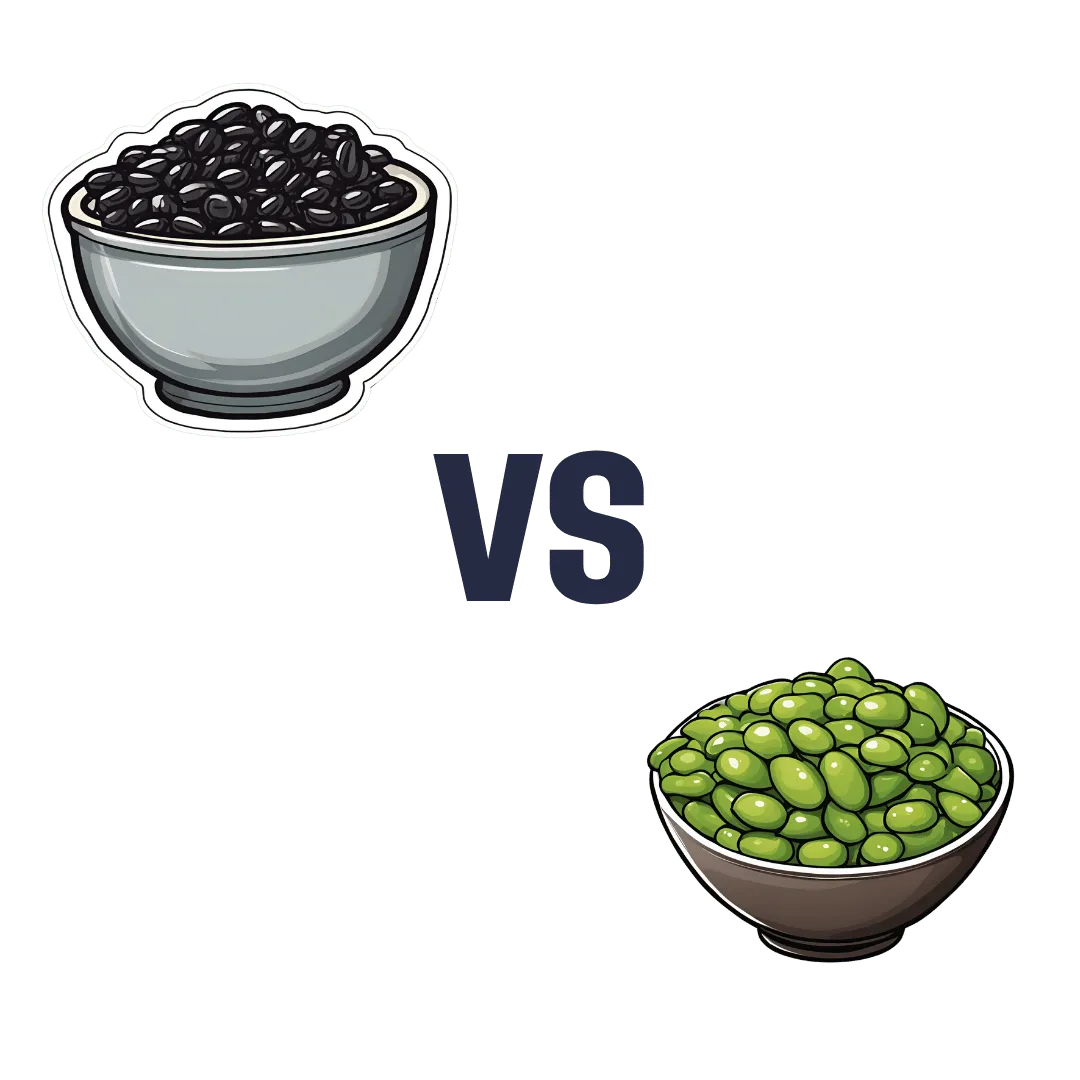
When comparing black beans to edamame, we picked the edamame.

Why?

Both are very much top-tier beans!

In terms of macros, black beans have more fiber and carbs while edamame has more protein. We’re calling this round a tie.

In the category of vitamins, black beans have more of vitamins B1 and E, while edamame has more of vitamins A, B2, B3, B5, B6, B7, B9, C, and K. A clear win for edamame this time.

When it comes to minerals, black beans have more iron and selenium, while edamame has more calcium, copper, magnesium, manganese, phosphorus, and zinc. Another win for edamame.

Adding up the sections makes for an overall win for edamame, but black beans definitely have their merits too and beat almost every other bean we’ve pitted them against so far, so by all means enjoy either or both; diversity is best!

(unless you have a soy allergy, then maybe skip the edamame, which are young soy beans)

Want to learn more?

You might like:

What’s Your Plant Diversity Score?

Enjoy!

Don’t Forget…

Did you arrive here from our newsletter? Don’t forget to return to the email to continue learning!

Learn to Age Gracefully

Join the 98k+ American women taking control of their health & aging with our 100% free (and fun!) daily emails:

  • Moving Through Cancer – by Dr. Kathryn Schmitz

    10almonds is reader-supported. We may, at no cost to you, receive a portion of sales if you purchase a product through a link in this article.

    We all know exercise is good for most things, but cancer is complicated, so… What should we do? Should we take it easy? Exercise more? Conserve energy? Can speeding up our metabolism (generally considered good) commensurately speed up the cancer (bad)?

    Dr. Kathryn Schmitz is an expert in sports medicine for cancer patients, with decades of experience in that field.

    Then, when her wife was diagnosed with an aggressive stage 3 cancer, Dr. Schmitz (of course) applied everything she knew, and doubled-down going through all available research with a fine-toothed comb. What was already her career, became her reason for living.

    Prior to her wife getting cancer, Dr. Schmitz had already overturned the medical convention of yesteryear; it was her own research that changed mainstream policies on exercise recommendation for breast cancer patients specifically (previous advice was: avoid upper body exercise). That was about six years before her wife’s cancer diagnosis, which is at time of writing, 9 years ago now (happily, she is doing fine now, and is officially cancer-free* in the sense of “no evidence of disease”), and she’s only continued to increase her research since, to share it with us.

    *this term is often avoided due to the technically non-zero chance of cancer returning, but the author uses it in this case, so we’ll use it here too.

    This book covers many different kinds of cancer, with exercise protocols tailored for each, and also covers exercise in the context of surgery, chemotherapy and other infusion therapies, radiation therapies, hormonal therapies, and more.

    On that note, she makes the distinction between “prehabilitation” (getting into the best possible condition before treatment) and post-treatment recovery protocols, and how to balance getting adequate exercise with getting adequate rest, during treatments of the ongoing kind (i.e. pretty much anything apart from surgery—since during surgery, one will certainly not be exercising).

    All of this is very evidence-based, as one might expect from someone with her background in both academia and practice, and as such she refers to many studies throughout.

    This is mostly a practical book, with direct instructions on what to do and how to do it and how to tailor it to your specific cancer/situation, with day-by-day, week-by-week plans, coupled with frequent reminders of such things as “but this adds to your stress, don’t do it; managing your stress is more important”, and “if you are unable to do the exercise on any given day, or must do a modified version, or cut your exercise short, just log that in your exercise journal and try again tomorrow”, and so forth.

    That side of things is not limited to just disclaimers, either—she’s very aware, from her own experience with her wife, that fighting cancer is an emotional battle as much as a physical one, and she gives genuine attention to that too.

    Bottom line: if you or a loved one has or has had cancer, this book can help survivorship and recovery, with highly specialised advice from someone who is not only a world-class expert in her field, but also very clearly cares very deeply.

    Click here to check out Moving Through Cancer, and move through cancer!

    Share This Post

  • Exercising in mid and later life can reduce dementia risk – new study

    10almonds is reader-supported. We may, at no cost to you, receive a portion of sales if you purchase a product through a link in this article.

    For years, scientists have known that moving our bodies can sharpen our minds. Physical activity boosts blood flow to the brain, enhances neuroplasticity and reduces chronic inflammation. These processes are believed to protect against cognitive decline, including dementia.

    Yet despite decades of research, major questions have remained unresolved.

    Does exercising at any age help reduce your risk of dementia? Or only when you’re young? And what if you have a higher genetic risk – can exercising still make a difference?

    New research from the long-running Framingham Heart Study in the United States, published today, offers some of the clearest answers to date. Their findings support what many clinicians already tell patients: exercise helps.

    But the study also offers new insight into the potentially protective effect of staying active at the age of 45 and over – even for those with a certain genetic predisposition to dementia.

    Centre for Ageing Better/Unsplash

    What did the study examine?

    The new research draws on data from 4,290 participants enrolled in the Framingham Heart Study Offspring cohort. This study began in 1948, when researchers recruited more than 5,000 adults aged 30 and over from the town of Framingham, Massachusetts, to investigate long-term risk factors for cardiovascular disease.

    In 1971, a second generation (more than 5,000 adult children of the original cohort, and their spouses) were enrolled, forming the Offspring cohort. This generation then had regular health and medical assessments every four to eight years.

    In the new study, participants self-reported their physical activity. This included incidental activity such as climbing stairs as well as vigorous exercise.

    Participants first reported these activities in 1971, and then again over several decades. Based on the age at which each participant was first evaluated, they were grouped into three categories:

    • young adulthood (26–44 years): assessed in the late 1970s
    • midlife (45–64 years): assessed during the late 1980s and 1990s
    • older adulthood (65 years and over): assessed in the late 1990s and early 2000s.

    To examine how physical activity influences dementia risk, the researchers looked at how many people developed dementia in each age group and at what age they were diagnosed.

    Then they considered physical activity patterns within age groups (low, moderate, high) to see if there was any link between how much exercise people did and whether they developed dementia.

    They also looked at who had a known genetic risk factor for Alzheimer’s disease, the APOE ε4 allele.

    Man doing freestyle in a pool.
    Research has long shown moving our bodies can sharpen our minds. Jonathan Borba/Unsplash

    What did they find?

    Over the follow-up period, 13.2% (567) of the 4,290 participants developed dementia, mostly in the older age group.

    This is quite high compared with other long-term longitudinal dementia studies and with Australian rates (one in 12 or 8.3% Australians over 65 currently have dementia).

    When researchers examined physical activity levels, the pattern was striking. Those with the highest levels of activity in midlife and later life were 41–45% less likely to develop dementia than those who had the lowest levels of activity.

    This was the case even after adjusting for demographic factors that increase dementia risk (such as age and education) and other chronic health factors (such as high blood pressure and diabetes).

    Interestingly, being physically active during early adulthood did not influence dementia risk.

    A key innovation of this study was its examination of the genetic risk factor, the APOE ε4 allele. This analysis suggests something new:

    • in midlife, higher physical activity lowered dementia risk only in people who didn’t carry this genetic predisposition
    • but in later life, higher physical activity lowered dementia risk in both carriers and non-carriers.

    This means for people genetically predisposed to dementia, staying active later in life may still offer meaningful protection.

    How significant are these results?

    The findings largely reinforce what scientists already know: exercise is good for the brain.

    What sets this study apart is its large sample, multi-decade follow-up, and its genetic analysis across different life periods.

    The suggestion that midlife activity benefits some individuals differently depending on their genetic risk, while late-life activity benefits nearly everyone, may also add a new layer to public health messaging.

    But there were some limitations

    Physical activity was largely self-reported in this study, so there is a possibility of recall bias. We also do not know what type of exercise brings the best benefits.

    Dementia cases in the youngest age group were rather rare too, so the small sample limits how definitively we can make conclusions about early adulthood.

    The cohort is also predominantly of European ancestry and share environmental factors as they come from the same town, so this limits how much we can generalise the findings to more diverse populations.

    This is particularly important given global inequities in dementia risk and diagnosis. Knowledge about dementia and risk factors also remains low in ethnically diverse groups, where it is often still seen as a “normal” part of ageing.

    What does this mean for us?

    The takeaway is refreshingly simple though: move more, at any age. At this stage we know there are more benefits than harm.

    Joyce Siette, Associate Professor | Deputy Director, The MARCS Institute for Brain, Behaviour and Development, Western Sydney University

    This article is republished from The Conversation under a Creative Commons license. Read the original article.

    Share This Post

  • The Lost Art of Silence – by Sarah Anderson

    10almonds is reader-supported. We may, at no cost to you, receive a portion of sales if you purchase a product through a link in this article.

    From “A Room Of One’s Own” to “Silent Mondays”, from spiritual retreats to noise-cancelling headphones, this book covers the many benefits of silence—and a couple of downsides too.

    In an age where most things are available at the touch of a button, a little peaceful solitude can come at quite a premium, but what it offers can effect all manner of physical changes, from reduced stress responses to increased neurogenesis (growing new brain cells).

    The tone throughout is a combination of personal and pop-science, and it’s very motivating to find a little more space-between-the-things in life.

    The book is best enjoyed in a quiet room.

    Bottom line: if you get the feeling sometimes that you could rest and recover fully and properly if you could just find the downtime, this book will help you find exactly that.

    Click here to check out the Lost Art of Silence, and find peace and strength in it!

    Share This Post

  • Teriyaki Chickpea Burgers

    10almonds is reader-supported. We may, at no cost to you, receive a portion of sales if you purchase a product through a link in this article.

    Burgers are often not considered the healthiest food, but they can be! Ok, so the teriyaki sauce component itself isn’t the healthiest, but the rest of this recipe is, and with all the fiber this contains, it’s a net positive healthwise, even before considering the protein, vitamins, minerals, and assorted phytonutrients.

    You will need

    • 2 cans chickpeas, drained and rinsed (or 2 cups of chickpeas, cooked drained and rinsed)
    • ¼ cup chickpea flour (also called gram flour or garbanzo bean flour)
    • ¼ cup teriyaki sauce
    • 2 tbsp almond butter (if allergic, substitute with a seed butter if available, or else just omit; do not substitute with actual butter—it will not work)
    • ½ bulb garlic, minced
    • 1 large chili, minced (your choice what kind, color, or even whether or multiply it)
    • 1 large shallot, minced
    • 1″ piece of ginger, grated
    • 2 tsp teriyaki sauce (we’re listing this separately from the ¼ cup above as that’ll be used differently)
    • 1 tsp yeast extract (even if you don’t like it; trust us, it’ll work—this writer doesn’t like it either but uses it regularly in recipes like these)
    • 1 tbsp black pepper
    • 1 tsp fennel powder
    • ½ tsp sweet cinnamon
    • ½ tsp MSG or 1 tsp low-sodium salt
    • Extra virgin olive oil for frying

    For serving:

    • Burger buns (you can use our Delicious Quinoa Avocado Bread recipe)
    • Whatever else you want in there; we recommend mung bean sprouts, red onion, and a nice coleslaw

    Method

    (we suggest you read everything at least once before doing anything)

    1) Preheat the oven to 400℉ / 200℃.

    2) Roast the chickpeas spaced out on a baking tray (lined with baking paper) for about 15 minutes. Leave the oven on afterwards; we still need it.

    3) While that’s happening, heat a little oil in a skillet to a medium heat and fry the shallot, chili, garlic, and ginger, for about 2–3 minutes. You want to release the flavors, but not destroy them.

    4) Let them cool, and when the chickpeas are done, let them cool for a few minutes too, before putting them all into a food processor along with the rest of the ingredients from the main section, except the oil and the ¼ cup teriyaki sauce. Process them into a dough.

    5) Form the dough into patties; you should have enough dough for 4–6 patties depending on how big you want them.

    6) Brush them with the teriyaki sauce; turn them onto a baking tray (lined with baking paper) and brush the other side too. Be generous.

    7) Bake them for about 15 minutes, turn them (taking the opportunity to add more teriyaki sauce if it seems to merit it) and bake for another 5–10 minutes.

    8) Assemble; we recommend the order: bun, a little coleslaw, burger, red onion, more coleslaw, mung bean sprouts, bun, but follow your heart!

    Enjoy!

    Want to learn more?

    For those interested in some of the science of what we have going on today:

    Take care!

    Don’t Forget…

    Did you arrive here from our newsletter? Don’t forget to return to the email to continue learning!

    Learn to Age Gracefully

    Join the 98k+ American women taking control of their health & aging with our 100% free (and fun!) daily emails:

  • Here’s To Getting Assuredly Good Health

    10almonds is reader-supported. We may, at no cost to you, receive a portion of sales if you purchase a product through a link in this article.

    An unusual amount of excitement in the health news world this week, with health insurance in the spotlight:

    Deny, Delay, Depose?

    Insurance company UnitedHealthcare, which used AI with a 90% error rate to deny insurance claims (of which, disproportionately denying insurance claims of the elderly), has come under extra public scrutiny this week for its recent-years business practices:

    ❝Nearly 1 in 5 insured adults experienced claim denials during a 12-month period.

    Those with job-based insurance or Affordable Care Act policies ran into this problem about twice as often as those covered by Medicare or Medicaid❞

    …although, the company has dramatically increased its care denials for Medicare Advantage enrollees, doubling the rate of denials as it implemented its new, automated denials process.

    Anesthesiologist Dr. Brain Schmutzler noted:

    ❝We have a bigger issue with the insurance companies in general, who, essentially, it’s their job to make money, not to actually pay for health care❞

    And in those cases where healthcare is not denied, it is often dangerously delayed, as insurance companies can stall for time to decide whether they’re going to pay or not.

    One useful take-away from all of this is that if your insurance claim is denied, consider fighting it, as often they can be overturned.

    Specifically, it can be good to insist on knowing who (named persons) was involved in the denial process, and their qualifications. Once upon a time, this was mostly unqualified interns, which prompted insurance companies to reverse the denial rather than admit that; nowadays it’s mostly AI, which many companies can hope will shield them from culpability—either way, fighting for one’s rights can often be successful.

    Read in full: Killing of UnitedHealthcare CEO prompts flurry of stories on social media over denied insurance claims

    Related: With Medical Debt Burdening Millions, a Financial Regulator Steps In to Help

    Rest Easy

    Health insurer Elevance Health (formerly Anthem Blue Cross Blue Shield), had last month announced plans to limit its coverage for anesthesia used in operations, whereby they would pay for only a certain amount of anesthetic, and if the procedure was still ongoing when that amount had been used, then well, you were on your own.

    However, on Thursday afternoon and allegedly completely coincidentally in the wake of the Wednesday assassination of the CEO who oversaw the denial of so many health insurance claims, this decision to limit paying for anesthesia was reversed, retracted, and they are now doing their best to downplay what the proposal would have meant for anesthesiologists and patients:

    Read in full: Insurance company halts plan to put time limits on coverage for anesthesia during surgery

    Related: The Insider’s Guide To Making Hospital As Comfortable As Possible ← an anesthesiologist’s tips

    Getting a good grip of your health

    What’s the best indicator of good health when it comes to age-related health issues? It’s not BMI! Could it be blood pressure? It could, but the news presently is about grip strength.

    While training to have an amazing grip (and neglecting all else) will not necessarily increase your general healthspan, having a weak or strong grip is strongly associated with, respectively, having weak or strong general health in later years.

    This is because unless someone has been training very unnaturally, grip strength is a good general measure of overall muscle strength, which in turn is a good indicator of metabolic health, as well as bodily robustness.

    Read in full: Handgrip strength is a reliable predictor for age-related disease and disability, finds study

    Related: Resistance Is Useful! (Especially As We Get Older)

    Take care!

    Don’t Forget…

    Did you arrive here from our newsletter? Don’t forget to return to the email to continue learning!

    Learn to Age Gracefully

    Join the 98k+ American women taking control of their health & aging with our 100% free (and fun!) daily emails:

  • How Sprinting Changes Your Body (Once Per Week Is Sufficient)

    10almonds is reader-supported. We may, at no cost to you, receive a portion of sales if you purchase a product through a link in this article.

    Sprinting is often thought of as a pursuit of the young, but it can bring particularly important health benefits in later life:

    And… Go!

    Sprinting once per week can drastically improve health and fitness as we age. Specifically, it offers benefits some of which are unique to sprinting:

    • Enhances range of motion and resilience.
    • Burns 200 kcal in 2.5 minutes
    • Boosts daily calorie burn by up to 950 kcal*
    • Reduces cognitive decline and supports brain health.
    • Builds bone density, especially in the tibia, but everywhere upwards from the tibia too.

    *this is specific to sprinting, be it a running sprint or other kind of sprint (e.g. cycling, swimming, etc), and is a topic we’ve explored a lot in the category of high-intensity interval training (HIIT). In short, HIIT “confuses” the heart in a good way, which results in a sustained metabolic increase to meet the perceived needs (i.e. the body thinks “we might have to suddenly sprint again any minute, so let’s stay ready for that”), instead of the post-exercise metabolic compensatory slump that occurs after longer exercise sessions (e.g. endurance training). Note that if you sprint, once, that’s basically just a single interval of HIIT, and has the same benefits as such. Of course, if you do more intervals, you’ll get more benefits, but the point is that one interval is already doing your body good.

    For more on all of this plus illustrative examples, enjoy:

    Click Here If The Embedded Video Doesn’t Load Automatically!

    Want to learn more?

    You might also like:

    How To Do HIIT (Without Wrecking Your Body)

    Take care!

    Don’t Forget…

    Did you arrive here from our newsletter? Don’t forget to return to the email to continue learning!

    Learn to Age Gracefully

    Join the 98k+ American women taking control of their health & aging with our 100% free (and fun!) daily emails: