
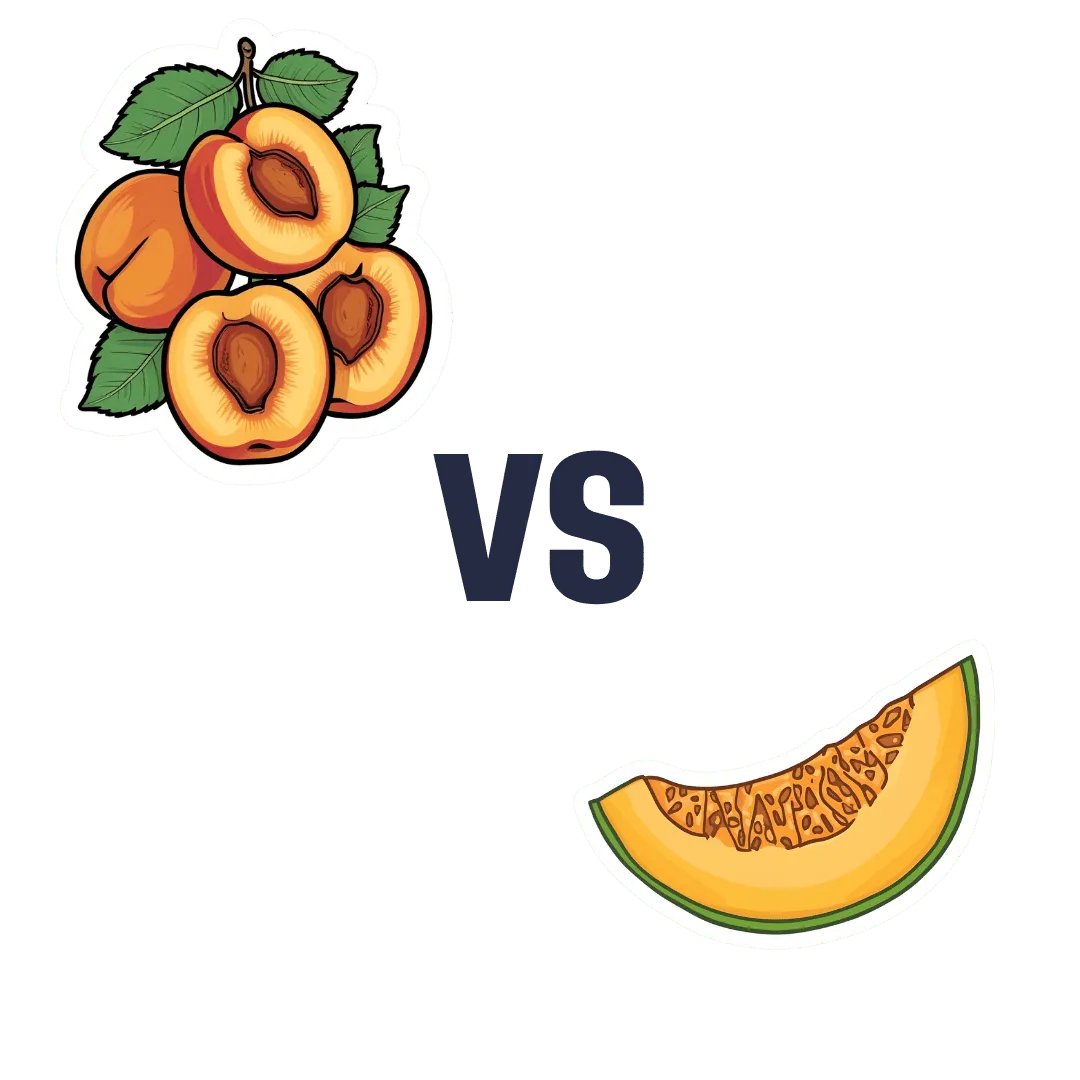
Apricot vs Cantaloupe – Which is Healthier?
10almonds is reader-supported. We may, at no cost to you, receive a portion of sales if you purchase a product through a link in this article.
Our Verdict
When comparing apricots to cantaloupe, we picked the apricots.
Why?
In terms of macros, apricots have 2x the fiber, for slightly more carbs and protein, winning in this first category.
In the category of vitamins, apricots have more of vitamins B2, B5, B7, E, and K, while cantaloupe has more of vitamins A, B1, B6, B9, and C, which would be a 5:5 tie, but it’s worth noticing the outlier that is the huge margin of difference when it comes to apricots having nearly 17x more vitamin E, so we say apricots win this round.
Looking at minerals, apricots have more calcium, copper, iron, manganese, phosphorus, and zinc, while cantaloupe has more magnesium, potassium, and selenium yielding a tidy 6:3 win to apricots here.
In other considerations, apricots are much higher in polyphenols, and also have some specific anticancer properties that cantaloupe can’t boast, so that’s another round in apricots’ favor.
Adding up the sections makes for a clear overall win for apricots, but by all means do enjoy either or both, as diversity is best!
Want to learn more?
You might like:
Top 8 Fruits That Prevent & Kill Cancer
Enjoy!
Don’t Forget…
Did you arrive here from our newsletter? Don’t forget to return to the email to continue learning!
Recommended

Learn to Age Gracefully
Join the 98k+ American women taking control of their health & aging with our 100% free (and fun!) daily emails:
-
The New Optimum Nutrition Bible – by Patrick Holford
10almonds is reader-supported. We may, at no cost to you, receive a portion of sales if you purchase a product through a link in this article.
While the author is not “Dr. Patrick Holford”, it’s worth mentioning that he is a career nutritionist with half the alphabet after his name, and decades of experience in the field.
Next, before getting into the real review of the book, we’ll also mention that his career has not been without controversy, but this has mostly been when he has strayed out of his field, such as when he bought into the (since not only soundly refuted, but outright demonstrated to be fraudulent) claim that the MMR vaccine causes autism.
In this book, he focuses on nutrition, and as such, the only nutritional advice that hasn’t stood the test of time was that he errantly claimed vitamin C could outperform the antiviral drugs of the day in beating HIV (a claim that would have killed anyone with HIV who believed it and swapped their AVT for vitamin C).
But the rest? Honestly, he was prescient in many respects. Arguably, this meant he came to conclusions for which the science was quite new at the time of writing, so perhaps indicative of the same person who believed the aforementioned false claims, but fact is, there he was, in the 90s, arguing for what has since come to be known as nutritional psychiatry and is now backed by decades more science, as well as championing phytochemicals that back then were little-known and/or ignored, but that we now know to have very potent beneficial effects; he talked about antinutrients that hardly anyone was talking about then, and more and more and more.
Bottom line: 49 chapters, each on a different nutrition-related health topic, and one of them had an overly bold nutritional claim that didn’t stand the test of time? We think that’s pretty good.
Click here to check out The New Optimum Nutrition Bible, and see how comprehensive it is!
Share This Post
-
Why do smart people get hooked on wellness trends? Personality traits may play a role
10almonds is reader-supported. We may, at no cost to you, receive a portion of sales if you purchase a product through a link in this article.
If you’ve spent time on social media recently you have probably been exposed to questionable “wellness” content. You may have been instructed to dip your toes in icy water or let the sun shine where it usually doesn’t.
Wellness trends such as drinking “loaded” water or taking ice baths may be benign for most people, while others such as drinking raw milk, eating raw organ meats, or taping your mouth while you sleep carry real risks.
The online spaces where they circulate can also be harmful, serving as breeding grounds for conspiracy theories, anti-vaccination sentiment, and misuse of appearance- and performance-enhancing drugs.
It’s easy to dismiss followers of extreme wellness trends as gullible or misinformed. But research suggests personality traits may help explain why some educated, well-intentioned people sometimes reject conventional medicine in favour of fringe practices.
The big five personality traits
Psychologists have shown that many aspects of human personality can be described via five fundamental dimensions, of which we all have varying levels.
Two of these “big five” traits – openness and agreeableness – are particularly relevant to people’s interest in alternative health practices. (The remaining three traits are conscientiousness, extraversion and neuroticism.)
People high in openness are curious, imaginative and adventurous. They question tradition and are attracted to novelty and unconventional ideas. As a result, they are more likely to try new and unorthodox diets or treatments.
Highly agreeable people are trusting, cooperative and empathetic. They are very receptive to emotional messages, especially when they appeal to ideas of caring for others and benefiting the community.
These personality traits also influence how people search for and evaluate online information. People higher in openness tend to adopt an exploratory search strategy, preferring to seek novel or unconventional sources rather than relying on established information channels.
Because they value harmony, trust and maintaining relationships, highly agreeable people tend to give greater weight to information that comes from familiar or socially endorsed sources. They do so even when this information has not been critically evaluated.
Personality and persuasive influence
In the online wellness ecosystem, high levels of openness and agreeableness can make people susceptible to persuasion.
Influencers have a powerful advantage. They can position themselves as both novel and trustworthy. Open people can be seduced by original, eye-catching content, and agreeable people by community-focused narratives.
Influencers cultivate one-sided “parasocial” relationships in which followers feel an intimate connection with someone they have never met. These close bonds, coupled with the open personality’s attraction to unconventional ideas, can draw people into extreme, untested and unsafe health practices.
Openness to new experiences and being interpersonally agreeable are usually seen as strengths. However, in the buzzing, emotionally charged environment of online wellness culture they can become vulnerabilities.
From ice baths to anti-vax
Not all wellness practices peddled by online influencers are harmful. But some relatively innocuous trends can be a gateway to more extreme practices.
Someone might start taking ice baths for a mood boost, move on to restrictive raw diets for “clean eating”, and eventually arrive at anti-vaccine beliefs grounded in deep mistrust of health authorities.
Gateway effects can occur if a trusted influencer makes increasingly extreme recommendations. If the influencer pivots to more dangerous ideas, many followers will follow.
Over time, exposure to fringe wellness narratives can erode trust in mainstream institutions. What began as curiosity and warmth may, through repeated exposure to extreme content, shift towards cynicism and institutional mistrust.
How can public health messages adapt?
Public health campaigns sometimes assume people reject mainstream health advice because they lack knowledge or have low “health literacy”.
But if personality traits influence receptiveness to alternative wellness claims, simply giving people more information may not produce positive change.
Public health campaigns should consider personality traits for more effective preventive interventions. They can target people high in openness, for example, by presenting health science as dynamic and evolving, not just a set of rules and prescriptions. They can reach highly agreeable people with health messages that emphasise empathy and community.
To be effective for all of us, public health communication needs to be as engaging as the messages emanating from influencers. It must use eye-catching visuals, personal stories, and moral hooks while remaining truthful.
People who engage in extreme or unusual wellness practices aren’t merely misinformed. Often, they’re driven by the same urge to explore, connect, and live well as everyone else. The challenge we face is to steer that drive toward health, not harm.
Samuel Cornell, PhD Candidate in Public Health & Community Medicine, School of Population Health, UNSW Sydney and Nick Haslam, Professor of Psychology, The University of Melbourne
This article is republished from The Conversation under a Creative Commons license. Read the original article.
Share This Post
-
A New $16,000 Postpartum Depression Drug Is Here. How Will Insurers Handle It?
10almonds is reader-supported. We may, at no cost to you, receive a portion of sales if you purchase a product through a link in this article.
A much-awaited treatment for postpartum depression, zuranolone, hit the market in December, promising an accessible and fast-acting medication for a debilitating illness. But most private health insurers have yet to publish criteria for when they will cover it, according to a new analysis of insurance policies.
The lack of guidance could limit use of the drug, which is both novel — it targets hormone function to relieve symptoms instead of the brain’s serotonin system, as typical antidepressants do — and expensive, at $15,900 for the 14-day pill regimen.
Lawyers, advocates, and regulators are watching closely to see how insurance companies will shape policies for zuranolone because of how some handled its predecessor, an intravenous form of the same drug called brexanolone, which came on the market in 2019. Many insurers required patients to try other, cheaper medications first — known as the fail-first approach — before they could be approved for brexanolone, which was shown in early trials reviewed by the FDA to provide relief within days. Typical antidepressants take four to six weeks to take effect.
“We’ll have to see if insurers cover this drug and what fail-first requirements they put in” for zuranolone, said Meiram Bendat, a licensed psychotherapist and an attorney who represents patients.
Most health plans have yet to issue any guidelines for zuranolone, and maternal health advocates worry that the few that have are taking a restrictive approach. Some policies require that patients first try and fail a standard antidepressant before the insurer will pay for zuranolone.
In other cases, guidelines require psychiatrists to prescribe it, rather than obstetricians, potentially delaying treatment since OB-GYN practitioners are usually the first medical providers to see signs of postpartum depression.
Advocates are most worried about the lack of coverage guidance.
“If you don’t have a published policy, there is going to be more variation in decision-making that isn’t fair and is less efficient. Transparency is really important,” said Joy Burkhard, executive director of the nonprofit Policy Center for Maternal Mental Health, which commissioned the study.
With brexanolone, which was priced at $34,000 for the three-day infusion, California’s largest insurer, Kaiser Permanente, had such rigorous criteria for prescribing it that experts said the policy amounted to a blanket denial for all patients, according to an NPR investigation in 2021.
KP’s written guidelines required patients to try and fail four medications and electroconvulsive therapy before they would be eligible for brexanolone. Because the drug was approved only for up to six months postpartum, and trials of typical antidepressants take four to six weeks each, the clock would run out before a patient had time to try brexanolone.
An analysis by NPR of a dozen other health plans at the time showed Kaiser Permanente’s policy on brexanolone to be an outlier. Some did require that patients fail one or two other drugs first, but KP was the only one that recommended four.
Miriam McDonald, who developed severe postpartum depression and suicidal ideation after giving birth in late 2019, battled Kaiser Permanente for more than a year to find effective treatment. Her doctors put her on a merry-go-round of medications that didn’t work and often carried unbearable side effects, she said. Her doctors refused to prescribe brexanolone, the only FDA-approved medication specifically for postpartum depression at the time.
“No woman should suffer like I did after having a child,” McDonald said. “The policy was completely unfair. I was in purgatory.”
One month after NPR published its investigation, KP overhauled its criteria to recommend that women try just one medication before becoming eligible for brexanolone.
Then, in March 2023, after the federal Department of Labor launched an investigation into the insurer — citing NPR’s reporting — the insurer revised its brexanolone guidelines again, removing all fail-first recommendations, according to internal documents recently obtained by NPR. Patients need only decline a trial of another medication.
“Since brexanolone was first approved for use, more experience and research have added to information about its efficacy and safety,” the insurer said in a statement. “Kaiser Permanente is committed to ensuring brexanolone is available when physicians and patients determine it is an appropriate treatment.”
“Kaiser basically went from having the most restrictive policy to the most robust,” said Burkhard of the Policy Center for Maternal Mental Health. “It’s now a gold standard for the rest of the industry.”
McDonald is hopeful that her willingness to speak out and the subsequent regulatory actions and policy changes for brexanolone will lead Kaiser Permanente and other health plans to set patient-friendly policies for zuranolone.
“This will prevent other women from having to go through a year of depression to find something that works,” she said.
Clinicians were excited when the FDA approved zuranolone last August, believing the pill form, taken once a day at home over two weeks, will be more accessible to women compared with the three-day hospital stay for the IV infusion. Many perinatal psychiatrists told NPR it is imperative to treat postpartum depression as quickly as possible to avoid negative effects, including cognitive and social problems in the baby, anxiety or depression in the father or partner, or the death of the mother to suicide, which accounts for up to 20% of maternal deaths.
So far, only one of the country’s six largest private insurers, Centene, has set a policy for zuranolone. It is unclear what criteria KP will set for the new pill. California’s Medicaid program, known as Medi-Cal, has not yet established coverage criteria.
Insurers’ policies for zuranolone will be written at a time when the regulatory environment around mental health treatment is shifting. The U.S. Department of Labor is cracking down on violations of the Mental Health Parity and Addiction Equity Act of 2008, which requires insurers to cover psychiatric treatments the same as physical treatments.
Insurers must now comply with stricter reporting and auditing requirements intended to increase patient access to mental health care, which advocates hope will compel health plans to be more careful about the policies they write in the first place.
In California, insurers must also comply with an even broader state mental health parity law from 2021, which requires them to use clinically based, expert-recognized criteria and guidelines in making medical decisions. The law was designed to limit arbitrary or cost-driven denials for mental health treatments and has been hailed as a model for the rest of the country. Much-anticipated regulations for the law are expected to be released this spring and could offer further guidance for insurers in California setting policies for zuranolone.
In the meantime, Burkhard said, patients suffering from postpartum depression should not hold back from asking their doctors about zuranolone. Insurers can still grant access to the drug on a case-by-case basis before they formalize their coverage criteria.
“Providers shouldn’t be deterred from prescribing zuranolone,” Burkhard said.
This article is from a partnership that includes KQED, NPR and KFF Health News.
KFF Health News is a national newsroom that produces in-depth journalism about health issues and is one of the core operating programs at KFF—an independent source of health policy research, polling, and journalism. Learn more about KFF.
Subscribe to KFF Health News’ free Morning Briefing.
Share This Post
Related Posts
-
Mango vs Strawberries – Which is Healthier?
10almonds is reader-supported. We may, at no cost to you, receive a portion of sales if you purchase a product through a link in this article.
Our Verdict
When comparing mango to strawberries, we picked the strawberries.
Why?
Both have their strengths! But…
In terms of macros, mangos have more carbs while strawberries have more fiber, so we’re calling this round a win for strawberries (mango is still perfectly healthy in this regard, though, like any non-poisonous fruit).
In the category of vitamins, mangos have more of vitamins A, B1, B2, B3, B5, B6, B9, E, K, and choline, while strawberries have more vitamin C. An easy win for mangoes in this round.
When it comes to minerals, mangos have more copper and selenium, while strawberries have more calcium, iron, magnesium, manganese, phosphorus, and zinc. A clear win for strawberries here.
Looking at polyphenols, strawberries have a lot more, and so win this round too.
Adding up the sections makes for an overall win for strawberries, but by all means enjoy either or both; diversity is good!
Want to learn more?
You might like:
From Apples to Bees, and High-Fructose Cs: Which Sugars Are Healthier, And Which Are Just The Same?
Enjoy!
Don’t Forget…
Did you arrive here from our newsletter? Don’t forget to return to the email to continue learning!
Learn to Age Gracefully
Join the 98k+ American women taking control of their health & aging with our 100% free (and fun!) daily emails:
-
Take These To Lower Cholesterol! (Statin Alternatives)
10almonds is reader-supported. We may, at no cost to you, receive a portion of sales if you purchase a product through a link in this article.
Dr. Ada Ozoh, a diabetes specialist, took an interest in this upon noting the many-headed beast that is metabolic syndrome means that neither diabetes nor cardiovascular disease exist in a vacuum, and there are some things that can help a lot against both. Here she shares some of her top recommendations:
Statin-free options
Dr. Ozoh recommends:
- Bergamot: lowers LDL (“bad” cholesterol) by about 30% and slightly increases HDL (“good” cholesterol), at 500–1000mg/day, seeing results in 1–6 months
- Berberine: prevents fat absorption and helps burn stored fat, as well as reducing blood sugar levels and blood pressure, at 1,500mg/day
- Silymarin: protects the liver, and lowers cholesterol in type 2 diabetes, at 280–420mg/day
- Phytosterols: lower cholesterol by about 10%; found naturally in many plants, but it takes supplementation to read the needed (for this purpose) dosage of 2g/day
- Red yeast rice: this is white rice fermented with yeast, and it lowers LDL cholesterol by about 25%, seeing results in around 3 months
For more information on all of the above (including more details on the biochemistry, as well as potential issues to be aware of), enjoy:
Click Here If The Embedded Video Doesn’t Load Automatically!
Want to learn more?
You might also like to read:
- Statins: His & Hers? Very Different For Men & Women
- Berberine For Metabolic Health
- Milk Thistle For The Brain, Bones, & More ← this is about silymarin, which is extracted from Silybum marianum, the milk thistle plant
Take care!
Don’t Forget…
Did you arrive here from our newsletter? Don’t forget to return to the email to continue learning!
Learn to Age Gracefully
Join the 98k+ American women taking control of their health & aging with our 100% free (and fun!) daily emails:
-
How To Make Your Body Fat Heart-Healthier
10almonds is reader-supported. We may, at no cost to you, receive a portion of sales if you purchase a product through a link in this article.
It matters where and how fat is stored, and the good news is, you can influence that!
Where it goes
Firstly, there’s an important distinction between subcutaneous fat (the squishable stuff just underneath your skin) and visceral fat (you can’t squish this; it’s under your abdominal muscles, surrounding your organs).
Subcutaneous fat is good in moderation, with a fairly wide margin for error. The healthiest body fat percentages are (assuming normal hormones) generally considered to be in the range of 20–25% for women and 15–20% for men. You can read more about this here: Is A Visible Six-Pack Obtainable Regardless Of Genetic Predisposition?
Visceral fat is generally bad. We technically do need some, but almost everyone has either the right amount or too much, and its presence is very strongly associated with metabolic health problems, well beyond the kind of health risks that can be attributed to systemic failures in the healthcare system when it comes to those with merely more subcutaneous fat than most (see: Fat’s Real Barriers To Health). So whereas subcutaneous fat tends to get scapegoated a lot for largely unrelated things, excess visceral fat is genuinely an undeniable problem metabolically.
We wrote more about visceral fat, here: Visceral Belly Fat & How To Lose It ← “visceral belly fat” is actually a redundant tautology repeated more than once unnecessarily (since the only place we get it is the viscera of the abdominal cavity), but including both terms makes the article easier to find when using our website’s search function 😉
Recently (the paper was published two days ago, at time of writing) researchers (Dr. Vladimir Losev et al.) analysed UK Biobank data from 21,241 people, using whole body and heart imaging and AI to calculate a “heart age” compared with chronological age.
What they found: excess visceral fat around organs was linked to faster aging of the heart and blood vessels, even in people who appear fit and have a “healthy” BMI.
We put that “healthy” in quotation marks there, because BMI isn’t very reliable for anything, and in this study, BMI didn’t predict heart age well, showing that fat location is more important than overall weight. See also: When BMI Doesn’t Quite Measure Up
Why this happens: people think of fat as being “just there”, but in reality it’s metabolically active, releasing cytokines, hormones, and chemokines; visceral fat promotes insulin resistance, inflammation, and lipid problems, while subcutaneous fat differs developmentally and functionally
They also found: hormonally-driven sex differences, notably that women have less visceral fat (54% of men’s level) but more subcutaneous fat (38% higher), and as such:
- men with “apple-shaped” fat distribution (belly fat) showed faster heart aging
- women with “pear-shaped” fat (hips and thighs) had slower heart aging
… and, confirming that hypothesis further, higher estrogen levels were found to be protective against heart aging.
For more on that, see: What Menopause Does To The Heart
As for this study we’ve been talking about, you can read the paper in full here: Sex-specific body fat distribution predicts cardiovascular ageing
What to do about it
Firstly, see our previous article: Visceral Belly Fat & How To Lose It for the dos and don’ts of getting healthier (which for most people means: lower) visceral fat levels.
Next up, see also: Body Fat & Pelvic Floor Problems: What Matters Most Is Where The Fat Is for more about those “apple or pear” distributions, and how to switch it up.
You may also be wondering: Can We Do Fat Redistribution? And the answer is yes, and we are doing it all the time whether we want to or not, so we might as well know what things affect our fat distribution in various body parts. The article we just linked there shows how.
While we’re at it, one other place you really don’t want excess fat, for metabolic reasons, is your liver. So: How To Unfatty A Fatty Liver
One more thing…
Did you know that even our subcutaneous fat is divided into kinds that are “better” or “worse” than others?
Learn about it here: The BAT-pause! ← this is about Brown Adipose Tissue (the best kind of subcutaneous fat) and how/why its levels often lower with menopause, and what to do about it.
Take care!
Don’t Forget…
Did you arrive here from our newsletter? Don’t forget to return to the email to continue learning!
Learn to Age Gracefully
Join the 98k+ American women taking control of their health & aging with our 100% free (and fun!) daily emails:


