Starfruit vs Strawberries – Which is Healthier?

10almonds is reader-supported. We may, at no cost to you, receive a portion of sales if you purchase a product through a link in this article.

Our Verdict

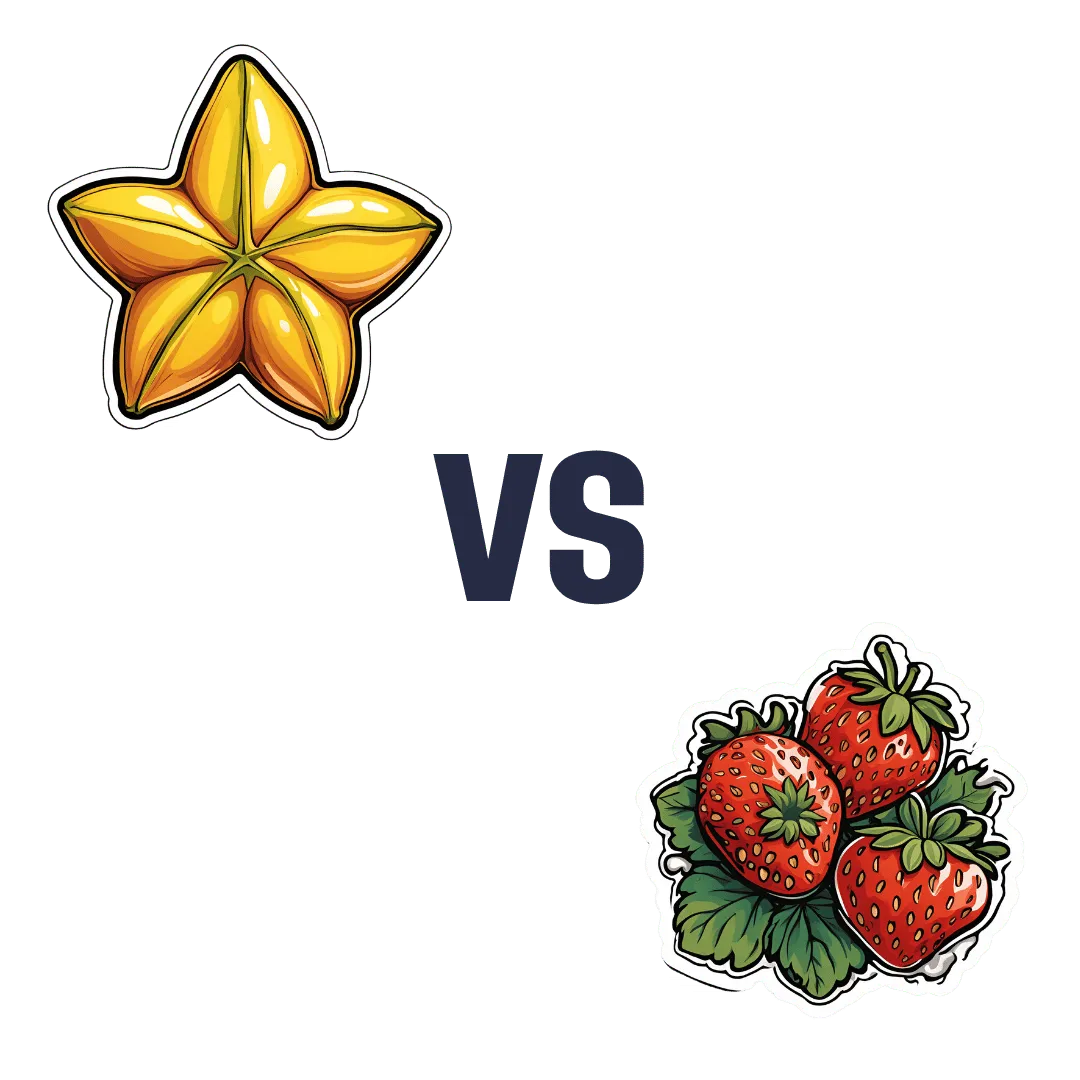
When comparing starfruit to strawberries, we picked the strawberries.

Why?

In terms of macros, starfruit has slightly more fiber while strawberries have slightly more carbs; the differences are very small (less than 1g/100g in each direction in each case) so this can be called either a tie, or the slenderest of nominal wins to starfruit in this category.

In the category of vitamins, starfruit has more of vitamins A and B5 (so, the vitamins it’s hardest to be deficient in while not starving to death), while strawberries have more of vitamins B1, B2, B3, B6, B7, B9, C, E, and K, winning easily by a long way.

Looking at minerals, starfruit has more copper and selenium, while strawberries have more calcium, iron, magnesium, manganese, phosphorus, potassium, and zinc, winning convincingly again.

In other considerations, strawberries are also higher in polyphenols (greater total and greater diversity) so that’s another round in strawberries’ favor.

Adding up the sections makes for a clear overall win for strawberries, but by all means do enjoy either or both, as diversity is best!

Want to learn more?

You might like:

Are You Getting The Right Kinds Of Flavonoids?

Enjoy!

Don’t Forget…

Did you arrive here from our newsletter? Don’t forget to return to the email to continue learning!

Learn to Age Gracefully

Join the 98k+ American women taking control of their health & aging with our 100% free (and fun!) daily emails:

  • The Beauty Molecule – by Dr. Nicholas Perricone

    10almonds is reader-supported. We may, at no cost to you, receive a portion of sales if you purchase a product through a link in this article.

    We’re a health science publication, not a beauty magazine, but what’s actually going on here is skin rejuvenation, and in any case, skin health does tend to affect mental health, especially if it’s not good—thus giving a second reason to consider it of importance.

    With that in mind, we’ll not keep “the beauty molecule” a secret: he’s talking about acetylcholine, a neurotransmitter.

    What does a neurotransmitter have to do with beauty, you wonder? In the largest part, it’s because (via a chain of events which, for brevity, we’ll not detail) it reduces inflammation.

    There are other factors too; it also triggers endothelial vasodilation which can result in the skin being better-nourished and better-maintained; the hair also benefits by the same process.

    Thus, while the title makes it sound like we will need to buy a mysterious newly-developed skincare product, it turns out that he recommends eating almonds and other choline-rich foods.

    On the flipside, he recommends acetylcholinesterase inhibitors, such as ginkgo biloba and huperzine A, which will (as the name suggests) inhibit acetylcholinesterase, which is an enzyme that breaks down acetylcholine.

    However, that is only part of the book, and much of the rest covers other nutraceuticals (neuroceuticals being a word coined by the author, but it doesn’t seem to add much, and he also includes things that are not specific to neural function, such as polyphenols of various kinds and even carotenoids).

    The style is a little more technical than most books we review here, but it’s nothing that should pose a barrier to comprehension if you:

    1. have sufficient scientific literacy that you can read at least the abstracts of scientific papers and understand what they mean, and/or…
    2. read the book from cover to cover such that many specific things are explained as we go (you learn what DMAE and EGCG and AMPK etc are, and you know that IRS2 is not about taxes), and…
    3. for other more general things you have a digital device to hand to look up, if necessary, the difference between modulate/moderate/mitigate/mediate and so forth.

    Bottom line: if you’d like to improve your skin health, systemic health, and your knowledge of physiology, this book can deliver those things!

    Click here to check out The Beauty Molecule, and get yourself a healthy dose of it!

    Share This Post

  • Black Bean Burgers With Guacamole

    10almonds is reader-supported. We may, at no cost to you, receive a portion of sales if you purchase a product through a link in this article.

    Once again proving that burgers do not have to be unhealthy, this one’s a nutritional powerhouse full of protein, fiber, vitamins, and minerals, as well as healthy fats and extra health-giving spices.

    You will need

    • 1 can black beans, drained and rinsed (or 1 cup same, cooked, drained, and rinsed)
    • 3 oz walnuts (if allergic, substitute with pumpkin seeds)
    • 1 tbsp chia seeds
    • 1 tbsp flax seeds
    • ½ red onion, finely chopped
    • 1 small eggplant, diced small (e.g. ½” cubes or smaller)
    • 1 small carrot, grated
    • 3 tbsp finely chopped cilantro (or if you have the “this tastes like soap” gene, then substitute with parsley)
    • 1 tbsp lemon juice
    • 1 jalapeño pepper, finely chopped (adjust per heat preferences)
    • ¼ bulb garlic, crushed
    • 2 tsp black pepper
    • 1 tsp smoked paprika
    • 1 tsp cayenne pepper (adjust per heat preferences)
    • ½ tsp MSG or 1 tsp low-sodium salt
    • Burger buns (you can use our Delicious Quinoa Avocado Bread recipe if you like)

    For the guacamole:

    • 1 large ripe avocado, pitted, skinned, and chopped
    • 1 tbsp lime juice
    • 1 tomato, finely chopped
    • ¼ red onion, finely chopped
    • ¼ bulb garlic, crushed
    • 1 tsp red chili pepper flakes (adjust per heat preferences)

    Method

    (we suggest you read everything at least once before doing anything)

    1) Process the walnuts, chia seeds, and flax seeds in a food processor/blender, until they become a coarse mixture. Set aside.

    2) Heat a little oil in a skillet, and fry the red onion, aubergine, and carrot for 5 minutes stirring frequently, then add the garlic and jalapeño and stir for a further 1 minute. Set aside.

    3) Combine both mixtures you set aside with the rest of the ingredients from the burger section of the recipe, except the buns, and process them in the food processor on a low setting if possible, until you have a coarse mixture—you still want some texture, not a paste.

    4) Shape into patties; this recipe gives for 4 large patties or 8 small ones. When you’ve done this, put them in the fridge for at least 30 minutes, to firm up.

    5) While you wait, make the guacamole by mashing the avocado with the lime juice, and then stirring into the onion, tomato, garlic, and pepper.

    6) Cook the patties; you can do this on the grill, in a skillet, or in the oven, per your preference. Grilling or frying should take about 5 minutes on each side, give or take the size and shape of the patties. Baking in the oven should take 20–30 minutes at 400℉ / 200℃ turning over halfway through, but keep an eye on them, because again, the size and shape of the patties will affect this. You may be wondering: aren’t they all going to be patty-shaped? And yes, but for example a wide flat patty will cook more quickly than the same volume of burger mixture in a taller less wide patty.

    7) Assemble! We recommend the order: bottom bun, guacamole, burger patty, any additional toppings you want to add (e.g. more salad, pickles, etc), top bun:

    Enjoy!

    Want to learn more?

    For those interested in some of the science of what we have going on today:

    Take care!

    Share This Post

  • Ageless – by Dr. Andrew Steele

    10almonds is reader-supported. We may, at no cost to you, receive a portion of sales if you purchase a product through a link in this article.

    So, yet another book with “The new science of…” in the title; does this one deliver new science?

    Actually, yes, this time! The author was originally a physicist before deciding that aging was the number one problem that needed solving, and switched tracks to computational biology, and pioneered a lot of research, some of the fruits of which can be found in this book, in amongst a more general history of the (very young!) field of biogerontology.

    Downside: most of this is not very practical for the lay reader; most of it is explanations of how things happen on a cellular and/or genetic level, and how we learned that. A lot also pertains to what we can learn from animals that either age very slowly, or are biologically immortal (in other words, they can still be killed, but they don’t age and won’t die of anything age-related), or are immune to cancer—and how we might borrow those genes for gene therapy.

    However, there are also chapters on such things as “running repairs”, “reprogramming aging”, and “how to live long enough to live even longer”.

    The style is conversational pop science; in the prose, he simply states things without reference, but at the back, there are 40 pages of bibliography, indexed in the order in which they occurred and prefaced with the statement that he’s referencing in each case. It’s an odd way to do citations, but it works comfortably enough.

    Bottom line: if you’d like to understand aging on the cellular level, and how we know what we know and what the likely future possibilities are, then this is a great book; it’s also simply very enjoyable to read, assuming you have an interest in the topic (as this reviewer does).

    Click here to check out Ageless, and understand the science of getting older without getting old!

    Share This Post

  • Hazelnuts vs Pistachios – Which is Healthier?

    10almonds is reader-supported. We may, at no cost to you, receive a portion of sales if you purchase a product through a link in this article.

    Our Verdict

    When comparing hazelnuts to pistachios, we picked the hazelnuts.

    Why?

    An argument could be made for either, depending on what we prioritize! So there was really no wrong answer here today, but it is good to know what each nut’s strengths are:

    In terms of macros, pistachios have more fiber, carbs, protein, and (mostly healthy) fat. That does make them the “more food per food” option, but it’s worth noting that while hazelnuts have more fiber, they also have a higher margin of difference when it comes to their greater carb count, and resultantly, hazelnuts do have the lower glycemic index. That said, they’re still both low-GI foods, so we’ll call this section a win for pistachios overall.

    When it comes to vitamins, hazelnuts have more of vitamins B3, B5, B9, C, E, K, and choline, while pistachios have more of vitamins A, B1, B2, and B6. So, a fair 7:4 win for hazelnuts here.

    In the category of minerals, hazelnuts have more calcium, copper, iron, magnesium, manganese, and zinc, while pistachios have more phosphorus, potassium, and selenium. A clear 6:3 win for hazelnuts.

    In short, both are good sources of many nutrients, so choose according to what you want to prioritize, or better yet, enjoy both.

    Want to learn more?

    You might like to read:

    Why You Should Diversify Your Nuts

    Take care!

    Don’t Forget…

    Did you arrive here from our newsletter? Don’t forget to return to the email to continue learning!

    Learn to Age Gracefully

    Join the 98k+ American women taking control of their health & aging with our 100% free (and fun!) daily emails:

  • Do Tanning Beds Have Any Benefits?

    10almonds is reader-supported. We may, at no cost to you, receive a portion of sales if you purchase a product through a link in this article.

    There is one answer:

    No

    Or rather, the answer is “no” unless we want to take some liberties about what we want to consider a benefit. For example:

    • If the temporary aesthetic of a tan is a benefit to you, then that’s a benefit (but we urge you to value your health over that)
    • If the experience of going there is a benefit to you, then that’s a benefit (but we urge you to find a comparable experience that’s less harmful)
    • If… You know what, we’re already out of things that could even be reasonably considered a benefit (but we trust you get the point)

    But, health benefits? Beyond any mental health benefits that could be better acquired through other means? No.

    The closest thing to a counterexample could be that some will say (correctly) that a tanning bed will clear up acne.

    But that’s a problem, not a benefit. Not because you pressingly needed the acne bacteria alive, but because irradiating your skin in such a manner that laid waste to your skin microbiome had two negative effects:

    1. It killed the rest of your skin microbiome, too. Or at least most of it.
    2. That same UV radiation is not any better for you than it was for those microbes.

    For more on that first item, see: Your Skin Microbiome & The Sun ← because your microbiome can actually help protect you against the sun’s rays, but even they can and will be destroyed by the intense ferocity that is the UV radiation of a tanning bed.

    Recently, researchers (Dr. Annika Marty et al.) compared medical records from 3,000 tanning bed users with similarly aged non-users and sequenced skin biopsies using technology focused on melanocytes and found that people who use tanning beds have nearly a 3x higher risk of melanoma compared with non-users, after adjusting for age, sunburn history, and family history.

    Based on this research and more (i.e., the many other papers cited in the paper we’ll link below), it’s clear that sunbeds cause mutations in melanocytes, with tanning bed users showing nearly twice as many mutations, making skin cells more susceptible to cancer.

    You can read the paper in full, here: Molecular effects of indoor tanning

    It’s also worth noting that World Health Organization’s International Agency for Research on Cancer classifies tanning beds in the highest cancer risk category, alongside smoking and asbestos, with melanoma causing nearly 60,000 deaths per year.

    So, please don’t let that be you or your loved ones.

    Want to learn more?

    We’ve tackled some related issues before, diving into the science, including:

    The Sun Exposure Dilemma

    …and:

    Who Screens The Sunscreens?

    And if you already have sun-damaged skin…

    Undo The Sun’s Damage To Your Skin

    Take care!

    Don’t Forget…

    Did you arrive here from our newsletter? Don’t forget to return to the email to continue learning!

    Learn to Age Gracefully

    Join the 98k+ American women taking control of their health & aging with our 100% free (and fun!) daily emails:

  • How To Grow In Comfort

    10almonds is reader-supported. We may, at no cost to you, receive a portion of sales if you purchase a product through a link in this article.

    How To Grow (Without Leaving Your Comfort Zone)

    “You have to get out of your comfort zone!” we are told, from cradle to grave.

    When we are young, we are advised (or sometimes more forcefully instructed!) that we have to try new things. In our middle age, we are expected to be the world’s greatest go-getters, afraid of nothing and always pushing limits. And when we are old, people bid us “don’t be such a dinosaur”.

    It is assumed, unquestioned, that growth can only occur through hardship and discomfort.

    But what if that’s a discomforting lie?

    Butler (2023) posited an idea: “We never achieve success faster and with less effort than when we are in our comfort zone”

    Her words are an obvious callback to the ideas of Csikszentmihalyi (1970) in the sense of “flow”, in the sense in which that word is used in psychology.

    Flow is: when a person is in a state of energized focus, full involvement, and enjoyment of an activity.

    As a necessary truth (i.e: a function of syllogistic logic), the conditions of “in a state of flow” and “outside of one’s comfort zone” cannot overlap.

    From there, we can further deduce (again by simple logic) that if flow can be found, and/but cannot be found outside of the comfort zone, then flow can only be found within the comfort zone.

    That is indeed comforting, but what about growth?

    Imagine you’ve never gone camping in your life, but you want to get outside of your comfort zone, and now’s the time to do it. So, you check out some maps of the Yukon, purchase some camping gear, and off you go into the wilderness. In the event that you survive to report it, you will indeed be able to say “it was not comfortable”.

    But, did growth occur? Maybe, but… it’s a folly to say “what doesn’t kill us makes us stronger” as a reason to pursue such things. Firstly, there’s a high chance it may kill us. Secondly, what doesn’t kill us often leaves us incredibly weakened and vulnerable.

    When Hannibal famously took his large army of mostly African mercenaries across the Alps during winter to march on Rome from the other side, he lost most of his men on the way, before proceeding to terrorize Northern Italy convincingly with the small remainder. But! Their hard experience hadn’t made them stronger; it had just removed the weaker soldiers, making the resultant formations harder to break.

    All this to say, please do not inflict hardship and discomfort and danger in the hopes it’ll make you stronger; it will probably do the opposite.

    But…

    If, instead of wilderness trekking in the Yukon…

    • You start off with a camper van holiday, then you’ll be taking a fair amount of your comfort with you. In effect, you will be stretching and expanding your comfort zone without leaving it.
    • Then maybe another year you might try camping in a tent on a well-catered camping site.
    • Later, you might try “roughing it” at a much less well-catered camping site.
    • And so on.

    Congratulations, you have tried new things and undergone growth, taking your comfort zone with you all the way!

    This is more than just “easing yourself into” something

    It really is about taking your comfort with you too. If you want to take up running, don’t ask “how can I run just a little bit first” or “how can I make it easier” (well, feel free to ask those things too, but) ask yourself: how can I bring my comfort with me? Comfortable shoes, perhaps, an ergonomic water bottle, shade for your head, maybe.

    ❝Any fool can rough it, but a good soldier can make himself comfortable in any circumstances❞

    ~ British Army maxim

    This goes for more than just physical stuff, too

    If you want to learn a new skill, the initial learning curve can be anxiety-inducing, especially if you are taking a course and worried about keeping up or “not being good enough”.

    So, “secretly” study in advance, at your leisure, get yourself a head start. Find a degree of comfort in what you’ve learned so far, and then bring that comfort with you into your entry-level course that is now less intimidating.

    Discomfort isn’t a badge of honor (and impedes growth)

    Take that extra rest stop on the highway. Bring your favorite coffee with you. Use that walking stick, if it helps.

    Whatever it takes to bring your comfort with you, bring it.

    Trust us, you’ll get further that way.

    Don’t Forget…

    Did you arrive here from our newsletter? Don’t forget to return to the email to continue learning!

    Learn to Age Gracefully

    Join the 98k+ American women taking control of their health & aging with our 100% free (and fun!) daily emails: