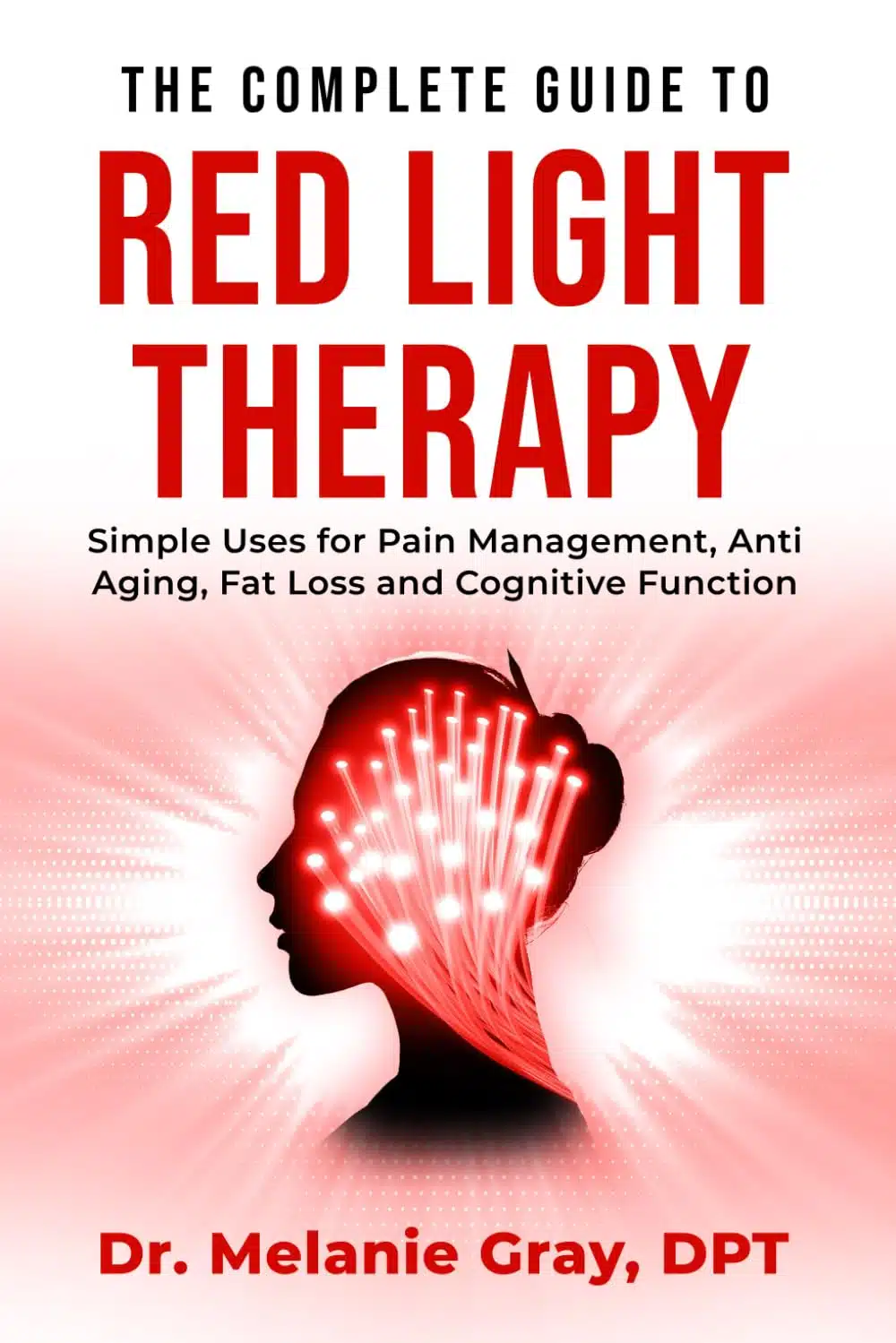
The Complete Guide To Red Light Therapy – by Dr. Melanie Gray

10almonds is reader-supported. We may, at no cost to you, receive a portion of sales if you purchase a product through a link in this article.

Red light therapy (RLT) is one of those things that sounds like it should be an ineffectual new-age fad that doesn’t do anything, but in fact, there’s a lot of evidence to show that it confers many benefits.

In particular, and to oversimply rather because this is a book review and not a scientific article (though we have written about RLT before and linked to various studies there), RLT is most noted for rejuvenating skin, and enhancing the healing of same, where applicable.

Dr. Gray explains not just what it does, but also some of how it does it, involving the stimulation of mitochondria, DNA-and-telomere repair, and more. She also talks the difference between RLT and near-infrared therapy, which are often delivered by the same devices, just, we can see part of the spectrum and not the other part.

She covers practical matters too, such as optimizing the frequency for different purposes (helpful when choosing a device, or when adjusting the settings on a multi-setting device), as well as optimal treatment duration, and other factors that can affect dosage (including the intensity of the light, and your skintone).

The style is… a little mixed, and can read a little like AI was involved. But on the bright side, it’s a perfectly easy read (and a short one, at 104 pages), and the author’s input includes a lot of niche technical knowledge, which makes it worthwhile. The bibliography is 12 items long and only 5 of those are scholarly articles, but honestly, she could have padded it with a lot more hard-science evidence for RLT’s benefits and it wouldn’t have actually increased the practical value of the book, so we don’t think this is a terrible thing.

Bottom line: this will probably not become anyone’s favorite book, but it is actually useful, and can help you to get the most out of RLT.

Click here to check out The Complete Guide To Red Light Therapy, and enjoy a healthy glow!

Don’t Forget…

Did you arrive here from our newsletter? Don’t forget to return to the email to continue learning!

Learn to Age Gracefully

Join the 98k+ American women taking control of their health & aging with our 100% free (and fun!) daily emails:

  • Raspberries vs Starfruit – Which is Healthier?

    10almonds is reader-supported. We may, at no cost to you, receive a portion of sales if you purchase a product through a link in this article.

    Our Verdict

    When comparing raspberries to starfruit, we picked the raspberries.

    Why?

    It’s quite a straightforward one today:

    In terms of macros, raspberries have more than 2x the fiber, as well as slightly more carbs, and for what it’s worth which isn’t much because the numbers are truly tiny for this one, slightly more protein. In any case, an easy win for raspberries mainly by virtue of the fiber.

    In the category of vitamins, raspberries have more of vitamins B1, B2, B3, B6, B7, B9, E, and K, while starfruit has more of vitamins A, B5, and C, yielding an 8:1 win for raspberries in this second round.

    Looking at minerals next, raspberries have more calcium, iron, magnesium, manganese, phosphorus, potassium, and zinc, while starfruit has more calcium and selenium, meaning it’s a tidy 7:2 win for raspberries here.

    In other considerations, raspberries are much higher in polyphenols, so that’s another point in their favor.

    Adding up the sections makes for an overwhelming overall win for raspberries, but by all means do enjoy either or both, as diversity is best!

    Want to learn more?

    You might like:

    Sharp Tastes, Sharp Brain?

    Enjoy!

    Share This Post

  • PCOS Repair Protocol – by Tamika Woods

    10almonds is reader-supported. We may, at no cost to you, receive a portion of sales if you purchase a product through a link in this article.

    PCOS (Polycystic Ovary Syndrome) affects about 1 in 5 women, and the general position of the medical establishment is “Oh dear, how sad; never mind”.

    …which leaves a lot of people suffering with symptoms with little to no help.

    This book looks to address that, and while it doesn’t claim to cure PCOS, it offers a system for managing (including: reducing) the symptoms. The author, a clinical nutritionist by academic background, tackles this in large part via being mindful about what one eats, in the context of the gut and endocrine system specifically.

    It’s not just “have a gut healthy diet and eat foods with these nutrients”, though (although yes: also that). Rather, the author walks us through in-depth quizzes and lab testing advice, to advise the reader on how to understand the root cause of your PCOS symptoms, and then address each of those with an individualized management plan.

    The style is on the low-end of pop-science, notwithstanding the clinically-informed content. For those who like a very chatty informal approach, you’ll find this one perfect. For those who don’t, well, you won’t find this one perfect, but you will most likely find it informative all the same.

    Bottom line: if you or someone you care about (do you know 5 women?) has PCOS, the information in here could make a difference.

    Click here to check out PCOS Repair Protocol, and suffer less!

    Share This Post

  • 10 Simple Japanese Habits For Healthier & Longer Life

    10almonds is reader-supported. We may, at no cost to you, receive a portion of sales if you purchase a product through a link in this article.

    You don’t have to be Japanese or live in Okinawa to enjoy the benefits of healthy longevity. A lot of it comes down to simple habits:

    Easy to implement

    We’ll not keep the 10 habits a mystery; they are:

    1. Start the day with hot water: drinking hot water in the morning helps with hydration, warming the body, and aiding digestion.
    2. Enjoy a hearty breakfast: Japanese breakfasts are traditionally filling, nutritious, and help promote energy and longevity. Typical components include rice, miso soup, fish, and pickles.
    3. Take balanced meals: Japanese education emphasizes nutrition from a young age, promoting balanced meals with proteins, fiber, and vitamins & minerals.
    4. Enjoy fermented foods: fermented foods, such as nattō and soy-based condiments, support digestion, heart health, and the immune system.
    5. Drink green tea and matcha: both are rich in health benefits; preparing matcha mindfully adds a peaceful ritual to daily life too.
    6. Keep the “80% full” rule: “hara hachi bu” encourages eating until 80% full, which can improve longevity and, of course, prevent overeating.
    7. Use multiple small dishes: small servings and a variety of dishes help prevent overeating and ensure a diverse intake of nutrients.
    8. Gratitude before and after meals: saying “itadakimasu” and “gochisousama” promotes mindful eating, and afterwards, good digestion. Speaking Japanese is of course not the key factor here, but rather, do give yourself a moment of reflection before and after meals.
    9. Use vinegar in cooking: vinegar, often used in sushi rice and sauces like ponzu, adds flavor and offers health benefits, mostly pertaining to blood sugar balance.
    10. Eat slowly: Eating at a slower pace will improve digestion, and can enhance satiety and prevent accidentally overeating.

    For more on all of these, enjoy:

    Click Here If The Embedded Video Doesn’t Load Automatically!

    Want to learn more?

    You might also like to read:

    How To Get More Out Of What’s On Your Plate

    Take care!

    Share This Post

  • Fall Special

    10almonds is reader-supported. We may, at no cost to you, receive a portion of sales if you purchase a product through a link in this article.

    Some fall-themed advice…

    It is now, nominally at least, fall. We’re going to talk about the other kind of “fall” though, the kind that results in broken hips and more.

    If you’re thinking “not me; that happens to older more infirm people”, rest assured, it can and statistically probably will happen to you at some point. So, how to play the odds?

    First, be robust!

    We may not be able to make ourselves like children who bounce easily, but we also don’t have to crumble into dust at the slightest knock, either. There are two important ways we can start to make ourselves robust from the inside out, and they are simple: diet and exercise.

    “But I don’t have osteoporosis”—great! But osteoporosis is preceded by osteopenia, which is generally asymptomatic at first, and also if we’re not very careful about it, we will lose about 1% bone density per year from the age of about 35 onwards, with that rate of loss climbing sharply from the age of 50 onwards, and even more steeply in cases of untreated menopause.

    So in other words, don’t take your bone strength for granted; there’s a first time for everything, and you don’t want to find out the hard (and yet, dare we say it, brittle) way.

    Second, be dynamic!

    Be able to fall and get up safely. If your later life is going to be a triathlon of things you need to train for now, then being able to fall and get up safely should be at the top of the list.

    Being able to “deep squat” will help you a lot here, in being able to get up with minimal (or no) use of your hands. We shared a great instructional video about this last week.

    It also means that the more your lower body can still take your weight while your torso is closer to the ground (without your legs buckling and collapsing, for instance), the softer and gentler you’ll hit the floor if you do fall, because the final “drop” will be from a lower height.

    If at all possible, consider taking some classes of a martial art that involves safely falling—aikido is typically the softest and gentlest and is famously great for people of all ages, but judo or jujitsu will suffice if aikido isn’t available where you are. You don’t have to get a black belt (unless you want to), and any decent instructor will be happy to guide you through the basics of safely falling and then send you on your merry way, if that’s all you wanted.

    The benefits of this are twofold:

    • Obviously, if you fall, you will have better technique and thus be less likely to incur injury
    • As you are falling, you will be less afraid, and thus less likely to tense up mid-fall (tensing up will exacerbate any falling injury)

    Click here to find an aikido teacher near you (you can search by country, state, and city)

    Third, be balanced!

    Spending even just a few minutes each day working on your balance can go a long way.

    Standing on one leg (and then the other) is a very good obvious starting point. Please, do so safely. The shower is not the best place to take up this practice, for instance. A nice safe grassy area is great. Your carpeted living room or bedroom is next-best.

    Another great approach is the practice of bāguàzhǎng circle-walking.

    Bāguà is tai chi’s lesser-known cousin, and those arts are two of the three main schools of wǔdāngquán. But, fear not, you don’t have to don orange robes and live atop the Wudang mountains to get what you need in this case.

    To give a text-based summary: bāguàzhǎng circle-walking involves walking in a small circle, with a low center of gravity, moving one’s weight very purposefully from one leg to the other, keeping complete stability the whole time that one is (often!) on one leg.

    Once you get good at this, you’ll see that this is essentially a super-enhanced version of the “standing on one leg” exercise, because it’s about keeping balance while on one leg, and/but while moving also.

    Naturally, if you do get good at this, you’ll be very unlikely to fall in the first place.

    Here’s a visual primer. This video will show the basic footwork, and the video that follows it (it’ll prompt you if you want to watch it) shows how to bring it up to a standard walking speed, without losing fluidity of movement:

    Don’t Forget…

    Did you arrive here from our newsletter? Don’t forget to return to the email to continue learning!

    Learn to Age Gracefully

    Join the 98k+ American women taking control of their health & aging with our 100% free (and fun!) daily emails:

  • Happy Mind, Happy Life – by Dr. Rangan Chatterjee

    10almonds is reader-supported. We may, at no cost to you, receive a portion of sales if you purchase a product through a link in this article.

    Let’s start with a “why”. If happiness doesn’t strike you as a worthwhile goal in and of itself, Dr. Chatterjee discusses the health implications of happiness/unhappiness.

    And, yes, including in studies where other factors were controlled for, so he shows how happiness/unhappiness does really have a causal role in health—it’s not just a matter of “breaking news: sick people are less happy”.

    The author, a British GP (General Practitioner, the equivalent of what the US calls a “family doctor”) with decades of experience, has found a lot of value in the practice of holistic medicine. For this reason, it’s what he recommends to his patients at work, in his books, his blog, and his regular spot on a popular BBC breakfast show.

    The writing style is relaxed and personable, without skimping on information density. Indeed, Dr. Chatterjee offers many pieces of holistic health advice, and dozens of practical exercises to boost your happiness and proof you against adversity.

    Because, whatever motivational speakers may say, we can’t purely “think ourselves happy”; sometimes we have real external threats and bad things in life. But, we can still improve our experience of even these things, not to mention suffer less, and get through it in better shape with a smile at the end of it.

    Bottom line: if you’d like to be happier and healthier (who wouldn’t?), then this book is a sure-fire way to set you on that path.

    Click here to check out Happy Mind, Happy Life and upgrade yours!

    Don’t Forget…

    Did you arrive here from our newsletter? Don’t forget to return to the email to continue learning!

    Learn to Age Gracefully

    Join the 98k+ American women taking control of their health & aging with our 100% free (and fun!) daily emails:

  • The Japanese Health Initiative That Lowers Blood Sugars

    10almonds is reader-supported. We may, at no cost to you, receive a portion of sales if you purchase a product through a link in this article.

    We’ve talked before about Good (Or Bad) Health Starts With Your Blood, and how a lot of human disease begins with, or is exacerbated by, diabetes or even pre-diabetes, and that in the US, this is even more strongly true than in the rest of the world, what with the US being #1 for diabetes.

    However! That does not mean if you’re not prediabetic, there is no threat. This is because it is usually insulin resistance, and not the high blood sugar content itself, that is the main driver of disease. It just so happens that blood sugars are a lot quicker and easier to test, and the correlation between them is high. On the other hand, insulin resistance will often go unnoticed for many years, because the pancreas just cranks out more and more extra insulin to compensate and keep the blood sugars balanced—until one day it can’t because the body is so resistant to insulin that the pancreas just can’t produce enough to get it to care adequately, and that’s when the blood sugars will finally rise (and get noticed).

    We reviewed an excellent book about precisely this (very, very common) phenomenon: Why We Get Sick – by Dr. Benjamin Bikman

    The good news is, there are things can be done to Improve Your Insulin Sensitivity.

    And with regard to blood sugars themselves, an excellent list is: 10 Ways To Balance Blood Sugars

    Number 8 in that list was:

    After you eat, move

    The glucose you eat will be used to replace lost muscle glycogen, before any left over is stored as fat… and, while it’s waiting to be stored as fat, just sitting in your bloodstream being high blood sugars. So, this whole thing will go a lot better if you are actively using muscle glycogen (by moving your body).

    Inchauspé gives a metaphor: imagine a steam train worker, shoveling coal into the furnace. Meanwhile, other workers are bringing more coal. If the train is moving quickly, the coal can be shoveled into the furnace and burned and won’t build up so quickly. But if the train is moving slowly or not at all, that coal is just going to build up and build up, until the worker can shovel no more because of being neck-deep in coal.

    Same with your blood sugars!

    But that—sound advice as it is—remains a little vague, leaving us with questions such as:

    • How much movement?
    • For how long?
    • And what’s the window of opportunity to enjoy this effect?

    With those questions in mind…

    Japan’s “Plus 10” Initiative

    The government of Japan has a “plus 10” initiative, whose goal is to encourage everyone to add just 10 minutes of extra activity to each day. You might think that won’t make a big difference, but in fact it all adds up, for example: Cumulative Exercise vs Neurodegeneration ← which shows how it is cumulative exercise over time that matters the most in this regard, which means that “little and often” really does count for a lot.

    We’ve also written before about How Useful Is “Exercise Snacking”, Really?, with some very specific protocols there for those who like to truly optimize everything.

    Most recently, a Japanese research team investigated the effects of two different approaches to post-dinner exercise, on blood sugars:

    1. Walk for 10 minutes, immediately after eating
    2. Walk for 30 minutes, 30 minutes after eating

    There was also a control condition (rest only, no walking).

    They measured the effect of these conditions on blood glucose in three ways:

    • 2‑hour blood glucose area under the curve (AUC)*
    • mean average glucose
    • peak glucose

    *that’s a way of looking at the total impact of it over the course of the recording period

    They additionally measured heart rate, perceived exertion, and gastrointestinal discomfort.

    They found that both walking conditions significantly reduced 2‑hour blood glucose AUC and mean glucose versus control:

    • 10-min walk: the AUC was 15,607 mg·min/dL (control was 16,605), and mean glucose = 127.9 mg/dL (control was 135.8mg/dL)
    • 30-min walk: also effective, but no significant difference compared to the 10‑min walk immediately after eating.

    However! Only the immediate 10‑min walk significantly lowered peak glucose (164.3 mg/dL, compared to the control condition’s 181.9 mg/dL).

    Which means that the immediate 10-minute walk not only equals the delayed 30-minute walk in most ways, but also outright beats that in a third way. And that third way, the peak glucose? That’s where the insulin resistance starts, so this is critical.

    As for the other things they measured: both walking conditions were rated as low perceived effort, with the 10‑min walk feeling the relatively easier of the two. No increase in gastrointestinal discomfort was reported for either walking condition.

    You may be wondering about the pace of this walking:

    ❝The walking speed was self-selected by the participants to be comfortable. The participants were instructed to walk at their usual relaxed pace as in their daily life. The walking speed was set on a treadmill and was implemented at the same speed for the two walking conditions.❞

    You can read the paper in full, here: Positive impact of a 10-min walk immediately after glucose intake on postprandial glucose levels

    If walking isn’t your thing, or you don’t have a treadmill and the weather outside is frightful, then you might like:

    No-Exercise Exercise! ← for a veritable buffet of exercise snacking ideas

    Want to learn more?

    Consider:

    15 Easy Japanese Habits That Will Transform Your Health

    Enjoy!

    Don’t Forget…

    Did you arrive here from our newsletter? Don’t forget to return to the email to continue learning!

    Learn to Age Gracefully

    Join the 98k+ American women taking control of their health & aging with our 100% free (and fun!) daily emails: