
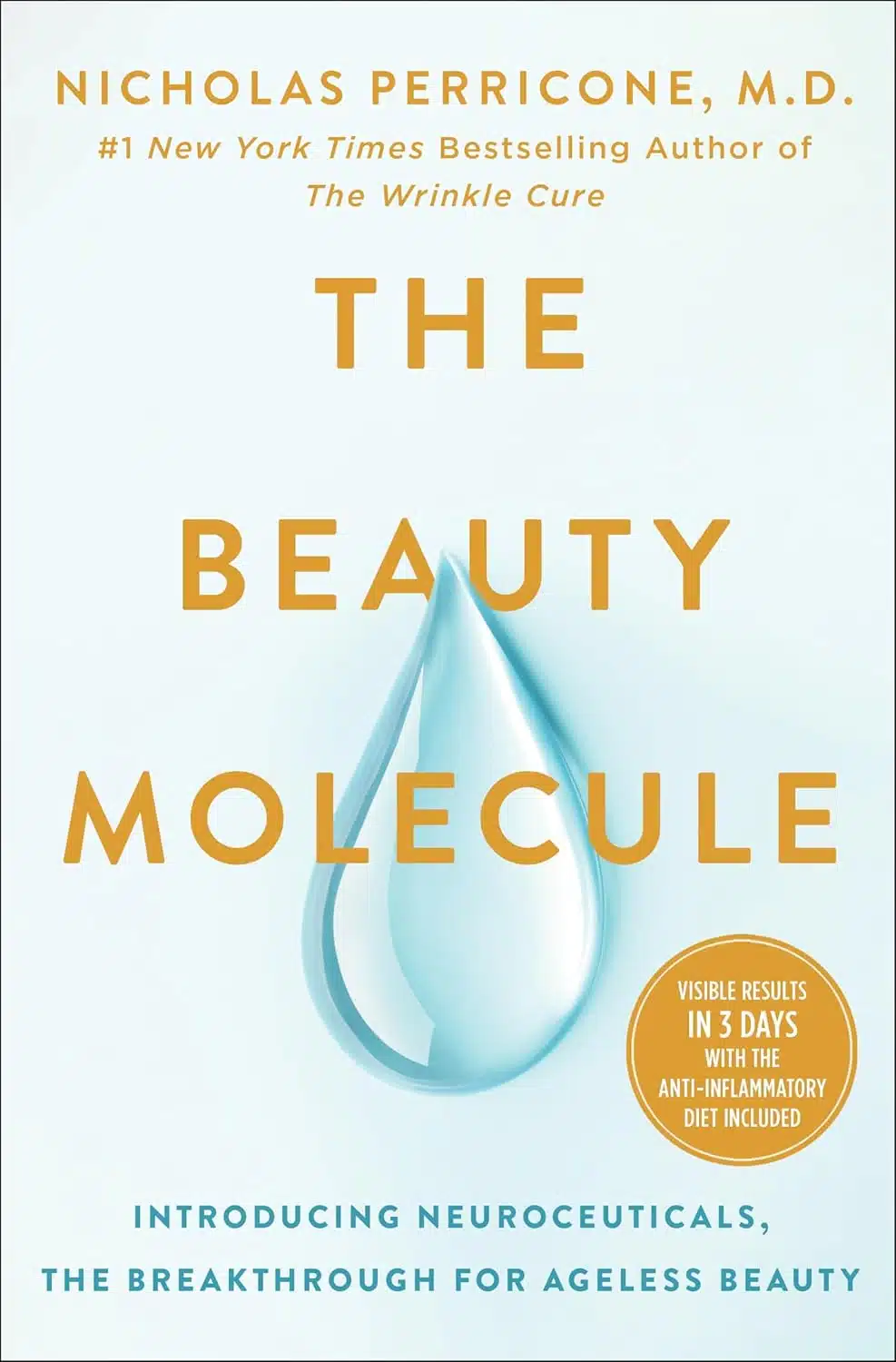
The Beauty Molecule – by Dr. Nicholas Perricone
10almonds is reader-supported. We may, at no cost to you, receive a portion of sales if you purchase a product through a link in this article.
We’re a health science publication, not a beauty magazine, but what’s actually going on here is skin rejuvenation, and in any case, skin health does tend to affect mental health, especially if it’s not good—thus giving a second reason to consider it of importance.
With that in mind, we’ll not keep “the beauty molecule” a secret: he’s talking about acetylcholine, a neurotransmitter.
What does a neurotransmitter have to do with beauty, you wonder? In the largest part, it’s because (via a chain of events which, for brevity, we’ll not detail) it reduces inflammation.
There are other factors too; it also triggers endothelial vasodilation which can result in the skin being better-nourished and better-maintained; the hair also benefits by the same process.
Thus, while the title makes it sound like we will need to buy a mysterious newly-developed skincare product, it turns out that he recommends eating almonds and other choline-rich foods.
On the flipside, he recommends acetylcholinesterase inhibitors, such as ginkgo biloba and huperzine A, which will (as the name suggests) inhibit acetylcholinesterase, which is an enzyme that breaks down acetylcholine.
However, that is only part of the book, and much of the rest covers other nutraceuticals (neuroceuticals being a word coined by the author, but it doesn’t seem to add much, and he also includes things that are not specific to neural function, such as polyphenols of various kinds and even carotenoids).
The style is a little more technical than most books we review here, but it’s nothing that should pose a barrier to comprehension if you:
- have sufficient scientific literacy that you can read at least the abstracts of scientific papers and understand what they mean, and/or…
- read the book from cover to cover such that many specific things are explained as we go (you learn what DMAE and EGCG and AMPK etc are, and you know that IRS2 is not about taxes), and…
- for other more general things you have a digital device to hand to look up, if necessary, the difference between modulate/moderate/mitigate/mediate and so forth.
Bottom line: if you’d like to improve your skin health, systemic health, and your knowledge of physiology, this book can deliver those things!
Click here to check out The Beauty Molecule, and get yourself a healthy dose of it!
Don’t Forget…
Did you arrive here from our newsletter? Don’t forget to return to the email to continue learning!
Recommended
Learn to Age Gracefully
Join the 98k+ American women taking control of their health & aging with our 100% free (and fun!) daily emails:
-
Becoming a Supple Leopard – by Dr. Kelly Starrett and Glen Cordoza
10almonds is reader-supported. We may, at no cost to you, receive a portion of sales if you purchase a product through a link in this article.
We’ve previously reviewed Dr. Starrett’s other book, “Built To Move“, and now today we’ll review his more famous book!
Why is this one so famous? It’s popularly considered “the Bible of Cross-Fit”, even though it’s not at all marketed as such, and nor does it talk about Cross Fit directly. But: people who are interested in being fit, fast, strong, mobile, stable, and so forth, tend to invest in this book at some point if they are serious.
The book is big, heavy, and textbook-like. This isn’t a quick light read. This is a “study over the course of a year or more while doing your physiotherapy degree” book. And yet, it’s written for the widest audience, and as such, everything is explained from the ground up, so no prior knowledge is expected.
It does have pictures, which are clear and helpful, though the print version is better for this than the Kindle edition.
The subtitle of the book is no lie; it does indeed cover all those things, deeply and at length, for everything musculoskeletal.
Bottom line: this book will seriously improve your knowledge and understanding of all things body mechanics and related body maintenance. If you care to get/remain fit/strong/mobile/etc, this book is a fine cornerstone for such endeavors.
Click here to check out Becoming A Supple Leopard, and become a supple leopard!*
*Metaphorically. Furry metamorphosis is not a side-effect. Suppleness, however, is on offer. Yes, even for you, dear reader!
Share This Post
-
10 Great Exercises to Improve Your Eyesight
10almonds is reader-supported. We may, at no cost to you, receive a portion of sales if you purchase a product through a link in this article.
If your eyesight has been declining a bit, all is not lost. Just like many other muscles in the body, the muscles of the eye—including those responsible for changing the focal length of your vision—can atrophy without exercise. So, without further ado, here are the exercises recommended:
The eyes (still) have it
- Blink for a minute: blink rapidly for 30–60 seconds to regulate blood circulation, lubricate your eyes, and prevent dryness.
- Rotate your head while staring ahead: turn your head in a circular motion while keeping your gaze straight ahead. This improves blood circulation to your eyes.
- Look to your right and left: slowly move your gaze from right to left while breathing. This one relaxes and stretches the eye muscles.
- Close your eyes and relax: close your eyes for at least 30 seconds to relax and strengthen your photoreceptor cells.
- Move your gaze in different directions: shift your gaze right-left, up-down, in circular motions, and trace a figure 8 with your eyes. This improves visual perception for both near- and far-sightedness.
- Close and open your eyes: tighten your eyes shut for 3–5 seconds, then open them. Repeat seven times to improve blood circulation and relax your eye muscles. ← 10almonds note: the duration makes this different from #4, so do try both!
- Push against your temples with your fingers: gently press your temples with your fingers for two seconds, then release. Repeat 4–5 times to improve fluid circulation in your eyes.
- Draw geometric figures with your gaze: use your eyes to trace shapes such as triangles, squares, and circles to enhance your eye coordination and muscle strength.
- Move your eyeballs up and down: close your eyes and slowly move your eyeballs up and down five times to stretch and relax the muscles ← 10almonds note: this seems to be the same as part of #5 and has a considerable overlap with #8, but we’re listing it anyway, or else everyone will wonder where #9 went!
- Strengthen near and far focusing: focus on your thumb 10 inches away for 10–15 seconds, then switch focus to an object 10–20 feet away. Repeat five times to improve focus adjustment ability.
By practicing these exercises daily, we are told that you can improve eye health and vision within a week.
For more on all these, plus visual demonstrations, enjoy:
Click Here If The Embedded Video Doesn’t Load Automatically!
Want to learn more?
You might also like to read:
Vision for Life, Revised Edition – by Dr. Meir Schneider
Take care!
Share This Post
-
What Doctors Feel – by Dr. Danielle Ofri
10almonds is reader-supported. We may, at no cost to you, receive a portion of sales if you purchase a product through a link in this article.
This book discusses how feelings such as shame, fear, anger, empathy, and even love influence patient care. Dr. Ofri notes early on:
❝One might reasonably say, I don’t give a damn how my doctor feels as long as she gets me better. In straightforward medical cases, this line of thinking is probably valid. Doctors who are angry, nervous, jealous, burned out, terrified, or ashamed can usually still treat bronchitis or ankle sprains competently.
The problems arise when clinical situations are convoluted, unyielding, or overlaid with unexpected complications, medical errors, or psychological components. This is where factors other than clinical competency come into play.❞
~ Dr. Danielle Ofri
What then follows is very much a no-holds-barred account of the emotional side of medicine.
Not portraying doctors as heroes or martyrs, just as people. Indeed, she even talks about an early, abject failure of hers as a medical student, literally hiding from a patient who badly needed attention and to whom she had been assigned.
We learn not just about the mistakes of doctors, but also the mistakes of patients that lead to mistakes by doctors. For example, emphasizing the severity of your symptom(s) can sometimes be useful to ensure they get attention, but if your regular doctor has heard you rating every symptom always as a 10 every appointment for the past many years, then the end result is that they don’t have information to work from, and will—at best—become frustrated, which will not work out well for you.
Mostly, though, it’s about what goes on behind that calm collected professional exterior that most doctors show most of the time.
The style is a fascinating blend of well-researched science (there’s an extensive bibliography) and very human tales of suffering, compassion, hope, loss, isolation, connection, and more.
Bottom line: if you want to understand your doctor(s), then you want to read this book.
Click here to check out What Doctors Feel, and learn how emotions affect the practice of medicine!
Share This Post
Related Posts
-
Basil vs Cilantro – Which is Healthier?
10almonds is reader-supported. We may, at no cost to you, receive a portion of sales if you purchase a product through a link in this article.
Our Verdict
When comparing basil to cilantro, we picked the cilantro.
Why?
Both have their strong merits, but there can be only one winner when all’s said and done:
First, you may be thinking: these are just herbs; we don’t eat enough of these for the nutritional values to be relevant!
And to this we say: there’s nothing stopping you :p Herbs are full of flavor and goodness and there is really no reason to deny yourself. On this note, check out the sabzi khordan (traditional Levantine herb platter), linked below. You’ll start thinking about herbs in new ways, and you can thank us later!
So, onwards to the comparisons…
In terms of macros, the only relevant distinguishing factor is that cilantro has nearly 2x the fiber, so that’s a win in this category of cilantro.
In the category of vitamins, basil has more of vitamins B6, B7, B9, and K, while cilantro has more of vitamins A, B1, B2, B3, B5, C, and E, winning this round too.
Looking at minerals, however, basil has more calcium, copper, iron, magnesium, manganese, phosphorus, and zinc, while cilantro has more potassium and selenium, yielding an 8:1 win to basil in this category.
In other considerations, both are equally good sources of polyphenols, so that’s a tie in this round.
Adding up the sections makes for a clear overall win for cilantro, but by all means do enjoy either or both, as diversity is best!
Want to learn more?
You might like:
- Holy Basil: What Does (And Doesn’t) It Do? ← this is not culinary basil, but it’s an interesting read nevertheless
- 21 Most Beneficial Polyphenols & What Foods Have Them
- Invigorating Sabzi Khordan (A Traditional Levantine Platter Of Herbs & Accompaniments)
Enjoy!
Don’t Forget…
Did you arrive here from our newsletter? Don’t forget to return to the email to continue learning!
Learn to Age Gracefully
Join the 98k+ American women taking control of their health & aging with our 100% free (and fun!) daily emails:
-
Ozempic Helps People Walk Further
10almonds is reader-supported. We may, at no cost to you, receive a portion of sales if you purchase a product through a link in this article.
There’s often a catch-22 when it comes to exercise: it’s important for good health, and/but people with ill health usually cannot exercise much.
A recent (published today, at time of writing, the 29th of March 2025, never let it be said we don’t bring you the very most up-to-date health science!) study by Dr. Neda Rasouli et al. has shown there is a possible way through that catch-22, depending on the nature of the illness.
This study followed 792 people across 112 outpatient clinical trial sites in 20 countries in North America, Asia, and Europe, with type 2 diabetes and peripheral artery disease.
What they found
Patients taking semaglutide (specifically, 1mg Ozempic) enjoyed a 21% median increase in walking distance, as well as some bonus benefits, namely:
- Weight reduction: the semaglutide group saw a greater reduction in body weight (–4.1 kg; P < 0 .0001)
- HbA1c levels: semaglutide lowered HbA1c by 1 percentage point (P < 0.0001)
- Blood pressure: systolic blood pressure decreased by 3.2 mmHg (P = 0.0042)
You may be wondering what that “P =” means: it’s the probability of this occurring by random chance, on a scale from zero (impossible outcome) to 1 (unavoidable outcome).
For example:
“We hypothesized that singing the happy birthday song before tossing a coin would result in it landing on heads. We sang the happy birthday song and tossed the coin; it landed on heads (P = 0.5)”
In science, generally speaking anything with a probability of under 0.05 (expressed as: “P < 0.05”) is considered a statistically significant result.
All this to say, the cited figures of, for example, P < 0.0001, are very significant indeed.
On which note, that 21% median increase in walking distance? P < 0.0004.
As for side effects? Serious adverse events related to the drug occurred in 1% of the semaglutide group vs 2% in the placebo group. So, that seems quite safe indeed.
You can find the paper itself here:
Want to learn more?
Check out:
- The Doctor Who Wants Us To Exercise Less, & Move More
- Walking… Better.
- 5 Ways To Naturally Boost The “Ozempic Effect”
Take care!
Don’t Forget…
Did you arrive here from our newsletter? Don’t forget to return to the email to continue learning!
Learn to Age Gracefully
Join the 98k+ American women taking control of their health & aging with our 100% free (and fun!) daily emails:
-
Long COVID is more than fatigue. Our new study suggests its impact is similar to a stroke or Parkinson’s
10almonds is reader-supported. We may, at no cost to you, receive a portion of sales if you purchase a product through a link in this article.
When most people think of COVID now, they picture a short illness like a cold – a few days of fever, sore throat or cough before getting better.
But for many, the story doesn’t end there. Long COVID – defined by the World Health Organization (WHO) as symptoms lasting at least three months after infection – has become a lasting part of the pandemic.
Most research has focused on describing symptoms – such as fatigue, brain fog and breathlessness. But we know less about their effect on daily life, and this hasn’t been well studied in Australia. That’s where our new study, published today, comes in.
We show long COVID isn’t just uncomfortable or inconvenient. People with the condition told us it can profoundly limit their daily life and stop them from doing what they want to do, and need to do.
elenaleonova/Getty What is long COVID?
Long COVID affects about 6% of people with COVID, with more than 200 symptoms recorded. For some, it lasts a few months. For “long haulers” it stretches into years.
The size of the problem is hard to measure, because symptoms vary from person to person. This has led to debate about what long COVID really is, what causes it, and even whether it’s real.
But mounting evidence shows long COVID is very real and serious. Studies confirm it reduces quality of life to levels seen in illnesses such as chronic fatigue syndrome, stroke, rheumatoid arthritis and Parkinson’s disease.
Here’s what people with long COVID told us
We surveyed 121 adults across Australia living with long COVID. They had caught COVID between February 2020 and June 2022, with most aged 36–50. Most were never hospitalised, and managed their illness at home.
But months or years later, they were still struggling with daily activities they once took for granted.
To understand the impact, we asked them to complete two surveys widely used in health research to measure disability and quality of life – the WHO Disability Assessment Schedule (WHODAS 2.0) and the Short Form Health Survey (SF-36).
These surveys capture people’s own voices and lived experience. Unlike scans or blood tests, they show what symptoms mean for everyday life.
The results were striking.
People with long COVID reported worse disability than 98% of the general Australian population. A total of 86% of those with long COVID met the threshold for serious disability compared with 9% of Australians overall.
On average, people had trouble with daily activities on about 27 days a month and were unable to function on about 18 days.
Tasks such as eating or dressing were less affected, but more complex areas – housework and socialising – were badly impacted. People could often meet basic needs, but their ability to contribute to their homes, workplaces and communities was limited.
Quality of life was also badly affected. Energy levels and social life were the most impacted, reflecting how fatigue and brain fog affect activities, relationships and community connections. On average, overall quality of life scores were 23% lower than the general population.
What are the implications?
International research shows similar patterns. One study across 13 countries found similar levels of disability. It also found women had higher disability scores than men. As long COVID disability has many facets and can change a lot over time, it doesn’t fit into traditional ways of providing health care for chronic conditions.
Another key insight from our study is the importance of self-reported outcomes. Long COVID has no diagnostic test, and people often report health professionals are sceptical about their symptoms and their impact. Yet our study showed people’s own ratings of their recovery strongly predicted their disability and quality of life.
This shows self-reports are not just “stories”. They are valid and reliable indicators of health. They also capture what medical tests cannot.
For example, fatigue is not just being tired. It can mean losing concentration while driving, giving up hobbies, or pulling away from cherished friendships.
Our study shows long COVID disrupts futures, breaks connections, and creates daily struggles that ripple out to families, workplaces and communities.
What needs to happen next?
Evidence presented to the 2023 parliamentary long COVID inquiry estimates hundreds of thousands of Australians are living with long COVID.
We know disadvantaged communities are even more likely to be impacted by the cascading effects of long COVID. So ignoring the scale and severity of long COVID risks deepening inequality and worsening its impact even further.
By building services based on lived experience, we can move towards restoring not just health, but dignity and participation in daily life for people with long COVID.
We need rehabilitation and support services that go beyond basic medical care. People need support to manage fatigue, such as “pacing” and conserving energy by not overexerting themselves. Workplaces need to accommodate people with long COVID by reducing hours, redesigning job demands and offering flexible leave. People also need support to rebuild social connections.
All this requires people with long COVID to be thoughtfully assessed and treated. Listening to patients and valuing their experience is a crucial first step.
We’d like to acknowledge the following co-authors of the research mentioned in this article: Tanita Botha, Fisaha Tesfay, Sara Holton, Cathy Said, Martin Hensher, Mary Rose Angeles, Catherine Bennett, Bodil Rasmussen and Kelli Nicola-Richmond.
Danielle Hitch, Senior Lecturer in Occupational Therapy, Deakin University; Genevieve Pepin, Professor, School of Health and Social Development, Deakin University, and Kieva Richards, Lecturer in Occupational Therapy, La Trobe University
This article is republished from The Conversation under a Creative Commons license. Read the original article.
Don’t Forget…
Did you arrive here from our newsletter? Don’t forget to return to the email to continue learning!
Learn to Age Gracefully
Join the 98k+ American women taking control of their health & aging with our 100% free (and fun!) daily emails:


