
My kids only want to eat processed foods. How can I get them eating a healthier and more varied diet?

10almonds is reader-supported. We may, at no cost to you, receive a portion of sales if you purchase a product through a link in this article.

If it feels like your child’s diet consists entirely of breakfast cereal, chicken nuggets and snacks that’d outlast the apocalypse, you’re not alone.

Processed foods are the go-to for many kids, and for some, they’re the only foods they’ll eat.

Here’s why – and what you can do about it.

Processed foods and their prevalence in kids’ diets

Processed foods are any foods altered from their natural state.

While some food processing is beneficial – such as pasteurising milk to kill bacteria – the ones that cause parents concern are ultra-processed foods, which use industrial methods to enhance flavour, texture and shelf life by adding sugars, salt, fats and artificial flavours, colours and preservatives.

Parents know some ultra-processed foods all too well – they’re the fast and junk foods kids love. But others hide in plain sight, disguised as “healthy” convenience foods such as flavoured yoghurts and muffins.

Ultra-processed foods offer low-to-no nutrition, which is why dietary guidelines recommend limiting them. But these “discretionary foods” make up one-third of Aussie kids’ daily energy intake.

Why do kids find processed foods so appealing?

Basic biology

Ultra-processed foods are engineered to be addictive, with their added sugar, salt and fat activating kids’ brains’ reward system, releasing feelgood chemicals.

Evolution has hardwired humans to seek natural sugar- and fat-rich foods – a physiological response our hunter-gatherer ancestors developed to avoid starvation.

Food fussiness

One in two kids will experience a fussy eating phase – another survival response inherited from our ancestors, who avoided toxins by developing an aversion to unfamiliar and bitter foods.

Fussy eaters also favour ultra-processed foods, such as chicken nuggets, chips and breakfast cereals, because they’re familiar and non-threatening, often beige like breastmilk and kids’ first solid foods. Plus their blander flavours don’t overwhelm developing tastebuds.

Pester power

From sneaky YouTube ads to eye-level supermarket displays, kids are incessantly exposed to marketing that makes them crave – and demand – ultra-processed foods.

How processed foods impact kids’ health

Ultra-processed foods can impact kids’ health in a range of ways, contributing to:

  • nutritional deficiencies. Kids filling up on ultra-processed foods are less likely to eat vegetables, fruits, whole grains and lean meats, producing a diet lacking in fibre and other key nutrients needed for growth and development
  • childhood obesity. Ultra-processed foods are high in calories, unhealthy sugars, salt and fat, and often lack portion control, promoting overeating
  • increased risk of diseases. Long-term overconsumption of ultra-processed foods is linked with a higher risk of developing a range of chronic diseases, including heart disease, type 2 diabetes and cancer.

Unhealthy eating habits can be hard to break, but positive diet and lifestyle changes – even later in childhood – can reverse these negative health effects.

Science-based tips for healthier eating habits

1. Eat together

Family mealtimes allow you to model healthy eating. Sit together around the table, share the same meal, and put devices away so everyone’s attention is on eating.

2. Introduce foods carefully

Research shows kids need eight to ten exposures before they willingly eat new foods. So offer them regularly, encourage tasting and don’t pressure them to eat.

While it’s tempting, avoid offering dessert as a reward for trying something healthy. Using treats as a reward increases kids’ preference for unhealthy foods.

Kids are also more likely to try new foods when they’re hungry, so avoid snacks one to preferably two hours before mealtimes.

3. Introduce variety to family favourites

Children are more open to trying new foods when there’s something familiar on their plate.

So, tweak family favourites by swapping ingredients, such as using lentils instead of beef in bolognese or roasting carrots to make “orange chippies”. Grating veggies into sauces also expands kids’ diets without overwhelming them.

4. Make food fun

Children respond positively when healthy foods are presented in fun ways, so include different colours, textures and shapes on their plate to hold their interest.

Changing meal locations – and enjoying an occasional outdoor picnic – is another simple way to make mealtimes feel special and fun.
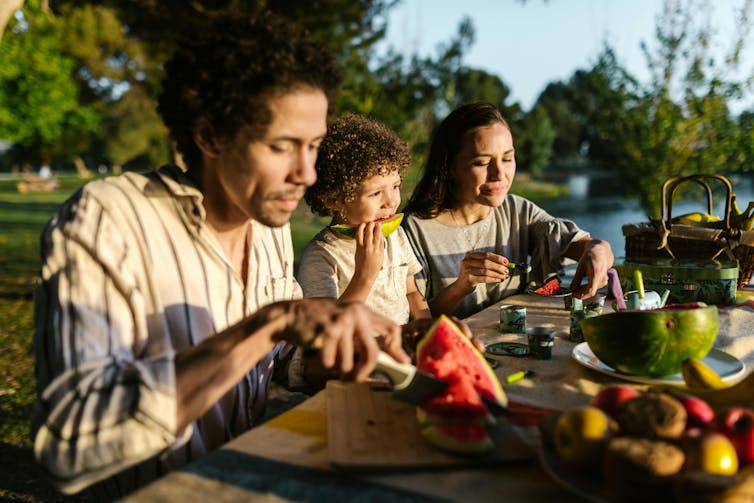
Family eats outdoors
Changing where you eat can make meals fun. RDNE/Pexels

5. Teach kids about the science of food

Teaching children in an age-appropriate way about the foods we eat promotes healthier eating, so:

  • encourage kids to grow herbs and veggies so they understand where healthy food comes from: toddlers can harvest produce; older kids can plant and prune
  • visit the greengrocer, fishmonger and butcher regularly so kids can see and explore the healthy foods on offer
  • talk to toddlers about food in energy terms: “eating wholegrain toast helps you play longer”
  • share fun facts with older kids: “fish has a special type of fat called omega-3 that makes us smarter”.

6. Involve kids in cooking

Spark kids’ interest in healthy meals by involving them in food preparation. Let them choose recipes and take on age-appropriate tasks such as mixing and chopping.

When kids help make a meal, they feel proud of their effort, and research shows they’re more likely to try what they’ve created.

It takes about two months to form a habit, so expect resistance along the way. But with perseverance, we can shift kids’ love of processed foods toward healthier choices, helping them establish healthy eating habits for life.

Nick Fuller is the author of Healthy Parents, Healthy Kids – Six Steps to Total Family Wellness.

Nick Fuller, Clinical Trials Director, Department of Endocrinology, RPA Hospital, University of Sydney

This article is republished from The Conversation under a Creative Commons license. Read the original article.

Don’t Forget…

Did you arrive here from our newsletter? Don’t forget to return to the email to continue learning!

Learn to Age Gracefully

Join the 98k+ American women taking control of their health & aging with our 100% free (and fun!) daily emails:

  • Celery vs Lettuce – Which is Healthier?

    10almonds is reader-supported. We may, at no cost to you, receive a portion of sales if you purchase a product through a link in this article.

    Our Verdict

    When comparing celery to lettuce, we picked the lettuce.

    Why?

    Lettuce examine the macros first: lettuce has 2x the protein, but of course the numbers are tiny and probably nobody is eating this for the protein. Both of these salad items are roughly equal in terms of carbs and fiber, being both mostly water with just enough other stuff to hold their shape. Nominally this section is a slight win for lettuce on account of the protein, but in realistic practical terms, it’s a tie.

    In the category of vitamins, celery has more of vitamins B5 and E, while lettuce has more of vitamins A, B1, B2, B3, B6, B7, B9, C, and K. An easy win for lettuce here.

    Looking at minerals, celery has more calcium, copper, and potassium, while lettuce has more iron, magnesium, manganese, phosphorus, potassium, selenium, and zinc. So, a fair win for lettuce in this round.

    In other considerations, lettuce has more polyphenols, especially flavonoids and phenolic acids, and thus takes a win in this round, too.

    Adding up the sections makes for a clear overall win for lettuce, but by all means enjoy either or both, as diversity is best!

    Want to learn more?

    You might like to read:

    Are You Getting The Right Kinds Of Flavonoids?

    Take care!

    Share This Post

  • What to Eat When – by Drs. Michael Roizen and Michael Crupain

    10almonds is reader-supported. We may, at no cost to you, receive a portion of sales if you purchase a product through a link in this article.

    Here at 10almonds, we cover a lot of the “what to eat”, but tend to only sometimes touch on the “when”—and indeed, this is a reflection of a popular focus. But what if we were to pay a little more attention to that “when”; what would it get us?

    According to Drs. Roizen and Crupain… Quite a bit!

    In this work, they take into account the various factors affecting the benefit (or harm!) of what we eat when:

    • in the context of our circadian rhythm
    • in the context of our insulin responses
    • in the context of intermittent fasting

    The style throughout is very focused on practical actionable advice. For example, amongst other lifestyle-adjustment suggestions, the authors make the case for front-loading various kinds of food earlier in the day, and eating more attentively and mindfully when we do eat.

    They also offer a lot of “quick tips” of the kind we love here at 10almonds! Ranging from “how about this breakfast idea” to “roasting chickpeas like this makes a great snack” to “this dessert is three healthy foods disguised as a sundae”

    All in all, if you’d like a stack of small tweaks that can add up to a big difference in your overall health, this is a book for you.

    Click here to get “What To Eat When” from Amazon today!

    Share This Post

  • Modern Friendship – by Anna Goldfarb

    10almonds is reader-supported. We may, at no cost to you, receive a portion of sales if you purchase a product through a link in this article.

    It’s a topic we’ve covered before at 10almonds: Human Connection In An All-Too-Busy World.

    Here, however, Goldfarb has an entire book to cover what we had one article to cover, so of course it’s a lot more in-depth.

    Importantly, if also covers: what if you seem to be doing everything right, and it’s still not working out? What if you’re already reaching out, suggesting things, doing your part?

    Piece by piece, she uncovers what the very many problems are, ranging from availability issues and priorities, to health concerns and financial difficulties, to challenges as diverse as trust issues and exhaustion, and much more.

    After all the hard truths about modern friendship, she gets onto equally cheery topics such as why friendships fail, but fear not, solutions are forthcoming too—and indeed, that’s what most of the book is about.

    Covering such topics as desire, diligence, and delight, we learn how to not only practise wholehearted friendship, but also, how to matter to others, too. She finishes up with a “14-day friendship cleanse”, which sounds a lot more alarming than it actually is.

    The style is interesting, being personal and, well, friendly throughout—but still with scholarly citations as we go along, and actual social science rather than mere conjecture.

    Bottom line: if you find that your friendships are facing challenges, this book can help you to get to the bottom of any problems and move forwards (likely doing so together).

    Click here to check out Modern Friendship, and learn how to truly nurture and grow your connections!

    Share This Post

  • Keeping Your Kidneys Healthy (Especially After 60)

    10almonds is reader-supported. We may, at no cost to you, receive a portion of sales if you purchase a product through a link in this article.

    Keeping your kidneys happy: it’s more than just hydration!

    Your kidneys are very busy organs. They filter waste products, balance hydration, pH, salt, and potassium. They also make some of our hormones, and are responsible for regulating red blood cell production too. They also handle vitamin D in a way our bodies would not work without, making them essential for calcium absorption and the health of our bones, and even muscular function.

    So, how to keep them in good working order?

    Yes, hydrate

    This is obvious and may go without saying, but we try to not leave important things without saying. So yes, get plenty of water, spread out over the day (you can only usefully absorb so much at once!). If you feel thirsty, you’re probably already dehydrated, so have a little (hydrating!) drink.

    Don’t smoke

    It’s bad for everything, including your kidneys.

    Look after your blood

    Not just “try to keep it inside your body”, but also:

    Basically, your kidneys’ primary job of filtering blood will go much more smoothly if that blood is less problematic on the way in.

    Watch your over-the-counter pill intake

    A lot of PRN OTC NSAIDs (PRN = pro re nata, i.e. you take them as and when symptoms arise) (NSAIDs = Non-Steroidal Anti-Inflammatory Drugs, such as ibuprofen for example) can cause kidney damage if taken regularly.

    Many people take ibuprofen (for example) constantly for chronic pain, especially the kind cause by chronic inflammation, including many autoimmune diseases.

    It is recommended to not take them for more than 10 days, nor more than 8 per day. Taking more than that, or taking them for longer, could damage your kidneys temporarily or permanently.

    Read more: National Kidney Foundation: Advice About Pain Medicines

    See also: Which Drugs Are Harmful To Your Kidneys?

    Get a regular kidney function checkup if you’re in a high risk group

    Who’s in a high risk group?

    • If you’re over 60
    • If you have diabetes
    • If you have cardiovascular disease
    • If you have high blood pressure
    • If you believe, or know, you have existing kidney damage

    The tests are very noninvasive, and will be a urine and/or blood test.

    For more information, see:

    Kidney Testing: Everything You Need to Know

    Take care!

    Don’t Forget…

    Did you arrive here from our newsletter? Don’t forget to return to the email to continue learning!

    Learn to Age Gracefully

    Join the 98k+ American women taking control of their health & aging with our 100% free (and fun!) daily emails:

  • Glucose Revolution – by Jessie Inchauspé

    10almonds is reader-supported. We may, at no cost to you, receive a portion of sales if you purchase a product through a link in this article.

    While we all know that keeping balanced blood sugars is important for all us (be we diabetic, pre-diabetic, or not at all), it can be a mystifying topic!

    Beyond a generic “sugar is bad”…

    • What does it all mean and how does it all work?
    • Should we go low-carb?
    • What’s the deal with fruit?
    • Carbs or protein for breakfast?
    • Is “quick energy” ever a good thing?
    • How do starches weigh in again?

    It’s all so confusing!

    Happily, Jessie Inchauspé has the incredible trifecta of qualifications to help us: she’s a biochemist, a keen cook, and a great educator. What we mean by this latter is:

    Instead of dry textbook explanations, or “trust me” hand-waives, she explains biochemistry in a clear, simple, digestible (if you’ll pardon the pun) way with very helpful diagrams what things cause (or flatten) blood sugar spikes and how and why. If you read this book, you will understand, without guesswork or gaps, exactly what is happening on a physical level, and why and how her “10 hacks” work.

    Her “10 hacks” are explained so thoroughly that each gets a chapter of its own, but we’ll not keep them a mystery from you meanwhile, they are:

    1. Eat foods in the right order
    2. Add a green starter to your meals
    3. Stop counting calories
    4. Flatten your breakfast curve
    5. Have any type of sugar you like—they’re all the same
    6. Pick dessert over a sweet snack
    7. Reach for the vinegar before you eat
    8. After you eat, move
    9. If you have to snack, go savoury
    10. Put some clothes on your carbs

    She then finishes up with a collection of handy cheat-sheets and some of her own recipes.

    Bottom line: this isn’t just a “how-to” book. It gives the how-to, yes, but it also gives such good explanations that you’ll never be confused again by what’s going on in your glucose-related health.

    Get your copy of Jessie Inchauspé’s #1 international bestseller, “Glucose Revolution”, from Amazon today!

    Don’t Forget…

    Did you arrive here from our newsletter? Don’t forget to return to the email to continue learning!

    Learn to Age Gracefully

    Join the 98k+ American women taking control of their health & aging with our 100% free (and fun!) daily emails:

  • Brothy Beans & Greens

    10almonds is reader-supported. We may, at no cost to you, receive a portion of sales if you purchase a product through a link in this article.

    “Eat beans and greens”, we say, “but how”, you ask. Here’s how! Tasty, filling, and fulfilling, this dish is full of protein, fiber, vitamins, minerals, and assorted powerful phytochemicals.

    You will need

    • 2½ cups low-sodium vegetable stock
    • 2 cans cannellini beans, drained and rinsed
    • 1 cup kale, stems removed and roughly chopped
    • 4 dried shiitake mushrooms
    • 2 shallots, sliced
    • ½ bulb garlic, crushed
    • 1 tbsp white miso paste
    • 1 tbsp nutritional yeast
    • 1 tsp rosemary leaves
    • 1 tsp thyme leaves
    • 1 tsp black pepper, coarse ground
    • ½ tsp red chili flakes
    • Juice of ½ lemon
    • Extra virgin olive oil
    • Optional: your favorite crusty bread, perhaps using our Delicious Quinoa Avocado Bread recipe

    Method

    (we suggest you read everything at least once before doing anything)

    1) Heat some oil in a skillet and fry the shallots for 2–3 minutes.

    2) Add the nutritional yeast, garlic, herbs, and spices, and stir for another 1 minute.

    3) Add the beans, vegetable stock, and mushrooms. Simmer for 10 minutes.

    4) Add the miso paste, stirring well to dissolve and distribute evenly.

    5) Add the kale until it begins to wilt, and remove the pot from the heat.

    6) Add the lemon juice and stir.

    7) Serve; we recommend enjoying it with crusty wholegrain bread.

    Enjoy!

    Want to learn more?

    For those interested in some of the science of what we have going on today:

    Take care!

    Don’t Forget…

    Did you arrive here from our newsletter? Don’t forget to return to the email to continue learning!

    Learn to Age Gracefully

    Join the 98k+ American women taking control of their health & aging with our 100% free (and fun!) daily emails: