
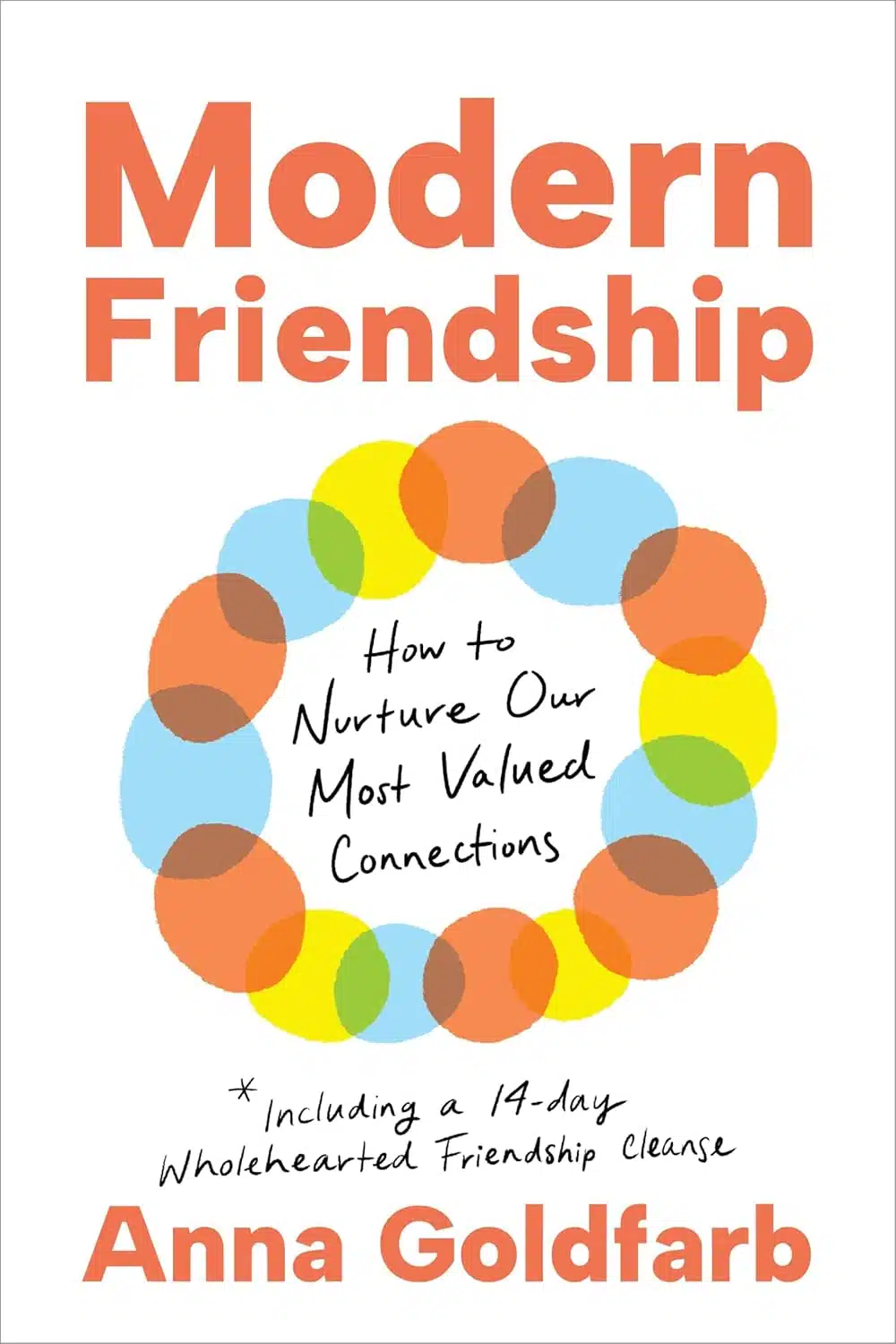
Modern Friendship – by Anna Goldfarb

10almonds is reader-supported. We may, at no cost to you, receive a portion of sales if you purchase a product through a link in this article.

It’s a topic we’ve covered before at 10almonds: Human Connection In An All-Too-Busy World.

Here, however, Goldfarb has an entire book to cover what we had one article to cover, so of course it’s a lot more in-depth.

Importantly, if also covers: what if you seem to be doing everything right, and it’s still not working out? What if you’re already reaching out, suggesting things, doing your part?

Piece by piece, she uncovers what the very many problems are, ranging from availability issues and priorities, to health concerns and financial difficulties, to challenges as diverse as trust issues and exhaustion, and much more.

After all the hard truths about modern friendship, she gets onto equally cheery topics such as why friendships fail, but fear not, solutions are forthcoming too—and indeed, that’s what most of the book is about.

Covering such topics as desire, diligence, and delight, we learn how to not only practise wholehearted friendship, but also, how to matter to others, too. She finishes up with a “14-day friendship cleanse”, which sounds a lot more alarming than it actually is.

The style is interesting, being personal and, well, friendly throughout—but still with scholarly citations as we go along, and actual social science rather than mere conjecture.

Bottom line: if you find that your friendships are facing challenges, this book can help you to get to the bottom of any problems and move forwards (likely doing so together).

Click here to check out Modern Friendship, and learn how to truly nurture and grow your connections!

Don’t Forget…

Did you arrive here from our newsletter? Don’t forget to return to the email to continue learning!

Learn to Age Gracefully

Join the 98k+ American women taking control of their health & aging with our 100% free (and fun!) daily emails:

  • Biohack Your Way to Healthy Skin – by Jennifer Sun

    10almonds is reader-supported. We may, at no cost to you, receive a portion of sales if you purchase a product through a link in this article.

    The author, an aesthetician with a biotech background, explains about the overlap of skin health and skin beauty, making it better from the inside first (diet and other lifestyle factors), and then tweaking things as desired from the outside.

    We previous reviewed another book of hers, “Unleashing Your Best Skin”, and this time the focus is on things you can do at home—not requiring expensive salon treatments (the other book covers both approaches; this one simply skips the clinic work and instead has a lot more detail in the at-home category).

    As for what she covers, it comes in categories:

    • Gadgets to consider investing in, how to pick good ones, and what gadgets to avoid
    • Basic skincare knowledge and practice; here we’re talking cleaners, tonics, moisturizers, and so forth
    • Best topical and oral ingredients for the skin (and in contrast, ingredients to be wary of)
    • Nutrition for skincare; not just “your skin needs these ingredients”, but also…
    • Gut health for skincare, which gets a whole chapter just for that
    • Biohacking hormones for skincare, including in the cases of various common hormone imbalances (e.g. menopause, PCOS, etc) and other complications not generally thought of in terms of skincare, such as diabetes and hypo-/hyperthyroidism.
    • Circulatory health for skincare (blood and lymph)
    • Mental health techniques for skincare (including improving sleep, managing stress, supplements to consider, etc).

    As with her other book that we reviewed, the book is broadly aimed at women, and the section on sex-hormonal considerations is completely aimed at women, but as for the rest of the book, there’s no pressing reason why this book couldn’t benefit men too. It also addresses considerations when it comes to darker skintones, something that a lot of similar books overlook.

    The style is directly instructional, albeit light and conversational in tone, and still with 20+ pages of scientific references to show that she does indeed know her stuff.

    Bottom line: if you’d like to improve your skin health, and/but aren’t a fan of going to the salon, then this book will be an invaluable resource.

    Click here to check out Biohack Your Way To Healthy Skin, and biohack your way to healthy skin!

    Share This Post

  • Are Age Spots Inevitable? And What Do They Mean For Skin Health?

    10almonds is reader-supported. We may, at no cost to you, receive a portion of sales if you purchase a product through a link in this article.

    We’ll file this one under “life hacks” as we will address reducing them too!

    First though, what are they? Also called liver spots, they’re yellow-brown (depending on intensity) marks in the skin that typically come with age.

    You may be wondering: is it about liver health? And the answer is: no

    In fact they have nothing to do with liver function, except insofar as a diseased liver will promote metabolic problems in general more rapid aging, but that is systemic, and is no more reasonably considerable a matter of liver function than graying hair or arthritis.

    Liver health is very important for many things, though so do also check out: How To Unfatty A Fatty Liver

    As for “liver spots”, however, the name comes from color, and that once upon a time it was popularly believed that they were connected, but there is no scientific basis to that.

    What, then, does cause them?

    As our cells age, they start bringing forward mistakes that accumulate over time, like a photocopy of a photocopy of a photocopy.

    One common mistake is to bring forward senescent fibroblasts, whose non-senescent versions are supposed to be there, but whose senescent editions contain more melanin than average (as in, average for your normal skintone) which consequently also gets brought forward and with no reason to disappear, also accumulates over time.

    You may be wondering: is this related to cancer? And the answer is: yes and no

    More helpfully: it’s a somewhat similar process, but benign (in contrast to cancer cells that would be similar, but multiply rapidly as they divide without any programmed cell death).

    However, since they can look a lot like skin cancer, that also means that they can mask skin cancer. For this reason, get it checked if what you have assumed to be an age spot…

    • turns black
    • turns multicolored
    • gets bigger
    • bleeds (for a reason other than: you just stabbed it with something)

    Any one (or more) of those happening is cause for concern. Note, we say cause for concern, not cause for panic; it will quite possibly be fine, but it also might not be, so book yourself a doctor visit about it.

    Learn more: We don’t all need regular skin cancer screening–but you can know your risk and check yourself

    The other major factor besides simply “how many times your cells have been copied” is sun exposure, because UV radiation not only can cause cellular mutations in the long-run, but also cues our skin to speed up melanin production (it’s trying to save us by giving us darker skin*).

    *Note: dark skin is moderately protective against sun damage (and resultant cancer risk) initially, but this is a double-edged sword, so please do still wear sunscreen even if you have naturally dark skin! Darker-skinned people who do get skin cancer have higher mortality rates than people with lighter skin (even if the same race/ethnicity and just lighter- or darker-skinned)—at least in part because it will then spread more aggressively. Simply put: dark skin will stop a lot of skin cancers from starting, but the cancers that do get past that initial hurdle are, on average, much worse.

    How, then, to reduce them?

    In advance:

    After they show up:

    • The same things as above; they will slow any exacerbation, and killing senescent cells does work retroactively too, per that (justified) “reverses aging” claim.
    • Normal anti-aging skincare: here we’re talking things like: Undo The Sun’s Damage To Your Skin
    • Laser treatment: or an at-home IPL device which is not technically laser but works on the same principles; it breaks up the pigment and allows your immune system to eat the resultant parts. However, this is only suitable for small, moderate pigmented spots, and only on skin that is notably lighter than it (or else it’ll superheat the natural pigmentation there, too, which means much more heat will be absorbed, creating a burn risk)

    There are also harsher clinical options like cryotherapy (freezing it off) or chemical peels (corrosively removing the affected skin), and… Well, we’re not the boss of you, but we would encourage you to consider whether that’s really worth it for something that’s not harmful in itself, and will probably be a losing battle in the long run—since, if we be so fortunate as to live many more years, we’ll accumulate more as we go no matter how careful we are.

    Want to tackle things the tastiest way?

    Check out:

    The Diet That Slows Skin Aging

    Enjoy!

    Share This Post

  • Who Will Take Care of Me When I’m Old? – by Joy Loverde

    10almonds is reader-supported. We may, at no cost to you, receive a portion of sales if you purchase a product through a link in this article.

    Regular readers of 10almonds will know we’ve written before about how isolation kills (in numerous ways), and this book tackles that in much greater length and depth than we ever have room for here.

    Specifically, she talks about preparing for medical and related (financial, living will in case of dementia, housing, etc) considerations down the line, with checklists and worksheets and such to make it easy, and help you make sure it actually gets done.

    She also talks about creating a support network, from scratch if necessary (“foraging a family”), so that even if you will now be prepared to handle things alone, you’ll become a lot less likely to need to do so.

    Unlike many books of this genre, she also covers managing your mortality; that “just shoot me” is not a plan, and what lessons can be learned from the dying to make our own last years the best they can be.

    The style is upbeat and positive in outlook; less “prepare for doom” and more “get ready to do things right”, and it’s worth mentioning that the format is particularly helpful, outlining objectives towards the beginning of each chapter, and additional resources at the end of each chapter.

    Over on Amazon, most of the reviews that contain any criticism are some manner of “I’m in my 70s and wish I had read this sooner”. Still, better late than never.

    Bottom line: if you do not have an overabundance of support network around you, then this is an important book to read and to put into action.

    Click here to check out Who Will Take Care Of Me When I’m Old, and safeguard your own health & happiness for years to come!

    Share This Post

  • Is couples counselling right for me, and will the therapist take sides? An expert explains

    10almonds is reader-supported. We may, at no cost to you, receive a portion of sales if you purchase a product through a link in this article.

    Should we do couples counselling? Are we happy? Are we both pulling in the same direction? How can we get our spark back?

    These kinds of questions are normal in a society that places such importance on coupledom, despite there being no handbook or one-size-fits all approach.

    Many people seek out couples counselling when going through a rough patch, or wondering how to improve their relationship. And no doubt the hit show Couples Therapy has boosted public interest in this type of counselling.

    So, how do you decide if it’s right for you – and what should you expect?

    Antoni Shkraba Studio/Pexels

    Should we get couples counselling?

    Relationship satisfaction changes over time. Research shows even knowing this can help couples navigate the usual ups and downs of life together.

    Some research also shows couples therapy can help lower relationship distress (which might include things such as frequent arguments or feeling dissatisfied in your relationship).

    It may be suitable for some couples who want to work through infidelity or stressors such as caregiving responsibilities.

    Others may seek out preventative couples counselling, which is focused on finding ways to improve communications before your relationship reaches crisis point.

    Does it work? Well, some research has found certain types of counselling did help cut the divorce rate among newlyweds – but so too did getting couples to simply watch romance movies together and discuss the themes with their partner.

    Overall, much depends on your motivation for seeking counselling and the mindset you’re bringing to it. Ask yourself: what do I want to work on, and what do I hope to achieve?

    If your goal is to get someone to “take your side”, counselling may not help. A good couples counsellor should remain neutral, and they’re not there to take sides.

    Many who seek couples counselling do so because they’re arguing and disagreeing a lot with their partner. If that’s you, it might help to let go of notions about who is “right” and move beyond anger. Instead, the focus in counselling may be on finding new conflict resolution skills.

    Counselling may help with:

    • improving communication skills
    • making better connections with each other
    • exploring the couples’ hopes for the future
    • identifying what’s blocking them from achieving these goals.

    Couples counselling isn’t always about staying together. Some use it to explore how to separate in a way that centres the needs of children.

    Others may have specific issues with intimacy or sex. In that case, a sexual health counsellor or sex therapist may be more suitable than a standard couples counsellor. You can find one via professional organisations.

    With a sex therapist, you and your partner might talk about things such as:

    • mismatched libidos
    • bodily changes, for example, to do with ageing
    • expectations around sex
    • communication around sex
    • making adjustments to the way you interact to resolve these issues.

    Importantly, though, not everyone needs therapy, or would benefit from it.

    It’s no silver bullet.

    Not for everyone

    The problems or harms in some relationships will not be resolved through talking therapy. The most obvious is where violence and/or coercive control is used: safety planning, not couples counselling, is more appropriate.

    And it’s important to remember the problems that lead people to conflict or counselling sometimes have structural causes that can’t be “fixed” by a few therapy sessions. For instance, perhaps your relationship is suffering because you’re experiencing stress at work, financial pressures, or you’re supporting a partner with depression. These are complex structural issues.

    It’s also unclear how long the benefits of couples counselling last. One study noted “many distressed couples benefit during relationship education courses but that these benefits decline when the program ends.”

    Two women snuggle on a bed while one drinks her coffee.
    Couples in contented relationships do things daily for each other, such as making a coffee for your partner. Ketut Subiyanto/Pexels

    How do people choose a counsellor?

    There’s a wide range of therapeutic techniques.

    One famous approach is called the Gottman method, where couples focus on things such as creating “love maps” recording what you know about your partner, nurturing fondness, turning toward each other instead of away and solving problems. Famously, the Gottman approach also identifies the “four horsemen” of a relationship apocalypse: criticism, contempt, defensiveness and stonewalling.

    Other couples counsellors will take more of a psychological or psychoanalytical approach, informed by techniques such as cognitive behavioural therapy.

    Relationships Australia provides a range of services including relationship counselling.

    At the end of the day what matters most is that you and your couples counsellor “click”; if you don’t gel with yours, it’s OK to find a new one.

    Love is about doing

    It can be helpful to use American author bell hooks’ idea of love as a practice of “doing” rather than a passive “being”. In other words, love is about doing things (for each other, together, or for yourself to fuel your relationship) rather than just about “being in love”.

    Couples in long-term, contented relationships engage in day-to-day love practices, such as making a coffee for your partner, or watching a show together.

    So, consider snuggling up on the couch with your partner to watch something together. Perhaps even Couples Therapy can provide a healthy prompt to reflect on and appreciate one another in a new light.

    Priscilla Dunk-West, Professor of Social Work, Victoria University

    This article is republished from The Conversation under a Creative Commons license. Read the original article.

    Don’t Forget…

    Did you arrive here from our newsletter? Don’t forget to return to the email to continue learning!

    Learn to Age Gracefully

    Join the 98k+ American women taking control of their health & aging with our 100% free (and fun!) daily emails:

  • HBD: The Human Being Diet – by Petronella Ravenshear

    10almonds is reader-supported. We may, at no cost to you, receive a portion of sales if you purchase a product through a link in this article.

    We don’t often review diet books, so why did this one catch our attention? The answer lies in its comprehensive nature without being excessively long and complex.

    Ravenshear (a nutritionist) brings a focus on metabolic balance, and what will and won’t work for keeping it healthy.

    The first part of the book is mostly informational; covering such things as blood sugar balance, gut health, hormones, and circadian rhythm considerations, amongst others.

    The second, larger part of the book is mostly instructional; do this and that, don’t do the other, guidelines on quantities and timings, and what things may be different for some people, and what to do about those.

    The style is conversational and light, but well-grounded in good science.

    Bottom line: if you’d like a “one-stop shop” for giving your diet an overhaul, this book is a fine choice.

    Click here to check out the Human Being Diet, and enjoy the best of health!

    Don’t Forget…

    Did you arrive here from our newsletter? Don’t forget to return to the email to continue learning!

    Learn to Age Gracefully

    Join the 98k+ American women taking control of their health & aging with our 100% free (and fun!) daily emails:

  • I’m a woman approaching middle age, do I need to get my hormones checked?

    10almonds is reader-supported. We may, at no cost to you, receive a portion of sales if you purchase a product through a link in this article.

    If you’re a woman approaching middle age and you’re on social media, you might have been urged to get your hormones checked.

    These posts often highlight troubling symptoms of perimenopause. Then they flag blood tests as a way to help you understand what’s going on and to guide treatment.

    Some women are now turning to wellness providers and online services seeking these types of tests, often at substantial expense.

    But these tests don’t provide any benefits. An editorial in the British medical journal BMJ has raised an alert about these tests. The authors conclude they’re unnecessary and shouldn’t guide treatment decisions.

    So what hormonal changes occur in the transition to menopause? And why is hormonal testing mostly unhelpful?

    What do hormones do during menstrual cycles?

    The key hormones the ovaries produce before menopause are oestrogens (mostly as oestradiol, but also as oestrone) together with progesterone and testosterone.

    The amount of each hormone produced changes during the menstrual cycle.

    Blood oestradiol levels double around the time of ovulation. This is followed by an increase in progesterone.

    Testosterone blood levels also increase around ovulation, but the increase is less than about 10%.

    What’s the difference between menopause and perimenopause?

    Menopause happens when the ovaries have lost the capacity to produce an egg. After menopause, oestrogen and progesterone blood levels are dramatically lower than before menopause.

    Perimenopause is the time between being pre-menopausal, through to the first 12 months after having the last menstrual bleed. But the end of perimenopause is difficult to determine if you don’t menstruate, for example after a hysterectomy or when you have a hormonal intra-uterine device (IUD).

    Testosterone blood levels don’t meaningfully change at natural menopause; they slowly decline with age.

    What are the symptoms of perimenopause?

    During the transition to menopause, the ovaries function haphazardly. So oestrogen and progesterone blood levels can be unpredictably very high or very low.

    Hot flushes and night sweats, also known as vasomotor symptoms, commonly start in early perimenopause and may persist for many years. Vasomotor symptoms occur intermittently during perimenopause and persist after menopause.

    Perimenopause is identified by irregular periods (cycles closer together or further apart) or changed bleeding patterns (bleeding becoming scant or heavy), together with the onset of vasomotor and other symptoms such as:

    • increased abdominal fat
    • low mood
    • vaginal irritation and dryness
    • urinary symptoms, such as bladder irritability
    • memory difficulties, or “brain fog”. This seems to relate to the fluctuations in oestrogen levels and mostly resolves in the early postmenopausal years.

    Our recent study shows the onset of vasomotor symptoms is the hallmark of perimenopause, and should also be used to diagnose perimenopause in women not menstruating (after hysterectomy or for other reasons).

    Can a blood test tell you’re perimenopausal?

    Blood oestradiol and progesterone levels are continually fluctuating during perimenopause. A blood test cannot be “timed” to any specific part of the cycle, as cycles vary in length and frequency.

    So the results can’t generally be interpreted and are therefore not helpful.

    However, it’s sensible to have blood tests to check for common causes of fatigue (under-active thyroid or iron deficiency) and palpitations and overheating (over-active thyroid).

    How is perimenopause managed?

    Treating perimenopause is not the same as treatment after menopause. Perimenopause is a time of hormonal chaos, rather than deficiency. So standard menopause hormone therapy (also called MHT) can make things worse.

    Adding in an extra layer of hormones with the MHT that’s used after menopause will ease symptoms during the hormone lows, but often worsens symptoms during hormone highs (heavy bleeding, breast tenderness, fluid retention).

    Instead, getting on top of perimenopause requires managing heavy and unscheduled bleeding, symptom relief, and, where needed, contraception, as the ovaries are still randomly producing eggs.

    Can blood tests individualise hormone therapy?

    No. Blood hormone tests can’t determine whether you might benefit from menopause hormone therapy or what dose you might need.

    People’s oestrogen receptors have different levels of sensitivity and are turned up and down by other proteins and hormones in the cells. So even achieving the same blood oestradiol level with oestrogen therapy can have completely different effects in different people.

    Individuals also respond differently to prescribed oestrogen, whether it’s tablet or through the skin. For transdermal patches or gels, the temperature of the skin, exercise, skin hydration and site of application affect absorption.

    After absorption, oestradiol is metabolised rapidly to other oestrogens which are not measured in a standard blood test. So the total amount of oestrogen circulating is not determined by simply measuring blood oestradiol.

    Do you need a blood test to check your dose?

    No. There is no target blood oestradiol level that is right for everyone, and no established blood level that will prevent bone loss, heart disease or dementia.

    Nor is there a perfect time of day to measure oestradiol, as the pattern of absorption of oestrogen over 24 hours varies, especially with transdermal oestradiol.

    Plus, different commercial laboratories use different measurement systems so you cannot always directly compare test results between laboratories.

    What about progestogen and testosterone?

    Progestogens, including progesterone, are required to protect against thickening of the uterine lining by oestrogen.

    The type and dose of progestogen needed can vary substantially and this cannot be predicted, or fine tuned, by a blood test.

    For testosterone, there is no cut-off below which a woman can be diagnosed as having “insufficient testosterone”.

    Whether hormone therapy involves oestrogen, progesterone or testosterone, for women who experience natural menopause after the age of 45, diagnosis and treatment is determined on symptoms, not blood hormone levels.

    Susan Davis, Chair of Women’s Health, Monash University

    This article is republished from The Conversation under a Creative Commons license. Read the original article.

    Don’t Forget…

    Did you arrive here from our newsletter? Don’t forget to return to the email to continue learning!

    Learn to Age Gracefully

    Join the 98k+ American women taking control of their health & aging with our 100% free (and fun!) daily emails: