Longevity Guidebook – by Dr. Peter Diamandis

10almonds is reader-supported. We may, at no cost to you, receive a portion of sales if you purchase a product through a link in this article.

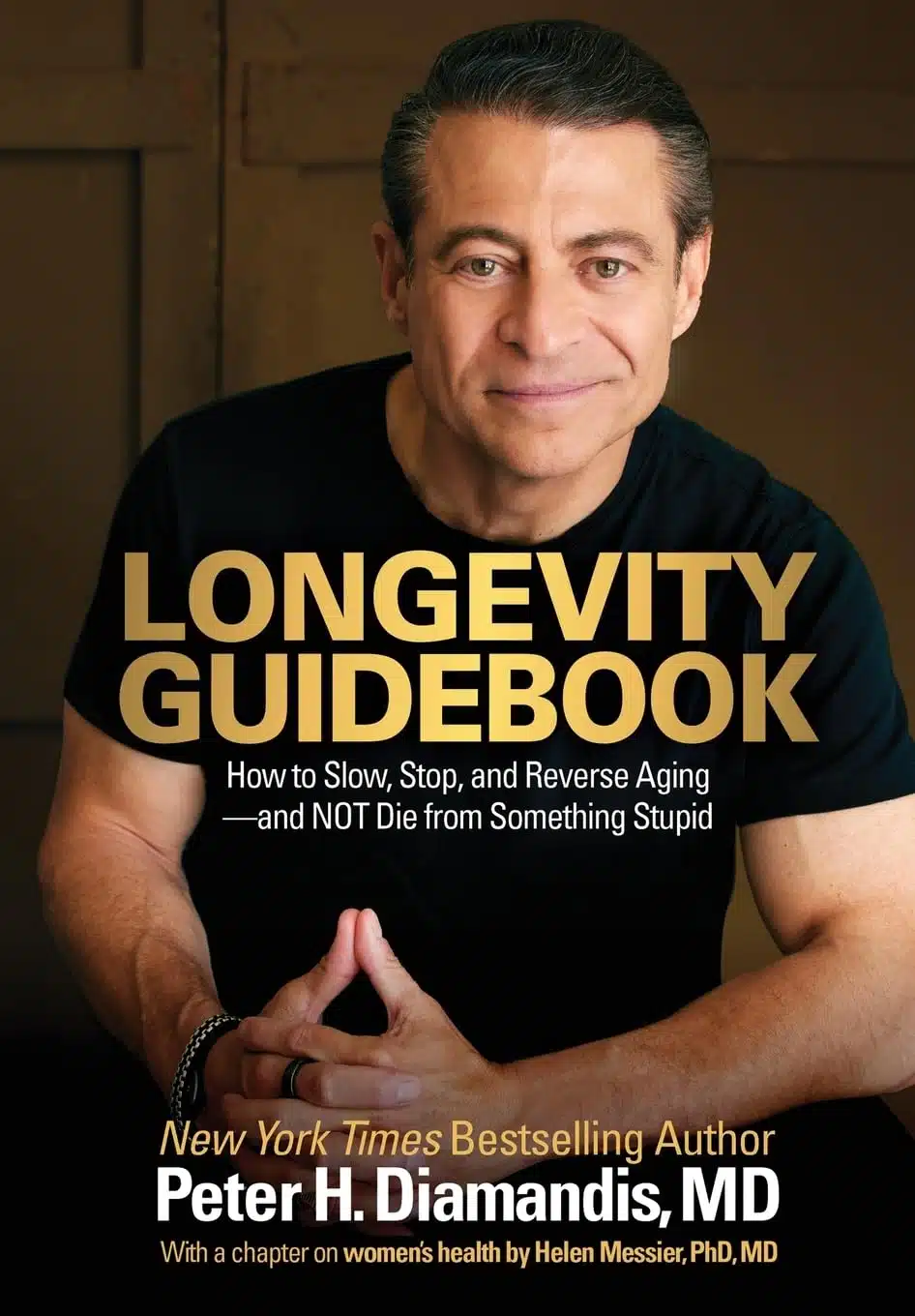
The main goal of this book is extending healthspan by maintaining various bodily functions, most notably cardiac, neuromuscular, cognitive, metabolic, and respiratory.

His tools for this task are mostly the usual lifestyle considerations, since they account for most of our longevity, not genetics—though he does also discuss CRISPR, gene therapy, and cellular medicine.

There is also a chapter on, as the subtitle promises, how to not die from something stupid. This, however, is about lifesaving breakthroughs in technology—not, for example, things like “don’t hold a maskless superspreader event during a pandemic lockdown” (such as he famously did, and yes, a lot of people got sick).

The style is chatty and personal; Dr. Diamandis likes to tell stories, and name-drops celebrities at a remarkable rate, often recommending difficult-to-come-by (and expensive) therapies that they have enjoyed. While this may be a wearying habit socially, it’s actually a good habit scientifically (in the cases where the celebrities in question are famous doctors and scientists), because it means crediting everyone for what they did and said, and allowing for full traceability of ideas/information. Still, most of that is little more than informative gossip, but on a more formal level, there are citations for claims throughout, and a generous bibliography at the back, which we love to see.

Bottom line: there’s a lot of practical advice in here, most of it well-sourced (however, his 75 different supplements that he takes are a bit hit-and-miss in that regard). Aside from that, much of the book is a “who’s who” of the the longevity industry, which may or may not interest all readers.

Click here to check out Longevity Guidebook, and get inspired!

Don’t Forget…

Did you arrive here from our newsletter? Don’t forget to return to the email to continue learning!

  • Should You Shower Daily?
    Q&A Day at 10almonds answers your showering queries! Is daily showering beneficial? Harvard Health weighs in, and we discuss when less may be more. Keep those questions coming!

Learn to Age Gracefully

Join the 98k+ American women taking control of their health & aging with our 100% free (and fun!) daily emails:

  • Get Past Executive Dysfunction

    10almonds is reader-supported. We may, at no cost to you, receive a portion of sales if you purchase a product through a link in this article.

    In mathematics, there is a thing called the “travelling salesman problem”, and it is hard. Not just subjectively; it is classified in mathematical terms as an “NP-hard problem”, wherein NP stands for “nondeterministic polynomial”.

    The problem is: a travelling salesman must visit a certain list of cities, order undetermined, by the shortest possible route that visits them all.

    To work out what the shortest route is involves either very advanced mathematics, or else solving it by brute force, which means measuring every possible combination order (which number gets exponentially larger very quickly after the first few cities) and then selecting the shortest.

    Why are we telling you this?

    Executive dysfunction’s analysis paralysis

    Executive dysfunction is the state of knowing you have things to do, wanting to do them, intending to do them, and then simply not doing them.

    Colloquially, this can be called “analysis paralysis” and is considered a problem of planning and organizing, as much as it is a problem of initiating tasks.

    Let’s give a simple example:

    You wake up in the morning, and you need to go to the bathroom. But the bathroom will be cold, so you’ll want to get dressed first. However, it will be uncomfortable to get dressed while you still need to use the bathroom, so you contemplate doing that first. Those two items are already a closed loop now. You’re thirsty, so you want to have a drink, but the bathroom is calling to you. Sitting up, it’s colder than under the covers, so you think about getting dressed. Maybe you should have just a sip of water first. What else do you need to do today anyway? You grab your phone to check, drink untouched, clothes unselected, bathroom unvisited.

    That was a simple example; now apply that to other parts of your day that have much more complex planning possible.

    This is like the travelling salesman problem, except that now, some things are better if done before or after certain other things. Sometimes, possibly, they are outright required to be done before or after certain other things.

    So you have four options:

    • Solve the problem of your travelling-salesman-like tasklist using advanced mathematics (good luck if you don’t have advanced mathematics)
    • Solve the problem by brute force, calculating all possible variations and selecting the shortest (good luck getting that done the same day)
    • Go with a gut feeling and stick to it (people without executive dysfunction do this)
    • Go towards the nearest item, notice another item on the way, go towards that, notice a different item on the way there, and another one, get stuck for a while choosing between those two, head towards one, notice another one, and so on until you’ve done a very long scenic curly route that has narrowly missed all of your targetted items (this is the executive dysfunction approach).

    So instead, just pick one, do it, pick another one, do it, and so forth.

    That may seem “easier said than done”, but there are tools available…

    Task zero

    We’ve mentioned this before in the little section at the top of our daily newsletter that we often use for tips.

    One of the problems that leads to executive function is a shortage of “working memory”, like the RAM of a computer, so it’s easy to get overwhelmed with lists of things to do.

    So instead, hold only two items in your mind:

    • Task zero: the thing you are doing right now
    • Task one: the thing you plan to do next

    When you’ve completed task zero, move on to task one, renaming it task zero, and select a new task one.

    With this approach, you will never:

    • Think “what did I come into this room for?”
    • Get distracted by alluring side-quests

    Do not get corrupted by the cursed artefact

    In fantasy, and occasionally science fiction, there is a trope: an item that people are drawn towards, but which corrupts them, changes their motivations and behaviors for the worse, as well as making them resistant to giving the item up.

    An archetypal example of this would be the One Ring from The Lord of the Rings.

    It’s easy to read/watch and think “well I would simply not be corrupted by the cursed artefact”.

    And then pick up one’s phone to open the same three apps in a cycle for the next 40 minutes.

    This is because technology that is designed to be addictive hijacks our dopamine processing, and takes advantage of executive dysfunction, while worsening it.

    There are some ways to mitigate this:

    Rebalancing Dopamine (Without “Dopamine Fasting”)

    …but one way to avoid it entirely is to mentally narrate your choices. It’s a lot harder to make bad choices with an internal narrator going:

    • “She picked up her phone absent-mindedly, certain that this time it really would be only a few seconds”
    • “She picked up her phone for the eleventy-third time”
    • “Despite her plan to put her shoes on, she headed instead for the kitchen”

    This method also helps against other bad choices aside from those pertaining to executive dysfunction, too:

    • “Abandoning her plan to eat healthily, she lingered in the confectionary aisle, scanning the shelves for sugary treats”
    • “Monday morning will be the best time to start my new exercise regime”, she thought, for the 35th week so far this year

    Get pharmaceutical or nutraceutical help

    While it’s not for everyone, many people with executive dysfunction benefit from ADHD meds. However, they have their pros and cons (perhaps we’ll do a run-down one of these days).

    There are also gentler options that can significantly ameliorate executive dysfunction, for example:

    Bacopa Monnieri: A Well-Evidenced Cognitive Enhancer For Focus & More

    Enjoy!

    Share This Post

  • Sweet Potato vs Winter Squash – Which is Healthier?

    10almonds is reader-supported. We may, at no cost to you, receive a portion of sales if you purchase a product through a link in this article.

    Our Verdict

    When comparing sweet potato to winter squash, we picked the sweet potato.

    Why?

    In terms of macros, the sweet potato has 2x the protein, 2x the carbs, and slightly more fiber. Because the protein numbers are small, the carb:fiber ratio is the deciding factor here, and has winter squash has the lower glycemic index (assuming cooking them both on a like-for-like basis), we’re going with that on macros, but it’s subjective.

    In the category of vitamins, sweet potato has more of vitamins A, B1, B2, B3, B5, B6, C, E, and choline, while winter squash has more of vitamins B9 and K. It’s interesting to note that while sweet potato is rightly famous for its vitamin A content, winter squash is actually very good for that too. Still, by the numbers, it’s a clear 9:2 victory for sweet potato here.

    When it comes to minerals, sweet potato has more calcium copper, iron, magnesium, manganese, phosphorus, potassium, and zinc, while winter squash has more selenium, meaning an 8:1 victory for sweet potato this time.

    In short, enjoy either or both, but sweet potato is the more nutritionally dense option for sure.

    Want to learn more?

    You might like to read:

    Carb-Strong or Carb-Wrong? Should You Go Light Or Heavy On Carbs?

    Enjoy!

    Share This Post

  • Planning a face lift? Why asking about your mental health doesn’t always hit the mark

    10almonds is reader-supported. We may, at no cost to you, receive a portion of sales if you purchase a product through a link in this article.

    If you walk into a cosmetic surgeon’s office, you probably wouldn’t expect to be asked about your recent break-up or how you cope with stress.

    But in Australia, that has been standard practice for nearly three years.

    That’s after the Australian Health Practitioner Regulation Agency introduced mandatory mental health screening before cosmetic procedures. This includes cosmetic surgery, like a facelift, and non-surgical procedures including cosmetic injections and laser treatments.

    This decision was part of a series of reforms designed to help keep patients safe. But it has also made the Australian cosmetic industry one of the most tightly regulated in the world.

    So how effective have these reforms been, almost three years on? And are patients any better off?

    Anna Shvets/Pexels

    Cosmetic medicine is booming in Australia

    Each year, Australians spend more than A$1 billion on more than 500,000 cosmetic procedures. That means we spend more money on cosmetic medicine per capita than the United States.

    In 2023, more than a third of Australians were considering having cosmetic surgery in the next decade. Interest is particularly strong among young women, with 54% of young Australian women considering cosmetic surgery at some point in their lives. Most people seeking surgery hope these elective procedures will improve their appearance or self-esteem.

    After having cosmetic surgery, about 80–90% of patients are satisfied with the results. Many also report feeling better about their appearance up to five years after the procedure. Some studies also show cosmetic surgery improves patients’ mood and quality of life.

    However, some patients may regret a cosmetic procedure or feel worse afterwards. This is why identifying vulnerable patients, especially those considering irreversible procedures, is crucial.

    So, what’s the link between cosmetic surgery and mental health?

    Research shows a patient’s psychological state before any cosmetic procedure affects how they feel after an operation. People with heightened symptoms of psychological distress, such as anxiety and depression, are more likely to be dissatisfied with the results of a cosmetic procedure. They are also more likely to find their recovery challenging and even experience more physical complications after surgery.

    Certain psychological conditions have a greater impact on patients’ mental health after surgery. One example is body dysmorphic disorder, where people often obsess over perceived flaws in their appearance. These so-called flaws can be subtle or not apparent to others. As a result, these patients may look to cosmetic surgery as a way to fix their perceived flaws.

    A 2022 review of related studies found up to 20% of patients requesting cosmetic procedures had body dysmorphic disorder. And our 2025 study shows about 12% of Australian cosmetic patients either have unrealistic expectations of cosmetic surgery or show symptoms of body dysmorphic disorder or psychological distress.

    Many patients with body dysmorphic disorder still feel dissatisfied with their appearance after cosmetic treatment. This is because they often focus on the same perceived flaw or a completely different one. This can negatively impact their mental health and, in some cases, may lead patients to take legal action against surgeons for not delivering the desired result.

    The reason for screening

    Nearly three years ago, the Australian Health Practitioner Regulation Agency changed its guidelines about cosmetic procedures.

    As a result, doctors who perform cosmetic procedures must screen patients for psychological conditions, such as body dysmorphic disorder. They can do this by conducting interviews or using tools such as a written questionnaire.

    If doctors identify any concerns, they must refer patients to a psychologist, psychiatrist or GP before proceeding with treatment.

    However, a recent national survey suggests the cosmetic industry is not embracing these reforms. This research shows 84% of plastic surgeons referred fewer than 5% of patients. This is far less than our research would indicate have body dysmorphic disorder. About 70% of plastic surgeons interviewed say they would not continue screening if it were not mandatory.

    Some surgeons have made their concerns public. In 2024, one group of surgeons even took the Australian Health Practitioner Regulation Agency to court. They sought to overturn the new guidelines or establish other protections for patients.

    From a patient’s perspective, mandatory screening may mean they can’t undergo cosmetic surgery. In our 2025 study involving more than 8,000 Australian cosmetic patients, we found people were much more hesitant to report mental health symptoms in a cosmetic clinic, compared to when completing the same questionnaire anonymously for research. This is likely because they felt they needed to “pass” psychological screening tests to receive cosmetic surgery. So, the self-reporting element of current questionnaires is a major limitation.

    So, is psychological screening necessary?

    The purpose of screening was never to exclude people from cosmetic treatment. Rather, it was designed to help practitioners and patients make informed decisions.

    Almost half of people considering cosmetic procedures report mental health concerns. For most, this does not make them unsuitable candidates. But in certain cases, they may benefit from delaying a cosmetic procedure. This would give them time to seek additional psychological support or talk to a practitioner about what they should expect from cosmetic surgery.

    Importantly, screening tools should not be used alone. Instead, they should be part of a broader assessment of a patient’s motivations, goals and overall wellbeing. This includes a discussion of how cosmetic surgery may positively or negatively affect their mental health.

    But researchers, like ourselves, are working on new screening questionnaires to help surgeons more accurately assess a patient’s mindset and identify any psychological concerns before they have a cosmetic procedure. But we need more research to know if these will improve outcomes for patients and practitioners.

    Yes, talking about your mental health with a cosmetic surgeon may feel uncomfortable. But it helps ensure any decision to change how you look comes from a place of stability, not distress.


    Correction: this article originally stated examining patients’ mental health before any cosmetic procedure affects how they feel after an operation. This has been amended to say it’s their psychological state rather than the examination of it.

    Toni Pikoos, Adjunct Research Fellow, Swinburne University of Technology; Federation University Australia and Ben Buchanan, Adjunct Research Fellow, School of Psychological Sciences, Monash University

    This article is republished from The Conversation under a Creative Commons license. Read the original article.

    Share This Post

  • More Mediterranean – by American’s Test Kitchen

    10almonds is reader-supported. We may, at no cost to you, receive a portion of sales if you purchase a product through a link in this article.

    Regular 10almonds readers will know that we talk about the Mediterranean diet often, and with good reason; it’s been for quite a while now the “Gold Standard” when it comes to scientific consensus on what constitutes a good diet for healthy longevity.

    However, it’s easy to get stuck in a rut of cooking the same three meals and thinking “I must do something different, but not today, because I have these ingredients and don’t know what to cook” and then when one is grocery-shopping, it’s “I should have researched a new thing to cook, but since I haven’t, I’ll just get the ingredients for what I usually cook, since we need to eat”, and so the cycle continues.

    This book will help break you out of that cycle! With (as the subtitle promises) hundreds of recipes, there’s no shortage of good ideas. The recipes are “plant-forward” rather than plant-based per se (i.e. there are some animal products in them), though for the vegetarians and vegans, it’s nothing that’s any challenge to substitute.

    Bottom line: if you’re looking for “delicious and nutritious”, this book is sure to put a rainbow on your plate and a smile on your face.

    Click here to check out More Mediterranean, and inspire your kitchen!

    Don’t Forget…

    Did you arrive here from our newsletter? Don’t forget to return to the email to continue learning!

    Learn to Age Gracefully

    Join the 98k+ American women taking control of their health & aging with our 100% free (and fun!) daily emails:

  • Genius Foods – by Max Lugavere

    10almonds is reader-supported. We may, at no cost to you, receive a portion of sales if you purchase a product through a link in this article.

    There is a lot of seemingly conflicting (or sometimes: actually conflicting!) information out there with regard to nutrition and various aspects of health. Why, for example, are we told:

    • Be sure to get plenty of good healthy fats from nuts and seeds, for metabolic health and brain health too!
    • But these terrible nut and seed oils lead to heart disease and dementia! Avoid them at all costs!

    Max Lugavere demystifies this and more.

    His science-led approach is primarily focused on avoiding dementia, and/but is at least not bad when it comes to other areas of health too.

    He takes us on a tour of different parts of our nutrition, including:

    • Perhaps the clearest explanation of “healthy” vs “unhealthy” fats this reviewer has read
    • Managing carbs (simple and complex) for healthy glucose management—essential for good brain health
    • What foods to improve or reduce—a lot you might guess, but this is a comprehensive guide to brain health so it’d be remiss to skip it
    • The role that intermittent fasting can play as a bonus extra

    While the main thrust of the book is about avoiding cognitive impairment in the long-term (including later-life dementia), he makes good, evidence-based arguments for how this same dietary plan improves cognitive function in the short-term, too.

    Speaking of that dietary plan: he does give a step-by-step guide in a “make this change first, then this, then this” fashion, and offers some sample recipes too. This is by no means a recipe book though—most of the book is taking us through the science, not the kitchen.

    Bottom line: this is the book for getting unconfused with regard to diet and brain health, making a lot of good science easy to understand. Which we love!

    Click here to check out “Genius Foods” on Amazon today, give your brain a boost!

    Don’t Forget…

    Did you arrive here from our newsletter? Don’t forget to return to the email to continue learning!

    Learn to Age Gracefully

    Join the 98k+ American women taking control of their health & aging with our 100% free (and fun!) daily emails:

  • 10 Tips To Reduce Morning Pain & Stiffness With Arthritis

    10almonds is reader-supported. We may, at no cost to you, receive a portion of sales if you purchase a product through a link in this article.

    Physiotherapist and osteoarthritis specialist Dr. Alyssa Kuhn has professional advice:

    Just the tips

    We’ll not keep them a mystery; they are:

    1. Perform movements that target the range of motion in stiff joints, especially in knees and hips, to prevent them from being stuck in limited positions overnight.
    2. Use relaxation techniques like a hot shower, heating pad, or light reading before bed to reduce muscle tension and stiffness upon waking.
    3. Manage joint swelling during the day through gentle movement, compression sleeves, and self-massage .
    4. Maintain a balanced level of activity throughout the day to avoid excessive stiffness from either overactivity or, on the flipside, prolonged inactivity.
    5. Use pillows to support joints, such as placing one between your knees for hip and knee arthritis, and ensure you have a comfortable pillow for neck support.
    6. Eat anti-inflammatory foods prioritizing fruits and vegetables to reduce joint stiffness, and avoid foods high in added sugar, trans-fats, and saturated fats.
    7. Perform simple morning exercises targeting stiff areas to quickly relieve stiffness and ease into your daily routine.
    8. Engage in strength training exercises 2–3 times per week to build stronger muscles around the joints, which can reduce stiffness and pain.
    9. Ensure you get 7–8 hours of restful sleep, as poor sleep can increase stiffness and pain sensitivity the next day. 10almonds note: we realize there’s a degree of “catch 22” here, but we’re simply reporting her advice. Of course, do what you can to prioritize being able to get the best quality sleep you can.
    10. Perform gentle movements or stretches before bed to keep joints limber, focusing on exercises that feel comfortable and soothing.

    For more on each of these plus some visual demonstrations, enjoy:

    Click Here If The Embedded Video Doesn’t Load Automatically!

    Want to learn more?

    You might also like to read:

    Take care!

    Don’t Forget…

    Did you arrive here from our newsletter? Don’t forget to return to the email to continue learning!

    Learn to Age Gracefully

    Join the 98k+ American women taking control of their health & aging with our 100% free (and fun!) daily emails: