
Is white rice bad for me? Can I make it lower GI or healthier?
10almonds is reader-supported. We may, at no cost to you, receive a portion of sales if you purchase a product through a link in this article.
Rice is a culinary staple in Australia and around the world.
It might seem like a given that brown rice is healthier than white and official public health resources often recommend brown rice instead of white as a “healthy swap”.
But Australians definitely prefer white rice over brown. So, what’s the difference, and what do we need to know when choosing rice?
What makes rice white or brown?
Rice “grains” are technically seeds. A complete, whole rice seed is called a “paddy”, which has multiple parts:
- the “hull” is the hard outer layer which protects the seed
- the “bran”, which is a softer protective layer containing the seed coat
- the “germ” or the embryo, which is the part of the seed that would develop into a new plant if was germinated
- the “endosperm”, which makes up most of the seed and is essentially the store of nutrients that feeds the developing plant as a seed grows into a plant.
Rice needs to be processed for humans to eat it.
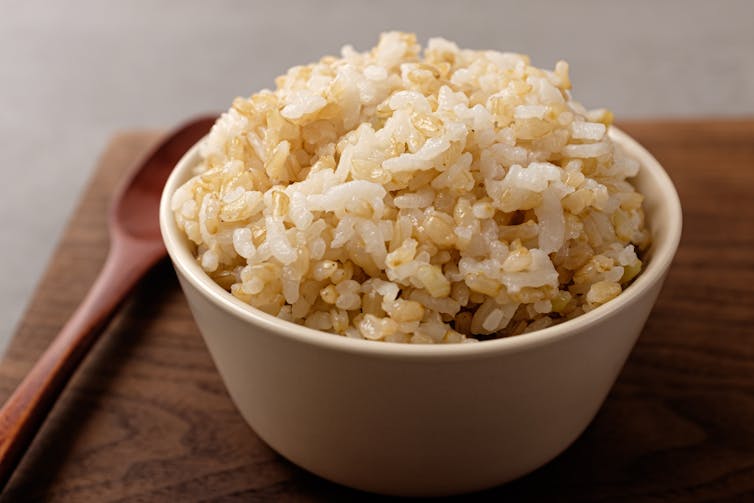
Along with cleaning and drying, the hard hulls are removed since we can’t digest them. This is how brown rice is made, with the other three parts of the rice remaining intact. This means brown rice is regarded as a “wholegrain”.
White rice, however, is a “refined” grain, as it is further polished to remove the bran and germ, leaving just the endosperm. This is a mechanical and not a chemical process.
What’s the difference, nutritionally?
Keeping the bran and the germ means brown rice has more magnesium, phosphorus, potassium B vitamins (niacin, folate, riboflavin and pyridoxine), iron, zinc and fibre.
The germ and the bran also contain more bioactives (compounds in foods that aren’t essential nutrients but have health benefits), like oryzanols and phenolic compounds which have antioxidant effects.
But that doesn’t mean white rice is just empty calories. It still contains vitamins, minerals and some fibre, and is low in fat and salt, and is naturally gluten-free.
White and brown rice actually have similar amounts of calories (or kilojoules) and total carbohydrates.
There are studies that show eating more white rice is linked to a higher risk of type 2 diabetes. But it is difficult to know if this is down to the rice itself, or other related factors such as socioeconomic variables or other dietary patterns.
What about the glycaemic index?
The higher fibre means brown rice has a lower glycaemic index (GI), meaning it raises blood sugar levels more slowly. But this is highly variable between different rices within the white and brown categories.
The GI system uses low (less than 55), medium (55–70) and high (above 70) categories. Brown rices fall into the low and medium categories. White rices fall in the medium and high.
There are specific low-GI types available for both white and brown types. You can also lower the GI of rice by heating and then cooling it. This process converts some of the “available carbohydrates” into “resistant starch”, which then functions like dietary fibre.
Are there any benefits to white rice?
The taste and textural qualities of white and brown rices differ. White rice tends to have a softer texture and more mild or neutral flavour. Brown rice has a chewier texture and nuttier flavour.
So, while you can technically substitute brown rice into most recipes, the experience will be different. Or other ingredients may need to be added or changed to create the desired texture.
Removing more of the outer layers may also reduce the levels of contaminants such as pesticides.
We don’t just eat rice
Comparing white and brown rice seems like an easy way to boost nutritional value. But just because one food (brown rice) is more nutrient-dense doesn’t make the other food (white rice) “bad”.
Ultimately, it’s not often that we eat just rice, so we don’t need the rice we choose to be the perfect one. Rice is typically the staple base of a more complex dish. So, it’s probably more important to think about what we eat with rice.
Adding vegetables and lean proteins to rice-based dishes can easily add the micronutrients, bioactives and fibre that white rice is comparatively lacking, and this can likely do more to contribute to diet quality than eating brown rice instead.
Emma Beckett, Adjunct Senior Lecturer, Nutrition, Dietetics & Food Innovation – School of Health Sciences, UNSW Sydney
This article is republished from The Conversation under a Creative Commons license. Read the original article.
Don’t Forget…
Did you arrive here from our newsletter? Don’t forget to return to the email to continue learning!
Recommended
Learn to Age Gracefully
Join the 98k+ American women taking control of their health & aging with our 100% free (and fun!) daily emails:
-
Slashed Federal Funding Cancels Vaccine Clinics Amid Measles Surge
10almonds is reader-supported. We may, at no cost to you, receive a portion of sales if you purchase a product through a link in this article.
More than a dozen vaccination clinics were canceled in Pima County, Arizona.
So was a media blitz to bring low-income children in Washoe County, Nevada, up to date on their shots.
Planned clinics were also scuttled in Texas, Minnesota, and Washington, among other places.
Immunization efforts across the country were upended after the federal Centers for Disease Control and Prevention abruptly canceled $11.4 billion in covid-related funds for state and local health departments in late March.
A federal judge temporarily blocked the cuts last week, but many of the organizations that receive the funds said they must proceed as though they’re gone, raising concerns amid a resurgence of measles, a rise in vaccine hesitancy, and growing distrust of public health agencies.
“I’m particularly concerned about the accessibility of vaccines for vulnerable populations,” former U.S. surgeon general Jerome Adams told KFF Health News. Adams served in President Donald Trump’s first administration. “Without high vaccination rates, we are setting those populations and communities up for preventable harm.”
The Department of Health and Human Services, which houses the CDC, does not comment on ongoing litigation, spokesperson Vianca Rodriguez Feliciano said. But she sent a statement on the original action, saying that HHS made the cuts because the covid-19 pandemic is over: “HHS will no longer waste billions of taxpayer dollars responding to a non-existent pandemic that Americans moved on from years ago.”
Still, clinics have also used the money to address other preventable diseases such as flu, mpox, and measles. More than 500 cases of measles so far in a Texas outbreak have led to 57 hospitalizations and the deaths of two school-age children.
In Pima County, Arizona, officials learned that one of its vaccination programs would have to end early because the federal government took away its remaining $1 million in grant money. The county had to cancel about 20 vaccine events offering covid and flu shots that it had already scheduled, said Theresa Cullen, director of the county health department. And it isn’t able to plan any more, she said.
The county is home to Tucson, the second-largest city in Arizona. But it also has sprawling rural areas, including part of the Tohono O’odham Nation, that are far from many health clinics and pharmacies, she said.
The county used the federal grant to offer free vaccines in mostly rural areas, usually on the weekends or after usual work hours on weekdays, Cullen said. The programs are held at community organizations, during fairs and other events, or inside buses turned into mobile health clinics.
Canceling vaccine-related grants has an impact beyond immunization rates, Cullen said. Vaccination events are also a chance to offer health education, connect people with other resources they may need, and build trust between communities and public health systems, she said.
County leaders knew the funding would run out at the end of June, but Cullen said the health department had been in talks with local communities to find a way to continue the events. Now “we’ve said, ‘Sorry, we had a commitment to you and we’re not able to honor it,’” she said.
Cullen said the health department won’t restart the events even though a judge temporarily blocked the funding cuts.
“The vaccine equity grant is a grant that goes from the CDC to the state to us,” she said. “The state is who gave us a stop work order.”
The full effect of the CDC cuts is not yet clear in many places. California Department of Public Health officials estimated that grant terminations would result in at least $840 million in federal funding losses for its state, including $330 million used for virus monitoring, testing, childhood vaccines, and addressing health disparities.
“We are working to evaluate the impact of these actions,” said California Department of Public Health Director Erica Pan.
In Washoe County, Nevada, the surprise cuts in federal funding mean the loss of two contract staffers who set up and advertise vaccination events, including state-mandated back-to-school immunizations for illnesses such as measles.
“Our core team can’t be in two places at once,” said Lisa Lottritz, division director for community and clinical health services at Northern Nevada Public Health.
She expected to retain the contractors through June, when the grants were scheduled to sunset. The health district scrambled to find money to keep the two workers for a few more weeks. They found enough to pay them only through May.
Lottritz immediately canceled a publicity blitz focused on getting children on government insurance up to date on their shots. Vaccine events at the public health clinic will go on, but are “very scaled back” with fewer staff members, she said. Nurses offering shots out and about at churches, senior centers, and food banks will stop in May, when the money to pay the workers runs out.
“The staff have other responsibilities. They do compliance visits, they’re running our clinic, so I won’t have the resources to put on events like that,” Lottritz said.
The effect of the cancellations will reverberate for a long time, said Chad Kingsley, district health officer for Northern Nevada Public Health, and it might take years for the full scope of decreasing vaccinations to be felt.
“Our society doesn’t have a collective knowledge of those diseases and what they did,” he said.
Measles is top of mind in Missouri, where a conference on strengthening immunization efforts statewide was abruptly canceled due to the cuts.
The Missouri Immunization Coalition, which organized the event for April 24-25, also had to lay off half its staff, according to board president Lynelle Phillips. The coalition, which coordinates immunization advocacy and education across the state, must now find alternative funding to stay open.
“It’s just cruel and unthinkably wrong to do this in the midst of a measles resurgence in the country,” Phillips said.
Dana Eby, of the health department in New Madrid County, Missouri, had planned to share tips about building trust for vaccines in rural communities at the conference, including using school nurses and the Vaccines for Children program, funded by the CDC.
New Madrid has one of the highest childhood vaccination rates in the state, despite being part of the largely rural “Bootheel” region that is often noted for its poor health outcomes. Over 98% of kindergartners in the county received the vaccine for measles, mumps, and rubella in 2023-24 compared with the state average of about 91%, and rates in some other counties as low as 61%.
“I will say I think measles will be a problem before I retire,” Eby, 42, said.
Also slated to speak at the Missouri event was former surgeon general Adams, who said he had planned to emphasize the need for community collaboration and the importance of vaccinations in protecting public health and reducing preventable diseases. He said the timing was especially pertinent given the explosion in measles cases in Texas and the rise in whooping cough cases and deaths in Louisiana.
“We can’t make America healthy again by going backwards on our historically high U.S. vaccination rates,” Adams said. “You can’t die from chronic diseases when you’re 50 if you’ve already died from measles or polio or whooping cough when you’re 5.”
California correspondent Christine Mai-Duc contributed to this article.
We’d like to speak with current and former personnel from the Department of Health and Human Services or its component agencies who believe the public should understand the impact of what’s happening within the federal health bureaucracy. Please message KFF Health News on Signal at (415) 519-8778 or get in touch here.
KFF Health News is a national newsroom that produces in-depth journalism about health issues and is one of the core operating programs at KFF—an independent source of health policy research, polling, and journalism. Learn more about KFF.
Subscribe to KFF Health News’ free Morning Briefing.
This article first appeared on KFF Health News and is republished here under a Creative Commons license.
Share This Post
-
Stop Sabotaging Your Gut
10almonds is reader-supported. We may, at no cost to you, receive a portion of sales if you purchase a product through a link in this article.
This is Dr. Robynne Chutkan. She’s an integrative gastroenterologist, and founder of the Digestive Center for Wellness, in Washington DC, which for the past 20 years has been dedicated to uncovering the root causes of gastrointestinal disorders, while the therapeutic side of things has been focused on microbial optimization, nutritional therapy, mind-body techniques, and lifestyle changes.
In other words, maximal health for minimal medicalization.
So… What does she want us to know?
Live dirty
While attentive handwashing is important to avoid the spread of communicable diseases*, excessive cleanliness in general can result in an immune system that has no idea how to deal with pathogens when exposure does finally occur.
*See also: The Truth About Handwashing
This goes doubly for babies: especially those who were born by c-section and thus missed out on getting colonized by vaginal bacteria, and especially those who are not breast-fed, and thus miss out on nutrients given in breast milk that are made solely for the benefit of certain symbiotic bacteria (humans can’t even digest those particular nutrients, we literally evolved to produce some nutrients solely for the bacteria).
See also: Breast Milk’s Benefits That Are (So Far) Not Replicable
However, it still goes for the rest of us who are not babies, too. We could, Dr. Chutkan tells us, stand to wash less in general, and definitely ease up on antibacterial soaps and so forth.
See also: Should You Shower Daily?
Take antibiotics only if absolutely necessary (and avoid taking them by proxy)
Dr. Chutkan describes antibiotics as the single biggest threat to our microbiome, not just because of overprescription, but also the antibiotics that are used in animal agriculture and thus enter the food chain (and thus, enter us, if we eat animal products).
Still, while the antibiotics meat/dairy-enjoyers will get from food are better avoided, antibiotics actually taken directly are even worse, and are absolutely a “scorched earth” tactic against whatever they’re being prescribed for.
See also: Antibiotics? Think Thrice ← which also brings up “Four Ways Antibiotics Can Kill You”; seriously, the risks of antibiotics are not to be underestimated, including the risks associated only with them working exactly as intended—let alone if something goes wrong.
Probiotics won’t save you
While like any gastroenterologist (or really, almost any person in general), she notes that probiotics can give a boost to health. However, she wants us to know about two shortcomings that are little-discussed:
1) Your body has a collection of microbiomes each with their own needs, and while it is possible to take “generally good” bacteria in probiotics and assume they’ll do good, taking Lactobacillus sp. will do nothing for a shortage of Bifidobacteria sp, and even taking the correct genus can have similar shortcomings if a different species of that genus is needed, e.g. taking L. acidophilus will do nothing for a shortage of L. reuteri.
It’d be like a person with a vitamin D deficiency taking vitamin B12 supplements and wondering why they’re not getting better.
2) Probiotics are often wasted if not taken mindfully of their recipient environment. For example, most gut bacteria only live for about 20 minutes in the gut. They’re usually inactive in the supplement form, they’re activated in the presence of heat and moisture and appropriate pH etc, and then the clock is ticking for them to thrive or die.
This means that if you take a supplement offering two billion strains of good gut bacteria, and you take it on an empty stomach, then congratulations, 20 minutes later, they’re mostly dead, because they had nothing to eat. Or if you take it after drinking a soda, congratulations, they’re mostly dead because not only were they starved, but also their competing “bad” microbes weren’t starved and changed the environment to make it worse for the “good” ones.
For this reason, taking probiotics with (or immediately after) plenty of fiber is best.
This is all accentuated if you’re recovering from using antibiotics, by the way.
Imagine: a nuclear war devastates the population of the Earth. Some astronauts manage to safely return, finding a mostly-dead world covered in nuclear winter. Is the addition of a few astronauts going to quickly repopulate the world? No, of course not. They are few, the death toll is many, and the environment is very hostile to life. A hundred years later, the population will be pretty much the same—a few straggling survivors.
It’s the same after taking antibiotics, just, generations pass in minutes instead of decades. You can’t wipe out almost everything beneficial in the gut, create a hostile environment there, throw in a couple of probiotic gummies, and expect the population to bounce back.
That said, although “probiotics will not save you”, they can help provided you give them a nice soft bed of fiber to land on, some is better than none, and guessing at what strains are needed is better than giving nothing.
See also: How Much Difference Do Probiotic Supplements Make, Really?
What she recommends
So to recap, we’ve had:
- Wash less, and/or with less harsh chemicals
- Avoid antibiotics like the plague, unless you literally have The Plague, for which the treatment is indeed antibiotics
- Avoid antibiotic-contaminated foods, which in the US is pretty much all animal products unless it’s, for example, your own back-yard hens whom you did not give antibiotics. Do not fall for greenwashing aesthetics in the packaging of “happy cows” and their beef, milk, etc, “happy hens” and their meat, eggs, etc… If it doesn’t explicitly claim to be free from the use of antibiotics, then antibiotics were almost certainly used.
- Dr. Chutkan herself is not even vegan, by the way, but very much wants us to be able to make informed choices about this, and does recommend at least a “plants-forward” diet, for the avoiding-antibiotics reason and for the plenty-of-fiber reason, amongst others.
- Consider probiotics, but don’t expect them to work miracles by themselves; you’ve got to help them to help you.
- Dr. Chutkan also recommends getting microbiome tests done if you think something might be amiss, and then you can supplement with probiotics in a more targetted fashion instead of guessing at what species is needed where.
She also recommends, of course, a good gut-healthy diet in general, especially “leafy green things that were recently alive; not powders”, beans, and nuts, while avoiding gut-unhealthy things such as sugars-without-fiber, alcohol, or some gut-harmful additives (such as most artificial sweeteners, although stevia is a gut-healthy exception, and sucralose is ok in moderation).
For more on gut-healthy eating, check out:
Make Friends With Your Gut (You Can Thank Us Later)
Want to know more from Dr. Chutkan?
We recently reviewed an excellent book of hers:
The Anti-Viral Gut: Tackling Pathogens From The Inside Out – by Dr. Robynne Chutkan
Enjoy!
Share This Post
-
How To Improve Your Brain In Your 90s
10almonds is reader-supported. We may, at no cost to you, receive a portion of sales if you purchase a product through a link in this article.
There’s a popular myth that our brains finish developing at 25 (not remotely true) and from then on, stays pretty much the same with no new growth (also not true), and in terms of cognitive performance, the only way is down (have a guess whether this is true).
If you guessed “no”, you guessed correctly!
The first two myths we’ve previous covered here: Building Your Brain At Every Age
And for more about the terribly misrepresented study that inadvertently launched the “brain finishes developing at 25” myth, see: The Brain As A Work-In-Progress
Because, as the saying goes: you are not too old and it is not too late!
Always, if you are alive, then there is still time:
Age is no barrier
Literally, it’s not even a limiting factor, as shown by the latest research from Dr. Lori Cook et al., in which they followed (in the longitudinal study sense, not in the stalker sense) 3,966 people aged 19–94 for three years and found that measures of brain health improved across the lifespan, amongst participants who completed brief brain-health activities, cognitive training, lifestyle modules, and coaching, typically requiring only 5–15 minutes per day.
how brain health was measured: the study used the BrainHealth Index (BHI), combining 20ish measures (it depends on how you want to count them*) to assess the following three domains:
- Clarity: cognitive function and complex thinking abilities
- Emotional balance: mental well-being and emotional health
- Connectedness: social engagement and sense of purpose
*You can learn more about how it’s done, here: The Brain Health Index: Integrating vulnerability, resilience, and cognitive function into a unified measure of cognitive health and risk of neurodegenerative disease
What they found, in few words: overall BrainHealth Index scores improved over the 3-year period, showing that brain health can indeed be actively strengthened rather than simply maintained, even in later life. Further, improvements were seen across all age groups studied, challenging the common assumption that cognitive decline is an unavoidable consequence of aging.
In fact, the strongest predictor of improvement wasn’t anything that already been determined at the start (e.g. age, sex, or education level)—it was how actively participants engaged with the training tools, coaching, and brain-healthy habits.
One of the co-authors of the study is a scientist we’ve featured before in our “Expert Insights” segment, and in this case she noted:
❝This study reminds us that our brain is not defined by age—it is defined by possibility❞
~ Dr. Sandra Bond Chapman, whom we previously featured in: How (And Why) To Train Your Pre-Frontal Cortex
As for this latest study and more about what specific things they did, you can read it in detail, here: Measuring and increasing the brain health span across adulthood: a public health imperative
Want to learn more?
As for how to do it for yourself, consider:
- Do Try This At Home: The 12-Week Brain Fitness Program
- Synergistic Brain-Training
- The Physical Exercises That Build Your Brain
- Sharper Minder & Body In 3 Weeks With 1 Supplement
- Seven Exercises To Strengthen Your Brain
- Ways To Boost Brain-Derived Neurotrophic Factor (BDNF)
- Reading As A Cognitive Exercise ← there are specific tips here for ensuring your reading is (and remains) cognitively beneficial
Take care!
Share This Post
Related Posts
-
Waist Size Worries: Age-Appropriate Solutions
10almonds is reader-supported. We may, at no cost to you, receive a portion of sales if you purchase a product through a link in this article.
It’s Q&A Day at 10almonds!
Have a question or a request? You can always hit “reply” to any of our emails, or use the feedback widget at the bottom!
In cases where we’ve already covered something, we might link to what we wrote before, but will always be happy to revisit any of our topics again in the future too—there’s always more to say!
As ever: if the question/request can be answered briefly, we’ll do it here in our Q&A Thursday edition. If not, we’ll make a main feature of it shortly afterwards!
So, no question/request too big or small
❝My BMI is fine, but my waist is too big. What do I do about that? I am 5′ 5″ tall and 128 pounds and 72 years old.❞
It’s hard to say without knowing about your lifestyle (and hormones, for that matter)! But, extra weight around the middle in particular is often correlated with high levels of cortisol, so you might find this of benefit:
Don’t Forget…
Did you arrive here from our newsletter? Don’t forget to return to the email to continue learning!
Learn to Age Gracefully
Join the 98k+ American women taking control of their health & aging with our 100% free (and fun!) daily emails:
-
Shrimp vs Caviar – Which is Healthier?
10almonds is reader-supported. We may, at no cost to you, receive a portion of sales if you purchase a product through a link in this article.
Our Verdict
When comparing shrimp to caviar, we picked the caviar.
Why?
Both of these seafoods share a common history (also shared with lobster, by the way) of “nutrient-dense peasant-food that got gentrified and now it’s more expensive despite being easier to source”. But, cost and social quirks aside, what are their strengths and weaknesses?
In terms of macros, both are high in protein, but caviar is much higher in fat. You may be wondering: are the fats healthy? And the answer is that it’s a fairly even mix between monounsaturated (healthy), polyunsaturated (healthy), and saturated (unhealthy). The fact that caviar is generally enjoyed in very small portions is its saving grace here, but quantity for quantity, shrimp is the natural winner on macros.
…unless we take into account the omega-3 and omega-6 balance, in which case, it’s worthy of note that caviar has more omega-3 (which most people could do with consuming more of) while shrimp has more omega-6 (which most people could do with consuming less of).
When it comes to vitamins, caviar has more of vitamins A, B1, B2, B5, B6, B9, B12, D, K, and choline; nor are the margins small in most cases, being multiples (or sometimes, tens of multiples) higher. Shrimp, meanwhile, boasts only more vitamin B3.
In the category of minerals, caviar leads with more calcium, iron, magnesium, manganese, phosphorus, potassium, and selenium, while shrimp has more copper and zinc.
All in all, while shrimp has its benefits for being lower in fat (and thus also, for those whom that may interest, lower in calories), caviar wins the day by virtue of its overwhelming nutritional density.
Want to learn more?
You might like to read:
What Omega-3 Fatty Acids Really Do For Us
Take care!
Don’t Forget…
Did you arrive here from our newsletter? Don’t forget to return to the email to continue learning!
Learn to Age Gracefully
Join the 98k+ American women taking control of their health & aging with our 100% free (and fun!) daily emails:
-
Healthy Relationship, Healthy Life
10almonds is reader-supported. We may, at no cost to you, receive a portion of sales if you purchase a product through a link in this article.
Only One Kind Of Relationship Promotes Longevity This Much!
One of the well-established keys of a long healthy life is being in a fulfilling relationship. That’s not to say that one can’t be single and happy and fulfilled—one totally can. But statistically, those who live longest, do so in happy, fulfilling, committed relationships.
Note: happy, fulfilling, committed relationships. Less than that won’t do. Your insurance company might care about your marital status for its own sake, but your actual health doesn’t—it’s about the emotional safety and security that a good, healthy, happy, fulfilling relationship offers.
How to keep the “love coals” warm
When “new relationship energy” subsides and we’ve made our way hand-in-hand through the “honeymoon period”, what next? For many, a life of routine. And that’s not intrinsically bad—routine itself can be comforting! But for love to work, according to relational psychologists, it also needs something a little more.
What things? Let’s break it down…
Bids for connection—and responsiveness to same
There’s an oft-quoted story about a person who knew their marriage was over when their spouse wouldn’t come look at their tomatoes. That may seem overblown, but…
When we care about someone, we want to share our life with them. Not just in the sense of cohabitation and taxes, but in the sense of:
- Little moments of joy
- Things we learned
- Things we saw
- Things we did
…and there’s someone we’re first to go to share these things with. And when we do, that’s a “bid for connection”. It’s important that we:
- Make bids for connection frequently
- Respond appropriately to our partner’s bids for connection
Of course, we cannot always give everything our full attention. But whenever we can, we should show as much genuine interest as we can.
Keep asking the important questions
Not just “what shall we have for dinner?”, but:
- “What’s a life dream that you have at the moment?”
- “What are the most important things in life?”
- “What would you regret not doing, if you never got the chance?”
…and so forth. Even after many years with a partner, the answers can sometimes surprise us. Not because we don’t know our partners, but because the answers can change with time, and sometimes we can even surprise ourselves, if it’s a question we haven’t considered for a while.
It’s good to learn and grow like this together—and to keep doing so!
Express gratitude/appreciation
For the little things as well as the big:
- Thank you for staying by my side during life’s storms
- Thank you for bringing me a coffee
- Thank you for taking on these responsibilities with me
- I really appreciate your DIY skills
- I really appreciate your understanding nature
On which note…
Compliment, often and sincerely
Most importantly, compliment things intrinsic to their character, not just peripheral attributes like appearance, and also not just what they do for you.
- You’re such a patient person; I really admire that
- I really hit the jackpot to get someone I can trust so completely as you
- You are the kindest and sweetest soul I have ever encountered in life
- I love that you have such a blend of strength and compassion
- Your unwavering dedication to your personal values makes me so proud
…whatever goes for your partner and how you see them and what you love about them!
Express your needs, and ask about theirs
We’re none of us mind-readers, and it’s easy to languish in “if they really cared, I wouldn’t have to ask”, or conversely, “if they wanted something, they would surely say so”.
Communicate. Effectively. Life is too short to waste in miscommunication and unsaid things!
We covered much more detailed how-tos of this in a previous issue, but good double-whammy of top tier communication is:
- “I need…” / “Please will you…”
- “What do you need?” / “How can I help?”
Touch. Often.
It takes about 20 seconds of sustained contact for oxytocin to take effect, so remember that when you hug your partner, hold hands when walking, or cuddle up the sofa.
Have regular date nights
It doesn’t have to be fancy. A date night can be cooking together, it can be watching a movie together at home. It can be having a scheduled time to each bring a “big question” or five, from what we talked about above!
Most importantly: it’s a planned shared experience where the intent is to enjoy each other’s romantic company, and have a focus on each other. Having a regularly recurring date night, be it the last day of each month, or every second Saturday, or every Friday night, whatever your schedules allow, makes such a big difference to feel you are indeed “dating” and in the full flushes of love—not merely cohabiting pleasantly.
Want ideas?
Check out these:
Don’t Forget…
Did you arrive here from our newsletter? Don’t forget to return to the email to continue learning!
Learn to Age Gracefully
Join the 98k+ American women taking control of their health & aging with our 100% free (and fun!) daily emails:


