
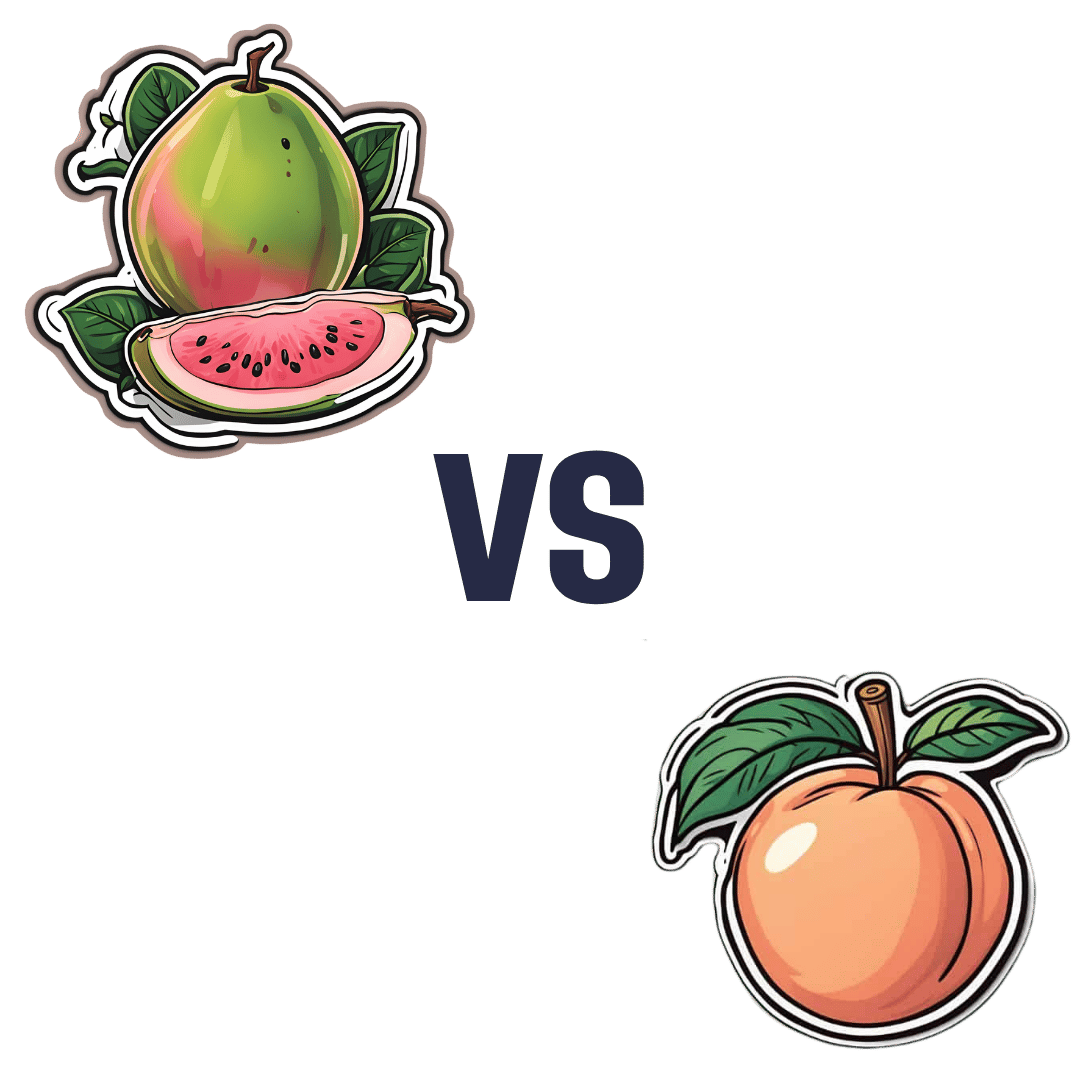
Guava vs Peach – Which is Healthier?
10almonds is reader-supported. We may, at no cost to you, receive a portion of sales if you purchase a product through a link in this article.
Our Verdict
When comparing guava to peach, we picked the guava.
Why?
This one’s quite clear-cut:
In terms of macros, guava has nearly 4x the fiber, nearly 3x the protein, and slightly more carbs, easily winning this round.
In the category of vitamins, guava has more of vitamins A, B1, B2, B3, B5, B6, B7, B9, C, and choline, while peach is not higher in any vitamins.
When it comes to minerals, guava has more calcium, copper, iron, magnesium, manganese, phosphorus, potassium, selenium, and zinc, while peach is not higher in any minerals.
Adding up the sections makes a clear overall win for guava, but by all means enjoy either or both; diversity is good!
Want to learn more?
You might like:
What’s Your Plant Diversity Score?
Enjoy!
Don’t Forget…
Did you arrive here from our newsletter? Don’t forget to return to the email to continue learning!
Recommended
Learn to Age Gracefully
Join the 98k+ American women taking control of their health & aging with our 100% free (and fun!) daily emails:
-
Does ‘fasted’ cardio help you lose weight? Here’s the science
10almonds is reader-supported. We may, at no cost to you, receive a portion of sales if you purchase a product through a link in this article.
Every few years, the concept of fasted exercise training pops up all over social media.
Fasted training refers to exercising in the morning, before eating breakfast.
Fans will claim it’s the most efficient way to lose body fat. Opponents say it’s a terrible idea and will cause you to gain weight.
Who’s right and what does the research evidence say?
Photo by Leandro Boogalu/Pexels Where did the idea come from?
Fasted exercise, proponents say, will cause better changes in body composition – the proportion of lean mass (muscle), bone and fat. In particular, they say fasted exercise leads to fat loss.
Positive changes in body composition can occur through losses of fat mass, while either maintaining or gaining lean mass. Or even through gaining lean mass in the absence of any loss of body fat. All of which may be considered positive.
The idea fasted exercises leads to such positive body composition changes stems from research that shows exercising after eating versus exercise before eating affects metabolism differently.
Aerobic exercise in a fasted state causes you to burn more fat as a fuel (what researchers would call “fat oxidation”) when measured at a single point in time.
So it wasn’t a big leap to assume this would translate to longer-term fat loss.
However, a 2017 systematic review from my team demonstrated that a fasted exercise training program doesn’t seem to translate into long-term differences in body fat loss.
This discrepancy between fat burned as a fuel during exercise, and changes in body fat in the long term has often been misunderstood.
This apparent contradiction may come down to the fact the body seems to find ways to compensate. Fat burning seems to reduce once you eat, and people who have exercised hard may end up expending less total energy over the course of the day.
In exercise science, it’s actually pretty common to find that short-term effects don’t always translate to longer-term impacts.
For example, intense short-term exercise can negatively affect your immune system in the moment, but doing regular exercise can actually affect it positively in the longer term.
Exercising after eating improves performance in activities lasting over 60 minutes. Photo by Jonathan/Pexels What does eating soon after or just before your workout do?
Eating a meal featuring carbohydrates and protein close to when you exercise is likely to help with performance during your next exercise session.
However, whether that meal is before or after your workout seems to have limited impact.
Interestingly, research has shown that increasing the proportion of the food you eat in the morning – and in particular, eating more protein – may help to improve body composition and enhance weight loss.
However, this timing is not in relation to exercise, rather in relation to when in the day you eat.
What about sports performance?
It’s fairly clear eating before exercising improves performance in activities lasting over 60 minutes but has little effect on performance of shorter duration activities.
This is also evidenced by the lack of elite athletes supporting fasted exercise. A survey completed by almost 2,000 endurance athletes showed non-professional athletes are more likely to exercise fasted compared to professional athletes.
What about strength training?
So do you get differences in muscle strength, size, and body composition changes in response to doing resistance training (such as weightlifting) when you’ve fasted versus when you’ve eaten? Unfortunately, the research is limited and low quality.
This limited evidence so far suggests it makes no difference.
One recent randomised controlled trial also found no difference in strength, power, or lean body mass when resistance training was done twice a week for 12 weeks either after fasting or after eating.
What are the potential drawbacks?
Fasted training can make you feel really hungry after exercise, which can lead you to make poorer food choices.
Some people may even get headaches and nausea when trying to exercise fasted. This isn’t universal experience, though; social media is full of people who say exercising while fasting makes them feel great.
In summary, there is no clear winner.
The evidence doesn’t support the superiority of fasted exercise for weight loss, or sports performance.
However, the evidence also doesn’t show it causes a problem in many scenarios (except perhaps elite sports performance).
So if you’re short on time and skipping breakfast is going to allow you to get out and get that run or workout in, then go for it. Don’t worry too much about the consequence.
But if the idea of exercising on an empty tummy makes you want to avoid the gym, then grab some breakfast before you go. Rest assured it won’t be working against your goals.
Exercise fads and wellness hacks come and go but the thing backed by solid and consistent evidence is exercise.
Simply doing it matters the most.
Not the time of day, not the exact exercise choice, not even the exact amount – and definitely, not if you have or haven’t eaten before you exercise.
Mandy Hagstrom, Senior Lecturer, Exercise Physiology. School of Health Sciences, UNSW Sydney
This article is republished from The Conversation under a Creative Commons license. Read the original article.
Share This Post
-
Machine-Dispensed Coffee & Heart Health
10almonds is reader-supported. We may, at no cost to you, receive a portion of sales if you purchase a product through a link in this article.
We have written before about the health benefits (and risks) of coffee; for most people, the benefits far outweigh the risks, but individual cases may vary:
The Bitter Truth About Coffee (or is it?) ← this is a mythbusting edition
Speaking of bitterness; coffee has abundant polyphenols, which means…
- Coffee is the world’s biggest source of antioxidants
- 65% reduced risk of Alzheimer’s for coffee-drinkers
- 67% reduced risk of type 2 diabetes for coffee-drinkers
- 43% reduced risk of liver cancer for coffee-drinkers
- 53% reduced suicide risk for coffee-drinkers
See also: Why Bitter Is Better: Enjoy Bitter Foods For Your Heart & Brain ← while it says foods in the title, this does cover coffee too.
For mythbusting on caffeine specifically, enjoy: Caffeine: Cognitive Enhancer Or Brain-Wrecker?
There are also gut health benefits from drinking coffee, and what’s good for our gut is invariably good for our heart and brain:
Coffee & Your Gut ← gut bacteria do not, by the way, have a preference about how you make your coffee or whether it is caffeinated or not
The latest science on coffee and heart health
Specifically, on coffee and cholesterol levels, so for a quick primer on cholesterol, check out: Demystifying Cholesterol
High total cholesterol, and especially high LDL (“bad” cholesterol) is generally associated with cardiovascular disease, for the reasons outlined in the link above.
Recently, researchers at Uppsala University in Sweden examined the levels of cafestol and kahweol, which are both diterpenes, substances known to increase cholesterol levels, in coffee made by various methods, including those dispensed from coffee machines in workplaces.
Two samples were taken from each machine every 2–3 weeks, and the most common kinds of machines produced the highest concentrations of diterpenes. These machines are the ones that push hot water through a small amount of ground coffee, through a wide-gauge filter, dispensing coffee into a cup in about 30 seconds.
Actual espresso machines, which work on the same principle but usually with a finer filter, higher pressure, and slower dispensing of the drink, had widely varying results, quite possibly because there is (in most machines) a human element in how tightly the ground coffee is packed into the metal filter basket.
Simple filter coffee, whether made in a coffee percolator machine or made using the pour-over method, had the lowest concentrations of diterpenes.
You can read about this study here:
However!
We were curious as to how, exactly, cafestol and kahweol increase cholesterol levels.
It turns out that research in this area has been scant, because most mice aren’t affected by it in the way that most humans are, which has limited mouse model studies.
Scant does not mean non-existent, though, and the answer came by virtue of transgenic mice (specifically, apolipoprotein (apo) E*3-Leiden transgenic mice, which do have the same reaction to cafestol as humans), the paper title sums it up nicely:
You may be wondering: what does suppression of bile acid synthesis have to do with cholesterol levels?
To oversimplify it a bit: cafestol messes with cholesterol metabolism by interfering with the enzymes involved in cholesterol metabolism (specifically, regulatory enzymes found in bile acid).
As to what it actually does in that regard: it reduces LDLR (LDL receptor) mRNA levels by 37% (that figure’s an average of the specific enzymes, sterol 27-hydroxylase and oxysterol 7α-hydroxylase, which were reduced by 32% and 48%, respectively).
Why this matters in practical terms: cafestol does not add any cholesterol to our systems, it inhibits our ability to clear LDL cholesterol, thus promoting raised LDL cholesterol levels.
In other words: if you have little or no dietary cholesterol (no dietary cholesterol, for example, if you are vegan), then your body will only have the cholesterol that it made for itself because it needed it, and as such, the body won’t need to do the same kind of clean-up job that it would if you had that coffee with a double cheeseburger with extra bacon.
As such, if you have little or no dietary cholesterol, cafestol is unlikely to have anything like the same effect on cholesterol levels.
Disclaimer: this latter is technically a hypothesis, but based on sound reasoning:
It’s the same logic that says “if you do not drink alcohol, then eating a durian fruit, which inhibits aldehyde dehydrogenase, which the body uses to metabolize alcohol, will not cause alcohol-related problems for you”.
Want to know more?
We wrote previously on coffee and cafestol, along with some suggestions:
Health-Hack Your Coffee To Make Your Coffee Heart-Healthier!
Enjoy!
Share This Post
-
Is It Possible To Lose Weight Quickly?
10almonds is reader-supported. We may, at no cost to you, receive a portion of sales if you purchase a product through a link in this article.
In Victorian England, weight-loss trends like the dangerous tapeworm diet were popular. While modern fad diets can seem less extreme, they often promise similarly fast results. However, these quick fixes can have similarly harmful consequences:
Not so fast
To illustrate the difference between gradual and extreme dieting, the video bids us consider two identical twins, Sam and Felix:
- Sam adopts a gradual approach, slowly reducing calorie intake and exercising regularly. This causes his body to burn glycogen stores before transitioning to fat as an energy source. Regular exercise helps Sam maintain muscle mass, which boosts his metabolism and supports sustained weight loss.
- Felix drastically cuts calories, forcing his body into starvation mode. He quickly depletes glycogen stores, loses muscle mass, and burns fewer calories, making long-term weight loss more difficult. Although Felix might initially lose water weight, this is temporary and unsustainable.
You cannot “just lose it quickly now, and then worry about healthiness once the weight’s gone”, because you will lose health much more quickly than you will lose fat, and that will sabotage, rather than help, your fat loss journey.Healthy weight loss requires gradual, balanced changes in diet and exercise tailored to individual needs. Extreme diets, whether through calorie restriction or things like elimination of carbs or fats, are unsustainable and shock the body. It’s important to prioritize long-term health over societal pressures for quick weight loss and focus on developing a sustainable, healthy lifestyle.
In short, the quickest way to lose weight and keep it off (without dying), is to lose it slowly.
For more on all of this, enjoy:
Click Here If The Embedded Video Doesn’t Load Automatically!
Want to learn more?
You might also like to read:
How To Lose Weight (Healthily)
Take care!
Share This Post
Related Posts
-
How To Get Down To The Floor Without Kneeling (3 Simple Methods)
10almonds is reader-supported. We may, at no cost to you, receive a portion of sales if you purchase a product through a link in this article.
Dr. Alyssa Kuhn, arthritis expert, shows us how:
Let’s get down to it
Getting down to and up from the floor is a practical life skill that’s important for manner of things, including cleaning, play, fall mitigation, and general independence. However, many people have bad knees (sometimes or always), so how to handle it in such a case?
Three ways:
- Lower down from a seat: sit on a stable surface, slide to the edge, put your hands beside your legs, walk your feet forwards, and lower your body with your arms, while adjusting how far you walk your feet based on your knee mobility.
- Support and turn: place your hands on a stable surface, step one leg backwards to widen your base of support, lower your body using your arms and front leg, and then bend and turn into a seated position.
- Hand-walk out: stand without furniture support, hinge and walk your hands down to the floor, walk them out until stable, then rotate and sit sideways.
In all three cases, you can use a cushion to reduce the distance and provide you with a softer landing if you’re at all unsteady.
For more on all of this plus visual demonstrations, enjoy:
Click Here If The Embedded Video Doesn’t Load Automatically!
Want to learn more?
You might also like:
How To Stand Up From The Floor Without Kneeling (3 Simple Methods)
Take care!
Don’t Forget…
Did you arrive here from our newsletter? Don’t forget to return to the email to continue learning!
Learn to Age Gracefully
Join the 98k+ American women taking control of their health & aging with our 100% free (and fun!) daily emails:
-
The Subtle Art of Not Giving a F*ck – by Mark Manson
10almonds is reader-supported. We may, at no cost to you, receive a portion of sales if you purchase a product through a link in this article.
You may wonder from the title: is this book arguing that we should all be callous heartless monsters? And no, it is not.
Instead, author Mark Manson advocates for cynicism, but less in the manner of Scrooge, and more in the manner of Diogenes:
- That life will involve struggle, so we might as well at least choose our struggles.
- That we will make mistakes, so we might as well accept them as learning experiences.
- That we will love and we will lose, so we might as well do it right while we can.
In short, the book is less about not caring… And more about caring about the right things only.
So, what are “the right things”? Manson bids us decide for ourselves, but certainly has ideas and pointers, with regard to what may or may not be healthy values to pursue.
The style throughout is casual and almost conversational, without being overly padded. It makes for very easy reading.
If the book has a weak point, it’s that when it briefly makes a suprisingly prescriptive turn into recommending we take up Buddhism, it may feel a bit like our friend who wants us to join in the latest MLM scheme. But, he’s soon back on track.
Bottom line: if you ever find yourself stressed with living up to unwanted expectations—your own, other people’s, and society’s—this book can really help streamline things.
Don’t Forget…
Did you arrive here from our newsletter? Don’t forget to return to the email to continue learning!
Learn to Age Gracefully
Join the 98k+ American women taking control of their health & aging with our 100% free (and fun!) daily emails:
-
53 Studies Later: The Best Way to Improve VO2 Max
10almonds is reader-supported. We may, at no cost to you, receive a portion of sales if you purchase a product through a link in this article.
VO2 max measures maximum oxygen usage during intense exercise and reflects overall health and performance. To have a high VO2 max, efficient functioning of lungs, heart, red blood cells, muscles, and mitochondria is crucial. So, how to get those?
Let’s HIIT it!
High-Intensity Interval Training (HIIT) outperforms moderate-intensity exercise, by a long way. Further, based on the data from the 53 studies mentioned in the title, we can know which of the protocols tested work best, and they are:
- 15×15 Interval Training: 15 seconds sprint (90–95% max heart rate) + 15 seconds active rest (70% max heart rate), repeated 47 times.
- 4×4 Interval Training: 4 minutes sprint (90–95% max heart rate) + 3 minutes active rest (70% max heart rate), repeated 4 times.
Whichever you choose, it is best to then do that 3x per week.
Note that “sprint” can mean any maximum-effort cardio exercise; it doesn’t have to be running specifically. Cycling or swimming, for example, are fine options too, as is jumping rope.
For more on each of these, plus how the science got there, enjoy:
Click Here If The Embedded Video Doesn’t Load Automatically!
Want to learn more?
You might also like to read:
How To Do HIIT (Without Wrecking Your Body)
Take care!
Don’t Forget…
Did you arrive here from our newsletter? Don’t forget to return to the email to continue learning!
Learn to Age Gracefully
Join the 98k+ American women taking control of their health & aging with our 100% free (and fun!) daily emails:


