
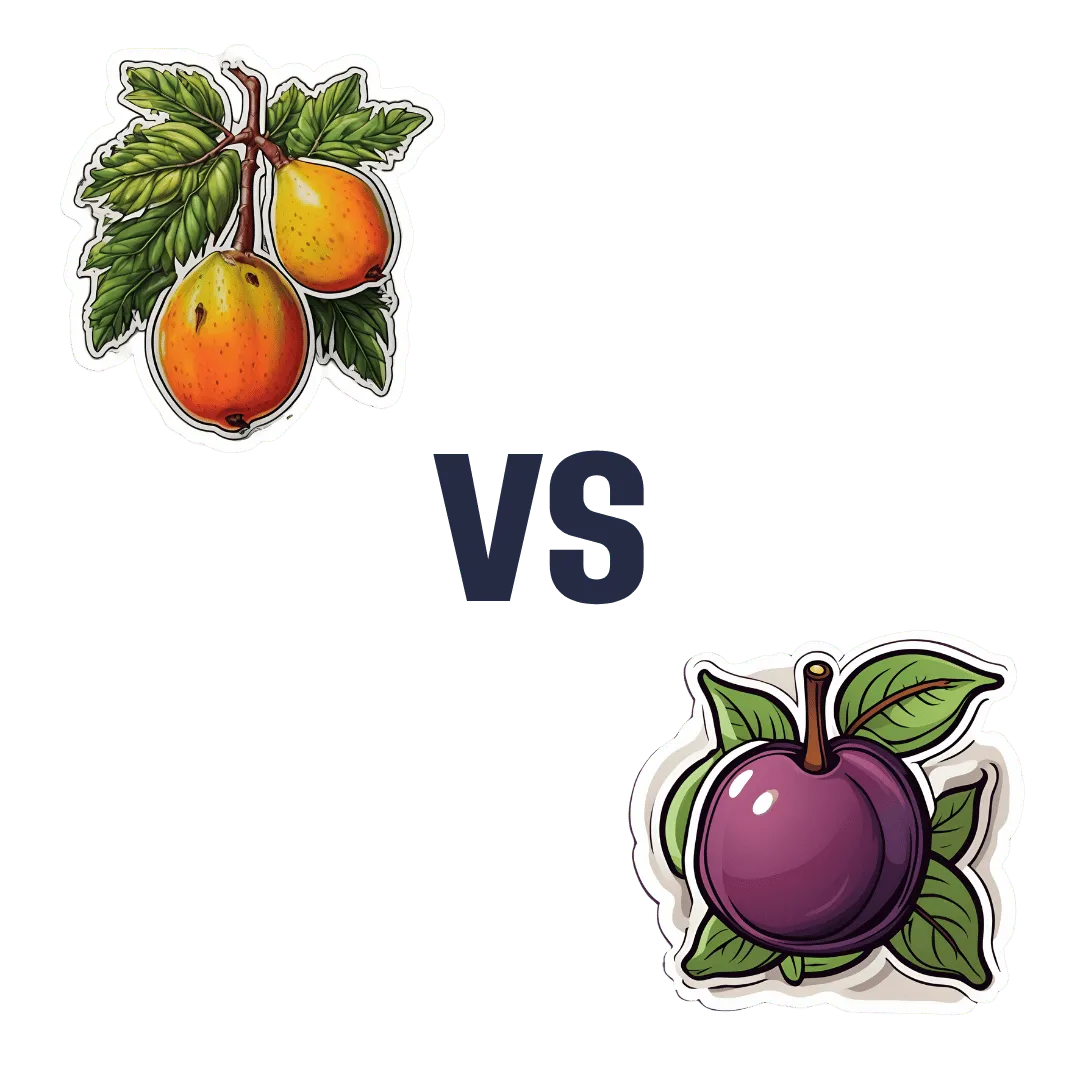
Mango vs Plum – Which is Healthier?
10almonds is reader-supported. We may, at no cost to you, receive a portion of sales if you purchase a product through a link in this article.
Our Verdict
When comparing mangos to plums, we picked the mangos.
Why?
In terms of macros, mangos have more fiber and carbs for the same (minimal) protein, scoring a first-round win as the “most food per food” option here.
In the category of vitamins, mangos have a lot more of vitamins A, B2, B3, B5, B9, B7, B9, C, and E, while plums have a little more vitamin K, so that’s an easy 9:1 win for mangos.
Looking at minerals, mangos have more calcium, copper, magnesium, manganese, potassium, and selenium, while plums have more iron, phosphorus, and zinc, yielding a 6:3 win for mangos here.
In other considerations, plums do have some anticancer properties that aren’t known of mangos (beyond “fruit is generally a good food to eat vs cancer”), so that is a point in their favor.
Still, adding up the sections makes for a clear overall win for mangos, but by all means do enjoy either or both, as diversity is best!
Want to learn more?
You might like:
Top 8 Fruits That Prevent & Kill Cancer
Enjoy!
Don’t Forget…
Did you arrive here from our newsletter? Don’t forget to return to the email to continue learning!
Recommended
Learn to Age Gracefully
Join the 98k+ American women taking control of their health & aging with our 100% free (and fun!) daily emails:
-
Papaya vs Plum – Which is Healthier?
10almonds is reader-supported. We may, at no cost to you, receive a portion of sales if you purchase a product through a link in this article.
Our Verdict
When comparing papaya to plum, we picked the papaya.
Why?
It was close in most categories!
In terms of macros, there’s nothing much between them; papaya has slightly more fiber, while carbs and protein are close enough to be within the margin of rounding errors. So, a marginal win for papaya, or a tie.
In the category of vitamins, papaya has more of vitamins A, B2, B5, B6, B7, B9, C, E, and choline, while plums have more of vitamins B1, B3, and K, giving this round to papaya.
Looking at minerals, papaya has more calcium, copper, iron, magnesium, potassium, and selenium, while plum has more copper, manganese, phosphorus, and zinc, making this a marginal 5:4 victory for papaya.
When it comes to other considerations, plum has some anticancer properties that papaya can’t boast, so that’s a point in plums’ favor.
Adding up the sections makes for an overall win for papaya, but by all means enjoy either or both, as diversity is good!
Want to learn more?
You might like:
Top 8 Fruits That Prevent & Kill Cancer
Enjoy!
Share This Post
-
10 Skin Warning Signs You Should Never Ignore
10almonds is reader-supported. We may, at no cost to you, receive a portion of sales if you purchase a product through a link in this article.
Do you have armpits? Don’t ignore them!
Heed the signs:
Without further ado, they are:
- Acanthosis nigricans: dark, velvety brown skin thickening on the neck, underarms, backs of the hands, or sides of the face can signal insulin resistance, prediabetes, or PMOS. The good news, however, is that despite common concerns of such, sudden widespread onset is rarely associated with cancer.
- Unexplained bruising: bruises appearing without remembered injury may be linked to platelet disorders, clotting disorders, vitamin deficiencies, liver disease, certain cancers, or medications such as blood thinners and corticosteroids; bruising accompanied by nosebleeds, bleeding gums, or large purple patches is especially concerning and merits medical attention.
- Yellowing of the skin or eyes: jaundice can indicate liver disease, bile duct obstruction, or increased breakdown of red blood cells; yellowing often appears under the tongue and inside the mouth before becoming obvious elsewhere. It’s worth knowing that unlike harmless carotene-related skin discoloration (i.e. you drank a lot of carrot juice and turned orange), jaundice also affects the eyes and mouth.
- Severe itching without a rash: persistent whole-body itching lasting more than six weeks with no visible rash can be associated with liver disease, kidney disease, thyroid disorders, iron deficiency, or cancers such as Hodgkin lymphoma. Itching triggered by showering is another warning sign.
- Thick, waxy, or tight skin: swollen, shiny, waxy skin on the shins may occur with Graves’ disease, while skin tightening on the fingers may suggest diabetes or Scleroderma, particularly when hand mobility becomes restricted.
- Butterfly rash on the face: a rash across the cheeks and nose that spares the folds beside the nose famously may indicate systemic lupus erythematosus, especially if it worsens with sun exposure and is accompanied by fatigue or joint pain.
- Dark streaks under the nails: a new dark band in a single nail, particularly one that widens, contains multiple colors, or extends onto the surrounding skin, can be a warning sign of melanoma and should be evaluated for such.
- Sudden hair shedding: rapid diffuse hair loss, known as telogen effluvium, often occurs about three months after a physical stressor and may be associated with thyroid disease, iron deficiency, infection, surgery, trauma, nutritional deficiencies, pregnancy, or rapid weight loss.
- Non-healing wounds or recurrent infections: cuts, scrapes, or ulcers that remain open for more than four weeks generally suggest poor circulation, vascular disease, diabetes, or impaired immune function.
- Yellow, thick, or crumbly nails: commonly caused by a fungal infection, but when accompanied by respiratory symptoms and leg swelling, they may indicate bigger problems and should be checked out.
For more on all of this plus visual illustrations, enjoy:
Click Here If The Embedded Video Doesn’t Load Automatically!
Want to learn more?
You might also like:
What Your Skin Texture Says About Your Health
Take care!
Share This Post
-
Growing Young – by Marta Zaraska
10almonds is reader-supported. We may, at no cost to you, receive a portion of sales if you purchase a product through a link in this article.
This one will be a slightly mixed review, but we think the book has more than enough of value to make it a very worthwhile read.
The premise of the book is that, as the subtitle suggests, positive social qualities increase personal longevity.
Author (and science journalist) Marta Zaraska looks at a lot of research to back this up, and also did a lot of travelling and digging into stories. This is of great value, because she notes where a lot of misconceptions have arisen.
To give one example, it’s commonly noted that marriage (or as-though-marriage life partnerships) is generally* associated with longer life.
*Statistics suggest that marriage-related longevity is enjoyed by men married to women, and people in same-sex marriages regardless of gender, but is not so much the case for women married to men.
However! Zaraska notes a factor she learned from Gottman’s research (yes, that Gottman), that what matters is not the official status of a relationship, so much as the sense of secure lifelong commitment to it.
These kinds of observations (throughout the book) add an extra layer beyond “common wisdom”, and allow us to better understand what’s really going on. The book’s main weaknesses, meanwhile, include such things as how the author is (in this reviewer’s opinion) unduly dismissive of physical health lifestyle factors such as diet and exercise, because they “only” account for a similar bonus to healthy longevity
Bottom line: the book has its flaws, but we think that only serves to make it more engaging. After all, reading should not be a purely passive activity! Zaraska’s well-studied insights give plenty of pointers for tweaking the social side of anyone’s quest for healthy longevity.
Click here to check out Growing Young, increase your healthspan, and take joy in doing it!
Share This Post
Related Posts
-
Healing After Loss – by Martha Hickman
10almonds is reader-supported. We may, at no cost to you, receive a portion of sales if you purchase a product through a link in this article.
Mental health is also just health, and this book’s about an underexamined area of mental health. We say “underexamined”, because for something that affects almost everyone sooner or later, there’s not nearly so much science being done about it as other areas of mental health.
This is not a book of science per se, but it is a very useful one. The format is:
Each calendar day of the year, there’s a daily reflection, consisting of:
- A one-liner insight about grief, quoted from somebody
- A page of thoughts about this
- A one-liner summary, often formulated as a piece of advice
The book is not religious in content, though the author does occasionally make reference to God, only in the most abstract way that shouldn’t be offputting to any but the most stridently anti-religious readers.
Bottom line: if this is a subject near to your heart, then you will almost certainly benefit from this daily reader.
Click here to check out Healing After Loss, and indeed heal after loss
Don’t Forget…
Did you arrive here from our newsletter? Don’t forget to return to the email to continue learning!
Learn to Age Gracefully
Join the 98k+ American women taking control of their health & aging with our 100% free (and fun!) daily emails:
-
Do We Need Sunscreen In Winter, Really?
10almonds is reader-supported. We may, at no cost to you, receive a portion of sales if you purchase a product through a link in this article.
It’s Q&A Day at 10almonds!
Have a question or a request? We love to hear from you!
In cases where we’ve already covered something, we might link to what we wrote before, but will always be happy to revisit any of our topics again in the future too—there’s always more to say!
As ever: if the question/request can be answered briefly, we’ll do it here in our Q&A Thursday edition. If not, we’ll make a main feature of it shortly afterwards!
So, no question/request too big or small 😎
❝I keep seeing advice that we shoudl wear sunscreen out in winter even if it’s not hot or sunny, but is there actually any real benefit to this?❞
Short answer: yes (but it’s indeed not as critical as it is during summer’s hot/sunny days)
Longer answer: first, let’s examine the physics of summer vs winter when it comes to the sun…
In summer (assuming we live far enough from the equator to have this kind of seasonal variation), the part of the planet where we live is tilted more towards the sun. This makes it closer, and more importantly, it’s more directly overhead during the day. The difference in distance through space isn’t as big a deal as the difference in distance through the atmosphere. When the sun is more directly overhead, its rays have a shorter path through our atmosphere, and thus less chance of being blocked by cloud cover / refracted elsewhere / bounced back off into space before it even gets that far.
In winter, the opposite of all that is true.
Morning/evening also somewhat replicate this compared to midday, because the sun being lower in the sky has a similar effect to seasonal variation causing it to be less directly overhead.
For this reason, even though visually the sun may be just as bright on a winter morning as it is on a summer midday, the rays have been filtered very differently by the time they get to us.
This is one reason why you’re much less likely to get sunburned in the winter, compared to the summer (others include the actual temperature difference, your likely better hydration, and your likely more modest attire protecting you).
However…
The reason it is advisable to wear sunscreen in winter is not generally about sunburn, and is rather more about long-term cumulative skin damage (ranging from accelerated aging to cancer) caused by the UV rays—specifically, mostly UVA rays, since UVB rays (with their higher energy but shorter wavelength) have nearly all been blocked by the atmosphere.
Here’s a good explainer of that from the American Cancer Society:
UV (Ultraviolet) Radiation and Cancer Risk
👆 this may seem like a no-brainer, but there’s a lot explained here that demystifies a lot of things, covering ionizing vs non-ionizing radiation, x-rays and gamma-rays, the very different kinds of cancer caused by different things, and what things are dangerous vs which there’s no need to worry about (so far as best current science can say, at least).
Consequently: yes, if you value your skin health and avoidance of cancer, wearing sunscreen when out even in the winter is a good idea. Especially if your phone’s weather app says the UV index is “moderate” or above, but even if it’s “low”, it doesn’t hurt to include it as part of your skincare routine.
But what if sunscreens are dangerous?
Firstly, not all sunscreens are created equal:
Learn more: Who Screens The Sunscreens?
Secondly: consider putting on a protective layer of moisturizer first, and then the sunscreen on top. Bear in mind, this is winter we’re talking about, so you’re probably not going out in a bikini, so this is likely a face-neck-hands job and you’re done.
What about vitamin D?
Humans evolved to have more or less melanin in our skin depending on where we lived, and white people evolved to wring the most vitamin D possible out of the meagre sun far from the equator. Black people’s greater melanin, on the other hand, offers some initial protection against the sun (but any resultant skin cancer is then more dangerous than it would be for white people if it does occur, so please do use sunscreen whatever your skintone).
Nowadays many people live in many places which may or may not be the places we evolved for, and so we have to take that into account when it comes to sun exposure.
Here’s a deeper dive into that, for those who want to learn:
Take care!
Don’t Forget…
Did you arrive here from our newsletter? Don’t forget to return to the email to continue learning!
Learn to Age Gracefully
Join the 98k+ American women taking control of their health & aging with our 100% free (and fun!) daily emails:
-
Apple vs Apricot – Which is Healthier?
10almonds is reader-supported. We may, at no cost to you, receive a portion of sales if you purchase a product through a link in this article.
Our Verdict
When comparing apples to apricots, we picked the apricots.
Why?
In terms of macros, there’s not too much between them; apples have a little more carbs and fiber, but the margins are slight and we’ll call this round a tie.
Micronutrients, however, set these two fruits apart:
In the category of vitamins, apples are not higher in any vitamins, while apricots are higher in vitamins A, B1, B2, B3, B5, B6, B9, C, E, and K—in most cases, by quite large margins, too. All in all, a clear and easy win for apricots.
Looking at minerals, apples are not higher in any minerals, while apricots are higher in calcium, copper, iron, magnesium, manganese, phosphorus, potassium, selenium, and zinc. There’s simply no contest here.
Adding up the sections makes the conclusion clear: if an apple a day keeps the doctor away, then an apricot a day will give the doctor a nice weekend break somewhere!
Want to learn more?
You might like to read:
Top 8 Fruits That Prevent & Kill Cancer
Take care!
Don’t Forget…
Did you arrive here from our newsletter? Don’t forget to return to the email to continue learning!
Learn to Age Gracefully
Join the 98k+ American women taking control of their health & aging with our 100% free (and fun!) daily emails:


