
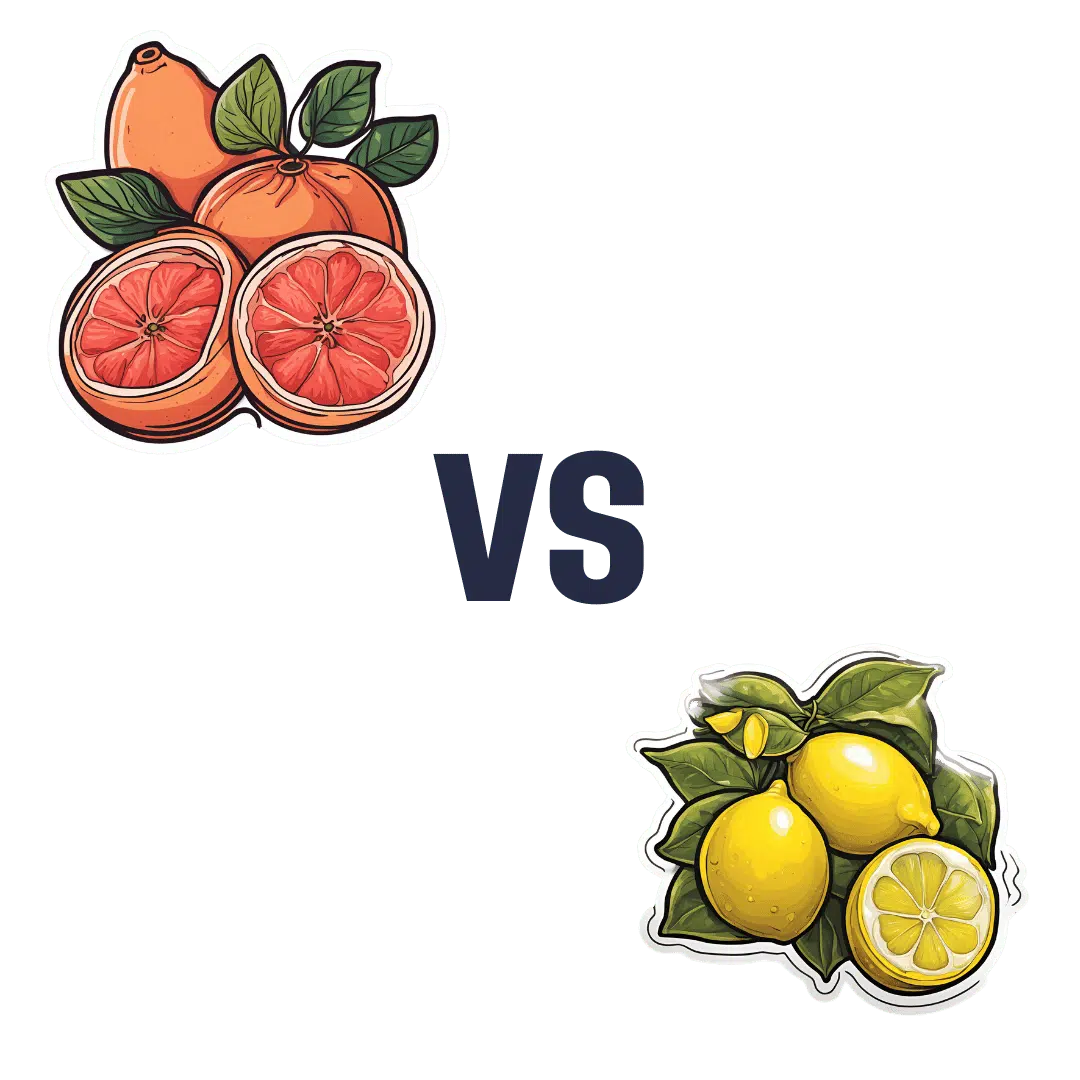
Grapefruit vs Lemon – Which is Healthier?
10almonds is reader-supported. We may, at no cost to you, receive a portion of sales if you purchase a product through a link in this article.
Our Verdict
When comparing grapefruit to lemon, we picked the lemon.
Why?
Grapefruit has its merits, but in the battle of the citrus fruits, lemons come out on top nutritionally:
In terms of macros, grapefruit has more carbs while lemons have more fiber. So, while both have a low glycemic index, lemon is still the winner by the numbers.
Looking at the vitamins, here we say grapefruit’s strengths: grapefruit has more of vitamins A, B2, B3, and choline, while lemon has more of vitamins B6 and C. So, a 4:2 win for grapefruit here.
In the category of minerals, lemons retake the lead: grapefruit has more zinc, while lemon has more calcium, copper, iron, manganese, and selenium.
One final consideration that’s not shown in the nutritional values, is that grapefruit contains high levels of furanocoumarin, which can inhibit cytochrome P-450 3A4 isoenzyme and P-glycoptrotein transporters in the intestine and liver—slowing down their drug metabolism capabilities, thus effectively increasing the bioavailability of many drugs manifold.
This may sound superficially like a good thing (improving bioavailability of things we want), but in practice it means that in the case of many drugs, if you take them with (or near in time to) grapefruit or grapefruit juice, then congratulations, you just took an overdose. This happens with a lot of meds for blood pressure, cholesterol (including statins), calcium channel-blockers, anti-depressants, benzo-family drugs, beta-blockers, and more. Oh, and Viagra, too. Which latter might sound funny, but remember, Viagra’s mechanism of action is blood pressure modulation, and that is not something you want to mess around with unduly. So, do check with your pharmacist to know if you’re on any meds that would be affected by grapefruit or grapefruit juice!
PS: the same substance is quite available in pummelos and sour oranges (but not meaningfully in sweet oranges); you can see a chart here showing the relative furanocoumarin contents of many citrus fruits, or lack thereof as the case may be, as it is for lemons and most limes)
Adding up the sections gives us a clear win for lemons, but by all means enjoy either or both; just watch out for that furanocoumarin content of grapefruit if you’re on any meds affected by such (again, do check with your pharmacist, as our list was far from exhaustive—and yes, this question is one that a pharmacist will answer more easily and accurately than a doctor will).
Want to learn more?
You might like to read:
Top 8 Fruits That Prevent & Kill Cancer ← citrus fruits in general make the list; they inhibit tumor growth and kill cancer cells; regular consumption is also associated with a lower cancer risk 🙂
Enjoy!
Don’t Forget…
Did you arrive here from our newsletter? Don’t forget to return to the email to continue learning!
Recommended
Learn to Age Gracefully
Join the 98k+ American women taking control of their health & aging with our 100% free (and fun!) daily emails:
-
The Best Exercise to Stop Your Legs From Giving Out
10almonds is reader-supported. We may, at no cost to you, receive a portion of sales if you purchase a product through a link in this article.
Dr. Doug Weiss, seniors-specialist physio, has an exercise that stops your knees from being tricked into collapsing (which is very common) by a misfiring (also common) reflex.
Step up…
Setup to step up thus:
- Use a sturdy support like a countertop or chair.
- Have an aerobic step or similar firm surface to step onto.
When you’re ready:
- Stand facing away from the step.
- Place one hand on the support for stability.
- Step backwards up onto the step with your right leg, then your left leg, so both feet are on the step.
- Step forward to come back down.
Once you’re confident of the series of movements, do it without the support, and do it for a few minutes each day. Don’t worry about how easy it becomes; this is not, first and foremost, a strength-training exercise; you don’t have to start adding weights or anything (although of course you can if you want).
How it works: there’s a part of you called the Golgi tendon organ, and it can trigger a Golgi tendon reflex, which is one of the body’s equivalents of a steam valve. However, instead of letting off steam to avoid a boiler explosion, it collapses a joint to save it from overload. However, if not exercised regularly, it can get overly sensitive, causing it to mistake your mere bodyweight for an overload. So, it collapses, thinking it is saving you from snapping a tendon, but it’s not. By exercising in the way described, the Golgi tendon reflex will go back to only being triggered by an actual overload, not the mere act of stepping.
Meanwhile, for more on all of the above plus a visual demonstration, enjoy:
Click Here If The Embedded Video Doesn’t Load Automatically!
Want to learn more?
You might also like:
What Nobody Teaches You About Strengthening Your Knees
Take care!
Share This Post
-
New News From The Centenarian Blue Zones
10almonds is reader-supported. We may, at no cost to you, receive a portion of sales if you purchase a product through a link in this article.
From Blue To Green…
We sometimes write about supercentenarians, which word is usually used in academia to refer to people who are not merely over 100 years of age, but over 110 years. These people can be found in many countries, but places where they have been found to be most populous (as a percentage of the local population) have earned the moniker “Blue Zones”—of which Okinawa and Sardinia are probably the most famous, but there are others too.
This is in contrast to, for example “Red Zones”, a term often used for areas where a particular disease is endemic, or areas where a disease is “merely” epidemic, but particularly rife at present.
In any case, back to the Blue Zones, where people live the longest and healthiest—because the latter part is important too! See also:
- Lifespan: how long we live
- Healthspan: how long we stay healthy (portmanteau of “healthy lifespan”)
Most of our readers don’t live in a Blue Zone (in fact, many live in the US, which is a COVID Red Zone, a diabetes Red Zone, and a heart disease Red Zone), but that doesn’t mean we can’t all take tips from the Blue Zones and apply them, for example:
- The basics: The Blue Zones’ Five Pillars Of Longevity
- Going beyond: The Five Key Traits Of Healthy Aging
You may be wondering… How much good will this do me? And, we do have an answer for that:
When All’s Said And Done, How Likely Are You To Live To 100?
Now that we’re all caught-up…
The news from the Blues
A team of researchers did a big review of observational studies of centenarians and near-centenarians (aged 95+). Why include the near-centenarians, you ask? Well, most of the studies are also longitudinal, and if we’re doing an observational study of the impact of lifestyle factors on a 100-year-old, it’s helpful to know what they’ve been doing recently. Hence nudging the younger-end cutoff a little lower, so as to not begin each study with fresh-faced 100-year-olds whom we know nothing about.
Looking at thousands of centenarians (and near-centenarians, but also including some supercentenarians, up the age of 118), the researchers got a lot of very valuable data, far more than we have room to go into here (do check out the paper at the bottom of this article, if you have time; it’s a treasure trove of data), but one of the key summary findings was a short list of four factors they found contributed the most to extreme longevity:
- A diverse diet with low salt intake: in particular, a wide variety of plant diversity, including protein-rich legumes, though fish featured prominently also. On average they got 57% and 65% of their energy intake from carbohydrates, 12% to 32% from protein, and 27% to 31% from fat. As for salt, they averaged 1.6g of sodium per day, which is well within the WHO’s recommendation of averaging under 2g of sodium per day. As a matter of interest, centenarians in Okinawa itself averaged 1.1g of sodium per day.
- Low medication use: obviously there may be a degree of non-causal association here, i.e. the same people who just happened to be healthier and therefore lived longer, correspondingly took fewer medications—they took fewer medications because they were healthier; they weren’t necessarily healthier because they took fewer medications. That said, overmedication can be a big problem, especially in places with a profit motive like the US, and can increase the risk of harmful drug interactions, and side effects that then need more medications to treat the side effects, as well as direct iatrogenic damage (i.e. this drug treats your condition, but as the cost of harming you in some other way). Naturally, sometimes we really do need meds, but it’s a good reminder to do a meds review with one’s doctor once in a while, and see if everything’s still of benefit.
- Getting good sleep: not shocking, and this one’s not exactly news. But what may be shocking is that 68% of centenarians reported consistently getting enough good-quality sleep. To put that into perspective, only 35% of 10almonds readers reported regularly getting sleep in the 7–9 hours range.
- Rural living environment: more than 75% of the centenarians and near-centenarians lived in rural areas. This is not usually something touted as a Blue Zones thing on lists of Blue zones things, but this review strongly highlighted it as very relevant. In the category of things that are more obvious once it’s pointed out, though, this isn’t necessarily such a difference between “country folk” and “city folk”, so much as the ability to regularly be in green spaces has well-established health benefits physically, mentally, and both combined (such as: neurologically).
And showing that yes, even parks in cities make a significant difference:
Want to know more?
You can read the study in full here:
A systematic review of diet and medication use among centenarians and near-centenarians worldwide
Take care!
Share This Post
-
Air Purifiers & Sleep
10almonds is reader-supported. We may, at no cost to you, receive a portion of sales if you purchase a product through a link in this article.
It’s Q&A Day at 10almonds!
Have a question or a request? We love to hear from you!
In cases where we’ve already covered something, we might link to what we wrote before, but will always be happy to revisit any of our topics again in the future too—there’s always more to say!
As ever: if the question/request can be answered briefly, we’ll do it here in our Q&A Thursday edition. If not, we’ll make a main feature of it shortly afterwards!
So, no question/request too big or small
❝I’ve read that air pollution has a negative effect on sleep quality and duration. Since I live next to a busy road, I was wondering whether I should invest in an air purifier. What are 10Almonds’s views?❞
Going straight to the science, there are two questions here:
- Does air pollution negatively affect sleep quality and duration?
- Does the use of an air purify actually improve the air quality in the way(s) necessary to make a difference?
We thought we’d have to tackle these questions separately, but we did find one study that addressed your question directly. It was a small study (n=30 if you believe the abstract; n=29 if you read the paper itself—one person dropped out); the results were modest but clear:
❝The purifier filter was associated with increased total sleep time for an average of 12 min per night, and increased total time in bed for an average of 19 min per night relative to the placebo.
There were several sleep and mood outcomes for which no changes were observed, and time awake after sleep onset was higher for the purifier filter. Air quality was better during the high-efficiency particulate air filter condition.
These findings offer positive indications that environmental interventions that improve air quality can have benefits for sleep outcomes in healthy populations who are not exhibiting clinical sleep disturbances.❞
In the above-linked paper’s introduction, it does establish the deleterious effect of air pollution on a wide variety of health metrics, including sleep, this latter evidenced per Caddick et al. (2018): A review of the environmental parameters necessary for an optimal sleep environment
Now, you may be wondering: is an extra 12 minutes per night worth it?
That’s your choice to make, but we would argue that it is. We can make many choices in our lives that affect our health slightly for the better or the worse. If we make a stack of choices in a particular direction, the effects will also stack, if not outright compound.
So in the case of sleep, it might be (arbitrary numbers for the sake of illustration):
- Get good exercise earlier in the day (+3%)
- Get good food earlier in the day (+2.5%)
- Practice mindfulness/meditation before bed (+2.5%)
- Have a nice dark room (+5%)
- Have fresh bedding (+2.5%)
- Have an air purifier running (+3%)
Now, those numbers are, as we said, arbitrary*, but remember that percentages don’t add up; they compound. So that “+3%” starts being a lot more meaningful than if it were just by itself.
*Confession: the figure of 3% for the air purifier wasn’t entirely arbitrary; it was based on 100(12/405) = 80/27 ≈ 3, wherein the 405 figure was an approximation of the average total time (in minutes) spent sleeping with placebo, based on a peep at their results graph. There are several ways the average could be reasonably calculated, but 6h45 (i.e., 405 minutes) was an approximate average of those reasonable approximate averages.
So, 12 minutes is a 3% improvement on that.
Don’t have an air purifier and want one?
We don’t sell them, but here’s an example on Amazon, for your convenience
Take care!
Share This Post
Related Posts
-
Vitamin D2 vs Vitamin D3: What You Would Benefit From Knowing
10almonds is reader-supported. We may, at no cost to you, receive a portion of sales if you purchase a product through a link in this article.
It’s Q&A Day at 10almonds!
Have a question or a request? We love to hear from you!
In cases where we’ve already covered something, we might link to what we wrote before, but will always be happy to revisit any of our topics again in the future too—there’s always more to say!
As ever: if the question/request can be answered briefly, we’ll do it here in our Q&A Thursday edition. If not, we’ll make a main feature of it shortly afterwards!
So, no question/request too big or small 😎
❝Hi, is there any important difference between vitamin d2 and vitamin d3? Is one better than the other?❞
There is indeed! And one is better than the other!
Where they come from
You’ll find a lot of sources that will tell you “Vitamin D2 is from plants, D3 is from animals”, and in fact only the second half of that is true.
In nature, there are no plants that are known to produce vitamin D.
Vitamin D2, however, is produced by many fungi, as well as algae, neither of which are part of the Kingdom Plantae.
Vitamin D3, meanwhile, is produced by many animals (including humans).
When “the sun” is sometimes considered a source of vitamin D, that’s true only insofar as the sun is also a source of tomatoes, for example, which required the sun to grow. While we humans (and other animals) cannot photosynthesize in general, producing vitamin D is something we can do if exposed to UV light (such as from the sun).
However, of course exposure to UV light (such as from the sun) comes with other problems, so… Should we get sun exposure or not?
We weighed up the balance of evidence, here: The Sun Exposure Dilemma
If, like this writer, you are a mostly crepuscular being who avoids the sun, we have good news: mushrooms can do the sunbathing for us!
❝Exposing mushrooms to UV (from sunlight or in a laboratory) increases the amount of vitamin D in mushrooms by nearly eightfold. Putting five store-bought button mushrooms in the sun, or just one portobello mushroom, produces 24 µg of vitamin D, which translates to nearly 1000 international units, providing the amount of vitamin D one needs in an entire day, and the equivalent found in most vitamin D supplements.
If you’re wondering if the vitamin D from mushrooms actually makes it into your bloodstream, it does. A recent meta-analysis of randomized controlled trials showed that tanned (UV-exposed) mushrooms may be effective in increasing active vitamin D levels in adults with low levels of vitamin D, and studies (randomised controlled trials) have shown that it may be just as effective as supplements at increasing vitamin D levels in the blood (here, and here).
Some research is very positive, saying that putting your mushrooms in direct sunlight for 10–15 minutes may provide you with 100% of your daily vitamin D needs, and the vitamin D content in sunlight-exposed mushrooms may be retained with refrigeration for up to 8 days.
The production of vitamin D may be increased by a further 30% by placing them in the sun with the underside, or gills, facing up, or by 60% if you slice them.❞
Read all about it: Tan your mushrooms, not your skin
Which is better?
In few words: D3 is better.
They both do the exact same job, but with D3, you simply get more bang-for-buck:
❝The WMD in change in total 25(OH)D based on 12 daily dosed vitamin D2-vitamin D3 comparisons, analyzed using liquid chromatography-tandem mass spectrometry, was 10.39 nmol/L (40%) lower for the vitamin D2 group compared with the vitamin D3 group.
Vitamin D3 leads to a greater increase of 25(OH)D than vitamin D2, even if limited to daily dose studies, but vitamin D2 and vitamin D3 had similar positive impacts on their corresponding 25(OH)D hydroxylated forms.❞
Note: “WMD” here means “weighted mean difference”, not “weapons of mass destruction”
About that “and importance of BMI”, by the way: in persons with a BMI >25, there was no longer a difference between the two forms. Literally, no difference at all; the difference was reduced to 0%.
Another study found similarly, but with different numbers (finding a greater difference), and without recording BMI as a factor:
❝D3 is approximately 87% more potent in raising and maintaining serum 25(OH)D concentrations and produces 2- to 3-fold greater storage of vitamin D than does equimolar D2.❞
See the paper: Vitamin D3 Is More Potent Than Vitamin D2 in Humans
“Well that sucks, because I’m vegan”
Fear not, you can get vegan D3 too.
Much like “you can’t get vegan B12” (but you can; it’s made by yeast), there are vegan D3 supplements, made by lichen.
The trouble with lichen, when it comes to classifying it, it that it’s actually a hybrid colony of many small, strange things (beyond the scope of this article, but they are fascinating, so this writer is holding herself back by the scruff of the neck from explaining in detail), some of which are technically part of Kingdom Animalia, but it is hard to find even the most ardent vegan who will object to consuming bacteria, for example.
Want to try some?
We don’t sell it, but here for your convenience is an example product on Amazon 😎
But watch out with the doses, if supplementing vitamin D in either form, because…
Vit D + Calcium: Too Much Of A Good Thing? ← this also talks about safe and effective doses, and what goes wrong if you take too much
Take care!
Don’t Forget…
Did you arrive here from our newsletter? Don’t forget to return to the email to continue learning!
Learn to Age Gracefully
Join the 98k+ American women taking control of their health & aging with our 100% free (and fun!) daily emails:
-
Focusing on how and why you eat, not just what, may be the key to healthy eating
10almonds is reader-supported. We may, at no cost to you, receive a portion of sales if you purchase a product through a link in this article.
When most people think about “healthy eating”, they usually focus on what they eat. That might mean trying to eat more fruit and vegetables or less fast food, or counting calories.
But there’s a lot more to healthy eating than just dietary intake. Behaviours and attitudes around food are also important.
Take, for example, orthorexia nervosa, which is an obsessive preoccupation with consuming only “healthy” foods. If healthy eating only means ingesting healthy foods, then people with orthorexia are super healthy.
But people who live with this eating disorder often struggle with relationships and report poor quality of life, among other issues.
Research suggests that shifting the focus from food itself to our experience of eating can have a range of health benefits. Let’s take a look.
Hinterhaus Productions/Getty Why are we so obsessed with diet?
Equating “healthy eating” with “healthy diet” may have taken off in the early 1980s with panic over the “obesity epidemic” in Western countries – defined as a rapid rise in the prevalence of people in the population with a body mass index (BMI) of 30 or greater.
But causes of obesity are complex and poorly understood, with numerous possible explanations beyond simply what a person eats. And admonishing overweight people to eat “healthier” has done nothing to reduce population rates of obesity.
There is some evidence that this fixation on weight has resulted in increased rates of disordered eating and eating disorders – both of which involve problematic eating behaviours and distorted attitudes towards food, weight, shape and appearance.
Clearly, something needs to change in how we think about healthy eating.
Listening to your body
A growing body of research on intuitive eating has found this approach has an array of health benefits.
Intuitive eating means trusting internal body cues that tell us when, what and how much to eat. For example, tuning into your stomach growling telling you it’s time to eat, or noticing feeling full or satisfied, or that you may crave certain foods because your body wants specific nutrients (such as protein after exercising).
Studies have shown this approach can lead to better physical and mental health as well as better diet quality, and is associated with lower BMIs.
Research also shows eating at regular intervals and eating with other people also lead to better overall health and diet.
But if you find it hard, you’re not alone
Most of us are surrounded by food environments that make healthy eating difficult.
Unhealthy food environments promote overeating and encourage us to override our innate signals of hunger and fullness.
When we’re surrounded by cheap and accessible sugary snacks, fast foods and large portions – and lots of marketing – it can be hard to develop a positive relationship with food.
The issue is particularly acute for people in more disadvantaged communities.
For example, in our research with rural Australians about food and eating, most told us they wanted to eat more healthily, but found it difficult for many reasons, These included busy schedules and the cost of healthier food.
Habits and emotional eating can also make healthy eating difficult.
So, what works?
For most people, healthy behaviours and attitudes to eating mean a balanced, flexible and non-judgmental approach, without fear of “bad” foods. It means paying attention to hunger and fullness cues.
But it also means recognising that food is a source of social and cultural connection. A healthy attitude to food doesn’t ignore nutritional information – it incorporates this knowledge into a broader and more joyous approach to eating.
Here are three suggestions to get you started.
1. Recognising signs of hunger and fullness
These may differ from person to person. Can you hear your stomach start to growl or your energy begin to dip? Is it a while since you ate? And while eating, is there a point where the hunger has gone away and you no longer feel a strong desire to continue eating? Some people find using hunger and fullness scales useful.
2. Reframing “bad” foods
Is there a food you really like but don’t eat because you consider it “bad” or “forbidden”? Try incorporating a small amount into your next meal or snack. You may find that doing so brings greater joy to your eating while simultaneously taking away its power.
3. Eating with people
If you normally eat by yourself or “grab and go”, see if there’s a way to plan more time for meals and include other people – whether this is more family meals or group lunches with coworkers.
But some people have to follow a specific diet
People with medical conditions that require a particular type of diet – such as those with diabetes or coeliac disease – need to follow that advice. But they may still be able to have healthy behaviours and attitudes towards food even within these constraints.
For example, one 2020 study of people with type 2 diabetes found that more intuitive eaters had better control of their blood sugar levels.
The bottom line
So – if you don’t have a medical condition that prevents it – go ahead and have some of that birthday cake. And then listen to your body when it tells you you’ve had enough.
If you feel that you have an unhealthy relationship with food that is interfering with your life, please contact your GP to discuss your options. You may also want to contact the Butterfly Foundation for support.
Nina Van Dyke, Associate Professor and Associate Director, Mitchell Institute, Victoria University and Rosemary V. Calder, Professor, Health Policy, Victoria University
This article is republished from The Conversation under a Creative Commons license. Read the original article.
Don’t Forget…
Did you arrive here from our newsletter? Don’t forget to return to the email to continue learning!
Learn to Age Gracefully
Join the 98k+ American women taking control of their health & aging with our 100% free (and fun!) daily emails:
-
3-Minute Tongue Decompression Technique For Better Breathing & Brain Health
10almonds is reader-supported. We may, at no cost to you, receive a portion of sales if you purchase a product through a link in this article.
The tongue is a much larger muscle than most people think about most of the time, because we only see the top part.
However, this means that what the tongue does can have a big effect on many nearby things, ranging from breathing to neck tension and more.
Here’s how to ensure it doesn’t work against you:
Don’t get tongue-tied
This technique is designed to release tension in the tongue and surrounding tissues to support lymphatic drainage, blood flow, and tongue mobility.
Here’s the step-by step process:
- Wash your hands thoroughly, and trim your nails if necessary
- Sit upright, relax your jaw, and breathe through your nose if possible
- Slide your third and fourth fingers of both hands inside your mouth and rest them on your inner gums below your teeth
- Curl your fingertips slightly so the pads contact the soft floor of your mouth beneath your tongue
- Draw your hands away from each other to broaden your jaw while lightly pressing your fingertips downward into the soft tissue
- Inhale for four counts and exhale for six counts, keeping your shoulders relaxed
- Lift the whole top surface of the tongue (not just the tip*) to the roof of your mouth to “suction,” then release and repeat in a steady pulse
- Keep the outward traction, downward pressure, and tongue pulsing continuously for about three minutes
- As the tissue softens, sink your fingertips a little deeper while staying pain free
- Lightly re-moisten your fingertips with your tongue if needed and slide them out gently rather than pulling straight out
*if you do it with just the tip, this will be worse than useless and will actually have the opposite effect; sounds strange, but it has to do with what the rest of the muscle is doing to position the tongue, and the internal force that results being in the wrong direction
For more on all of this plus a visual demonstration, enjoy:
Click Here If The Embedded Video Doesn’t Load Automatically!
Want to learn more?
You might also like:
The Exercises That Can Fix Sinus Problems (And More)
Take care!
Don’t Forget…
Did you arrive here from our newsletter? Don’t forget to return to the email to continue learning!
Learn to Age Gracefully
Join the 98k+ American women taking control of their health & aging with our 100% free (and fun!) daily emails:


