
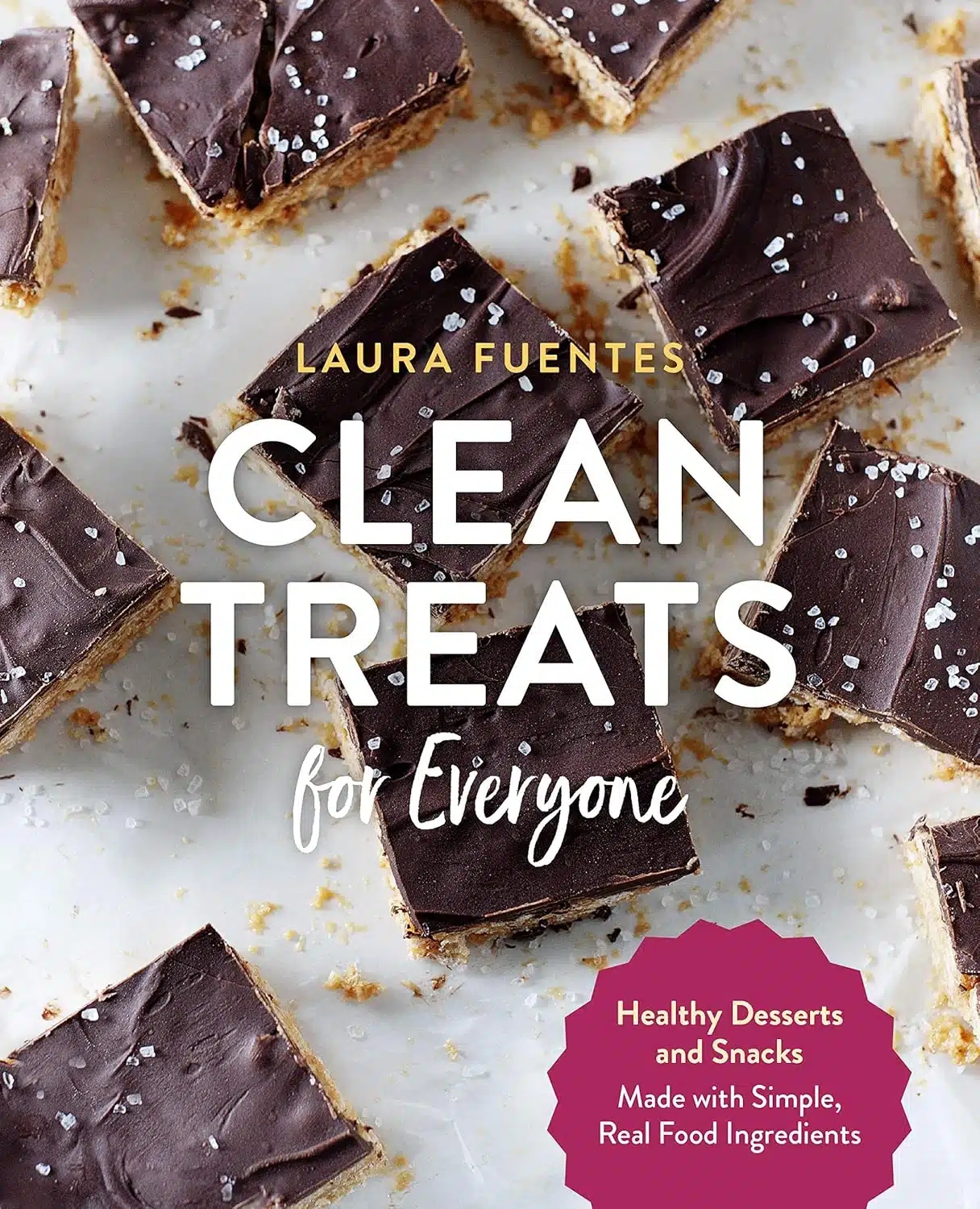
Clean Treats For Everyone – by Laura Fuentes
10almonds is reader-supported. We may, at no cost to you, receive a portion of sales if you purchase a product through a link in this article.
First let’s break down the title:
- Clean = simple ingredients that are mostly healthy and are minimally processed
- Treats = this is a book of dessert-and-similar recipes
- For Everyone = options are given to make recipes (as applicable) dairy-free, nut-free, gluten-free, etc.
When we say “desserts and similar” we mean that there are also sweet snacks that probably one wouldn’t serve as a dessert after a meal, but are nevertheless thematically more dessert-like than a savory thing might be.
The recipes are mostly quite simple, though it’ll still require a little practice, if you’re not already proficient, to get some of the things “just right”.
In terms of healthiness, most of this is indeed very healthy. There are some things where the healthiness is an illusion, such as butter, ghee, coconut palm sugar, maple syrup, and the like. However, if sticking to small portions for recipes that use those, then this is not a terrible problem.
Bottom line: if you like desserts and sweet snacks, but like to be healthy, then this book will help expand your culinary repertoire in that direction.
Click here to check out Clean Treats For Everyone, and enjoy!
Don’t Forget…
Did you arrive here from our newsletter? Don’t forget to return to the email to continue learning!
Recommended
Learn to Age Gracefully
Join the 98k+ American women taking control of their health & aging with our 100% free (and fun!) daily emails:
-
Beetroot For More Than Just Your Blood Pressure
10almonds is reader-supported. We may, at no cost to you, receive a portion of sales if you purchase a product through a link in this article.
Beetroot is well-known for being good for blood pressure, but what else can it do?
Firstly, blood pressure, yes
This is because… Well, we’ll quote from a paper:
❝As a source of nitrate, beetroot ingestion provides a natural means of increasing in vivo nitric oxide (NO) availability and has emerged as a potential strategy to prevent and manage pathologies associated with diminished NO bioavailability, notably hypertension and endothelial function❞
Source: The Potential Benefits of Red Beetroot Supplementation in Health and Disease
That’s a little modest in its wording though, so let’s just be clear, it does work:
- The effects of dietary nitrate on blood pressure and endothelial function: a review of human intervention studies
- Clinical evidence demonstrating the utility of inorganic nitrate in cardiovascular health
- Vascular effects of dietary nitrate (as found in green leafy vegetables and beetroot) via the nitrate-nitrite-nitric oxide pathway
…where you can see that it significantly reduced systolic and diastolic blood pressure.
Note: this does mean that if you suffer conversely from hypotension (dangerously low blood pressure) you should probably skip the beetroot.
For your blood sugar levels, too
The fiber in whole beetroot or powdered beetroot extract (but not beetroot juice) is, as usual, good for balancing blood sugars. However, in the case of beetroot, it (probably because of the betalain content, specifically betanin) also improves insulin sensitivity, resulting in lower fasting and postprandial (after-dinner) insulin levels:
See also (cited in the above paper): Post-prandial effect of beetroot (beta vulgaris) juice on glucose and lipids levels of apparently healthy subjects
For your blood lipids, also
This one has less readily available research to support it, so in the category of “papers that aren’t paywalled into oblivion”, here’s one that concludes with the entertainingly specific:
❝Results: Beetroot juice intake increased plasma high density lipoprotein (t= -60.88, P<0.05). Triglyceride, total cholesterol, and low density lipoprotein were reduced (P<0.05). Compared with placebo, beetroot juice reduced the concentrations of triglyceride, total cholesterol, and low density lipoprotein (P<0.05).
Conclusion: Regular beetroot juice intake has significant effects on lipid profile in female soccer players, hence its suggestion for preventing diseases such as hypercholesterolemia and hypertension in female soccer players.❞
However, even if you are not a female soccer player, chances are it will have the same effect on your physiology as theirs (but, credit where it’s due, it’s right that they make claims about only what they know for sure).
Here’s the paper: Efficacy of Beetroot Juice Consumption on the Lipid Profile of Female Soccer Players
What’s good for your blood, is good for your brain
…and that’s just as true here:
When reading that, you’ll see that as well as two health outcome benefits (antidiabetic and anti-Alzheimer’s), there are also two mechanisms of action, which are:
- The blood sugar lowering, insulin sensitivity increasing, lipid improving, qualities we discussed already
- Its fabulous flavonoid content
These two things each in turn have a lot of other components and nuances, so here’s an infographic covering them ← this flowchart makes it all a lot clearer
On which note, those flavonoids aren’t the only active compounds present that result in…
Antioxidant & anti-inflammatory action
This one’s pretty straightforward, but it’s worth mentioning also that (as is commonly the case) what fights oxidation also fights cancer:
❝In recent years, the beetroot, especially the betalains (betanin) and nitrates it contains, now has received increasing attention for their effective biological activity.
Betalains have been proven to eliminate oxidative and nitrative stress by scavenging DPPH, preventing DNA damage, and reducing LDL.
It also has been found to exert antitumor activity by inhibiting cell proliferation, angiogenesis, inducing cell apoptosis, and autophagy.❞
Want to try some?
We don’t sell it, but you can easily grow your own or find it at your local supermarket; if you prefer it in supplement form, dried is better than juice (for a multitude of reasons), so here for your convenience is an example product on Amazon 😎
Enjoy!
Share This Post
-
The Circadian Rhythm: Far More Than Most People Know
10almonds is reader-supported. We may, at no cost to you, receive a portion of sales if you purchase a product through a link in this article.
The Circadian Rhythm: Far More Than Most People Know
This is Dr. Satchidananda (Satchin) Panda, the scientist behind the discovery of the blue-light sensing cell type in the retina, and the many things it affects. But, he’s discovered more…
First, what you probably know (with a little more science)
Dr. Panda discovered that melanopsin, a photopigment, is “the primary candidate for photoreceptor-mediated entrainment”.
To put that in lay terms, it’s the brain’s go-to for knowing approximately what time of day or night it is, according to how much light there is (or isn’t), and how long it has (or hasn’t) been there.
But… the brain’s “go-to” isn’t the only method. By creating mice without melanopsin, he was able to find that they still keep a circadian rhythm, even in complete darkness:
Melanopsin (Opn4) Requirement for Normal Light-Induced Circadian Phase Shifting
In other words, it was a helpful, but not completely necessary, means of keeping a circadian rhythm.
So… What else is going on?
Dr. Panda and his team did a lot of science that is well beyond the scope of this main feature, but to give you an idea:
- With jargon: it explored the mechanisms and transcription translation negative feedback loops that regulate chronobiological processes, such as a histone lysine demathlyase 1a (JARID1a) that enhances Clock-Bmal1 transcription, and then used assorted genomic techniques to develop a model for how JARID1a works to moderate the level of Per transcription by regulating the transition between its repression and activation, and discovered that this heavily centered on hepatic gluconeogenesis and glucose homeostasis, facilitated by the protein cryptochrome regulating the fasting signal that occurs when glucagon binds to a G-protein coupled receptor, triggering CREB activation.
- Without jargon: a special protein tells our body how to respond to eating/fasting at different times of day—and conversely, certain physiological responses triggered by eating/fasting help us know what time of day it is.
- Simplest: our body keeps on its best cycle if we eat at the same time every day
This is important, because our circadian rhythm matters for a lot more than sleeping/waking! Take hormones, for example:
- Obvious hormones: testosterone and estrogen peak in the mornings around 9am, progesterone peaks between 10pm and 2am
- Forgotten hormones: cortisol peaks in the morning around 8:30am, melatonin peaks between 10pm and 2am
- More hormones: ghrelin (hunger hormone) peaks around 10am, leptin (satiety hormone) peaks 20 minutes after eating a certain amount of satiety-triggering food (protein does this most quickly), insulin is heavily tied to carbohydrate intake, but will still peak and trough according to when the body expects food.
What does this mean for us in practical terms?
For a start, it means that intermittent fasting can help guard against metabolic and related diseases (including inflammation, and thus also cancer, diabetes, arthritis, and more) a lot more if we practice it with our circadian rhythm in mind.
So that “8-hour window” for eating, that many intermittent fasting practitioners adhere to, is going to do much, much better if it’s 10am to 6pm, rather than, say, 4pm to midnight.
Additionally, Dr. Panda and his team found that a 12-hour eating window wasn’t sufficient to help significantly.
Some other take-aways:
- For reasons beyond the scope of this article, it’s good to exercise a) early b) before eating, so getting in some exercise between 8.30am and 10am is ideal
- It also means it’s beneficial to “front-load” eating, so a large breakfast at 10am, and smaller meals/snacks afterwards, is best.
- It also means that getting sunlight (even if cloud-covered) around 8.30am helps guard against metabolic disorders a lot, since the light remains the body’s go-to way of knowing the time.
- We realize that sunlight is not available at 8.30am at all latitudes at all times of year. Artificial is next-best.
- It also means sexual desire will typically peak in men in the mornings (per testosterone) and women in the evenings (per progesterone), but this is just an interesting bit of trivia (albeit sometimes an inconvenient one if you’re heterosexual), and not so relevant to metabolic health
What to do next…
Want to stabilize your own circadian rhythm in the best way, and also help Dr. Panda with his research?
His team’s (free!) app, “My Circadian Clock”, can help you track and organize all of the body’s measurable-by-you circadian events, and, if you give permission, will contribute to what will be the largest-yet human study into the topics covered today, to refine the conclusions and learn more about what works best.
Share This Post
-
5 Exercises You Shouldn’t Do With Osteoporosis
10almonds is reader-supported. We may, at no cost to you, receive a portion of sales if you purchase a product through a link in this article.
Can you guess what they are?
Hold up a little…
Per Dr. Lisa Moore, anyone with osteoporosis or osteopenia should avoid movements that stress the spine in risky ways, for example:
- Sit-ups: avoid because they round your spine into flexion, increasing pressure on your vertebrae
- Crunches: avoid all variations (floor, ball, side) because repeated spinal rounding raises fracture risk
- Forceful pelvic tilts: avoid aggressive ab squeezing that flattens your lower back, as it mimics spinal flexion under load
- Russian twists: avoid because rapid, weighted rotation adds excessive torque to your spine
- Forward folds: avoid repeated spinal rounding in yoga or Pilates, including seated forward bends and lateral bending
- Jefferson curls: avoid because loaded spinal flexion (rolling down and up with weight) places high stress on weakened vertebrae
Instead, she recommends to focus on isometric exercises such as planks, using forearm, full, side, or hover planks to train your core without spinal movement.
The general idea is to brace your core with a neutral pelvis instead of moving your spine. And when it comes to hip-hinging, she recommends to bend forwards from your hips with a long spine, rather than rounding your back.
Indeed, in the video she cites a study that found the following correlations:
- Flexion exercises: 89% fracture rate
- Combined flexion/extension: 53% fracture rate
- Extension exercises: 16% fracture rate
- No exercise: 67% fracture rate
…which seems a fairly strong argument for extension exercises and not flexion exercises!
For more on all of this plus visual demonstrations, enjoy:
Click Here If The Embedded Video Doesn’t Load Automatically!
Want to learn more?
You might also like:
Osteoporosis & Exercises: Which To Do (And Which To Avoid) ← for our main feature on this topic
Take care!
Share This Post
Related Posts
-
Foods For Managing Hypothyroidism (incl. Hashimoto’s)
10almonds is reader-supported. We may, at no cost to you, receive a portion of sales if you purchase a product through a link in this article.
Foods for Managing Hypothyroidism
For any unfamiliar, hypothyroidism is the condition of having an underactive thyroid gland. The thyroid gland lives at the base of the front of your neck, and, as the name suggests, it makes and stores thyroid hormones. Those are important for many systems in the body, and a shortage typically causes fatigue, weight gain, and other symptoms.
What causes it?
This makes a difference in some cases to how it can be treated/managed. Causes include:
- Hashimoto’s thyroiditis, an autoimmune condition
- Severe inflammation (end result is similar to the above, but more treatable)
- Dietary deficiencies, especially iodine deficiency
- Secondary endocrine issues, e.g. pituitary gland didn’t make enough TSH for the thyroid gland to do its thing
- Some medications (ask your pharmacist)
We can’t do a lot about those last two by leveraging diet alone, but we can make a big difference to the others.
What to eat (and what to avoid)
There is nuance here, which we’ll go into a bit, but let’s start by giving the
one-linetwo-line summary that tends to be the dietary advice for most things:- Eat a nutrient-dense whole-foods diet (shocking, we know)
- Avoid sugar, alcohol, flour, processed foods (ditto)
What’s the deal with meat and dairy?
- Meat: avoid red and processed meats; poultry and fish are fine or even good (unless fried; don’t do that)
- Dairy: limit/avoid milk; but unsweetened yogurt and cheese are fine or even good
What’s the deal with plants?
First, get plenty of fiber, because that’s important to ease almost any inflammation-related condition, and for general good health for most people (an exception is if you have Crohn’s Disease, for example).
If you have Hashimoto’s, then gluten (as found in wheat, barley, and rye) may be an issue, but the jury is still out, science-wise. Here’s an example study for “avoid gluten” and “don’t worry about gluten”, respectively:
- The Effect of Gluten-Free Diet on Thyroid Autoimmunity in Women with Hashimoto’s Thyroiditis
- Doubtful Justification of the Gluten-Free Diet in the Course of Hashimoto’s Disease
So, you might want to skip it, to be on the safe side, but that’s up to you (and the advice of your nutritionist/doctor, as applicable).
A word on goitrogens…
Goitrogens are found in cruciferous vegetables and soy, both of which are very healthy foods for most people, but need some extra awareness in the case of hypothyroidism. This means there’s no need to abstain completely, but:
- Keep serving sizes small, for example a 100g serving only
- Cook goitrogenic foods before eating them, to greatly reduce goitrogenic activity
For more details, reading even just the abstract (intro summary) of this paper will help you get healthy cruciferous veg content without having a goitrogenic effect.
(as for soy, consider just skipping that if you suffer from hypothyroidism)
What nutrients to focus on getting?
- Top tier nutrients: iodine, selenium, zinc
- Also important: vitamin B12, vitamin D, magnesium, iron
Enjoy!
Don’t Forget…
Did you arrive here from our newsletter? Don’t forget to return to the email to continue learning!
Learn to Age Gracefully
Join the 98k+ American women taking control of their health & aging with our 100% free (and fun!) daily emails:
-
Not So Fast: What Intermittent Fasting Will & Won’t Do
10almonds is reader-supported. We may, at no cost to you, receive a portion of sales if you purchase a product through a link in this article.
First, for any unaware: intermittent fasting (IF) is the practice of fasting during certain periods and not during others. A common method is to eat during a set window of time per day, with an 8-hour window being perhaps the most common choice. Scientists often refer to this by the slightly more helpful term “time-restricted eating“, since well, all fasting is intermittent if you do it more than once. Nevertheless, we’ll stick to the popular term here.
Intermittent fasting has been found to, amongst other things, promote healthy apoptosis and autophagy (in other words: early programmed cell death and recycling—these are good things).
This means that intermittent fasting has anti-aging and anticancer potential. We wrote more about it the mechanism in this article:
Fisetin: The Anti-Aging Assassin ← as the name suggests, this is about a senolytic supplement that does the same thing, not about intermittent fasting per se, but the mechanism is the same and it explains why healthy apoptosis and autophagy is important for these things
If-specific research
It also has anti-inflammatory benefits and decreases the risk of insulin resistance. In other words, intermittent fasting boosts the metabolism while simultaneously guarding against some of the dangers of a faster metabolism (harms you’d get if you instead increased your metabolism by doing intense exercise and then eating a mountain of convenience food to compensate).
Read the science: Intermittent Fasting: Is the Wait Worth the Weight?
Read our prior article: Fasting Without Crashing? We Sort The Science From The Hype
And as for that about insulin sensitivity, see: Improve Your Insulin Sensitivity! ← for many ways to do that, including (but not limited to) IF!
However, not everyone will get to enjoy these same effects. And, ironically, those who are most likely to be trying to lose weight, are least likely to get that benefit:
Why Intermittent Fasting (& GLP-1 Drugs!) Might Not Work For You
The circadian benefit
This is an underrated one, and can be a benefit that stands when some of the others don’t.
For example, remember how we said that people who are most likely to be trying to lose weight are the least likely to get that benefit from IF? Well, researchers (Dr. Olga Pivovarova-Ramich et al.) looked into this, and found that for women in the “overweight” or “obese” category…
❝During the restricted 8-hour eating period, participants were asked to consume their habitual food quality and quantity. Insulin sensitivity did not differ between (−0.07; 95% CI, −0.77 to 0.62; P = 0.60) or within (eTRE: 0.31; 95% CI, −0.14 to 0.76; P = 0.11; lTRE: 0.19; 95% CI, −0.22 to 0.60; P = 0.25) interventions. Twenty-four–hour glucose, lipid, inflammatory, and oxidative stress markers showed no clinically meaningful between- or within-intervention differences. Participants demonstrated high timely adherence (eTRE, 96.5%; lTRE, 97.7%), unchanged dietary composition and physical activity, minor daily calorie deficit (eTRE, −167 kilocalories/day), and weight loss (eTRE, −1.08 kilograms; lTRE, −0.44 kilograms).❞
- TRE = time-restricted eating
- eTRE = early time-restricted eating
- lTRE = late time-restricted eating
In other words, for these women in those weight categories, an eight-hour eating window did not improve insulin sensitivity, blood sugar, blood fats, or inflammatory markers when calories and nutrients were held constant.
However!
What meal timing did do is it shifted participants’ internal clocks, with later eating leading to later bedtimes and later wake times.
And this is important, because that does have a big impact on many other aspects of our health, for example:
The Other Circadian Rhythms ← this is about what happens when your body parts clock on and off at the wrong times
Breaking the fast correctly
When it’s time to break the fast, there are considerations, such as:
- Breakfasting For Health: When To Do It
- What Size Breakfast Is Best, By Science?
- What Breakfast Means For Metabolic Syndrome
Want to get intentional with your circadian rhythm?
One of the leading figures in the field of circadian rhythm research is Dr. Satchin Panda, whose work we wrote about here:
The Circadian Rhythm: Far More Than Most People Know
His team’s (free!) app, “My Circadian Clock”, can help you track and organize all of the body’s measurable-by-you circadian events, and, if you give permission, will contribute to what will be the largest-yet human study into the topics covered today, to refine the conclusions and learn more about what works best.
Check out the iOS app here | Check out the Android app here
Enjoy!
Don’t Forget…
Did you arrive here from our newsletter? Don’t forget to return to the email to continue learning!
Learn to Age Gracefully
Join the 98k+ American women taking control of their health & aging with our 100% free (and fun!) daily emails:
-
What’s the difference between heat exhaustion and heat stroke? One’s a medical emergency
10almonds is reader-supported. We may, at no cost to you, receive a portion of sales if you purchase a product through a link in this article.
When British TV doctor Michael Mosley died last year in Greece after walking in extreme heat, local police said “heat exhaustion” was a contributing factor.
Since than a coroner could not find a definitive cause of death but said this was most likely due to an un-identified medical reason or heat stroke.
Heat exhaustion and heat stroke are two illnesses that relate to heat.
So what’s the difference?
Studio Nut/Shutterstock A spectrum of conditions
Heat-related illnesses range from mild to severe. They’re caused by exposure to excessive heat, whether from hot conditions, physical exertion, or both. The most common ones include:
- heat oedema: swelling of the hands, feet and ankles
- heat cramps: painful, involuntary muscle spasms usually after exercise
- heat syncope: fainting due to overheating
- heat exhaustion: when the body loses water due to excessive sweating, leading to a rise in core body temperature (but still under 40°C). Symptoms include lethargy, weakness and dizziness, but there’s no change to consciousness or mental clarity
- heat stroke: a medical emergency when the core body temperature is over 40°C. This can lead to serious problems related to the nervous system, such as confusion, seizures and unconsciousness including coma, leading to death.
As you can see from the diagram below, some symptoms of heat stroke and heat exhaustion overlap. This makes it hard to recognise the difference, even for medical professionals.
CC BY-SA How does this happen?
The human body is an incredibly efficient and adaptable machine, equipped with several in-built mechanisms to keep our core temperature at an optimal 37°C.
But in healthy people, regulation of body temperature begins to break down when it’s hotter than about 31°C with 100% humidity (think Darwin or Cairns) or about 38°C with 60% humidity (typical of other parts of Australia in summer).
This is because humid air makes it harder for sweat to evaporate and take heat with it. Without that cooling effect, the body starts to overheat.
Once the core temperature rises above 37°C, heat exhaustion can set in, which can cause intense thirst, weakness, nausea and dizziness.
If the body heat continues to build and the core body temperature rises above 40°C, a much more severe heat stroke could begin. At this point, it’s a life-threatening emergency requiring immediate medical attention.
At this temperature, our proteins start to denature (like an egg on a hotplate) and blood flow to the intestines stops. This makes the gut very leaky, allowing harmful substances such as endotoxins (toxic substances in some bacteria) and pathogens (disease causing microbes) to leak into the bloodstream.
The liver can’t detoxify these fast enough, leading to the whole body becoming inflamed, organs failing, and in the worst-case scenario, death.
Who’s most at risk?
People doing strenuous exercise, especially if they’re not in great shape, are among those at risk of heat exhaustion or heat stroke. Others at risk include those exposed to high temperatures and humidity, particularly when wearing heavy clothing or protective gear.
Outdoor workers such as farmers, firefighters and construction workers are at higher risk too. Certain health conditions, such as diabetes, heart disease, or lung conditions (such as COPD or chronic obstructive pulmonary disease), and people taking blood pressure medications, can also be more vulnerable.
Adults over 65, infants and young children are especially sensitive to heat as they are less able to physically cope with fluctuations in heat and humidity.
Firefighters are among those at risk of heat-related illness. structuresxx/Shutterstock How are these conditions managed?
The risk of serious illness or death from heat-related conditions is very low if treatment starts early.
For heat exhaustion, have the individual lie down in a cool, shady area, loosen or remove excess clothing, and cool them by fanning, moistening their skin, or immersing their hands and feet in cold water.
As people with heat exhaustion almost always are dehydrated and have low electrolytes (certain minerals in the blood), they will usually need to drink fluids.
However, emergency hospital care is essential for heat stroke. In hospital, health professionals will focus on stabilising the patient’s:
- airway (ensure no obstructions, for instance, vomit)
- breathing (look for signs of respiratory distress or oxygen deprivation)
- circulation (check pulse, blood pressure and signs of shock).
Meanwhile, they will use rapid-cooling techniques including immersing the whole body in cold water, or applying wet ice packs covering the whole body.
Take home points
Heat-related illnesses, such as heat stroke and heat exhaustion, are serious health conditions that can lead to severe illness, or even death.
With climate change, heat-related illness will become more common and more severe. So recognising the early signs and responding promptly are crucial to prevent serious complications.
Matthew Barton, Senior lecturer, School of Nursing and Midwifery, Griffith University and Michael Todorovic, Associate Professor of Medicine, Bond University
This article is republished from The Conversation under a Creative Commons license. Read the original article.
Don’t Forget…
Did you arrive here from our newsletter? Don’t forget to return to the email to continue learning!
Learn to Age Gracefully
Join the 98k+ American women taking control of their health & aging with our 100% free (and fun!) daily emails:


