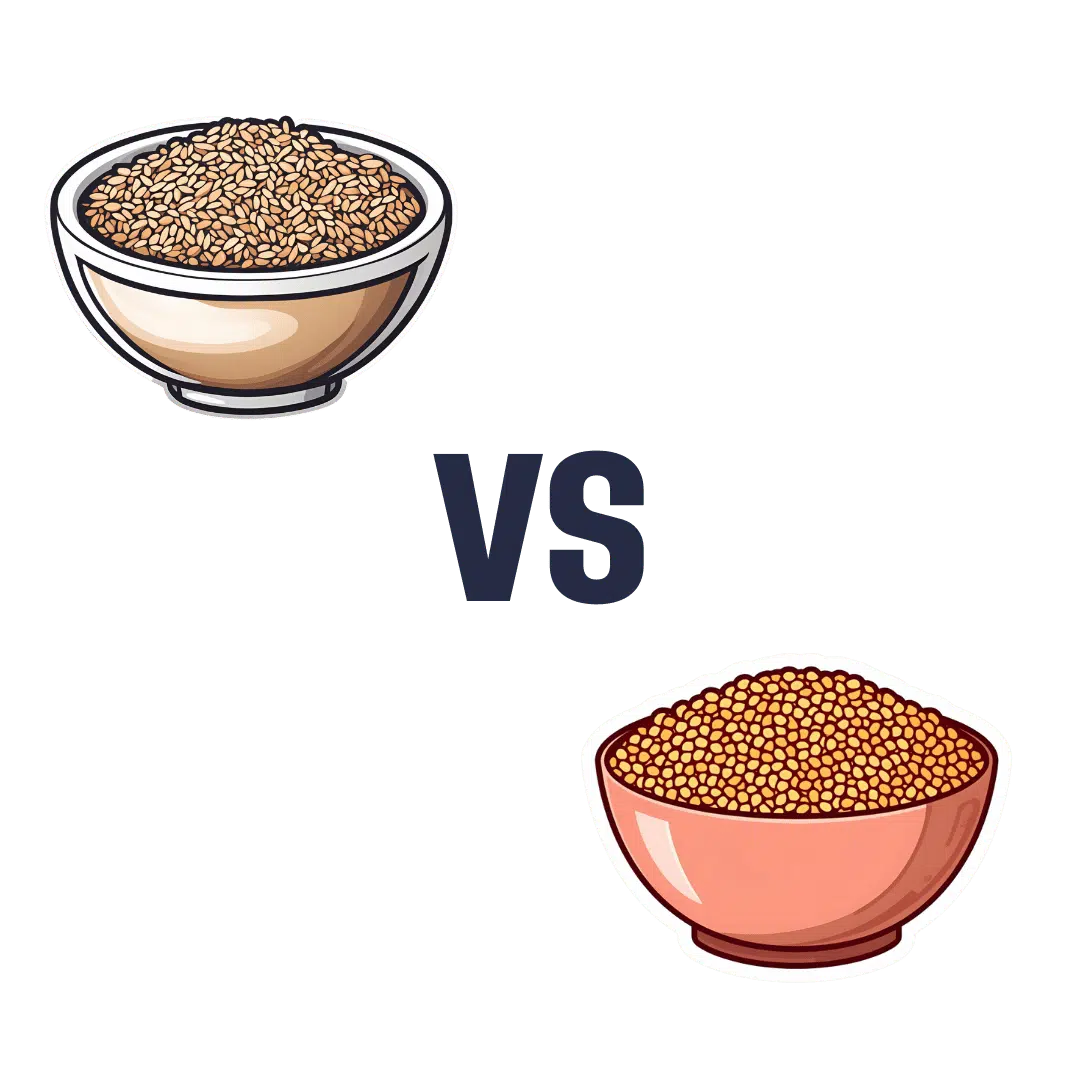
Brown Rice vs Millet – Which is Healthier?

10almonds is reader-supported. We may, at no cost to you, receive a portion of sales if you purchase a product through a link in this article.

Our Verdict

When comparing brown rice to millet, we picked the rice.

Why?

In terms of macros, the brown rice has slightly more fiber and carbs, while the millet has slightly more protein. While many may favor the protein, we say the fiber is the most important. That said, the numbers are very close, so it could be fair to call this first round a tie.

In the category of vitamins, brown rice has more of vitmains B1, B3, B5, B6, B7, and E, while millet has more of vitamins B2, B9, and K, yielding a 6:3 win to the rice.

Looking at minerals, the rice has more manganese, potassium, and selenium, while the millet has more copper and zinc, giving a marginal win to brown rice in this round.

Adding up the sections makes for a clear overall win for brown rice, but by all means do enjoy either or both, as diversity is great!

Want to learn more?

You might like:

Grains: Bread Of Life, Or Cereal Killer?

Enjoy!

Don’t Forget…

Did you arrive here from our newsletter? Don’t forget to return to the email to continue learning!

Learn to Age Gracefully

Join the 98k+ American women taking control of their health & aging with our 100% free (and fun!) daily emails:

  • Why We Get Fat: And What to Do About It – by Gary Taubes

    10almonds is reader-supported. We may, at no cost to you, receive a portion of sales if you purchase a product through a link in this article.

    We’ve previously reviewed Taubes’ “The Case Against Sugar“. What does this one bring differently?

    Mostly, it’s a different focus. Unsurprisingly, Taubes’ underlying argument is the same: sugar is the biggest dietary health hazard we face. However, this book looks at it specifically through the lens of weight loss, or avoiding weight gain.

    Taubes argues for low-carb in general; he doesn’t frame it specifically as the ketogenic diet here, but that is what he is advocating. However, he also acknowledges that not all carbs are created equal, and looks at several categories that are relatively better or worse for our insulin response, and thus, fat management.

    If the book has a fault it’s that it does argue a bit too much for eating large quantities of meat, based on Weston Price’s outdated and poorly-conducted research. However, if one chooses to disregard that, the arguments for a low-carb diet for weight management remain strong.

    Bottom line: if you’d like to cut some fat without eating less (or exercising more), this book offers a good, well-explained guide for doing so.

    Click here to check out Why We Get Fat, and manage yours!

    Share This Post

  • How Internal Organs Can Be Affected By Spicy Foods (Doctor Explains)

    10almonds is reader-supported. We may, at no cost to you, receive a portion of sales if you purchase a product through a link in this article.

    Capsaicin has an array of health-giving properties in moderation, but consumed in immoderation and/or without building up tolerance first, can cause problems—serious health issues such as heart attacks, brain spasms, torn esophagus, and even death can occur.

    Heating up

    Capsaicin, the compound that gives peppers their “heat”, is a chemical irritant and neurotoxin that activates pain receptors (TRPV1) tricking the brain into sensing heat, leading to a burning sensation, sweating, and flushing. The pain signal can also trigger the fight-or-flight response, causing a surge of adrenaline. Endorphins are eventually released, creating a pain-relief effect similar to a runner’s high, and ultimately it reduces systemic inflammation, boosts the metabolism, and increases healthy longevity.

    However, in cases of extreme consumption and/or lack of preparation, woe can befall, for example:

    • A man ruptured his esophagus after vomiting from eating a ghost pepper.
    • A participant experienced severe brain blood vessel constriction (reversible cerebral vasoconstriction syndrome) after eating a Carolina reaper.
    • A 25-year-old suffered permanent heart damage from cayenne pepper pills due to restricted blood flow.
    • A teenager died after the “one chip challenge,” although the cause of death was undetermined.

    So, what does moderation and preparation look like?

    Moderation can be different to different people, since genetics do play a part—some people have more TRPV1 receptors than other people. However, for all people (unless in case of having an allergy or similar), acclimatization is important, and a much bigger factor than genetics. 

    Writer’s anecdote: on the other hand, when my son was a toddler I once left the room and came back to find him cheerfully drinking hot sauce straight from the bottle, so it can be suspected that genetics are definitely relevant too, as while I did season his food and he did already enjoy curries and such, he didn’t exactly have a background of entering chili-eating competitions.

    Still, regardless of genes (unless you actually have a medical condition that disallows this), a person who regularly eats spicy food will develop an increasing tolerance for spicy food, and will get to enjoy the benefits without the risks, provided they don’t suddenly jump way past their point of tolerance.

    On which note, in this video you can also see what happens when Dr. Deshauer goes from biting a jalapeño (relatively low on the Scoville heat scale) to biting a Scotch bonnet pepper (about 10x higher on the Scoville heat scale):

    Click Here If The Embedded Video Doesn’t Load Automatically!

    Want to learn more?

    You might also like to read:

    Capsaicin For Weight Loss And Against Inflammation

    Take care!

    Share This Post

  • Early Bird Or Night Owl? Genes vs Environment

    10almonds is reader-supported. We may, at no cost to you, receive a portion of sales if you purchase a product through a link in this article.

    A Sliding Slope?

    In Tuesday’s newsletter, we asked you how much control you believe we have over our sleep schedule, and got the above-depicted, below-described, set of responses:

    • 45% said “most people can control it; some people with sleep disorders cannot
    • 35% said “our genes predispose us to early/late, but we can slide it a bit
    • 15% said: “going against our hardwired sleep schedules is a road to ruin”
    • 5% said “anyone can adjust their sleep schedule with enough willpower”

    You may be wondering: what’s with those single-digit numbers in the graph there? And the answer is: Tuesday’s email didn’t go out at the usual time due to a scheduling mistake (sorry!), which is probably what affected the number of responses (poll response levels vary, but are usually a lot higher than this).

    Note: yes, this does mean most people who read our newsletter don’t vote. So, not to sound like a politician on the campaign trail, but… Your vote counts! We always love reading your comments when you add those, too—often they provide context that allow us to tailor what we focus on in our articles

    However, those are the responses we got, so here we are!

    What does the science say?

    Anyone can adjust their sleep with enough willpower: True or False?

    False, simply. It’s difficult for most people, but for many people with sleep disorders, it is outright impossible.

    In a battle of narcolepsy vs willpower, for example, no amount of willpower will stop the brain from switching to sleep mode when it thinks it’s time to sleep:

    ❝Narcolepsy is the most common neurological cause of chronic sleepiness. The discovery about 20 years ago that narcolepsy is caused by selective loss of the neurons producing orexins sparked great advances in the field

    [There is also] developing evidence that narcolepsy is an autoimmune disorder that may be caused by a T cell-mediated attack on the orexin neurons and explain how these new perspectives can inform better therapeutic approaches.❞

    ~ Dr. Carrie Mahoney et al. (lightly edited for brevity)

    Source: The neurobiological basis of narcolepsy

    For further reading, especially if this applies to you or a loved one:

    Living with Narcolepsy: Current Management Strategies, Future Prospects, and Overlooked Real-Life Concerns

    Our genes predispose us to early/late, but we can slide it a bit: True or False?

    True! First, about our genes predisposing us:

    Genome-wide association analysis of 89,283 individuals identifies genetic variants associated with self-reporting of being a morning person

    …and also:

    Gene distinguishes early birds from night owls and helps predict time of death

    Now, as for the “can slide it a bit”, this is really just a function of the general categories of “early bird” and “night owl” spanning periods of time that allow for a few hours’ wiggle-room at either side.

    However, it is recommended to make any actual changes more gradually, with the Sleep Foundation going so far as to recommend 30 minutes, or even just 15 minutes, of change per day:

    Sleep Foundation | How to Fix Your Sleep Schedule

    Going against our hardwired sleep schedule is a road to ruin: True or False?

    False, contextually. By this we mean: our “hardwired” sleep schedule is (for most of us), genetically predisposed but not predetermined.

    Also, genetic predispositions are not necessarily always good for us; one would not argue, for example, for avoiding going against a genetic predisposition to addiction.

    Some genetic predispositions are just plain bad for us, and genes can be a bit of a lottery.

    That said, we do recommend getting some insider knowledge (literally), by getting personal genomics tests done, if that’s a viable option for you, so you know what’s really a genetic trait (and what to do with that information) and what’s probably caused by something else (and what to do with that information):

    Genetic Testing: Health Benefits & Methods

    Take care!

    Share This Post

  • You can thaw and refreeze meat: five food safety myths busted

    10almonds is reader-supported. We may, at no cost to you, receive a portion of sales if you purchase a product through a link in this article.

    This time of year, most fridges are stocked up with food and drinks to share with family and friends. Let’s not make ourselves and our guests sick by getting things wrong when preparing and serving food.

    As the weather warms up, so does the environment for micro-organisms in foods, potentially allowing them to multiply faster to hazardous levels. So put the drinks on ice and keep the fridge for the food.

    But what are some of those food safety myths we’ve long come to believe that aren’t actually true?

    Myth 1: if you’ve defrosted frozen meat or chicken you can’t refreeze it

    From a safety point of view, it is fine to refreeze defrosted meat or chicken or any frozen food as long as it was defrosted in a fridge running at 5°C or below. Some quality may be lost by defrosting then refreezing foods as the cells break down a little and the food can become slightly watery.

    Another option is to cook the defrosted food and then divide into small portions and refreeze once it has stopped steaming. Steam in a closed container leads to condensation, which can result in pools of water forming. This, combined with the nutrients in the food, creates the perfect environment for microbial growth. So it’s always best to wait about 30 minutes before refrigerating or freezing hot food.

    Plan ahead so food can be defrosted in the fridge, especially with large items such as a frozen turkey or roll of meat. If left on the bench, the external surface could be at room temperature and micro-organisms could be growing rapidly while the centre of the piece is still frozen!

    Myth 2: Wash meat before you prepare and/or cook it

    It is not a good idea to wash meats and poultry when preparing for cooking. Splashing water that might contain potentially hazardous bacteria around the kitchen can create more of a hazard if those bacteria are splashed onto ready-to-eat foods or food preparation surfaces.

    It is, however, a good idea to wash fruits and vegetables before preparing and serving, especially if they’re grown near or in the ground as they may carry some dirt and therefore micro-organisms.

    This applies particularly to foods that will be prepared and eaten without further cooking. Consuming foods raw that traditionally have been eaten cooked or otherwise processed to kill pathogenic micro-organisms (potentially deadly to humans) might increase the risk of food poisoning.

    Fruit, salad, vegetables and other ready-to-eat foods should be prepared separately, away from raw meat, chicken, seafood and other foods that need cooking.

    Myth 3: Hot food should be left out to cool completely before putting it in the fridge

    It’s not OK to leave perishable food out for an extended time or overnight before putting it in the fridge.

    Micro-organisms can grow rapidly in food at temperatures between 5° and 60°C. Temperature control is the simplest and most effective way of controlling the growth of bacteria. Perishable food should spend as little time as possible in the 5-60°C danger zone. If food is left in the danger zone, be aware it is potentially unsafe to eat.

    Hot leftovers, and any other leftovers for that matter, should go into the fridge once they have stopped steaming to reduce condensation, within about 30 minutes.

    Large portions of hot food will cool faster if broken down into smaller amounts in shallow containers. It is possible that hot food such as stews or soup left in a bulky container, say a two-litre mixing bowl (versus a shallow tray), in the fridge can take nearly 24 hours to cool to the safe zone of less than 5°C.

    Myth 4: If it smells OK, then it’s OK to eat

    This is definitely not always true. Spoilage bacteria, yeasts and moulds are the usual culprits for making food smell off or go slimy and these may not make you sick, although it is always advisable not to consume spoiled food.

    Pathogenic bacteria can grow in food and not cause any obvious changes to the food, so the best option is to inhibit pathogen growth by refrigerating foods.

    Myth 5: Oil preserves food so it can be left at room temperature

    Adding oil to foods will not necessarily kill bugs lurking in your food. The opposite is true for many products in oil if anaerobic micro-organisms, such as Clostridium botulinum (botulism), are present in the food. A lack of oxygen provides perfect conditions for their growth.

    Outbreaks of botulism arising from consumption of vegetables in oil – including garlic, olives, mushrooms, beans and hot peppers – have mostly been attributed to the products not being properly prepared.

    Vegetables in oil can be made safely. In 1991, Australian regulations stipulated that this class of product (vegetables in oil) can be safely made if the pH (a measure of acid) is less than 4.6. Foods with a pH below 4.6 do not in general support the growth of food-poisoning bacteria including botulism.

    So keep food out of the danger zone to reduce your guests’ risk of getting food poisoning this summer. Check out other food safety tips and resources from CSIRO and the Food Safety Information Council, including testing your food safety knowledge.

    Cathy Moir, Team leader, Microbial and chemical sciences, Food microbiologist and food safety specialist, CSIRO

    This article is republished from The Conversation under a Creative Commons license. Read the original article.

    The Conversation

    Don’t Forget…

    Did you arrive here from our newsletter? Don’t forget to return to the email to continue learning!

    Learn to Age Gracefully

    Join the 98k+ American women taking control of their health & aging with our 100% free (and fun!) daily emails:

  • Whole – by Dr. T. Colin Campbell

    10almonds is reader-supported. We may, at no cost to you, receive a portion of sales if you purchase a product through a link in this article.

    Most of us have at least a broad idea of what we’re supposed to be eating, what nutrients we should be getting. Many of us look at labels, and try to get our daily dose of this and that and the other.

    And what we don’t get from food? There are supplements.

    Dr. Campbell thinks we can do better:

    Perhaps most critical in this book, where it stands out from others (we may already know, for example, that we should try to eat diverse plants and whole foods) is its treatment of why many supplements aren’t helpful.

    We tend to hear “supplements are a waste of money” and sometimes they are, sometimes they aren’t. How to know the difference?

    Key: things directly made from whole food sources will tend to be better. Seems reasonable, but… why? The answer lies in what else those foods contain. An apple may contain a small amount of vitamin C, less than a vitamin C tablet, but also contains a whole host of other things—tiny phytonutrients, whose machinations are mostly still mysteries to us—that go with that vitamin C and help it work much better. Lab-made supplements won’t have those.

    There’s a lot more to the book… A chunk of which is a damning critique of the US healthcare system (the author argues it would be better named a sicknesscare system). We also learn about getting a good balance of macro- and micronutrients from our diet rather than having to supplement so much.

    The style is conversational, while not skimping on the science. The author has had more than 150 papers published in peer-reviewed journals, and is no stranger to the relevant academia. Here, however, he focuses on making things easily comprehensible to the lay reader.

    In short: if you’ve ever wondered how you’re doing at getting a good nutritional profile, and how you could do better, this is definitely the book for you.

    Click here to check out “Whole” on Amazon today, and level up your daily diet!

    Don’t Forget…

    Did you arrive here from our newsletter? Don’t forget to return to the email to continue learning!

    Learn to Age Gracefully

    Join the 98k+ American women taking control of their health & aging with our 100% free (and fun!) daily emails:

  • Demystifying Peptides

    10almonds is reader-supported. We may, at no cost to you, receive a portion of sales if you purchase a product through a link in this article.

    It’s Q&A Day at 10almonds!

    Have a question or a request? We love to hear from you!

    In cases where we’ve already covered something, we might link to what we wrote before, but will always be happy to revisit any of our topics again in the future too—there’s always more to say!

    As ever: if the question/request can be answered briefly, we’ll do it here in our Q&A Thursday edition. If not, we’ll make a main feature of it shortly afterwards!

    So, no question/request too big or small 😎

    ❝Would love some in depth look at peptides. Benefits, side effects of several of the popular ones❞

    Great question! It’s a huge topic that can easily be confusing, but not if we break it down a bit.

    Which, as you’ll see, is what peptides are all about:

    Breaking it down

    In a nutshell: peptides are short chains of amino acids—smaller than proteins—that do a variety of things for us, perhaps most noteably including:

    1. act as chemical messengers within the body*
    2. act as the building blocks of larger proteins (the general stuff that most of our body is made of)**

    *If that first one sounds familiar and you’re thinking “you mean hormones?”, then you’re on the right track, and indeed there’s an overlap, because there are such things as peptide hormones, for example:

    ❝Peptide hormones play a prominent role in controlling energy homeostasis and metabolism. They have been implicated in controlling appetite, the function of the gastrointestinal and cardiovascular systems, energy expenditure, and reproduction. Furthermore, there is growing evidence indicating that peptide hormones and their receptors contribute to energy homeostasis regulation by interacting with white and brown adipose tissue.❞

    Read in full: The Role of Peptide Hormones Discovered in the 21st Century in the Regulation of Adipose Tissue Functions

    And about that brown adipose tissue (BAT), this is very important to understand: The BAT-pause! When Cold Weather & The Menopause Battle It Out

    **As for these building blocks, then here there are two important things to know about:

    • Why You Can’t Skimp On Amino Acids ← when it comes to essential amino acids, the ill effects of deficiency can range from “muscle atrophy” to “brain stops working” and “bones fall apart” and more. In short, any essential amino acid deficiency not remedied will ultimately result in death; we literally become non-viable as organisms without these 9 things.
    • We Are Such Stuff As Fish Are Made Of ← this is about collagen, which brings us to collagen peptides next.

    A common question about collagen is whether the molecules can actually be absorbed. And the answer is, broadly speaking “not without being broken down first”.

    This is because collagen molecules are absolutely huge (as molecules go) and cannot be absorbed by the skin. Not only that, but the epidermis (the outer part of your skin) is not where collagen synthesis happens, so this is a bit like trying to fix a structural problem in your house by flinging mud at it from the outside. The mud may have the same minerals that are needed, but it’s just going to sit on the outside of your house until it gets washed off.

    Collagen molecules are also too large to be absorbed by the gut, too. So, for both cases, collagen peptides are the answer. This is what is meant when a product says “hydrolysed collagen” or “collagen peptides” or perhaps “hydrolysed collagen peptides” to cover all bases, but really that is a redundant tautology repeated more than once unnecessarily—it refers to the same thing: collagen that has been broken down into bits (peptides) for ease of absorption.

    You can read about this in full, here: Are Collagen Molecules Too Big To Be Absorbed?

    You also asked for several of the popular ones, so in terms of benefits (and how backed those benefits are by scientific evidence), and side effects:

    • Collagen peptides: support skin elasticity and joint health; evidence moderate but growing, and to our eyes, it looks promising.
    • Creatine or BPC-157: tissue repair and inflammation control; most data from non-human animals, limited clinical trials, astonishingly.
    • Melanotan II: stimulates tanning; can cause nausea, blood-pressure spikes, and pigment changes. Generally a terrible idea, and we certainly do not recommend it.
    • GLP-1 mimetics (e.g., semaglutide): originally for diabetes, now known for weight loss; strong clinical evidence but really does need medical supervision, and has a long list of potential (and even, probable) side effects
    • Thymosin beta-4 and GHK-Cu: wound healing and hair growth claims; evidence early-stage or cosmetic only.
      • We haven’t done a main feature yet, in part for that precise reason—the paucity of evidence. But, we’ll see what we can find, so watch this space for a main feature coming soon!

    There are also other kinds of peptides relevant for health (and beauty, which is after all in large part a factor of health) too, including:

    • Carrier peptides: deliver metals like copper or manganese to aid repair.
    • Enzyme-inhibiting peptides: slow down collagen/elastin breakdown (e.g. tripeptide-1).
    • Neurotransmitter-inhibiting peptides: reduce muscle activity to soften expression lines (e.g. argireline/acetyl hexapeptide-8).
    • Specialty peptides: target brightening (e.g. hexapeptide-2) or barrier repair.

    However, not all of them actually have a lot of evidence for helping. When it comes to skincare specifically, one of the dermatologists we feature sometimes recommends these ones as being “worth the hype”:

    • Signal peptides like matrixyl: tried-and-true for firmness and plumpness.
    • Copper peptides: aid repair and overall skin health.
    • Argireline: softer alternative to Botox for fine lines.
    • Hexapeptide-2: gentle brightening when paired with vitamin C.

    You can learn about why, here: Not All Peptides Are Equal (So, Which Are Worth the Hype?)

    Do be aware also that with almost any of these there are other potential (but much less common) risks, including allergic reactions, hormonal disruption, infection from injections, and unknown long-term effects for most things that haven’t been studied nearly enough yet.

    If in doubt, speak with a dermatologist (or, if it’s not about skincare, speak with a relevant professional who can give you advice tailored to you), and know that it’s always better to err on the side of caution.

    Want to learn more?

    Check out:

    What Really Works For Anti-Aging? Science-Backed Skincare Ingredients

    Enjoy!

    Don’t Forget…

    Did you arrive here from our newsletter? Don’t forget to return to the email to continue learning!

    Learn to Age Gracefully

    Join the 98k+ American women taking control of their health & aging with our 100% free (and fun!) daily emails: