
What’s the difference between a heart attack and cardiac arrest? One’s about plumbing, the other wiring

10almonds is reader-supported. We may, at no cost to you, receive a portion of sales if you purchase a product through a link in this article.

In July 2023, rising US basketball star Bronny James collapsed on the court during practice and was sent to hospital. The 18-year-old athlete, son of famous LA Lakers’ veteran LeBron James, had experienced a cardiac arrest.

Many media outlets incorrectly referred to the event as a “heart attack” or used the terms interchangeably.

A cardiac arrest and a heart attack are distinct yet overlapping concepts associated with the heart.

With some background in how the heart works, we can see how they differ and how they’re related.
Explode/Shutterstock

Understanding the heart

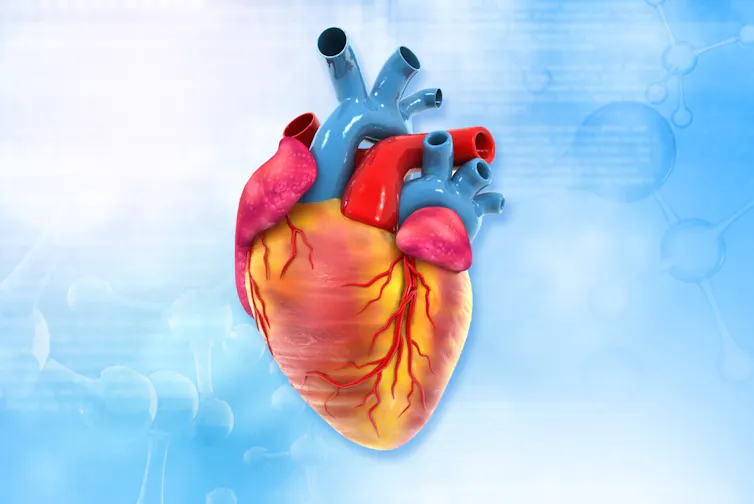
The heart is a muscle that contracts to work as a pump. When it contracts it pushes blood – containing oxygen and nutrients – to all the tissues of our body.

For the heart muscle to work effectively as a pump, it needs to be fed its own blood supply, delivered by the coronary arteries. If these arteries are blocked, the heart muscle doesn’t get the blood it needs.

This can cause the heart muscle to become injured or die, and results in the heart not pumping properly.

Heart attack or cardiac arrest?

Simply put, a heart attack, technically known as a myocardial infarction, describes injury to, or death of, the heart muscle.

A cardiac arrest, sometimes called a sudden cardiac arrest, is when the heart stops beating, or put another way, stops working as an effective pump.

In other words, both relate to the heart not working as it should, but for different reasons. As we’ll see later, one can lead to the other.

Why do they happen? Who’s at risk?

Heart attacks typically result from blockages in the coronary arteries. Sometimes this is called coronary artery disease, but in Australia, we tend to refer to it as ischaemic heart disease.

The underlying cause in about 75% of people is a process called atherosclerosis. This is where fatty and fibrous tissue build up in the walls of the coronary arteries, forming a plaque. The plaque can block the blood vessel or, in some instances, lead to the formation of a blood clot.

Atherosclerosis is a long-term, stealthy process, with a number of risk factors that can sneak up on anyone. High blood pressure, high cholesterol, diet, diabetes, stress, and your genes have all been implicated in this plaque-building process.

Other causes of heart attacks include spasms of the coronary arteries (causing them to constrict), chest trauma, or anything else that reduces blood flow to the heart muscle.

Regardless of the cause, blocking or reducing the flow of blood through these pipes can result in the heart muscle not receiving enough oxygen and nutrients. So cells in the heart muscle can be injured or die.
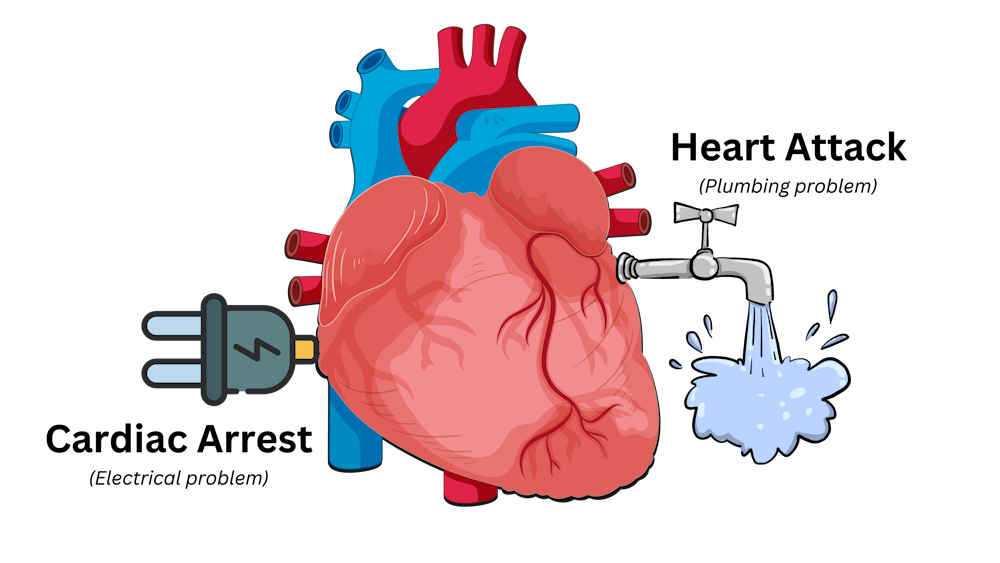
Heart attack vs cardiac arrest
Here’s a simple way to remember the difference. Author provided

But a cardiac arrest is the result of heartbeat irregularities, making it harder for the heart to pump blood effectively around the body. These heartbeat irregularities are generally due to electrical malfunctions in the heart. There are four distinct types:

  • ventricular tachycardia: a rapid and abnormal heart rhythm in which the heartbeat is more than 100 beats per minute (normal adult, resting heart rate is generally 60-90 beats per minute). This fast heart rate prevents the heart from filling with blood and thus pumping adequately
  • ventricular fibrillation: instead of regular beats, the heart quivers or “fibrillates”, resembling a bag of worms, resulting in an irregular heartbeat greater than 300 beats per minute
  • pulseless electrical activity: arises when the heart muscle fails to generate sufficient pumping force after electrical stimulation, resulting in no pulse
  • asystole: the classic flat-line heart rhythm you see in movies, indicating no electrical activity in the heart.
Aystole heart rhythm showing no electrical activity
Remember this flat-line rhythm from the movies? It’s asystole, when there’s no electrical activity in the heart. Kateryna Kon/Shutterstock

Cardiac arrest can arise from numerous underlying conditions, both heart-related and not, such as drowning, trauma, asphyxia, electrical shock and drug overdose. James’ cardiac arrest was attributed to a congenital heart defect, a heart condition he was born with.

But among the many causes of a cardiac arrest, ischaemic heart disease, such as a heart attack, stands out as the most common cause, accounting for 70% of all cases.

So how can a heart attack cause a cardiac arrest? You’ll remember that during a heart attack, heart muscle can be damaged or parts of it may die. This damaged or dead tissue can disrupt the heart’s ability to conduct electrical signals, increasing the risk of developing arrhythmias, possibly causing a cardiac arrest.

So while a heart attack is a common cause of cardiac arrest, a cardiac arrest generally does not cause a heart attack.

What do they look like?

Because a cardiac arrest results in the sudden loss of effective heart pumping, the most common signs and symptoms are a sudden loss of consciousness, absence of pulse or heartbeat, stopping of breathing, and pale or blue-tinged skin.

But the common signs and symptoms of a heart attack include chest pain or discomfort, which can show up in other regions of the body such as the arms, back, neck, jaw, or stomach. Also frequent are shortness of breath, nausea, light-headedness, looking pale, and sweating.

What’s the take-home message?

While both heart attack and cardiac arrest are disorders related to the heart, they differ in their mechanisms and outcomes.

A heart attack is like a blockage in the plumbing supplying water to a house. But a cardiac arrest is like an electrical malfunction in the house’s wiring.

Despite their different nature both conditions can have severe consequences and require immediate medical attention.

Michael Todorovic, Associate Professor of Medicine, Bond University and Matthew Barton, Senior lecturer, School of Nursing and Midwifery, Griffith University

This article is republished from The Conversation under a Creative Commons license. Read the original article.

Don’t Forget…

Did you arrive here from our newsletter? Don’t forget to return to the email to continue learning!

Learn to Age Gracefully

Join the 98k+ American women taking control of their health & aging with our 100% free (and fun!) daily emails:

  • A New, Smarter Wearable That Fights Joint Pain

    10almonds is reader-supported. We may, at no cost to you, receive a portion of sales if you purchase a product through a link in this article.

    …and other items from this week’s health news:

    The Wearable “Goldilocks” Heater

    If you’ve ever used a heating pad to combat joint pain, chances are you ran into two problems:

    1. Getting it to be and remain where it needs to be
    2. Getting it to a therapeutic temperature without the heat then building up to the point that it needs to be switched off after a short while

    Scientists (and engineers) have now tackled this:

    ❝Our goal was to make thermal therapy truly wearable—not just portable, but adaptive and intuitive. By integrating precise sensors and closed-loop control into a stretchable format, we’re giving patients the ability to receive therapy in real time, tailored to their specific environment and condition.

    This technology reflects the future of personalized medicine, where treatment moves with the body and responds as needed. It’s not just engineering—it’s empathy through innovation.❞

    This flexibility and adaptiveness was found to be durable throughout testing (including more than 1,000 use cycles), and even remained accurate during exercise:

    Read in full: Flexible smart heater delivers real-time thermal therapy for joint pain

    Related: 10 Tips To Reduce Morning Pain & Stiffness With Arthritis

    How Likely is not recovering from covid now?

    After the initial lockdowns in what is now the increasingly dim and distant past, numbers were crunched, and it was decided that it was best to lift anti-COVID measures, and that hopefully the deaths would be mostly confined to minorities such as the very young, the old, the chronically ill, the disabled, and so forth.

    Which may have a bit of a Lord Farquaad “Some of you may die, but it’s a sacrifice I am willing to make” feel to it (if you know the meme), but it’s certainly become “the new normal”. Of course, the reports on incidence rates (and thus, mortality rates) have gone down a lot since testing was discontinued, so it’s difficult to know certain parts of the statistical background to COVID in the US in 2025.

    What we can know, however, is that of those that are recorded, and who survive initial infection (which, one bit of good news, does at least seem to be most people nowadays), there is approximately a 20% chance of not recovering fully within a year. That doesn’t mean “it’ll take a year to recover”, by the way, that means “it was 12-month study” so what happens to those people in the future after those 12 months is not yet known.

    However, it seems fair to say that even at the very best if it’s been a year and you haven’t recovered, it’s not exactly “just a cold”.

    Read in full: One in five never fully recover quality of life after COVID-like illness

    Related: Why Some People Get Sick More (And How To Not Be One Of Them)

    It’s time for diabetes prevention

    Intermittent fasting is a common tool used with the intention of improving metabolic health, and there has been much discussion about how much it matters what time of day (in the context of the rest of our circadian rhythm) we eat.

    To this end, researchers investigated how the timing of lifestyle habits (eating, sleeping, moving) affects metabolic health and risk for type 2 diabetes, using wearable tech and real-time tracking. They found:

    About meal timing:

    • Eating more between 14:00–17:00 was linked to lower fasting glucose.
    • Eating more between 17:00–21:00 was linked to higher glucose, more time in hyperglycemia, and worse next-day glucose levels.

    About the meals:

    • Carbs from non-starchy vegetables were linked to better glucose control.
    • Carbs from starchy vegetables were linked to higher fasting glucose and HbA1c.

    About sleep:

    • Greater variability in sleep efficiency led to higher night and next-day glucose.
    • Irregular wake times were linked to worse glucose tolerance and lower incretin effects.

    About links between diet and sleep:

    • More legumes, fruit, potassium, and fiber = better and longer sleep.
    • Early energy intake (especially 8:00–11:00) correlated with longer sleep duration.

    About physical activity:

    • More steps between 8:00–11:00 improved glucose control in insulin-resistant individuals.
    • More steps between 14:00–17:00 improved glucose control in insulin-sensitive individuals.
    • More steps after dinner but before midnight reduced nocturnal hyperglycemia.
    • Nocturnal activity (00:00–5:00) worsened glucose regulation for all.

    Also, longer sedentary periods at any time were linked to greater hyperglycemia.

    Read in full: Meal and sleep timing play key roles in diabetes prevention

    Related: The Circadian Rhythm: Far More Than Most People Know ← our expert insights feature on Dr. Satchin Panda, author of The Circadian Diabetes Code

    Take care!

    Share This Post

  • The Medicinal Chef – by Dale Pinnock

    10almonds is reader-supported. We may, at no cost to you, receive a portion of sales if you purchase a product through a link in this article.

    The philosophy here is very much like our own—to borrow from Hippocrates: “let food be thy medicine”. Obviously please do also let medicine be thy medicine if you need it, but the point is that food is a very good starting place for combatting a lot of disease.

    To this end, instead of labelling the recipes with such things as “V”, “Ve”, “GF” and suchlike, it assumes we can tell those things from the ingredients lists, and instead labels things per what they are especially good for:

    • S: skin
    • J: joints & bones
    • R: respiratory system
    • I: immune system
    • M: metabolic health
    • N: nervous system and mental health
    • H: heart and circulation
    • D: digestive system
    • U: reproductive & urinary systems

    As for the recipes themselves… They’re a lot like the recipes we share here at 10almonds in their healthiness, skill level, and balance of easy-to-find ingredients with the occasional “order it online” items that punch above their weight. In fact, we’ll probably modify some of the recipes for sharing here.

    Bottom line: if you’re looking for genuinely healthy recipes that are neither too basic nor too arcane, this book has about 80 of them.

    Click here to check out The Medicinal Chef: Healthy Every Day, and be healthy every day!

    Share This Post

  • Knees Hurt? This Exercise Takes Pressure Off (Even “Bone-On-Bone”)

    10almonds is reader-supported. We may, at no cost to you, receive a portion of sales if you purchase a product through a link in this article.

    Dr. Alyssa Kuhn, arthritis expert, shows us how:

    Gently does it

    The main exercise to do is a simple supported backward step: hold a kitchen counter for support, step one leg backwards at a time, touch your toes first, then lower your heel, keep your chest up, avoid leaning forwards, and you can even use a smaller step or double-handed support if you need to, to start with.

    The reason this works is because backward stepping strengthens your glutes and hamstrings, supports your knees differently than forward movement, and can reduce irritation from repetitive forward walking.

    Once you’ve got that down, you can progress it by putting a resistance band around your mid-shin, repeat backward stepping while maintaining posture, press your leg backwards against resistance, and actively squeeze your glutes. Do start with a lighter band, increase thickness only as comfort and control improve.

    You can then also move to walking backwards along a counter or hallway (so you know you’re not going to walk into anything), stepping toe first then heel, and keeping your chest upright.

    For more on all of this plus visual demonstrations, enjoy:

    Click Here If The Embedded Video Doesn’t Load Automatically!

    Want to learn more?

    You might also like:

    Walking: Have We Had It Backwards?

    Take care!

    Share This Post

  • Guava vs Pomegranate – Which is Healthier?

    10almonds is reader-supported. We may, at no cost to you, receive a portion of sales if you purchase a product through a link in this article.

    Our Verdict

    When comparing guava to pomegranate, we picked the guava.

    Why?

    In terms of macros, the guava has more fiber and protein, while the pomegranate has more carbs; an easy first-round win for guava.

    In the category of vitamins, guava has more of vitamins A, B3, B5, B6, B7 B9, C, and E, while pomegranate has more of vitamins B2 and K, yielding an 8:2 win for guava, especially considering that it’s more than 20x the amount of vitamin C.

    Looking at minerals, guava has more calcium, copper, magnesium, manganese, phosphorus, potassium, and selenium, while pomegranate has more iron and zinc. Another win for guava, this time 7:2.

    In other considerations, pomegranate has some interesting extra phytochemical benefits, but they’re mostly in the peel. So, don’t through that away! Use it to make a tea (herbal infusion style) or dry it, and turn it into a powdered supplement—see the “learn more” section below for details on why.

    Adding up the sections makes for a clear overall win for guava, but by all means do enjoy either or both, as diversity is best!

    Want to learn more?

    You might like:

    Pomegranate’s Health Gifts Are Mostly In Its Peel

    Enjoy!

    Don’t Forget…

    Did you arrive here from our newsletter? Don’t forget to return to the email to continue learning!

    Learn to Age Gracefully

    Join the 98k+ American women taking control of their health & aging with our 100% free (and fun!) daily emails:

  • Pajama Pilates – by Maria Mankin

    10almonds is reader-supported. We may, at no cost to you, receive a portion of sales if you purchase a product through a link in this article.

    If The Science Of Pilates was a bit more information than you wanted to get up and running with Pilates at home, then this book offers a much easier way in.

    As the name suggests, it’s all about convenience, and making things as easy as possible while enjoying the gradual cumulative gains that come when one practises even just a little every day instead of thinking “well I would, but I have to read all this technical stuff and get changed and clear a space and…”, and thus results in meaningful improvements to mobility and strength over time.

    The 40 exercises promised by the subtitle are demonstrate via cute illustrations, of which the cover art is a good representative example. There’s nothing unduly technical here, and yet everything is quite clear. There are also simple practical explanations for each, as well as an initial overview of Pilates as a whole, its principles and necessary knowledge and so forth.

    Bottom line: if you’d like to get into Pilates but it has seemed sufficiently taxing that you’ve never quite got started, or if you did then it didn’t stick, then this book can make things easier.

    Click here to check out Pajama Pilates, and get ready to pajama Pilates party!

    Don’t Forget…

    Did you arrive here from our newsletter? Don’t forget to return to the email to continue learning!

    Learn to Age Gracefully

    Join the 98k+ American women taking control of their health & aging with our 100% free (and fun!) daily emails:

  • Cabbage vs Onion – Which is Healthier?

    10almonds is reader-supported. We may, at no cost to you, receive a portion of sales if you purchase a product through a link in this article.

    Our Verdict

    When comparing cabbage to onion, we picked the cabbage.

    Why?

    In terms of macros, cabbage has more fiber while onion has more carbs, making cabbage the winner in this category as most people need more fiber, and especially a better fiber-to-carbs ratio.

    In the category of vitamins, cabbage has more of vitamins A, B1, B2, B3, B5, B6, B7, B9, C, E, and K, while onions are not higher in any vitamins, giving cabbage a complete win in this round.

    Looking at minerals, cabbage has more calcium, iron, magnesium, manganese, potassium, and zinc, while onions have more copper, phosphorus, and selenium, meaning cabbage enjoys a 6:3 win here.

    In other considerations, polyphenols will vary a lot for these, but both are strong contenders in this regard and we say it averages out to a tie in this round.

    Adding up the sections makes for a clear overall win for cabbage, but by all means enjoy either or both, as diversity is good!

    Want to learn more?

    You might like:

    Enjoy Bitter Foods For Your Heart & Brain

    Enjoy!

    Don’t Forget…

    Did you arrive here from our newsletter? Don’t forget to return to the email to continue learning!

    Learn to Age Gracefully

    Join the 98k+ American women taking control of their health & aging with our 100% free (and fun!) daily emails: