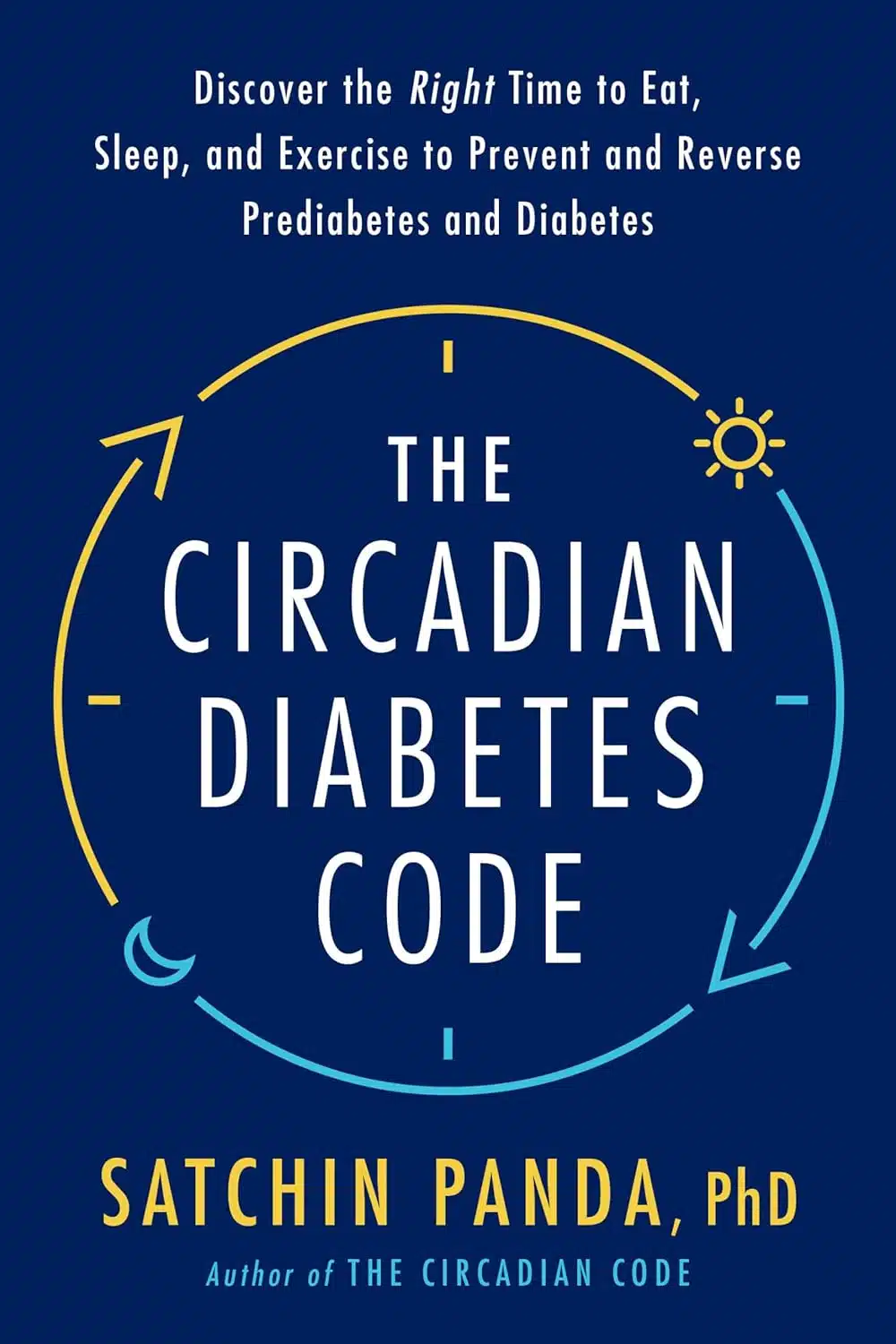
The Circadian Diabetes Code – by Dr. Satchin Panda

10almonds is reader-supported. We may, at no cost to you, receive a portion of sales if you purchase a product through a link in this article.

We have previously reviewed Dr. Panda’s “The Circadian Code” which pertains to the circadian rhythms (yes, plural) in general; this one uses much of the same research, but with a strong focus on the implications for blood sugar management.

It’s first a primer in diabetes (and prediabetes, and, in contrast, what things should look like if healthy). You’ll understand about glucose metabolism and glycogen and insulin and more; you’ll understand what blood sugar readings mean, and you’ll know what an Hb1AC count actually is and what it should look like too, things like that.

After that, it’s indeed about what the subtitle promises: the right times to eat (and what to eat), when to exercise (and how, at which time), and how to optimize your sleep in the context of circadian rhythm and blood sugar management.

You may be wondering: why does circadian rhythm matter for blood sugars? And the answer is explained at some length in the first part of the book, but to oversimplify greatly: your body needs energy all the time, no matter when it was that you last ate. Thus, it has to organize its energy reserves to that at all times you can 1) function, on a cellular level 2) maintain a steady balance of sugar in your blood despite using it at slightly higher or lower levels at different times of day. Because the basal metabolic rate accounts for most of our energy use, the body has to plan for a base rate of so much energy per day, and to do that, it needs to know what a day is. Dr. Panda explains this in detail (the marvels of PER proteins and all that), but basically, that’s the relevance of circadian rhythm.

However, it’s not all theory and biochemistry; there is also a 12-week program to reverse prediabetes and type 2 diabetes (it will not, of course, reverse Type 1 Diabetes, sorry—but the program will still be beneficial even in that case, since more even blood sugars means fewer woes).

They style is friendly and clear, explaining the science simply, yet without patronizing the reader. References are given, with claims sourced in an extensive bibliography.

Bottom line: if you or a loved one have diabetes or prediabetes, or just have a strong desire to avoid getting such and generally keep your metabolic health in good order, this book will definitely help.

Click here to check out The Diabetes Code, and enjoy better blood sugar health than ever!

Don’t Forget…

Did you arrive here from our newsletter? Don’t forget to return to the email to continue learning!

Learn to Age Gracefully

Join the 98k+ American women taking control of their health & aging with our 100% free (and fun!) daily emails:

  • Does PRP Work For Hair Loss?

    10almonds is reader-supported. We may, at no cost to you, receive a portion of sales if you purchase a product through a link in this article.

    Dr. Ankit Gupta takes us through the details of this hair loss remedy for androgenic alopecia.

    The bald truth

    Platelet-Rich Plasma (PRP) is a controversial treatment for androgenic hair loss.

    What it involves: blood is drawn and separated using a centrifuge. PRP—including growth proteins and hormones—is extracted from the blood; about 30 ml of blood is needed to produce 5 ml of PRP. This is then injected directly into the scalp. As this can be painful, local anaesthetic is sometimes used first. This usually involves monthly sessions for the first 3 months, then booster sessions every 3–6 months thereafter.

    Does it work? Research is young; so far 60% of trials have found it worked; 40% found it didn’t. When it works, effectiveness (in terms of hair restoration) is considered to be between 25–43%. Results are inconsistent and seem to vary from person to person.

    In short, this doctor’s recommendation is to consider it after already having tried standard treatments such as finasteride and/or minoxidil, as they are more likely to work and don’t involve such exciting procedures as injecting your own blood extracts back into your head.

    For more on all of this, plus links to the 13 papers cited, enjoy:

    Click Here If The Embedded Video Doesn’t Load Automatically!

    Want to learn more?

    You might also like to read:

    Take care!

    Share This Post

  • Unlock Your Flexibility With These 4 New Stretches

    10almonds is reader-supported. We may, at no cost to you, receive a portion of sales if you purchase a product through a link in this article.

    People often stick to the same few stretches, which may limit flexibility progress, especially as the most common stretches often miss deeper, harder-to-reach areas.

    So, here are some new (well, probably new to most people, at least) stretches that can get things moving in different directions:

    Diversity Continues To Be Good!

    The stretches are:

    90/90 Hip stretch with a twist:

    • Sit with your knees forming 90° angles; add an arm bar and twist your chest upward.
    • Hold for 5 deep breaths and repeat.
    • This one targets top glute muscles and quadratus lumborum in the lower back.

    Shoulder mobility stretch using a wall:

    • Kneel in front of a wall with your forearms placed shoulder-width apart, hands turned outward.
    • Lift your hips, push your chest toward your legs, and use the wall and your body weight for deeper leverage.
    • This one targets multiple shoulder and rotator cuff muscles through external rotation.

    Quad stretch using body weight:

    • Sit with your feet hip-width apart, lift your hips, step one foot back, and tuck in your tailbone.
    • Focus on pointing your knee down and forward for a deep quad stretch.
    • This one targets all four quad muscles, hip flexors, plantar fascia, and opens chest/shoulders.

    Chicken wing stretch for upper back:

    • Sit with bent knees, place the back of one hand on your waist (chicken wing position).
    • Tuck the “wing” into the inner thigh, press your knee inward while resisting with the arm.
    • This one broadens the shoulder blade and stretches rear shoulder/upper back muscles; it’s particularly effective for reaching difficult upper back areas not typically stretched.

    For more on each of these plus visual demonstrations, enjoy:

    Click Here If The Embedded Video Doesn’t Load Automatically!

    Want to learn more?

    You might also like:

    Yoga Teacher: “If I wanted to get flexible in 2025, here’s what I’d do”

    Take care!

    Share This Post

  • Chard vs Garden Cress – Which is Healthier?

    10almonds is reader-supported. We may, at no cost to you, receive a portion of sales if you purchase a product through a link in this article.

    Our Verdict

    When comparing chard to garden cress, we picked the cress.

    Why?

    In terms of macros, these two plants are both mostly water with just enough other stuff to hold them together, but cress has a little more protein. Still, it’s close enough (and small enough numbers on both sides) that it’d be fairest to call this first round a tie.

    In the category of vitamins, chard has more of vitamins E and K, while cress has more of vitamins A, B1, B2, B3, B5, B6, B7, B9, and C, winning easily here.

    Looking at minerals, chard has more iron, magnesium, and zinc, while cress has more calcium, manganese, phosphorus, and potassium, for a modest third-round win.

    In other considerations, both are good for polyphenols, but cress has more, so that’s another point in cress’s favor.

    Adding up the sections makes for a clear overall win for garden cress, but by all means do enjoy either or both, as diversity is best!

    Want to learn more?

    You might like:

    Sprout Your Seeds, Grains, Beans, Etc ← cress is a great example of this!

    Enjoy!

    Share This Post

  • Why Women Are 3x More Likely To Get Severe Long COVID

    10almonds is reader-supported. We may, at no cost to you, receive a portion of sales if you purchase a product through a link in this article.

    Long COVID is no picnic. See for example:

    How To Triple Your Chances Of Getting The “Razorblade Throat” COVID Variant Or Long COVID

    And for that matter, here’s an interesting guest article:

    Can you die from long COVID? The answer is not so simple

    Actually, the answer is quite simple:

    • In practical terms, it’s “yes”.
    • In pedantic terms, it’s much like how technically nobody dies of AIDS (one gets AIDS, one’s immune system flatlines, and then one dies of pneumonia, or flu, or a cold, or something like that).
      • So, on the books, people aren’t directly dying of long COVID, they’re dying of other things because they have long COVID which has compromised their ability to deal with the other things.

    See also: falling doesn’t kill anyone!

    What kills people is other events that transpire after falling (i.e., starting from when you stop falling).

    So, onto the main topic…

    Hormones & your gut

    Researchers (Dr. Shima Shahbaz et al.) investigated why women seem to be much more likely to get severe long COVID, compared to men.

    Specifically, women are 3x more likely than men to develop severe long COVID, particularly forms resembling chronic fatigue syndrome, despite often having only mild initial infections.

    They analysed blood and genetic data from 78 long COVID patients (one year post-infection) and 62 controls without long COVID, and found that women with long COVID showed a distinct immune signature marked by heightened inflammation and gut permeability markers, namely:

    • intestinal fatty acid binding protein
    • lipopolysaccharide
    • soluble CD14 (a particular kind of protein)

    …all of which point to intestinal permeability (“leaky gut”) and systemic inflammation.

    Notably, the female patients’ intestines were more prone to viral invasion during acute infection, allowing inflammatory molecules to circulate and sustain long-term immune activation.

    This seems to have a hormonal basis. Generally speaking, sex hormones modulate immune function, often having pros and cons, and these factors are at least partially (sometimes entirely) responsible for why, as a general rule of thumb, many diseases affect men and women differently

    See for example: Testosterone and estradiol reduce inflammation of human macrophages induced by anti-SARS-CoV-2 IgG

    In the study cohort, women with long COVID had reduced testosterone, while men with long COVID had reduced estrogen; both had low cortisol. While normally not a problem, these shifts may have circumstantially impaired immune regulation and stress responses.

    These findings overlap with myalgic encephalomyelitis/chronic fatigue syndrome, which also predominantly affects women.

    To read the paper in full, see: Integrated immune, hormonal, and transcriptomic profiling reveals sex-specific dysregulation in long COVID patients with ME/CFS

    We explored this connection previously, here: How To Be 7.5x More Likely To Develop Chronic Fatigue Syndrome

    Already have long COVID?

    Well, that sucks. You have our condolences. There has been some progress on treating this, though not as much as we’d like to see.

    One of our earlier articles about it, for example: Support For Long COVID & Chronic Fatigue

    And more recently: What Can Be Done About Long COVID? ← includes explanation about a potential treatment that has shown a lot of promise in trials so far

    Take care!

    Don’t Forget…

    Did you arrive here from our newsletter? Don’t forget to return to the email to continue learning!

    Learn to Age Gracefully

    Join the 98k+ American women taking control of their health & aging with our 100% free (and fun!) daily emails:

  • Breast Cancer and Birth Control: A Huge New Study Shows How Science Can Be Distorted

    10almonds is reader-supported. We may, at no cost to you, receive a portion of sales if you purchase a product through a link in this article.

    As misinformation about women’s health spreads faster than ever, doctors say new research on the risks of hormonal birth control underscores the challenge of communicating nuance in the social media age.

    The massive study, which was conducted in Sweden and tracked more than 2 million teenage girls and women under age 50 for more than a decade, found that hormonal contraception remains safe overall, but also found small differences in breast cancer risk based on the hormones used in the formulation. In addition, the researchers observed a small, short-term rise in breast cancer diagnoses among current or recent users. Those findings are consistent with prior large studies, including a 2017 Danish registry analysis and a 2023 meta-analysis.

    It was published online Oct. 30 in JAMA Oncology.

    Doctors say these study results won’t change how they advise patients and that women should not stop using their birth control.

    Still, TikTok is flooded with factually incomplete warnings that contraceptives cause cancer and are as dangerous as smoking. Reproductive health advocates warn that studies like this can easily be taken out of context online and be reduced to a single alarming number.

    Case in point: The study reported that women who had used hormonal birth control had about a 24% higher rate of breast cancer than women who hadn’t. But because breast cancer is still uncommon in younger women, that works out to an increase from roughly 54 to 67 breast cancer cases per 100,000 women per year — about 13 extra cases per 100,000 women, or about one extra case per 7,800 users of hormonal contraceptives per year.

    Co-authors Åsa Johansson and Fatemeh Hadizadeh, epidemiologists at Uppsala University, said the rise is modest and short-term, with risk highest during current use and fading within five to 10 years after stopping.

    Rachel Fey — interim co-CEO of Power to Decide, a group whose mission is to provide accurate information on sexual health and contraceptive methods — said that kind of nuance is exactly what tends to disappear on social media. “I get really angry at this because it’s designed to scare people like me away from birth control, which has made my life so much better in so many ways,” she said. “It’s really frustrating … especially when it’s given without context. And then in this era of social media, it can just take off without anybody who knows what they’re talking about providing that context.”

    The researchers also found the risk was slightly higher with certain progestins such as desogestrel — found in combined oral contraceptives like Cyred EQ, Reclipsen, Azurette, and Pimtrea — but did not increase with others, such as medroxyprogesterone acetate injections, sold under the brand name Depo‑Provera.

    A photo from the shoulders down of a woman holding her a birth control pill pack in her left hand and a mobile phone in her right.
    (Moment/Getty Images)

    How To Interpret the Findings

    Some experts say the results should be viewed with care because the study counted both invasive breast cancers and early, noninvasive lesions known as in situ tumors, growths that may never become life-threatening. Including these precancerous cases could make the overall risk of clinically significant disease appear higher than it is.

    “A substantial proportion of the ‘cases’ would never have progressed to invasive breast cancer,” said Lina S. Mørch, a senior researcher and team leader at the Danish Cancer Institute. Mørch was not associated with the Swedish study. She added that experts should wait for more data separating early-stage and advanced cancers before making new rules or warnings about specific hormones.

    The Doctor-Patient Conversation

    Even as scientists debate how to interpret the finer points of the data, physicians emphasize that for most patients, the study reinforces what they already discuss in the exam room: that hormonal birth control is broadly safe, and decisions should be tailored to each woman’s needs and values.

    Katharine White, chief of Obstetrics and Gynecology at Boston Medical Center, said this study won’t change how she talks to her patients.

    “When counseling patients about their contraceptive options, I focus on their past experiences with birth control, their medical history, and what’s important to them about their birth control method and pregnancy planning (if applicable),” White wrote in an email. “Side effects and risks of methods are already a key part of my counseling about both hormonal and non-hormonal methods.”

    Other doctors noted there are other contraceptive options.

    Eleanor Bimla Schwarz, chief of General Internal Medicine at Zuckerberg San Francisco General Hospital, said, “For those who prefer hormone-free contraception, the copper IUD offers safe, convenient, highly effective contraception for over a decade after placement, and is rapidly reversible when pregnancy is desired,” referring to a type of long-acting intrauterine device.

    Mary Rosser, director of Integrated Women’s Health at Columbia University Irving Medical Center, said this was a large, high-quality study that looked at many types of hormones over many years. But she added that doctors shouldn’t change their advice yet.

    Johansson and Hadizadeh stressed that the results should guide shared decision-making, not cause alarm. “It may be reasonable to consider formulations associated with lower observed risk in our data,” they said. They noted that products containing medroxyprogesterone acetate, drospirenone, or levonorgestrel were linked to lower risk, while long-term use of desogestrel-only contraceptives might be best avoided when other options fit.

    Keeping the Risk in Perspective

    Hormonal birth control provides many health benefits beyond pregnancy prevention. It can lighten heavy periods, ease pain from endometriosis, and lower the risk of ovarian and uterine cancers for years after stopping. Mørch noted that even small risks are worth discussing but said decisions should be guided by women’s “values and preferences.”

    White said it’s important to see the big picture. “The risk of an unintended pregnancy is 85% for people who do not use contraception—so any risks of birth control need to be weighed against the risk of an unexpected pregnancy,” she wrote.

    KFF Health News is a national newsroom that produces in-depth journalism about health issues and is one of the core operating programs at KFF—an independent source of health policy research, polling, and journalism. Learn more about KFF.

    This article first appeared on KFF Health News and is republished here under a Creative Commons Attribution-NonCommercial-NoDerivatives 4.0 International License.

    Don’t Forget…

    Did you arrive here from our newsletter? Don’t forget to return to the email to continue learning!

    Learn to Age Gracefully

    Join the 98k+ American women taking control of their health & aging with our 100% free (and fun!) daily emails:

  • Heal Your Nervous System – by Dr. Linnea Passaler

    10almonds is reader-supported. We may, at no cost to you, receive a portion of sales if you purchase a product through a link in this article.

    This book focuses on the oft-overlooked connection between nervous system dysregulation (i.e. sympathetic nervous system dominance, keeping the brain in “may have to fight for my life at any moment” mode) and the many symptoms—mental and physical—that can arise as a result.

    While there is a lot of theory explained in here, there’s practicality too, providing the reader with tools to assess our own levels of nervous system dysregulation and what factors affect that.

    In particular in that category, a lot of value is delivered in terms of practical guidance on avoiding common pitfalls in the healing journey. Dr. Passaler discusses the four biggest mistakes people make when attempting to heal, and gives clear strategies to sidestep each of them, with exercises to do and habits to implement.

    Another thing that sets this book apart from many of its genre is her emphasis on the importance of sequencing healing practices in the right order. By offering a structured approach, the book helps us implement healing practices without getting overwhelmed or hitting the proverbial brick wall and getting frustrated, which makes a big difference.

    The style is easy-to-understand pop-science, albeit with a reassuring 20 pages of references at the back.

    Bottom line: if you feel like “peace of mind” is something that’s always just out of reach, this book can help you to get where you need to be, physically as well as mentally.

    Click here to check out Heal Your Nervous System, and get things into much better order!

    Don’t Forget…

    Did you arrive here from our newsletter? Don’t forget to return to the email to continue learning!

    Learn to Age Gracefully

    Join the 98k+ American women taking control of their health & aging with our 100% free (and fun!) daily emails: