
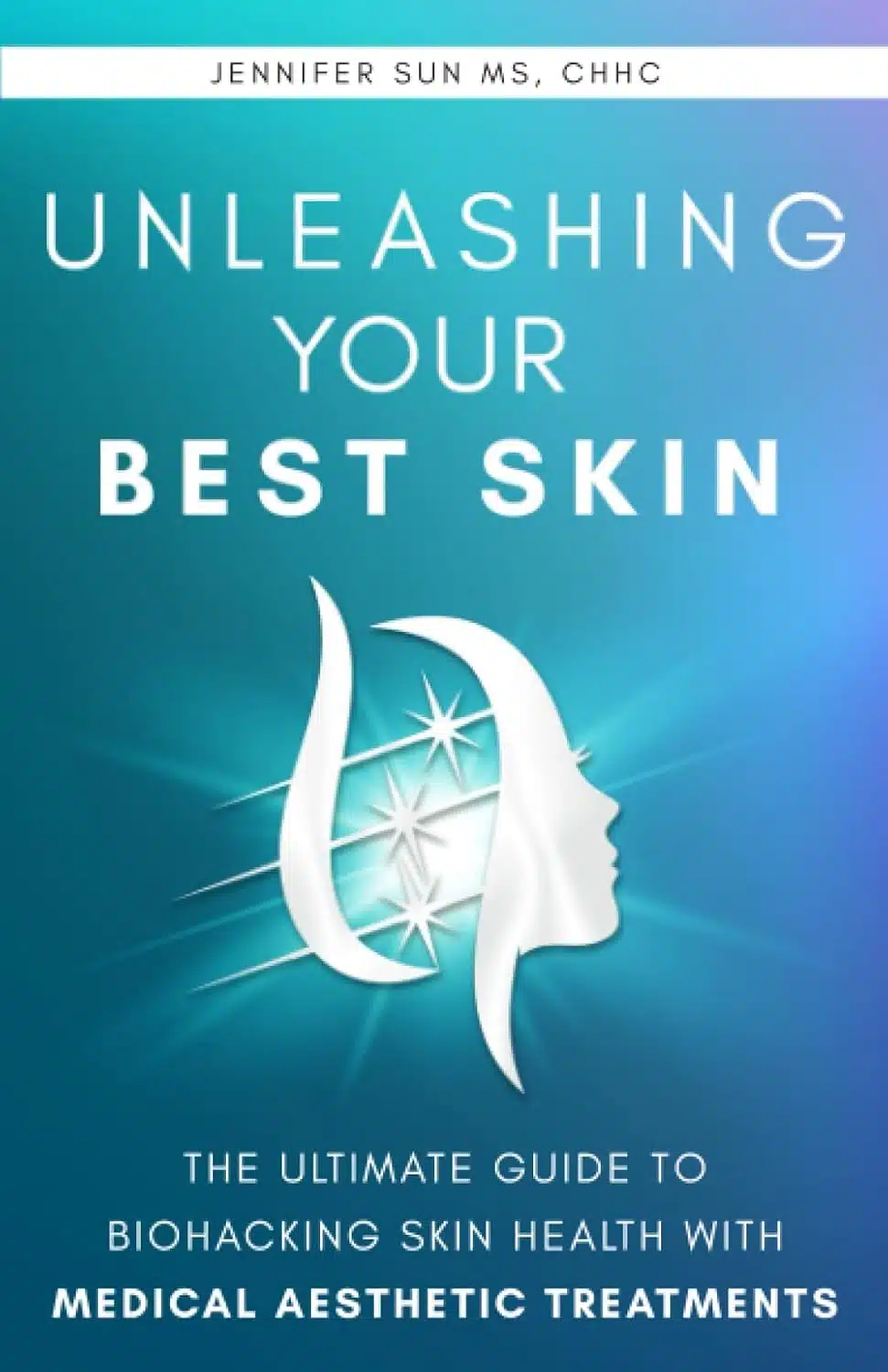
Unleashing Your Best Skin – by Jennifer Sun
10almonds is reader-supported. We may, at no cost to you, receive a portion of sales if you purchase a product through a link in this article.
The author, an aesthetician with a biotech background, explains about the overlap of skin health and skin beauty, making it better from the inside first (diet and other lifestyle factors), and then tweaking things as desired from the outside.
In the broad category of “tweakments” as she puts it, she covers most of the wide array of modern treatments available at many skin care clinics and the options for which at-home do-it-yourself kits are available—and the pros and cons of various approaches.
And yes, those methods do range from microneedling and red light therapy to dermal fillers and thread lifts. Most of them are relatively non-invasive though.
She also covers common ailments of the skin, and how to identify and treat those quickly and easily, without making things worse along the way.
One last thing she also includes is dealing with unwanted hairs—being a very common side-along issue when it comes to aesthetic medicine.
The book is broadly aimed at women, but hormones are not a main component discussed (except in the context of acne), so there’s no pressing reason why this book couldn’t benefit men too. It also addresses considerations when it comes to darker skintones, something that a lot of similar books overlook.
Bottom line: if you find yourself mystified by the world of skin treatment options and wondering what’s really best for you without the bias of someone who’s trying to sell you a particular treatment, then this is the book for you.
Click here to check out Unleashing Your Best Skin, and unleash your best skin!
Don’t Forget…
Did you arrive here from our newsletter? Don’t forget to return to the email to continue learning!
Recommended
Learn to Age Gracefully
Join the 98k+ American women taking control of their health & aging with our 100% free (and fun!) daily emails:
-
Chia Seeds vs Pumpkin Seeds – Which is Healthier?
10almonds is reader-supported. We may, at no cost to you, receive a portion of sales if you purchase a product through a link in this article.
Our Verdict
When comparing chia seeds to pumpkin seeds, we picked the chia.
Why?
Both are great! But chia is best.
Note: we’re going to abbreviate them both to “chia” and “pumpkin”, respectively, but we’ll still be referring to the seeds throughout.
In terms of macros, pumpkin has a little more protein and notably higher carbs, whereas chia has nearly 2x the fiber, as well as more fat, and/but they are famously healthy fats. We’ll call this category a subjective win for chia, though you might disagree if you want to prioritize an extra 2g of protein per 100g (for pumpkin) over an extra 16g of fiber per 100g (for chia). Chia is also vastly preferable for omega-3.
When it comes to vitamins, pumpkin is marginally higher in vitamin A, while chia is a lot higher in vitamins B1, B2, B3, B9, C, and E. An easy win for chia.
In the category of minerals, for which pumpkin seeds are so famously a good source, chia has a lot more calcium, copper, iron, magnesium, manganese, phosphorus, and selenium. On the other hand, pumpkin has more potassium and zinc. Still, that’s a 7:2 win for chia.
Adding up the categories makes for a very compelling win for the humble chia seed.
Want to learn more?
You might like to read:
If You’re Not Taking Chia, You’re Missing Out: The Tiniest Seeds With The Most Value
Take care!
Share This Post
-
What Are The “Bright Lines” Of Bright Line Eating?
10almonds is reader-supported. We may, at no cost to you, receive a portion of sales if you purchase a product through a link in this article.
This is Dr. Susan Thompson. She’s a cognitive neuroscientist who has turned her hand to helping people to lose weight and maintain it at a lower level, using psychology to combat overeating. She is the founder of “Bright Line Eating”.
We’ll say up front: it’s not without some controversy, and we’ll address that as we go, but we do believe the ideas are worth examining, and then we can apply them or not as befits our personal lives.
What does she want us to know?
Bright Line Eating’s general goal
Dr. Thompson’s mission statement is to help people be “happy, thin, and free”.
You will note that this presupposes thinness as desirable, and presumes it to be healthy, which frankly, it’s not for everyone. Indeed, for people over a certain age, having a BMI that’s slightly into the “overweight” category is a protective factor against mortality (which is partly a flaw of the BMI system, but is an interesting observation nonetheless):
When BMI Doesn’t Quite Measure Up
Nevertheless, Dr. Thompson makes the case for the three items (happy, thin, free) coming together, which means that any miserable or unhealthy thinness is not what the approach is valuing, since it is important for “thin” to be bookended by “happy” and “free”.
What are these “bright lines”?
Bright Line Eating comes with 4 rules:
- No flour (no, not even wholegrain flour; enjoy whole grains themselves yes, but flour, no)
- No sugar (and as a tag-along to this, no alcohol) (sugars naturally found in whole foods, e.g. the sugar in an apple if eating an apple, is ok, but other kinds are not, e.g. foods with apple juice concentrate as a sweetener; no “natural raw cane sugar” etc is not allowed either; despite the name, it certainly doesn’t grow on the plant like that)
- No snacking, just three meals per day(not even eating the ingredients while cooking—which also means no taste-testing while cooking)
- Weigh all your food (have fun in restaurants—but more seriously, the idea here is to plan each day’s 3 meals to deliver a healthy macronutrient balance and a capped calorie total).
You may be thinking: “that sounds dismal, and not at all bright and cheerful, and certainly not happy and free”
The name comes from the idea that these rules are lines that one does not cross. They are “bright” lines because they should be observed with a bright and cheery demeanour, for they are the rules that, Dr. Thompson says, will make you “happy, thin, and free”.
You will note that this is completely in opposition to the expert opinion we hosted last week:
What Flexible Dieting Really Means
Dr. Thompson’s position on “freedom” is that Bright Line Eating is “very structured and takes a liberating stand against moderation”
Which may sound a bit of an oxymoron—is she really saying that we are going to be made free from freedom?
But there is some logic to it, and it’s about the freedom from having to make many food-related decisions at times when we’re likely to make bad ones:
Where does the psychology come in?
Dr. Thompson’s position is that willpower is a finite, expendable resource, and therefore we should use it judiciously.
So, much like Steve Jobs famously wore the same clothes every day because he had enough decisions to make later in the day that he didn’t want unnecessary extra decisions to make… Bright Line Eating proposes that we make certain clear decisions up front about our eating, so then we don’t have to make so many decisions (and potentially the wrong decisions) later when hungry.
You may be wondering: ”doesn’t sticking to what we decided still require willpower?”
And… Potentially. But the key here is shutting down self-negotiation.
Without clear lines drawn in advance, one must decide, “shall I have this cake or not?”, perhaps reflecting on the pros and cons, the context of the situation, the kind of day we’re having, how hungry we are, what else there is available to eat, what else we have eaten already, etc etc.
In short, there are lots of opportunities to rationalize the decision to eat the cake.
With clear lines drawn in advance, one must decide, “shall I have this cake or not?” and the answer is “no”.
So while sticking to that pre-decided “no” still may require some willpower, it no longer comes with a slew of tempting opportunities to rationalize a “yes”.
Which means a much greater success rate, both in adherence and outcomes. Here’s an 8-week interventional study and 2-year follow-up:
Bright Line Eating | Research Publications
Counterpoint: pick your own “bright lines”
Dr. Thompson is very keen on her 4 rules that have worked for her and many people, but she recognizes that they may not be a perfect fit for everyone.
So, it is possible to pick and choose our own “bright lines”; it is after all a dietary approach, not a religion. Here’s her response to someone who adopted the first 3 rules, but not the 4th:
Bright Lines as Guidelines for Weight Loss
The most important thing for Bright Line Eating, therefore, is perhaps the action of making clear decisions in advance and sticking to them, rather than seat-of-the-pantsing our diet, and with it, our health.
Want to know more from Dr. Thompson?
You might like her book, which we reviewed a while ago:
Bright Line Eating – by Dr. Susan Peirce Thompson
Enjoy!
Share This Post
-
Ferment: The Life-Changing Power of Microbes – by Dr. Tim Spector
10almonds is reader-supported. We may, at no cost to you, receive a portion of sales if you purchase a product through a link in this article.
You probably know that the gut microbiome is key to a lot of aspects of health.
Dr. Tim Spector, most well-known for the huge ZOE epigenetic study which covered, amongst other things, the effect of diet on the gut microbiome, and the effect of the gut microbiome on health, explains here about the process of fermentation. But…
Unlike the usual “and then the product is fermented and ready to consume” usual end-point of such description, Dr. Spector also covers what happens in the mouth, stomach, small intestine, large intestine.
Which is important, because all of these environments have very different conditions in terms of pH, temperature, and pre-existing microbiome (which latter will partially dictate how friendly or not the environment is to any given new arrivals, on a per-species basis).
For example…
- If you take unprotected microbes (say, in kombucha) then most will die in the stomach acid and certainly not make it to the gut. Some may make it through though, and whether they then survive and flourish in the gut becomes a numbers game.
- Semi-protected microbes (say, in kimchi, where many may have made for themselves a home inside a piece of fermented vegetable, that allows for some temporary protection from the stomach acid, and save them long enough to get into the gut) will fare better.
- Specialist probiotics in nice safe capsules designed to release only in the gut will usually deliver their load safely, but will tend to have less biodiversity than fermented foods.
With these things in mind, it’s clear that getting a mix of all these things is best, and this book covers many kinds of fermented products, instructions on how to make them, and appropriate recipes with your fermented products too.
In terms of style, it’s Dr. Spector’s usual very-accessible pop-science, well-referenced with a respectable bibliography.
Bottom line: if you’re curious about getting into fermenting your own products, and/or simply want to improve your gut health, this book will give you a lot of information that’s easy to apply.
Share This Post
Related Posts
-
Rise And (Really) Shine!
10almonds is reader-supported. We may, at no cost to you, receive a portion of sales if you purchase a product through a link in this article.
Q&A with 10almonds Subscribers!
Q: Would love to hear more ideas about effective first thing in the morning time management to get a great start on your day.
A: There are a lot of schools of thought about what’s best in this regard! Maybe we’ll do a main feature sometime. But some things that are almost universally agreed upon are:
- Prepare your to-do list the night before
- Have some sort of buffer between waking up and getting to productivity.
- For me (hi, your writer here) it’s my first coffee of the day. It’s not even about the caffeine, it’s about the ritual of it, it’s a marker that separates my night from the day and tells my brain what gear to get into.
- Others may like to exercise first thing in the morning
- For still yet others, it could be a shower, cold or otherwise
- Some people like a tall glass of lemon water to rehydrate after sleeping!
- If you take drinkable morning supplements such as this pretty awesome nootropic stack, it’s a great time for that and an excellent way to get the brain-juices flowing!
- When you do get to productivity: eat the frog first! What this means is: if eating a frog is the hardest thing you’ll have to do all day, do that first. Basically, tackle the most intimidating task first. That way, you won’t spend your day stressed/anxious and/or subconsciously wasting time in order to procrastinate and avoid it.
- Counterpart to the above: a great idea is to also plan something to look forward to when your working day is done. It doesn’t matter much what it is, provided it’s rewarding to you, that makes you keen to finish your tasks to get to it.
Have a question you’d like to see answered here? Hit reply to this email, or use the feedback widget at the bottom! We always love to hear from you
Don’t Forget…
Did you arrive here from our newsletter? Don’t forget to return to the email to continue learning!
Learn to Age Gracefully
Join the 98k+ American women taking control of their health & aging with our 100% free (and fun!) daily emails:
-
Why We Remember – by Dr. Charan Ranganath
10almonds is reader-supported. We may, at no cost to you, receive a portion of sales if you purchase a product through a link in this article.
As we get older, forgetfulness can become more of a spectre; the threat that one day it could be less “where did I put my sunglasses?” and more “who is this person claiming to be my spouse?”.
Dr. Ranganath explores in this work the science of memory, from a position of neurobiology, but also in application. How and why we remember, and how and why we forget, and how and why both are important.
There is a practical element to the book too; we read about things that increase our tendency to remember (and things that increase our tendency to forget), and how we can leverage that information to curate our memory in an active, ongoing basis.
The style of the book is quite casual in tone for such a serious topic, but there’s plenty of hard science too; indeed there are 74 pages of bibliography cited.
Bottom line: while filled with a lot of science, this is also a very human book, and a helpful guide to building and preserving our memory.
Click here to check out “Why We Remember”, and learn how to hold on to what matters the most!
Don’t Forget…
Did you arrive here from our newsletter? Don’t forget to return to the email to continue learning!
Learn to Age Gracefully
Join the 98k+ American women taking control of their health & aging with our 100% free (and fun!) daily emails:
-
Sleep & Exercise: A One-Way Relationship?
10almonds is reader-supported. We may, at no cost to you, receive a portion of sales if you purchase a product through a link in this article.
It’s a long-held reasonable assumption that sleep and exercise benefit each other. After all, sleep is restorative ready for exercise, and exercise tires you out ready for sleep.
Indeed, this forms at least part of a lot of circadian rhythm-based approaches to healthy living, for example:
10 Tips for Better Sleep: Starting In The Morning ← note though that the exercise timing advice here is “Exercise regularly but avoid strenuous activity 2 hours before bed. Optimal exercise time is 4–6 hours before bedtime.”
And yet, it turns out that the relationship is a lot more one-sided than has been believed:
You snooze, you… Choose? Enthuse? Put on your running shoes?
Researchers (Dr. Hannah Scott et al.) looked at data from 70,963 people (using an under-mattress sleep sensor and a wrist-worn health tracker) for a little over three and a half years, and found some surprising things, including:
- only 12.9% regularly attained the recommended seven to nine hours of sleep and more than 8,000 steps per day
- on the other end of the scale, 16.5% slept less than seven hours and walked fewer than 5,000 steps—an association with higher risks of chronic disease, weight gain, and mental-health challenges
However, putting the data together in a way we haven’t seen done before, Dr. Scott and her team were able to establish that there was more to this than “healthy people tend to be healthy in multiple life areas; unhealthy people tend to be unhealthy in multiple life areas”.
Specifically, six to seven hours of sleep was linked to the highest next-day step counts, though sleep quality remained most important. In other words, high-quality, efficient sleep (less tossing and turning) reliably predicted higher step counts the next day.
On the other hand, and which is more surprising, doing more steps during the day did not meaningfully improve sleep that night.
Putting it in numbers, we’ll quote directly from the “results” section of the paper:
❝We show that only 12.9% of people achieve the recommended sleep duration of 7-9hrs/night and >8,000 steps/day, with 16.5% having short sleep (<7hrs/night) and sedentary lives (<5,000 steps/day). Approximately 6hrs sleep equates to the greatest next-day step count (e.g., +339 steps vs 8 hrs/night), and sleep efficiency positively predicts next-day step count in a dose-dependent manner (25th vs 75th percentile: +282 steps/day). Sleep appears largely unaffected by previous-day step count. Effects are similar across age groups but decline in magnitude when adjusted for awake duration.❞
You can read the paper in full, here: Bidirectional associations between sleep and physical activity investigated using large-scale objective monitoring data
Note: curiously, and which doesn’t really affect the science here but we should found it interesting:
- Josh Fitton is the corresponding (and thus first-listed) author of the study, although he is a student, and
- Dr. Hannah Scott is Senior Research Fellow, NHMRC Emerging Leadership Fellow, and co-Lead of the Clinical Sleep Health research group at the Flinders Health and Medical Research Institute (FHMRI): Sleep Health Flagship program, and also has getting on for a hundred peer-reviewed papers to her name. Oh, and she’s the Chair on the Board of the Australasian Sleep Association (ASA): Australia’s peak sleep advocacy body. Aside from that, she’s received multiple awards including the Flinders University Vice-Chancellor’s Early Career Researcher Award, the ASA New Investigator Award and ASA Helen Bearpark Award, and the Society of Behavioural Sleep Medicine Fellow Rising Star Award. In short, she’s pretty cool and she knows her stuff.
Given that Dr. Scott’s research specialty involves investigating the use of digital technologies to better assess and manage sleep health and sleep disorders, we infer that Mr. Fitton is one of her students.
About those technologies, Dr Scott is also one of the researchers responsible for THIM: the first wearable device specifically to track and treat chronic insomnia.
On which note, you might want to check out: What Your Fitness Tracker Is Best & Worst At
Want to learn more?
For a particular kind of exercise that can help you sleep, you might like this book that we reviewed a while back:
Yoga For Better Sleep – by Mark Stephens
Sweet dreams!
Don’t Forget…
Did you arrive here from our newsletter? Don’t forget to return to the email to continue learning!
Learn to Age Gracefully
Join the 98k+ American women taking control of their health & aging with our 100% free (and fun!) daily emails:


