
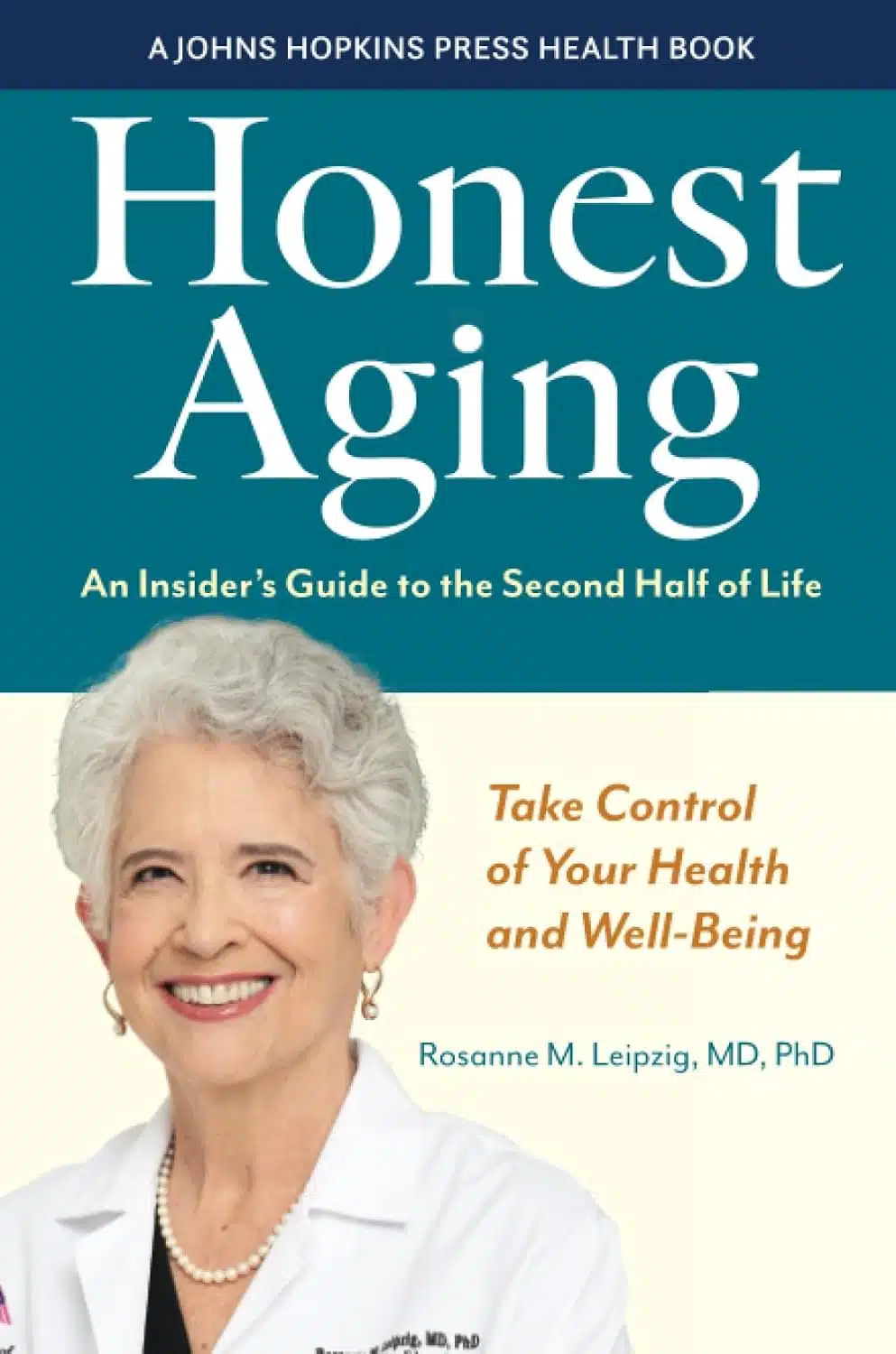
Honest Aging – by Dr. Roseanne Leipzig
10almonds is reader-supported. We may, at no cost to you, receive a portion of sales if you purchase a product through a link in this article.
This book is mostly about what happens for most people between the ages of 60 and 80. Of course, individual experiences may vary, but broadly speaking, there’s usually a big difference (or rather, numerous big differences) between 60 and 80, so it can be worthwhile knowing about such, when a lot of medical advice out there is limited to “under the age of 65” vs “over the age of 65”.
Two quick notes the formatting:
- If you get the Kindle edition, be aware that the tables do not display very well
- If you get the print edition, be aware that the print is very small, which is an astonishing choice for the publisher to have made for a book aimed at 60–80-year-olds with a chapter about eyesight difficulties
You may be wondering: how “honest” is Honest Aging?
If you’ve ever noticed that people who pride themselves on being “brutally honest” are often more focused on delivering brutality than honesty, there’s a little bit of that at play here.
Dr. Leipzig delivers a rather comprehensive guide to the woes of aging, what to expect, and how to deal with the many new challenges that will come with older age. And the perspective of this book is certainly that it is a matter of “will”, not “may”. Every single part of age-related declined, we are told, is inevitable, so we might as well get used to it.
While a lot of books about aging advocate for various strategies to remain biologically younger, this one’s more about what to do once we’re not.
For example,
- it won’t tell you how to keep a youthful spring in your step, but
- it will tell you how to calculate the correct length cane to use to help you walk
…and so on, for many other age-related issues.
Bottom line: the information in this book will be useful when and if you or a loved one suffer various parts of age-related decline. Until that happens, though, we recommend other books to help avoid that outcome. Meanwhile…
Don’t Forget…
Did you arrive here from our newsletter? Don’t forget to return to the email to continue learning!
Recommended
Learn to Age Gracefully
Join the 98k+ American women taking control of their health & aging with our 100% free (and fun!) daily emails:
-
Hate Sit-Ups? Try This 10-Minute Standing Abs Routine!
10almonds is reader-supported. We may, at no cost to you, receive a portion of sales if you purchase a product through a link in this article.
Abdominal muscles are important to many people for aesthetics; they also fulfil the important role of keeping your innards in, as well as being a critical part of core stability (and you cannot have a truly healthy back without healthy abs on the other side). However, not everyone loves sit-ups and their many variations, so here’s an all-standing workout instead:
On your feet!
The exercise are as follows:
- High knees: engage core to work abs; do slow for low impact. Great for speeding up the metabolism. Jog during rest to keep moving.
- Extend & twist: raise arms high, drive them down while raising one leg into a twist. No rest, switch sides immediately.
- Extend & vertical crunch: extend leg back, drive knee forward into a crunch. Swap sides with no breaks.
- Oblique jacks: jump or slow version; targeting the obliques.
- Front toe-touch: engage core for effectiveness.
- Crossover toe-touch: no break; move into this directly from the front toe-touch.
- Wood chop: lift arms up, twist, chop down. Great for obliques. No rest between sides.
- Heisman: step side to side, bringing your other knee up towards the opposite side. Focus on core engagement rather than speed.
- Side leg raise & side bent: raise leg to side with slight bend; works obliques. No rest between sides.
That’s it!
For a visual demonstration, enjoy:
Click Here If The Embedded Video Doesn’t Load Automatically!
Want to learn more?
You might also like to read:
Is A Visible Six-Pack Obtainable Regardless Of Genetic Predisposition?
Take care!
Share This Post
-
What is creatine? What does the science say about its claims to build muscle and boost brain health?
10almonds is reader-supported. We may, at no cost to you, receive a portion of sales if you purchase a product through a link in this article.
If you’ve walked down the wellness aisle at your local supermarket recently, or scrolled the latest wellness trends on social media, you’ve likely heard about creatine.
Creatine is a compound our body naturally makes to deliver energy to our muscles during exercise. Most (95%) is stored in muscle, with small amounts stored in the brain.
We use about 1–3 grams of creatine a day. Our body makes around half of this and we get the rest from protein-rich foods, such as meat and fish.
Creatine supplements come as powders, tablets and other forms, with doses ranging from 3–5g a day, to up to 20g. It’s difficult to get these levels from diet alone: you would need to eat about 1kg of meat to get 5g of creatine.
But can consuming greater levels of creatine help you build muscle, improve athletic performance or boost brain health, as social media influencers claim?
Athletic performance
Creatine increases the rate at which the body re-synthesises a molecule called adenosine triphosphate, or ATP, which provides us with energy. When we use ATP for energy, it’s broken down to another molecule, adenosine diphosphate, or ADP.
To be used as ATP again, ADP needs phosphate. This is where creatine helps. Creatine enters cells and adds the phosphate which was lost. The newly formed creatine phopshate then helps to very quickly re-synthesise ADP back to ATP.
Other energy systems we have to create ATP are comparatively slower.
Because of this quick action, creatine helps with short bursts of activities such as jumping and lifting weights.
This has an indirect effect on muscle-building and sports performance by allowing increased training that leads to improved strength, speed and power.
The evidence shows creatine is an effective nutritional supplement for athletes who want to improve physical performance and function in response to their training.
And you don’t have to be an elite athlete: gym-goers and weekend warriors can get similar benefits.
What about muscle and bone health in older adults?
Most of the research on creatine outside of athletes has been in older adults. This is due to its ability to indirectly help with muscle gain and reduce sarcopeania (age-related muscle wasting).
There is good evidence that creatine supplements (5–20g per day) can improve muscle mass and strength when combined with resistance training in older people.
A review of the research, which included 22 studies in people aged 57–70, found it improved muscle mass by 1.4kg and resulted in a small increase in strength.
Another review of 12 studies considered older adults taking 3–20 grams of creatine supplements a day. It found combining creatine with resistance training 2–3 times per week resulted in more muscle and strength gains compared to resistance training alone.
When it comes to bone health and improving bone density, the evidence is not clear. Some studies show benefits, while others don’t. An overall analysis of five studies found there was no effect.
However, there is some evidence that creatine improves older people’s ability to go from sitting to standing, which is a good predictor of falls.
What about cognition?
Another review looked at the impact on cognitive function across 16 studies. Participants were aged 20 to 77 years and were either healthy or had conditions such as fibromyalgia, mild cognitive impairment associated with Parkinson’s disease, and schizophrenia.
The reviewers found creatine supplementation (5–20g a day) had positive effects on memory, attention time and information processing speed. The benefits were greater in people with disease, those aged between 18 and 60, and among women.
Another review of eight studies also showed creatine improved memory in healthy people, with greater improvements in older adults aged 66 to 76. The effect was similar between those who took high (20g) and low doses (3g).
An earlier review showed similar improvements with memory and reasoning among healthy people who consumed 5-20g of creatine for between five days and six weeks.
What about for other adults?
A 2021 review of creatine across the lifespan indicates creatine maybe useful for pre- and post-menopausal women to improve strength and brain function, and reduce mental fatigue.
For adults aged over 60, supplementation may provide some benefits for cognitive and muscle mass, particularly if you’re physically active.
But there isn’t an evidence base to support its general use across the younger population, beyond athletic performance.
What are the risks?
Creatine is generally considered to be safe. Some users report side effects, mostly related to gastrointestinal problems such as nausea and stomach upset. Some people also experience headaches and muscle cramps when they change the amount or frequency.
Creatine may lead to temporary water gain, seen with a small increase in weight. But this subsides after a few days of supplementation.
The evidence is not clear yet for creatine supplementation for certain people, including those who are pregnant, breastfeeding, have kidney disease or liver disease, or who have psychiatric disorders.
As with any supplement, and in particular if you have underlying health conditions, talk to your doctor if you’re considering taking creatine.
What should you look out for?
Creatine as a supplement is synthetically made from sarcosine and cyanamide (no, it’s not related to cyanide). There are different forms of creatine supplements, but the research uses a type called creatine monohydrate.
There is no difference between brands that manufacture creatine monohydrate and you don’t need to buy it with added ingredients.
If you do want to try creatine, monitor your use over 4–8 weeks to see if you notice an improvement. And if you don’t, you might want to save your money.
Evangeline Mantzioris, Program Director of Nutrition and Food Sciences, Accredited Practising Dietitian, University of South Australia
This article is republished from The Conversation under a Creative Commons license. Read the original article.
Share This Post
-
Goji Berries vs Blueberries – Which is Healthier?
10almonds is reader-supported. We may, at no cost to you, receive a portion of sales if you purchase a product through a link in this article.
Our Verdict
When comparing goji berries to blueberries, we picked the goji berries.
Why?
As you might have guessed, both are very good options:
- Both have plenty of vitamins and minerals, and/but goji berries have more. How much more? It varies, but for example about 5x more vitamin C, about 25x more iron, about 30x more calcium, about 50x more vitamin A.
- Blueberries beat goji berries with some vitamins (B, E, K), but only in quite small amounts.
- Both are great sources of antioxidants, and/but goji berries have 2–4 times the antioxidants that blueberries do.
- Goji berries do have more sugar, but since they have about 4x more sugar and 5x more fiber, we’re still calling this a win for goji berries on the glycemic index front (and indeed, the GI of goji berries is lower).
In short: blueberries are great, but goji berries beat them in most metrics.
Want to read more?
Check out our previous main features, detailing some of the science, and also where to get them:
Enjoy!
Share This Post
Related Posts
-
What to Eat When – by Drs. Michael Roizen and Michael Crupain
10almonds is reader-supported. We may, at no cost to you, receive a portion of sales if you purchase a product through a link in this article.
Here at 10almonds, we cover a lot of the “what to eat”, but tend to only sometimes touch on the “when”—and indeed, this is a reflection of a popular focus. But what if we were to pay a little more attention to that “when”; what would it get us?
According to Drs. Roizen and Crupain… Quite a bit!
In this work, they take into account the various factors affecting the benefit (or harm!) of what we eat when:
- in the context of our circadian rhythm
- in the context of our insulin responses
- in the context of intermittent fasting
The style throughout is very focused on practical actionable advice. For example, amongst other lifestyle-adjustment suggestions, the authors make the case for front-loading various kinds of food earlier in the day, and eating more attentively and mindfully when we do eat.
They also offer a lot of “quick tips” of the kind we love here at 10almonds! Ranging from “how about this breakfast idea” to “roasting chickpeas like this makes a great snack” to “this dessert is three healthy foods disguised as a sundae”
All in all, if you’d like a stack of small tweaks that can add up to a big difference in your overall health, this is a book for you.
Don’t Forget…
Did you arrive here from our newsletter? Don’t forget to return to the email to continue learning!
Learn to Age Gracefully
Join the 98k+ American women taking control of their health & aging with our 100% free (and fun!) daily emails:
-
Heal Your Gut, Save Your Brain – by Dr. Partha Nandi
10almonds is reader-supported. We may, at no cost to you, receive a portion of sales if you purchase a product through a link in this article.
The gut-brain axis is well-known, at least to those of us who care to learn about health science, which of course includes everyone reading this (because that’s why you’re here, after all). However, its importance cannot be overstated when it comes to the connection between gut health and brain health, both in terms of the good and the bad.
Dr. Nandi explores and explains this in terms of correct systemic functioning and pathology—in other words, what goes on and what can go wrong. As it happens, what goes on is a lot, and what can go wrong is also a lot, and it’s important to understand how, in order to prevent it and keep our brain healthy.
This is not just about general brain health, by the way. Not that that would be bad; general brain health is a great thing to have. But, the focus here is on the involvement of gut health (for better or for worse) in the specific contexts of stroke, Alzheimer’s, and Parkinson’s, with several chapters dedicated to each of the aforementioned brain health threats, covering how gut health affects the risks, and how specifically to change course to avoid it in each case.
Oh, and three more chapters (i.e. one additional chapter for each of those diseases) with recipes optimized to improve your gut-brain health in the best of ways, to avoid stroke, Alzheimer’s, and Parkinson’s, respectively. Of course, all are good against each; this isn’t a zero-sum game. But, some things have specialities that others don’t, and Dr. Nandi highlights such cases for us.
The style is (aside from the recipes) high-end pop-science, with scientific references at a rate of several per page (sometimes several per paragraph), yet very comprehensible, and while he explains everything as he goes, he also does provide a glossary at the back, so that’s good too.
Bottom line: if you have a gut and a brain and would like to keep both in the best possible working order, this book will help you to do so.
Click here to check out Heal Your Gut, Save Your Brain, and do exactly that!
Don’t Forget…
Did you arrive here from our newsletter? Don’t forget to return to the email to continue learning!
Learn to Age Gracefully
Join the 98k+ American women taking control of their health & aging with our 100% free (and fun!) daily emails:
-
How To Actually Get Abs (10 Annoying Tips That Work!)
10almonds is reader-supported. We may, at no cost to you, receive a portion of sales if you purchase a product through a link in this article.
Cori Lefkowitz, of “Strong At Any Age”, advises…
The method
It may not be fun, but here’s what she finds works:
- Be boring: stick to a simple, repetitive diet to track progress easily, and make hitting macros simpler.
- Cut back on protein bars: processed protein bars are calorie-dense but not filling (due to their small volume), so limit them, especially when trying to get lean.
- Stop daily fluctuations: she advises to be precise with macros and calories daily, not just weekly, to see consistent results.
- Focus on fiber: aim for 25–30g of fiber daily to improve gut health, reduce cravings, and maintain health while cutting fat.
- Get 30–40g of protein per meal: ensure each meal has enough protein to fuel muscle growth and support overall body function.
- Prioritize carbs around workouts: eat carbs before and after training to fuel performance, aid muscle repair, and maintain lean mass.
- Take diet breaks: incorporate 1–2 week maintenance phases to prevent metabolic adaptation, maintain muscle, and thus stay consistent in the long-term.
- Be careful with fat burners & preworkout: these can harm sleep, recovery, and long-term fat loss; opt for natural dietary energy sources instead.
- Don’t set-and-forget: regularly assess and adjust your diet and macros as your body and lifestyle change.
- “Suck it up, buttercup”: fat loss requires persistence, discipline, and pushing through tough moments when you feel like quitting.
For more on all of this, enjoy:
Click Here If The Embedded Video Doesn’t Load Automatically!
Want to learn more?
You might also like:
Is A Visible Six-Pack Obtainable Regardless Of Genetic Predisposition?
Take care!
Don’t Forget…
Did you arrive here from our newsletter? Don’t forget to return to the email to continue learning!
Learn to Age Gracefully
Join the 98k+ American women taking control of their health & aging with our 100% free (and fun!) daily emails:


