
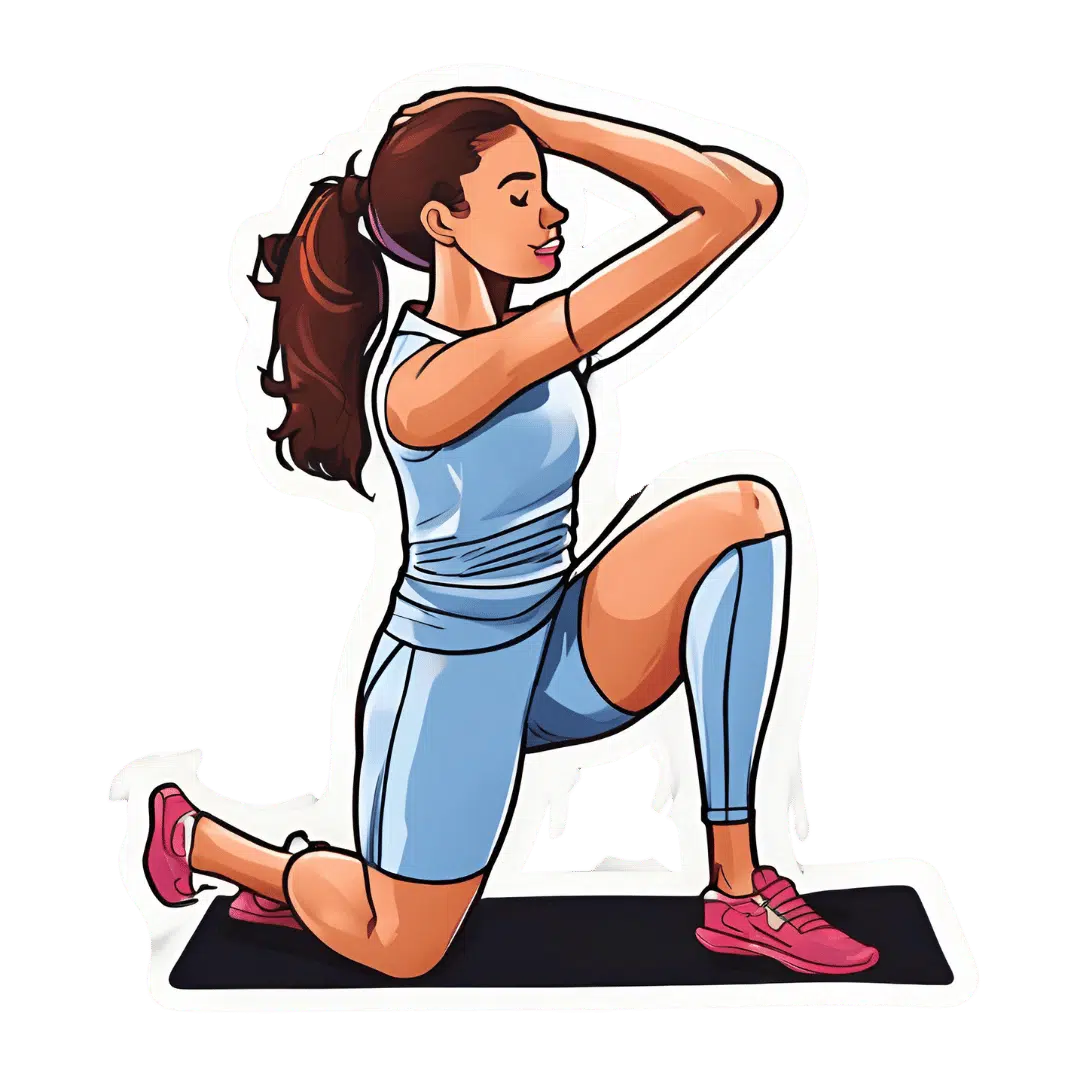
Tight Hamstrings? Here’s A Test To Know If It’s Actually Your Sciatic Nerve
10almonds is reader-supported. We may, at no cost to you, receive a portion of sales if you purchase a product through a link in this article.
Tight hamstrings are often not actually due to hamstring issues, but rather, are often being limited by the sciatic nerve. This video offers a home test to determine if the sciatic nerve is causing mobility problems (and how to improve it, if so):
The Connection
Try this test:
- Sit down with a slumped posture.
- Extend one leg with the ankle flexed.
- Note any stretching or pulling sensation behind the knee or in the calf.
- Bring your head down to your chest
If this increases the sensation, it likely indicates sciatic nerve involvement.
If only the hamstrings are tight, head movement won’t change the stretch sensation.
This is because the nervous system is a continuous structure, so head movement can affect nerve tension throughout the body. While this can cause problems, it can also be integral in the solution. Here are two ways:
- Flossing method: sit with “poor” slumped posture, extend the knee, keep the ankle flexed, and lift the head to relieve nerve tension. This movement helps the sciatic nerve slide without stretching it.
- Even easier method: lie on your back, grab behind the knee, and extend the leg while extending the neck. This position avoids compression in the gluteal area, making it suitable for severely compromised nerves. Perform the movement without significant stretching or pain.
In both cases: move gently to avoid straining the nerve, which can worsen muscle tension. Do 10 repetitions per leg, multiple times a day; after a week, increase to 20 reps.
A word of caution: speak with your doctor before trying these exercises if you have underlying neurological diseases, cut or infected nerves, or other severe conditions.
For more on all of this, plus visual demonstrations, enjoy:
Click Here If The Embedded Video Doesn’t Load Automatically!
Want to learn more?
You might also like to read:
Exercises for Sciatica Pain Relief
Take care!
Don’t Forget…
Did you arrive here from our newsletter? Don’t forget to return to the email to continue learning!
Recommended

Learn to Age Gracefully
Join the 98k+ American women taking control of their health & aging with our 100% free (and fun!) daily emails:
-
Are your Kidneys Ok? Detect Early To Protect Kidney Health (Here’s How)
10almonds is reader-supported. We may, at no cost to you, receive a portion of sales if you purchase a product through a link in this article.
Tomorrow (at time of publication) will be World Kidney Day (WKD). Perhaps not the most well-known initiative, but it celebrates its 21st year this year!
For those of us who celebrated our own 21st year quite some time ago now, it’s as good a reason as any to check in on our kidney health.
Here are some things they’d like us to know about Chronic Kidney Disease (CKD):
❝CKD is a silent disease, people with CKD have no signs or symptoms until the late stage of the disease.
CKD usually does not go away, instead, it progresses, unless early treatment to slow or halt the disease is ensured.
CKD can progress to kidney failure – a condition when kidneys cannot maintain their function anymore, posing a life-threatening risk.
CKD ranks number 7 in the top ten causes of death among noncommunicable diseases worldwide.
CKD increases the risk of premature death from associated cardiovascular disease.
CKD is more common among certain ethnic groups due in part to high rates of diabetes and high blood pressure.
CKD is more common among women, here is why.❞Source: World Kidney Day: Your Amazing Kidneys
How can we check our kidney health?
There are clinical tests that can be done (they’ll just need a urine sample from you; ask your doctor about it), but there’s some screening that can be done at home already:
Are Your Kidneys Healthy? Take This One-Minute Quiz To Find out
👆 this is about medical indicators; there are also non-medical factors that affect risk, including:
- Where someone lives
- Where they work
- The foods they eat
- How much exercise they do
- If they are able to get the medical care they need
For more information on this, see: Keeping Your Kidneys Healthy (Especially After 60) ← there’s a lot more to it than just hydration!
What can we do for our kidney health, besides the obvious “hydrate”?
Some top things to do include:
Hydrate, yes. See also: Things Many People Forget When It Comes To Hydration
Don’t smoke. It’s bad for everything, including your kidneys. So, just don’t. See also: Addiction Myths That Are Hard To Quit
Look after your blood. Not just “try to keep it inside your body”, but also:
- Keep your blood sugar levels healthy (hyperglycemia can cause kidney damage)
- Keep your blood pressure healthy (hypertension can cause kidney damage)
Basically, your kidneys’ primary job of filtering blood will go much more smoothly if that blood is less problematic on the way in.
Watch your over-the-counter pill intake. A lot of PRN OTC NSAIDs (PRN = pro re nata, i.e. you take them as and when symptoms arise) (NSAIDs = Non-Steroidal Anti-Inflammatory Drugs, such as ibuprofen for example) can cause kidney damage if taken regularly.
Keep an eye on your urine. Hydration is only one side of the story, and our urine can say quite a bit about our health. Indeed, we have written about this before:
12 Things Your Urine Says About Your Health (Test At Home) ← no special equipment required!
On which note, see also: To Pee Or Not To Pee ← spoiler: there’s a flood of reasons to not hold your pee
Want to know more?
Check out the WKD website’s…
8 Golden Rules Of Kidney Disease Prevention
Take care!
Share This Post
-
How misinformation about fentanyl exposure threatens to undermine overdose response
10almonds is reader-supported. We may, at no cost to you, receive a portion of sales if you purchase a product through a link in this article.
Fentanyl, the deadly synthetic opioid driving the nation’s high drug overdose rates, is also caught up in another increasingly serious problem: misinformation.
False and misleading narratives on social media, in news reports, and even in popular television dramas suggesting people can overdose from touching fentanyl—rather than ingesting it—are now informing policy and spending decisions.
In an episode of the CBS cop drama “Blue Bloods,” for instance, Detective Maria Baez becomes comatose after accidentally touching powdered fentanyl. In another drama, “S.W.A.T.,” Sgt. Daniel “Hondo” Harrelson warns his co-workers: “You touch the pure stuff without wearing gloves, say good night.”
While fentanyl-related deaths have drastically risen over the past decade, no evidence suggests any resulted from incidentally touching or inhaling it, and little to no evidence that any resulted from consuming it in marijuana products. (Recent data indicates that fentanyl-related deaths have begun to drop.)
There is also almost no evidence that law enforcement personnel are at heightened risk of accidental overdoses due to such exposures. Still, there is a steady stream of reports—which generally turn out to be false—of officers allegedly becoming ill after handling fentanyl.
“It’s only in the TV dramas” where that happens, said Brandon del Pozo, a retired Burlington, Vermont, police chief who researches policing and public health policies and practices at Brown University.
In fact, fentanyl overdoses are commonly caused by ingesting the drug illicitly as a pill or powder. And most accidental exposures occur when people who use drugs, even those who do not use opioids, unknowingly consume fentanyl because it is so often used to “cut” street drugs such as heroin and cocaine.
Despite what scientific evidence suggests about fentanyl and its risks, misinformation can persist in public discourse and among first responders on the front lines of the crisis. Daniel Meloy, a senior community engagement specialist at the drug recovery organizations Operation 2 Save Lives and QRT National, said he thinks of misinformation as “more of an unknown than it is an anxiety or a fear.”
“We’re experiencing it often before the information” can be understood and shared by public health and addiction medicine practitioners, Meloy said.
Some state and local governments are investing money from their share of the billions in opioid settlement funds in efforts to protect first responders from purported risks perpetuated through fentanyl misinformation.
In 2022 and 2023, 19 cities, towns, and counties across eight states used settlement funds to purchase drug detection devices for law enforcement agencies, spending just over $1 million altogether. Two mass spectrometers were purchased for at least $136,000 for the Greeley, Colorado, police department, “to protect those who are tasked with handling those substances.”
Del Pozo, the retired police chief, said fentanyl is present in most illicit opioids found at the scene of an arrest. But that “doesn’t mean you need to spend a lot of money on fentanyl detection for officer safety,” he said. If that spending decision is motivated by officer safety concerns, then it’s “misspent money,” del Pozo said.
Fentanyl misinformation is affecting policy in other ways, too.
Florida, for instance, has on the books a law that makes it a second-degree felony to cause an overdose or bodily injury to a first responder through this kind of secondhand fentanyl exposure. Similar legislation has been considered by states such as Tennessee and West Virginia, the latter stipulating a penalty of 15 years to life imprisonment if the exposure results in death.
Public health advocates worry these laws will make people shy away from seeking help for people who are overdosing.
“A lot of people leave overdose scenes because they don’t want to interact with police,” said Erin Russell, a principal with Health Management Associates, a health care industry research and consulting firm. Florida does include a caveat in its statute that any person “acting in good faith” to seek medical assistance for someone they believe to be overdosing “may not” be arrested, charged, or prosecuted.
And even when public policy is crafted to protect first responders as well as regular people, misinformation can undermine a program’s messaging.
Take Mississippi’s One Pill Can Kill initiative. Led by the state attorney general, Lynn Fitch, the initiative aims to provide resources and education to Mississippi residents about fentanyl and its risks. While it promotes the availability and use of harm reduction tools, such as naloxone and fentanyl test strips, Fitch has also propped up misinformation.
At the 2024 Mississippi Coalition of Bail Sureties conference, Fitch said, “If you figure out that pill’s got fentanyl, you better be ready to dispose of it, because you can get it through your fingers,” based on the repeatedly debunked belief that a person can overdose by simply touching fentanyl.
Officers on the ground, meanwhile, sometimes are warned to proceed with caution in providing lifesaving interventions at overdose scenes because of these alleged accidental exposure risks. This caution is often evidenced in a push to provide first responders with masks and other personal protective equipment. Fitch told the crowd at the conference: “You can’t just go out and give CPR like you did before.” However, as with other secondhand exposures, the risk for a fentanyl overdose from applying mouth-to-mouth is negligible, with no clinical evidence to suggest it has occurred.
Her comments underscore growing concerns, often not supported by science, that officers and first responders increasingly face exposure risks during overdose responses. Her office did not respond to questions about these comments.
Health care experts say they are not against providing first responders with protective equipment, but that fentanyl misinformation is clouding policy and risks delaying critical interventions such as CPR and rescue breathing.
“People are afraid to do rescue breathing because they’re like, ‘Well, what if there’s fentanyl in the person’s mouth,’” Russell said. Hesitating for even a moment because of fentanyl misinformation could delay a technique that “is incredibly important in an overdose response.”
This article first appeared on KFF Health News and is republished here under a Creative Commons license. KFF Health News is a national newsroom that produces in-depth journalism about health issues and is one of the core operating programs at KFF — the independent source for health policy research, polling, and journalism.
This article first appeared on Public Good News and is republished here under a Creative Commons Attribution-NoDerivatives 4.0 International License.
Share This Post
-
“I Stretched Every Day For 30 Days: Game Changer!”
10almonds is reader-supported. We may, at no cost to you, receive a portion of sales if you purchase a product through a link in this article.
How much can an unflexible person really improve in just 20 minutes per day for a month? Makari Espe finds out:
Consistency really is key
We’re supposed to stretch at least 3 times per week; for many people, the reality is often more like 2 times per year (often the 1st and 2nd of January).
So, how quickly can such neglect be turned around?
Upon initial testing, she found she was even less flexible than thought, and set about her work:
The stretches she used were from random 20-minute full body stretch videos on YouTube, of which there are many, but she used a different one each day. As she went along, she found some favorite kinds of stretching and some favorite instructors, and settled on mostly Peloton stretching videos—she also switched to evening stretching sessions instead of morning.
Along the way, she already noticed gradual improvement in mobility and reduced body tension, and after 3 weeks, it had become a habit that she started craving.
The final test? There’s a marked improvement; see the video:
Click Here If The Embedded Video Doesn’t Load Automatically!
Want to learn more?
You might also like to read:
Yoga Teacher: “If I wanted to get flexible in 2025, here’s what I’d do”
Take care!
Share This Post
Related Posts
-
Why We Get Fat: And What to Do About It – by Gary Taubes
10almonds is reader-supported. We may, at no cost to you, receive a portion of sales if you purchase a product through a link in this article.
We’ve previously reviewed Taubes’ “The Case Against Sugar“. What does this one bring differently?
Mostly, it’s a different focus. Unsurprisingly, Taubes’ underlying argument is the same: sugar is the biggest dietary health hazard we face. However, this book looks at it specifically through the lens of weight loss, or avoiding weight gain.
Taubes argues for low-carb in general; he doesn’t frame it specifically as the ketogenic diet here, but that is what he is advocating. However, he also acknowledges that not all carbs are created equal, and looks at several categories that are relatively better or worse for our insulin response, and thus, fat management.
If the book has a fault it’s that it does argue a bit too much for eating large quantities of meat, based on Weston Price’s outdated and poorly-conducted research. However, if one chooses to disregard that, the arguments for a low-carb diet for weight management remain strong.
Bottom line: if you’d like to cut some fat without eating less (or exercising more), this book offers a good, well-explained guide for doing so.
Don’t Forget…
Did you arrive here from our newsletter? Don’t forget to return to the email to continue learning!
Learn to Age Gracefully
Join the 98k+ American women taking control of their health & aging with our 100% free (and fun!) daily emails:
-
How To Get Unstuck
10almonds is reader-supported. We may, at no cost to you, receive a portion of sales if you purchase a product through a link in this article.
At 10almonds we sometimes say “mental health is also simply health”, and in this video, we get an examination of how one’s state of mind affects physical health and life in general—for better or for worse—and how to shift out of the wrong mental gear and into a better one:
Inside out
Zuzka notes that feeling stuck is often a result of fear and limited perspective, not an actual lack of options. Now, this does not mean that external circumstances don’t exist, or that we go through life without limitations. But it does mean we must start by asking ourselves the right questions, such as in this case, “Am I being resourceful right now?”
For her, she considers that being resourceful means seeking solutions and seeing possibilities, even in difficult situations—and that it’s a skill that can be trained like a muscle.
To that end, she champions trying things even if we think we may fail (indeed, she acknowledges that experiencing failure is inevitable and/but ultimately, however, learning from short-term failure increases chances of long-term success).
In the case of being afraid (of failure, or more specifically, trying hard and failing anyway, which can feel worse than not trying at all), she recommends that small actions (which she calls actions of “micro-bravery”) can break the cycle and reduce fear—which is important, because otherwise, fear only grows over time if we avoid taking actions to challenge it.
For more on all of this, enjoy:
Click Here If The Embedded Video Doesn’t Load Automatically!
Want to learn more?
You might also like:
The Most Anti-Aging Exercise ← this same YouTuber’s most well-known video (and our discussion of it). She is, by the way, in her early 40s at time of writing. So, rather younger than the average 10almonds reader, but also rather older than the average fitness influencer!
Take care!
Don’t Forget…
Did you arrive here from our newsletter? Don’t forget to return to the email to continue learning!
Learn to Age Gracefully
Join the 98k+ American women taking control of their health & aging with our 100% free (and fun!) daily emails:
-
Decoding Hormone Balancing in Ads
10almonds is reader-supported. We may, at no cost to you, receive a portion of sales if you purchase a product through a link in this article.
It’s Q&A Time!
This is the bit whereby each week, we respond to subscriber questions/requests/etc
Have something you’d like to ask us, or ask us to look into? Hit reply to any of our emails, or use the feedback widget at the bottom, and a Real Human™ will be glad to read it!
Q: As to specific health topics, I would love to see someone address all these Instagram ads targeted to women that claim “You only need to ‘balance your hormones’ to lose weight, get ripped, etc.” What does this mean? Which hormones are they all talking about? They all seem to be selling a workout program and/or supplements or something similar, as they are ads, after all. Is there any science behind this stuff or is it mostly hot air, as I suspect?
Thank you for asking this, as your question prompted yesterday’s main feature, What Does “Balancing Your Hormones” Even Mean?
That’s a great suggestion also about addressing ads (and goes for health-related things in general, not just hormonal stuff) and examining their claims, what they mean, how they work (if they work!), and what’s “technically true but may
be misleading* cause confusion”*We don’t want companies to sue us, of course.
Only, we’re going to need your help for this one, subscribers!
See, here at 10almonds we practice what we preach. We limit screen time, we focus on our work when working, and simply put, we don’t see as many ads as our thousands of subscribers do. Also, ads tend to be targeted to the individual, and often vary from country to country, so chances are good that we’re not seeing the same ads that you’re seeing.
So, how about we pull together as a bit of a 10almonds community project?
- Step 1: add our email address to your contacts list, if you haven’t already
- Step 2: When you see an ad you’re curious about, select “share” (there is usually an option to share ads, but if not, feel free to screenshot or such)
- Step 3: Send the ad to us by email
We’ll do the rest! Whenever we have enough ads to review, we’ll do a special on the topic.
We will categorically not be able to do this without you, so please do join in—Many thanks in advance!
Don’t Forget…
Did you arrive here from our newsletter? Don’t forget to return to the email to continue learning!
Learn to Age Gracefully
Join the 98k+ American women taking control of their health & aging with our 100% free (and fun!) daily emails:


