
Thinking about acupuncture or herbs for menopause? Read this first

10almonds is reader-supported. We may, at no cost to you, receive a portion of sales if you purchase a product through a link in this article.

Hot flushes, night sweats or swinging mood changes are some of the most common symptoms of menopause – the stage of a woman’s life when menstrual periods stop permanently, and she is no longer fertile.

Some women choose to ride out the symptoms. Some choose hormone replacement therapy (HRT), also known as menopausal hormone therapy or MHT. This contains oestrogen, progesterone or combined therapies. Others use complementary therapies.

But do complementary therapies such as acupuncture and herbal medicines actually help?
Westend61/Getty

Remind me, what’s going on with menopause?

Menopause is a normal part of ageing, as is the menopausal transition (or perimenopause), which occurs for several years before it. Some women’s periods stop earlier than others. But most women become menopausal naturally between the ages of 45 and 55.

During menopause, women often have a range of symptoms. These can include hot flushes, night sweats, mood swings, joint discomfort, sleep disturbances, decreased libido, headache or migraine, cardiometabolic disturbances (such as high blood pressure), weight gain, and loss of bone mineral density.

These symptoms can be distressing and can affect women’s quality of life.

Why complementary therapies?

Some women prefer to use complementary therapies alongside conventional treatment, or instead of it, due to side effects of menopausal hormone therapy.

Other women cannot use MHT because of other medical conditions, such as breast cancer.

But what does the evidence say about complementary therapies used in menopause?

Earlier this year, we and our colleagues published a large review to draw together the evidence. We analysed 158 clinical trials and systematic reviews conducted in women over 40. These studies looked at 86 complementary therapies, such as acupuncture, Chinese herbal medicine, vitamin and nutrient supplements, and mind-body approaches.

Most studies were of low or very low quality. This could be because they included a small number of participants, were not double-blinded (when neither the participants nor the researchers knew which people were given which therapy) and sometimes did not use placebos.

So clinicians don’t have sufficient evidence to recommend them.

Now, the detail

Most studies in the review asked women to report the frequency and severity of their symptoms. Some used questionnaires covering a range of symptoms to give an overall menopause score. Others just asked about hot flushes.

Here are some of the findings.

Black cohosh is a flowering plant that improves overall menopausal scores, and hot flushes. Studies found benefits when taken from four to 52 weeks. Women took different products containing black cohosh, on its own or with other herbs. None of these studies reported serious side effects.

Isoflavones also known as phytoestrogens are found in soy and other legumes, and mimic oestrogen in the body. Soy-derived isoflavones improve hot flushes as well as overall menopausal scores. However in the same study, red clover-derived isoflavones did not reduce hot flushes. Side effects to isoflavones are generally mild and improve quickly without needing medical intervention.

Our ability to make vitamin D from sunlight reduces as we get older. In women, this decline starts at about the same time as menopause. For reducing the risk of fracture, women who have diagnosed osteoporosis need to take 800 IU (international units) vitamin D and 1,200 milligram calcium daily under medical supervision. But vitamin D plus calcium are not recommended to women without osteoporosis and without low vitamin D levels. This is because long-term use (over seven years) may increase the risk of cardiovascular disease (such as a heart attack).

Chinese herbal medicines can be combinations of multiple herbs (often between five and 20) in a formula. Seventy studies, using a variety of formulas, showed taking Chinese herbal medicines for seven days to three months improved menopausal scores and sleep quality. The most common formula was Suan Zao Ren Tang. Short-term use (up to a year) appears to be safe, but there are no studies looking at its longer-term use.

Another meta-analysis on Chinese herbal medicines using Rehmannia as the main herb found 17 studies. When taken for two weeks to three months there was an improvement in overall menopausal scores. No adverse events were reported.

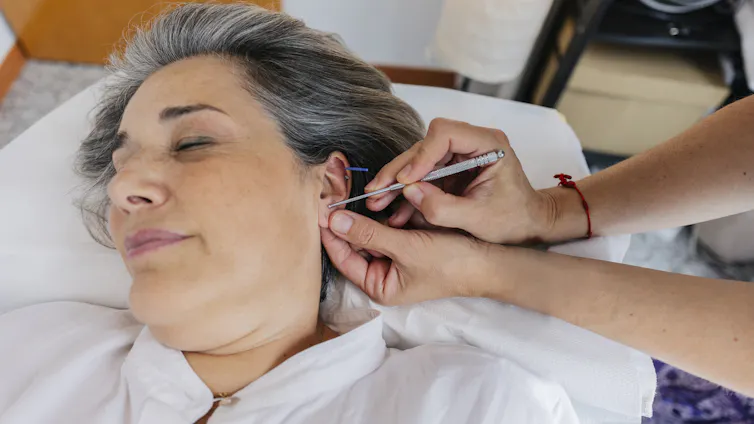
Acupuncture comes in several forms and you can have it with and without other therapies. We found no evidence to recommend regular acupuncture for hot flushes. Acupuncture with Chinese herbal medicines improves sleep quality, but only in perimenopausal women with insomnia. Electro-acupunture is a form of acupuncture that passes a gentle current between two needles into your skin. It improves hot flushes.

In summary, most treatments included in our review did not show enough evidence to be able to recommend them clinically. Complementary therapies including soy-isoflavones, vitamin D, black cohosh and Chinese herbal medicine may help some menopausal symptoms, but more high-quality research is needed to understand how effective and safe these treatments truly are.

So what should I do?

The International Menopause Society recommends that if women in midlife choose complementary therapies, these should be alongside MHT.

So always talk to your GP about your plans, and only consider using the complementary therapies that have good evidence for the symptoms you currently have. Your GP can help you think about the risks and benefits for you, and help you make a decision based on the best available scientific evidence.

A healthy lifestyle – including eating well, staying active, looking after your mental wellbeing, getting restorative sleep, maintaining healthy relationships, and avoiding drugs and alcohol – are all important in menopause care.

These are linked with benefits including fewer hot flushes, a healthier weight, a lower risk of heart disease and diabetes, and a lower risk of falls and fractures.

Complementary therapies should not replace these fundamental lifestyle habits.

Correction: the original version of this article incorrectly suggested MHT might not be suitable for women at risk of thromboembolism.

Evangeline Mantzioris, Program Director of Nutrition and Food Sciences, Accredited Practising Dietitian, Adelaide University ; Alison Maunder, Postdoctoral Research Fellow, National Institute of Complementary Medicine, Western Sydney University, and Carolyn Ee, Associate Professor, Cancer Survivorship and Primary Care, Caring Futures Institute, Flinders University; Western Sydney University

This article is republished from The Conversation under a Creative Commons license. Read the original article.

Don’t Forget…

Did you arrive here from our newsletter? Don’t forget to return to the email to continue learning!
Learn to Age Gracefully

Join the 98k+ American women taking control of their health & aging with our 100% free (and fun!) daily emails:

  • No, sugar doesn’t make your kids hyperactive

    10almonds is reader-supported. We may, at no cost to you, receive a portion of sales if you purchase a product through a link in this article.

    It’s a Saturday afternoon at a kids’ birthday party. Hordes of children are swarming between the spread of birthday treats and party games. Half-eaten cupcakes, biscuits and lollies litter the floor, and the kids seem to have gained superhuman speed and bounce-off-the-wall energy. But is sugar to blame?

    The belief that eating sugary foods and drinks leads to hyperactivity has steadfastly persisted for decades. And parents have curtailed their children’s intake accordingly.

    Balanced nutrition is critical during childhood. As a neuroscientist who has studied the negative effects of high sugar “junk food” diets on brain function, I can confidently say excessive sugar consumption does not have benefits to the young mind. In fact, neuroimaging studies show the brains of children who eat more processed snack foods are smaller in volume, particularly in the frontal cortices, than those of children who eat a more healthful diet.

    But today’s scientific evidence does not support the claim sugar makes kids hyperactive.

    Sharomka/Shutterstock

    The hyperactivity myth

    Sugar is a rapid source of fuel for the body. The myth of sugar-induced hyperactivity can be traced to a handful of studies conducted in the 1970s and early 1980s. These were focused on the Feingold Diet as a treatment for what we now call Attention Deficit Hyperactivity Disorder (ADHD), a neurodivergent profile where problems with inattention and/or hyperactivity and impulsivity can negatively affect school, work or relationships.

    Devised by American paediatric allergist Benjamin Feingold, the diet is extremely restrictive. Artificial colours, sweeteners (including sugar) and flavourings, salicylates including aspirin, and three preservatives (butylated hydroxyanisole, butylated hydroxytoluene, and tert-Butrylhdryquinone) are eliminated.

    Salicylates occur naturally in many healthy foods, including apples, berries, tomatoes, broccoli, cucumbers, capsicums, nuts, seeds, spices and some grains. So, as well as eliminating processed foods containing artificial colours, flavours, preservatives and sweeteners, the Feingold diet eliminates many nutritious foods helpful for healthy development.

    However, Feingold believed avoiding these ingredients improved focus and behaviour. He conducted some small studies, which he claimed showed a large proportion of hyperactive children responded favourably to his diet.

    bowls of lollies on table
    Even it doesn’t make kids hyperactive, they shouldn’t have too much sugar. DenisMArt/Shutterstock

    Flawed by design

    The methods used in the studies were flawed, particularly with respect to adequate control groups (who did not restrict foods) and failed to establish a causal link between sugar consumption and hyperactive behaviour.

    Subsequent studies suggested less than 2% responded to restrictions rather than Feingold’s claimed 75%. But the idea still took hold in the public consciousness and was perpetuated by anecdotal experiences.

    Fast forward to the present day. The scientific landscape looks vastly different. Rigorous research conducted by experts has consistently failed to find a connection between sugar and hyperactivity. Numerous placebo-controlled studies have demonstrated sugar does not significantly impact children’s behaviour or attention span.

    One landmark meta-analysis study, published almost 20 years ago, compared the effects of sugar versus a placebo on children’s behaviour across multiple studies. The results were clear: in the vast majority of studies, sugar consumption did not lead to increased hyperactivity or disruptive behaviour.

    Subsequent research has reinforced these findings, providing further evidence sugar does not cause hyperactivity in children, even in those diagnosed with ADHD.

    While Feingold’s original claims were overstated, a small proportion of children do experience allergies to artificial food flavourings and dyes.

    Pre-school aged children may be more sensitive to food additives than older children. This is potentially due to their smaller body size, or their still-developing brain and body.

    Hooked on dopamine?

    Although the link between sugar and hyperactivity is murky at best, there is a proven link between the neurotransmitter dopamine and increased activity.

    The brain releases dopamine when a reward is encountered – such as an unexpected sweet treat. A surge of dopamine also invigorates movement – we see this increased activity after taking psychostimulant drugs like amphetamine. The excited behaviour of children towards sugary foods may be attributed to a burst of dopamine released in expectation of a reward, although the level of dopamine release is much less than that of a psychostimulant drug.

    Dopamine function is also critically linked to ADHD, which is thought to be due to diminished dopamine receptor function in the brain. Some ADHD treatments such as methylphenidate (labelled Ritalin or Concerta) and lisdexamfetamine (sold as Vyvanse) are also psychostimulants. But in the ADHD brain the increased dopamine from these drugs recalibrates brain function to aid focus and behavioural control.

    girl in yellow top licks large lollipop while holding a pink icecream
    Maybe it’s less of a sugar rush and more of a dopamine rush? Anastasiya Tsiasemnikava/Shutterstock

    Why does the myth persist?

    The complex interplay between diet, behaviour and societal beliefs endures. Expecting sugar to change your child’s behaviour can influence how you interpret what you see. In a study where parents were told their child had either received a sugary drink, or a placebo drink (with a non-sugar sweetener), those parents who expected their child to be hyperactive after having sugar perceived this effect, even when they’d only had the sugar-free placebo.

    The allure of a simple explanation – blaming sugar for hyperactivity – can also be appealing in a world filled with many choices and conflicting voices.

    Healthy foods, healthy brains

    Sugar itself may not make your child hyperactive, but it can affect your child’s mental and physical health. Rather than demonising sugar, we should encourage moderation and balanced nutrition, teaching children healthy eating habits and fostering a positive relationship with food.

    In both children and adults, the World Health Organization (WHO) recommends limiting free sugar consumption to less than 10% of energy intake, and a reduction to 5% for further health benefits. Free sugars include sugars added to foods during manufacturing, and naturally present sugars in honey, syrups, fruit juices and fruit juice concentrates.

    Treating sugary foods as rewards can result in them becoming highly valued by children. Non-sugar rewards also have this effect, so it’s a good idea to use stickers, toys or a fun activity as incentives for positive behaviour instead.

    While sugar may provide a temporary energy boost, it does not turn children into hyperactive whirlwinds.

    Amy Reichelt, Senior Lecturer (Adjunct), Nutritional neuroscientist, University of Adelaide

    This article is republished from The Conversation under a Creative Commons license. Read the original article.

    Share This Post

  • How To Leverage Attachment Theory In Your Relationship

    10almonds is reader-supported. We may, at no cost to you, receive a portion of sales if you purchase a product through a link in this article.

    How To Leverage Attachment Theory In Your Relationship

    Attachment theory has come to be seen in “kids nowadays”’ TikTok circles as almost a sort of astrology, but that’s not what it was intended for, and there’s really nothing esoteric about it.

    What it can be, is a (fairly simple, but) powerful tool to understand about our relationships with each other.

    To demystify it, let’s start with a little history…

    Attachment theory was conceived by developmental psychologist Mary Ainsworth, and popularized as a theory bypsychiatrist John Bowlby. The two would later become research partners.

    • Dr. Ainsworth’s initial work focused on children having different attachment styles when it came to their caregivers: secure, avoidant, or anxious.
    • Later, she would add a fourth attachment style: disorganized, and then subdivisions, such as anxious-avoidant and dismissive-avoidant.
    • Much later, the theory would be extended to attachments in (and between) adults.

    What does it all mean?

    To understand this, we must first talk about “The Strange Situation”.

    “The Strange Situation” was an experiment conducted by Dr. Ainsworth, in which a child would be observed playing, while caregivers and strangers would periodically arrive and leave, recreating a natural environment of most children’s lives. Each child’s different reactions were recorded, especially noting:

    • The child’s reaction (if any) to their caregiver’s departure
    • The child’s reaction (if any) to the stranger’s presence
    • The child’s reaction (if any) to their caregiver’s return
    • The child’s behavior on play, specifically, how much or little the child explored and played with new toys

    She observed different attachment styles, including:

    1. Secure: a securely attached child would play freely, using the caregiver as a secure base from which to explore. Will engage with the stranger when the caregiver is also present. May become upset when the caregiver leaves, and happy when they return.
    2. Avoidant: an avoidantly attached child will not explore much regardless of who is there; will not care much when the caregiver departs or returns.
    3. Anxious: an anxiously attached child may be clingy before separation, helplessly passive when the caregiver is absent, and difficult to comfort upon the caregiver’s return.
    4. Disorganized: a disorganizedly attached child may flit between the above types

    These attachment styles were generally reflective of the parenting styles of the respective caregivers:

    1. If a caregiver was reliably present (physically and emotionally), the child would learn to expect that and feel secure about it.
    2. If a caregiver was absent a lot (physically and/or emotionally), the child would learn to give up on expecting a caregiver to give care.
    3. If a caregiver was unpredictable a lot in presence (physical and/or emotional), the child would become anxious and/or confused about whether the caregiver would give care.

    What does this mean for us as adults?

    As we learn when we are children, tends to go for us in life. We can change, but we usually don’t. And while we (usually) no longer rely on caregivers per se as adults, we do rely (or not!) on our partners, friends, and so forth. Let’s look at it in terms of partners:

    1. A securely attached adult will trust that their partner loves them and will be there for them if necessary. They may miss their partner when absent, but won’t be anxious about it and will look forward to their return.
    2. An avoidantly attached adult will not assume their partner’s love, and will feel their partner might let them down at any time. To protect themself, they may try to manage their own expectations, and strive always to keep their independence, to make sure that if the worst happens, they’ll still be ok by themself.
    3. An anxiously attached adult will tend towards clinginess, and try to keep their partner’s attention and commitment by any means necessary.

    Which means…

    • When both partners have secure attachment styles, most things go swimmingly, and indeed, securely attached partners most often end up with each other.
    • A very common pairing, however, is one anxious partner dating one avoidant partner. This happens because the avoidant partner looks like a tower of strength, which the anxious partner needs. The anxious partner’s clinginess can also help the avoidant partner feel better about themself (bearing in mind, the avoidant partner almost certainly grew up feeling deeply unwanted).
    • Anxious-anxious pairings happen less because anxiously attached people don’t tend to be attracted to people who are in the same boat.
    • Avoidant-avoidant pairings happen least of all, because avoidantly attached people having nothing to bind them together. Iff they even get together in the first place, then later when trouble hits, one will propose breaking up, and the other will say “ok, bye”.

    This is fascinating, but is there a practical use for this knowledge?

    Yes! Understanding our own attachment styles, and those around us, helps us understand why we/they act a certain way, and realize what relational need is or isn’t being met, and react accordingly.

    That sometimes, an anxiously attached person just needs some reassurance:

    • “I love you”
    • “I miss you”
    • “I look forward to seeing you later”

    That sometimes, an avoidantly attached person needs exactly the right amount of space:

    • Give them too little space, and they will feel their independence slipping, and yearn to break free
    • Give them too much space, and oops, they’re gone now

    Maybe you’re reading that and thinking “won’t that make their anxious partner anxious?” and yes, yes it will. That’s why the avoidant partner needs to skip back up and remember to do the reassurance.

    It helps also when either partner is going to be away (physically or emotionally! This counts the same for if a partner will just be preoccupied for a while), that they parameter that, for example:

    • Not: “Don’t worry, I just need some space for now, that’s all” (à la “I am just going outside and may be some time“)
    • But: “I need to be undisturbed for a bit, but let’s schedule some me-and-you-time for [specific scheduled time]”.

    Want to learn more about addressing attachment issues?

    Psychology Today: Ten Ways to Heal Your Attachment Issues

    You also might enjoy such articles such as:

    Lastly, to end on a light note…

    Share This Post

  • Peach vs Strawberries – Which is Healthier?

    10almonds is reader-supported. We may, at no cost to you, receive a portion of sales if you purchase a product through a link in this article.

    Our Verdict

    When comparing peaches to strawberries, we picked the strawberries.

    Why?

    In terms of macros, peaches have more carbs while strawberries have more fiber. The differences aren’t huge, but are at least compelling enough to call this round a nominal win for strawberries.

    In the category of vitamins, peaches have more of vitamins A, B2, B3, and E, while strawberries have more of vitamins B6, B9, and C, making this round a marginal 4:3 win for peaches.

    When it comes to minerals, peaches have more copper, potassium, and zinc, while strawberries have more calcium, copper, iron, magnesium, manganese, phosphorus, and selenium. A clear win for strawberries.

    Looking at other properties, it’s worth noting that peaches have some anticancer properties that strawberries don’t (so far as we know), while strawberries have rather more polyphenols in general. We’re calling this round a tie.

    Adding up the sections makes for an overall win for strawberries, but it was very close, so by all means enjoy either or both!

    Want to learn more?

    You might like:

    Top 8 Fruits That Prevent & Kill Cancer

    Enjoy!

    Share This Post

  • The Vagina Bible – by Dr. Jen Gunter

    10almonds is reader-supported. We may, at no cost to you, receive a portion of sales if you purchase a product through a link in this article.

    The vagina is mysterious to most men, and honestly, also to a lot of women. School education on this is minimal, if even extant, and as an adult, everyone’s expected to “just know” stuff. However, here in reality, that isn’t how knowledge works.

    To remedy this, gynecologist Dr. Jen Gunter takes 432 pages to give us the low-down and the ins-and-outs of this remarkable organ that affects, and is affected by, a lot of the rest of our health.

    (On which note, if you think you already know it, ask yourself: could you write 432 pages about it? If not, you’ll probably still learn some things from this book)

    Stylistically, this book is more of a textbook in presentation, but the writing is still very much easy-reading. The focus is mostly on anatomy and physiology, though she does give due attention to relevant healthcare options; what’s good, what’s bad, and what’s just plain unnecessary. In such cases, she always has plenty of science to hand; it’s never just “one woman’s opinion”.

    If the book has a downside, it’s that (based on other reviews) it seems to upset some readers with unwelcome truths, but that’s more in the vein of “she’s right, of course, but I didn’t like reading it”.

    Bottom line: if you have a vagina, or spend any amount of time in close proximity to one, then this is a great book for you.

    Click here to check out The Vagina Bible, and upgrade your knowledge!

    Don’t Forget…

    Did you arrive here from our newsletter? Don’t forget to return to the email to continue learning!

    Learn to Age Gracefully

    Join the 98k+ American women taking control of their health & aging with our 100% free (and fun!) daily emails:

  • The Protein Mistake That’s Sabotaging Your Progress

    10almonds is reader-supported. We may, at no cost to you, receive a portion of sales if you purchase a product through a link in this article.

    Many Americans consume too much protein and also don’t get enough. And no, it’s not even about protein “quality”.

    Here’s the real reason:

    The numbers game

    Protein protein is important, especially as we get older. It’s critical for muscle repair, connective tissue, hormones, and structural tissues, and without enough of it your body can’t rebuild when it needs to (spoiler: it needs to literally all the time).

    From our 30s onwards, our bodies will tend towards sarcopenia (muscle loss), if we don’t take great care to maintain our muscle mass.

    Now, maybe you are not planning on entering any bodybuilding competitions (this writer neither!), but higher muscle mass is associated with lower mortality risk, meaning adequate protein and strength training contribute not just to lifespan but to maintaining independence and quality of life. And that’s something that’s important for all of us!

    As for how much: research suggests about 1.2–2.0g of protein per kilogram of body weight per day for people with normal* body fat levels, though many benefit from aiming closer to 1.6 g/kg or higher.

    *Which for this purpose is “normal healthy”, which for most people is in the ballpark of 15% for men and 21% for women. If you have more body fat than that, you will still need to get your protein in to keep your lean muscle mass levels up, but you can (after the 15% or 21% cutoff) disregard the rest of your bodyweight that comes from additional fat after that, because your body doesn’t need protein to maintain fat!

    The mistake: a lot of people, if trying to get enough protein in, will get most of it in one sitting to “get it out of the way” for the day. However, the body simply cannot make use of that much protein at once, so it needs to be spread out more, with 30g/meal being generally considered ideal.

    That does of course mean that if you weigh more than 45kg (99 lbs, Americans), then you’ll need more than 3 “meals”, but that’s fine, because a “meal” containing 30g of protein can easily be a high-protein snack, or a protein supplement, between meals (this writer eats so many nuts that you might be tempted to tell me I am what I eat!).

    For more on all of this, enjoy:

    Click Here If The Embedded Video Doesn’t Load Automatically!

    Want to learn more?

    You might also like:

    Take care!

    Don’t Forget…

    Did you arrive here from our newsletter? Don’t forget to return to the email to continue learning!

    Learn to Age Gracefully

    Join the 98k+ American women taking control of their health & aging with our 100% free (and fun!) daily emails:

  • Top Diets & Fasting vs Fatty Liver: What’s Best?

    10almonds is reader-supported. We may, at no cost to you, receive a portion of sales if you purchase a product through a link in this article.

    We previously wrote about how the Mediterranean diet was voted (by a panel of 69 doctors and nutritionists) as best for liver regeneration (followed by Flexitarian, Vegan, DASH, MIND).

    Here is that article, for reference: Which Diet? Top Diets Ranked By Experts

    Those diets in the “followed by” section are not surprising to see there either, since the Mediterranean diet is mostly plant-based anyway with very little meat and some fermented dairy, and DASH and MIND are variations of the Mediterranean in any case; see: Four Ways To Upgrade The Mediterranean Diet

    So, what happens when we take various diets and various kinds of intermittent fasting into account?

    Dietary approaches vs MASLD

    First, a note on terminology, because there has been a rebrand: what used to be called non-alcoholic fatty liver disease (NAFLD) is now called metabolic dysfunction-associated steatotic liver disease (MASLD).

    Attentive readers may have noticed that there appears to be a D missing from the acronym. We noticed that too, and were not able to find any explanation of why it’s not MDASLD.

    However, you can read about why the change was made, and how the decision was agreed upon, here: A multisociety Delphi consensus statement on new fatty liver disease nomenclature

    Now, onto the science. A team of researchers, Dr. Katarzyna Zablocka-Sowinska et al., investigated, well, the title of the paper explains it:

    The Impact of Dietary Interventions on Metabolic Outcomes in Metabolic Dysfunction-Associated Steatotic Liver Disease (MASLD) and Comorbid Conditions, Including Obesity and Type 2 Diabetes

    They found:

    • Mediterranean diet: unsurprisingly, was found to significantly reduce weight, BMI, waist circumference, and improve glucose control, insulin sensitivity, and inflammation. Early evidence also shows improved liver enzyme levels and reduced MASLD severity.
    • DASH diet: a modified version of the Mediterranean diet originally aimed at lowering blood pressure (whence the name, dietary approaches to stop hypertension), DASH also helped reduce weight and improved glucose and lipid metabolism in MASLD patients.
    • Lacto-ovo-vegetarian diet—in other words, what’s usually just called vegetarianism (as opposed to veganism)—was associated with improved body measurements and liver function, which the researchers considered to be likely due to high nutrient density and reduced processed food intake, as well as the obvious reduction in saturated fats and other well-established meat-related health risks.
    • Intermittent fasting: approaches like alternate-day fasting and time-restricted feeding (especially the 16:8 method) led to improved body composition, fasting glucose, triglycerides, LDL-C, inflammation, and liver health.

    About those different kinds of fasting, check out: Intermittent Fasting, Intermittently?

    We haven’t given numbers there because a lot of metrics were measured for each one and we don’t want to pad the page with tables of data that can be found in the linked paper anyway, but it’s worth noting that the Mediterranean diet and intermittent fasting show the strongest benefits for MASLD management by far, while DASH and vegetarianism provided more modest metabolic and liver health improvements (compared to control).

    We are curious as to how a purely plant-based diet (i.e. veganism) would have fared, and hypothesize it’d score more highly than vegetarianism on a like-for-like basis without other adaptations, but alas, that’ll have to remain a hypothesis until further research is done. Same deal with pescatarianism; we’d have liked to see that tested, too.

    See also: The Diet That Reduces Postmenopausal Weight Gain, Hot Flashes, & More

    Want to learn more?

    Check out:

    How To Unfatty A Fatty Liver

    Take care!

    Don’t Forget…

    Did you arrive here from our newsletter? Don’t forget to return to the email to continue learning!

    Learn to Age Gracefully

    Join the 98k+ American women taking control of their health & aging with our 100% free (and fun!) daily emails: