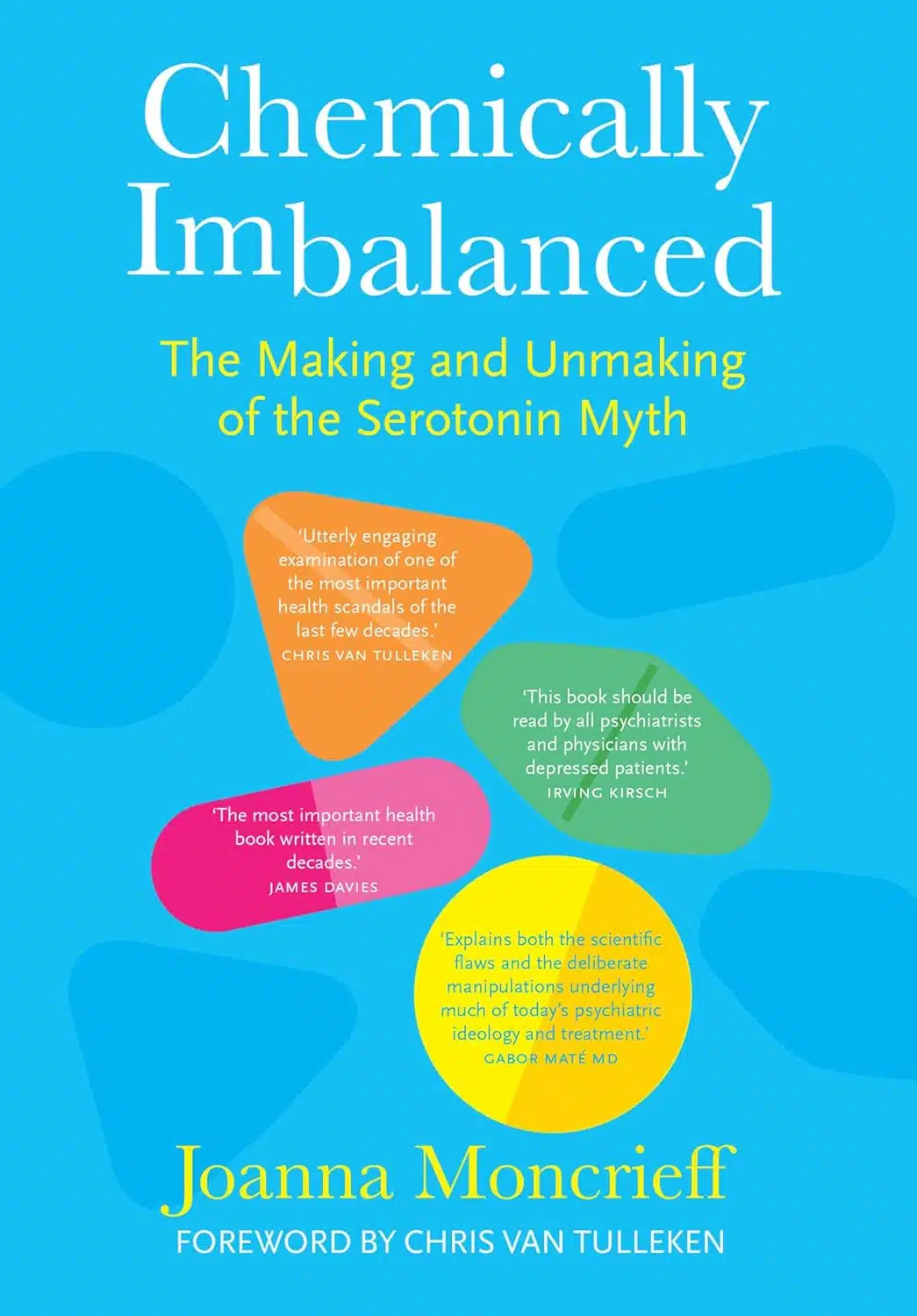
Chemically Imbalanced – by Dr. Joanna Moncrieff

10almonds is reader-supported. We may, at no cost to you, receive a portion of sales if you purchase a product through a link in this article.

The author, a professor of psychiatry, challenges the prevailing consensus that depression is often caused by a neurotransmitter imbalance, and as such, she further challenges the most popularly-prescribed class of antidepressants, SSRIs (selective serotonin reuptake inhibitors, whose job is do what it says on the tin, with the end goal of your brain having more serotonin in it because you’re keeping the serotonin you do make for longer).

Her position is that depression is only caused by—and can only be fixed by—external factors, and that any benefit from antidepressants is placebo (in contrast, at 10almonds we wrote a while back about the more widely-accepted explanation of the hit-and-miss nature of whether antidepressants help someone is that often people are simply taking the wrong class of antidepressants for their specific depression; see: Antidepressants: Personalization Is Key!).

She asserts that depression is not even a real medical condition, and is simply a social phenomenon, and she hopes that one day her colleagues in the profession will agree.

It’s worth noting that a more moderate version of the first part of her assertions (that personal life conditions are often a major causal factor) is a common view by prescribers in the author’s native UK, where doctors have coined a colorful name for this condition. However, SSRIs are usually still the first recourse, on a “try it and see” basis.

Dr. Moncrieff devotes several chapters to the unwanted side effects that can be experienced, and considers the incidence of such to be important enough—and persistent enough, sometimes lasting for a while after discontinuation—to be a violation of the “first, do no harm” principle.

The style is… confident, let’s say. The author accepts that there are a plurality of views—hers, and the wrong ones held by most people in her profession. She also encourages us as readers to make our own decisions—avoid antidepressants (and, in fact, psychiatric meds of any kind, especially antipsychotics for people experiencing psychosis), or destroy our health; it’s up to us. She recognizes that very many people believe antidepressants have changed their lives for the better—and she considers those now-happier people to be fools duped by Big Pharma.

Bottom line: on the one hand, this looks a lot like 288 pages of the author’s firmly-held confirmation bias; on the other hand, that doesn’t change the fact that it is worth at the very least considering, before embarking on a course of treatment, “why are we assuming that the issue is serotonin specifically?”, because (per the prevailing scientific consensus) sometimes it is, sometimes it isn’t.

Click here to check out Chemically Imbalanced, and consider the options!

Don’t Forget…

Did you arrive here from our newsletter? Don’t forget to return to the email to continue learning!

Learn to Age Gracefully

Join the 98k+ American women taking control of their health & aging with our 100% free (and fun!) daily emails:

  • More Health Risks From Cinnamon

    10almonds is reader-supported. We may, at no cost to you, receive a portion of sales if you purchase a product through a link in this article.

    Cinnamon contains, by default:

    • Beneficial phytochemicals (most notably: cinnamaldehyde)
    • Poison (here we are talking about: coumarin)

    However! Not all cinnamons are created equal, and of the two main kinds of cinnamon widely available in most of the world…

    • One kind has moderate levels of the beneficial phytochemicals and negligible levels of the poison
    • The other kind has high levels of the beneficial phytochemicals and very high levels of the poison

    Guess which kind is by far the most common on N. American supermarket shelves? If you guessed the second kind, you were right:

    Sweet Cinnamon vs Regular Cinnamon – Which is Healthier?

    Please note: if your cinnamon does not specifically claim to be Ceylon cinnamon (not poisonous), it is Cassia cinnamon (poisonous). In countries like the US that do not have stringent regulations around what advertisers can claim, it’s also possible they will simply label regular cinnamon as “sweet cinnamon” on the strength of it being adjectivally describable as sweet (plausible deniability) and/or the fact that they added sugar or some other sweetener to it (in which case they’ve gone beyond merely taking liberties, and are now taking the p—).

    You can read more about the distinctions between these two kinds of cinnamon, here: A Tale Of Two Cinnamons

    PS: if you’re wondering “how poisonous can it be if it’s readily available on supermarket shelves; isn’t this hyperbole?” then we direct your attention to the alcohol aisle or perhaps the tobacco kiosk. Stores will sell what they can get away with selling.

    It gets worse

    Cinnamon samples were studied from 104 commercially-available sources, and the following problems were found:

    About coumarin content specifically: 29.8% of samples posed health risks to children under 10 in just one teaspoonful, and given that the recommended safe amount is 0.1mg/kg, so even an adult could easily go over this with a couple of teaspoons of cassia cinnamon.

    Of the 104 sources tested…

    • 10 had lead content exceeding industry-acceptable safety levels
    • 13 contained levels coumarin beyond acceptable limits
    • 13 had elevated sulfur levels, meaning likely dangerous levels of sulfites.
    • 15 contained high levels of aluminum (up to 2g/kg, meaning the maximum safe amount of this cinnamon is about ¼ of a teaspoon).
    • 19 had high chromium levels (up to 20mg/kg), which is unregulated even in the EU, but known to be dangerous.

    About outright mislabelling:

    • 9% of “Ceylon” cinnamon samples were actually Cassia.
    • 11.4% showed signs of root adulteration (e.g. camphor, aluminum, silicon, titanium).
    • DNA tests found undeclared species like rice, onion, fenugreek, and mustard in some products.

    Only 33.7% were free from fraud, safety, or quality issues.

    You may be thinking: “well, 33.7% certainly isn’t great, but it could be worse”

    And, yes it could: those 104 samples were from the EU (famously high regulatory standards). So, if samples from the most safety-regulated place on Earth scored that badly, imagine what it might be like in places with less testing and fewer regulations!

    You can read the paper in full here: High rate of safety and fraud issues in commercially available cinnamon

    Want to learn more?

    Check out:

    Heavy Metals In Health Foods (And How To Reduce Them)

    Take care!

    Share This Post

  • Passion Fruit vs Persimmon – Which is Healthier?

    10almonds is reader-supported. We may, at no cost to you, receive a portion of sales if you purchase a product through a link in this article.

    Our Verdict

    When comparing passion fruit to persimmon, we picked the passion fruit.

    Why?

    You may be wondering: “what is this fruit passionate about?” and the answer is: delivering nutrients of many kinds!

    In terms of macros, passion fruit has a little more protein and a lot more fiber, while persimmon has more carbs. This means that while persimmon’s glycemic index isn’t bad, passion fruit’s glycemic index is a lot lower, which makes for an easy first round win for passion fruit.

    In the category of vitamins, passion fruit has a lot more of vitamins A, B2, B3, B6, B9, E, and K, while persimmon has more vitamin C. For the record passion fruit is also a good source of vitamin C, with a cup of passion fruit already giving a day’s daily dose of vitamin C, but persimmon gives twice that. Still, that’s a 7:1 win for passion fruit here.

    Looking at minerals, passion fruit has more copper, magnesium, phosphorus, potassium, selenium, and zinc, while persimmon has more calcium and iron, meaning a third win in a row for passion fruit, 6:2 this time.

    Adding up the sections makes for a clear overall win for passion fruit, but by all means enjoy either or both (passionately, even!), as diversity is great!

    Want to learn more?

    You might like to read:

    Glycemic Index vs Glycemic Load vs Insulin Index

    Take care!

    Share This Post

  • Ex-Cyclone Alfred has left flooding in its wake. Here’s how floods affect our health

    10almonds is reader-supported. We may, at no cost to you, receive a portion of sales if you purchase a product through a link in this article.

    Ex-Cyclone Alfred is bringing significant rainfall to southeast Queensland and the Northern Rivers of New South Wales. Flooding has hit Lismore, Ballina, Grafton, Brisbane and Hervey Bay, which received 150 mm of rainfall in two hours this morning.

    Tragically, a 61-year-old man died after being swept away in floodwaters near Dorrigo in northern New South Wales.

    More heavy rain and flash flooding is expected in the coming days as the weather system moves inland and weakens.

    Climate change is making these weather events more intense and frequent. Earlier this year, far north Queensland experienced major flooding. As residents of the Northern Rivers, this latest disaster is especially tough because only three years ago we faced the catastrophic 2022 floods.

    We’ve studied the impact of floods on human health and wellbeing, and found floods are linked to a range of physical and mental health effects in both the short- and long-term.

    So what might you experience if you live in an area affected by these floods?

    We reviewed the evidence

    We recently reviewed research on the physical and mental health impacts of floods across mainland Australia. We included 69 studies in our review, published over 70 years. The majority were from the past ten years, examining the effects of floods in Queensland and NSW.

    These studies suggest people can expect a range of health impacts. Immediate physical health effects of floods include drowning, falls and injuries.

    Chronic diseases such as diabetes or renal disease can also worsen due to factors such as reduced access to transport, health-care services, medications and hospitals.

    Exposure to contaminated floodwaters can lead to skin infections, while respiratory problems can occur due to mould and damp housing in the aftermath of floods.

    Floods also create ideal conditions for mosquito borne infections such as Ross River virus and Murray Valley encephalitis, while also spreading infectious diseases including leptospirosis, a bacterial infection from contaminated soil.

    There are mental health consequences too

    Our review showed floods also affect mental health. The more you’re exposed to floodwaters in your home or business, the worse the mental health impacts are likely to be.

    The After the Flood study examined mental health and wellbeing outcomes six months after the 2017 flood in the Northern Rivers. It found people who had floodwater in their home, yard or business, or who were displaced from their home for a more than six months, were much more likely to have probable post-traumatic stress disorder, anxiety or depression, compared to those who didn’t experience flooding or weren’t displaced.

    Repeated natural disasters could compound these mental health consequences. Southeast Queensland and the Northern Rivers in NSW have experienced multiple disasters over recent years. The Northern Rivers faced major flooding in 2017, bushfires in 2020, further major floods in 2022, and now Cyclone Alfred in 2025. These repeated disasters have taken a toll on our community, creating a seemingly never-ending cycle of recovery, rebuilding and preparation for the next disaster.

    Our understanding of the unique challenges faced by communities which experience multiple disasters is still growing. However, a recent Australian study showed exposure to repeated disasters has a compounding effect on people’s mental health, leading to worse mental health outcomes compared to people who experience a single disaster.

    Mums and babies

    The health effects of floods extend far beyond the initial emergency and beyond the infections and mental health consequences you might expect.

    The Queensland Flood Study tracked pregnant women exposed to the 2011 Brisbane floods. Researchers assessed mothers’ stress related to the flood and tracked them and their children at six weeks old, six months, 16 months, 2.5 years, four and six years. It found some links between prenatal stress and developmental outcomes in children.

    Mother breastfeeds baby
    Some evidence suggests maternal stress from floods can affect children’s development. Nastyaofly/Shutterstock

    While the health effects after flooding are diverse, the research to date is not comprehensive. We need to learn more about how floods contribute to or exacerbate existing chronic illnesses, disability and long-term mental health issues.

    The impacts are inequitable

    Flooding exposes and worsens existing inequalities. Socially vulnerable groups are more likely to be exposed to flooding in their homes and have less access to resources to respond and recover from these events, putting some groups at higher risk of negative health impacts afterwards.

    Some research has looked at the disproportionate impacts on people with disabilities and their carers, First Nations communities and people from disadvantaged backgrounds.

    After the 2017 Northern Rivers floods, for example, people with disability and their carers were more likely than others to:

    • experience disrupted access to food, support networks and essentials such as health care and social services
    • continue to be distressed about the flood six months after it happened
    • be at relatively high risk of post-traumatic stress disorder six months after the flood.

    However, targeted flood research exploring the experiences of these vulnerable groups in Australia is limited.

    Moving forward, it’s vital we examine the varied impacts of flood events for more vulnerable groups, so we can better support them in the wake of devastating events such as Cyclone Alfred.

    If this article has raised issues for you, or if you’re concerned about someone you know, call Lifeline on 13 11 14.

    Jodie Bailie, Senior Research Fellow, The University Centre for Rural Health and The Centre for Disability Research and Policy, University of Sydney; Jo Longman, Senior Research Fellow, The University Centre for Rural Health, University of Sydney; Rebecca McNaught, Research Fellow, Rural and Remote Health, University of Sydney, and Ross Bailie, School of Public Health, Honorary Professor, University of Sydney

    This article is republished from The Conversation under a Creative Commons license. Read the original article.

    Share This Post

  • Perfectionism, And How To Make Yours Work For You

    10almonds is reader-supported. We may, at no cost to you, receive a portion of sales if you purchase a product through a link in this article.

    Harness The Power Of Your Perfectionism

    A lot of people see perfectionism as a problem—and it can be that!

    We can use perfectionism as a would-be shield against our fear of failure, by putting things off until we’re better prepared (repeat forever, or at least until the deadliniest deadline that ever deadlined), or do things but really struggle to draw a line under them and check them off as “done” because we keep tweaking and improving and improving… With diminishing returns (forever). So, that’s not helpful.

    But, if we’re mindful, we can also leverage our perfectionism to our benefit.

    Great! How?

    First we need to be able to discern the ways in which perfectionism can be bad or good for us. Or as it’s called in psychology, ways in which our perfectionism can be maladaptive or adaptive.

    • Maladaptive: describing a behavioral adaptation to our environment—specifically, a reactive behavioral adaptation that is unhealthy and really is not a solution to the problem at hand
    • Adaptive: describing a behavioral adaptation to our environment—specifically, a responsive behavioral adaptation that is healthy and helps us to thrive

    So in the case of perfectionism, one example for each might be:

    • Maladaptive: never taking up that new hobby, because you’re just going to suck at it anyway, and what’s the point if you’re not going to excel? You’re a perfectionist, and you don’t settle for anything less than excellence.
    • Adaptive: researching the new hobby, learning the basics, and recognizing that even if the results are not immediately perfect, the learning process can be… Yes, even with mistakes along the way, for they too are part of learning! You’re a perfectionist, and you’re going to be the best possible student of your new hobby.

    Did you catch the key there?

    When it comes to approaching things we do in life—either because we want to or because we must—there are two kinds of mindset: goal-oriented, and task-oriented.

    Broadly speaking, each has their merits, and as a general topic, it’s beyond the scope of today’s main feature. Here we’re looking at it in the context of perfectionism, and in that frame, there’s a clear qualitative difference:

    • The goal-oriented perfectionist will be frustrated to the point of torment, at not immediately attaining the goal. Everything short of that will be a means to an end, at best. Not fun.
    • The task-oriented perfectionist will take joy in going about the task in the best way possible, and optimizing their process as they go. The journey itself will be rewarding and a tangible product of their consistent perfectionism.

    The good news is: you get to choose! You’re not stuck in a box.

    If you’re thinking “I’m a perfectionist and I’m generally a goal-oriented person”, that’s fine. You’re just going to need to reframe your goals.

    • Instead of: my goal is to be fluent in Arabic
      • …so you never speak it, because to err is human, all too human, and you’re a perfectionist, so you don’t want that!
    • Let’s try: my goal is to study Arabic for at least 15 minutes per day, every day, without fail, covering at least some new material each time, no matter how small the increase
      • …and then you go and throw yourself into conversation way out of your depth, make mistakes, and get corrections, because that’s how you learn, and you’re a perfectionist, so you want that!

    This goes for any field of expertise, of course.

    • If you want to play the violin solo in Carnegie Hall, you have to pick up your violin and practice each day.
    • If you want to be a world-renowned pastry chef, you have to make a consistent habit of baking.
    • If you want to write a bestselling book, you have to show up at your keyboard.

    Be perfect all you want, but be the perfect student.

    And as your skills grow, maybe you’ll upgrade that to also being the perfect practitioner, and perhaps later still, the perfect teacher.

    But just remember:

    Perfection comes not from the end goal (that would be backwards thinking!) but from the process (which includes mistakes; they’re an important part of learning; embrace them and grow!), so perfect that first.

    Don’t Forget…

    Did you arrive here from our newsletter? Don’t forget to return to the email to continue learning!

    Learn to Age Gracefully

    Join the 98k+ American women taking control of their health & aging with our 100% free (and fun!) daily emails:

  • The Hormone Therapy That Reduces Breast Cancer Risk & More

    10almonds is reader-supported. We may, at no cost to you, receive a portion of sales if you purchase a product through a link in this article.

    The Hormone Balancing Act

    We’ve written before about menopausal HRT:

    What You Should Have Been Told About Menopause Beforehand

    …and even specifically about the considerations when it comes to breast cancer risk:

    Menopausal Hormone Replacement Therapy

    this really does bear reading, by the way—scroll down to the bit about breast cancer risk, because it’s not a simple increased/decreased risk; it can go either way, and which way it goes will depend on various factors including your medical history and what HRT, if any, you are taking.

    Hormone Modulating Therapy

    Hormone modulating therapy, henceforth HMT, is something a little different.

    Instead of replacing hormones, as hormone replacement therapy does, guess what hormone modulating therapy does instead? That’s right…

    MHT can modulate hormones by various means, but the one we’re going to talk about today does it by blocking estrogen receptors,

    Isn’t that the opposite of what we want?

    You would think so, but since for many people with an increased breast cancer risk, the presence of estrogen increases that risk, which leaves menopausal (peri- or post) people in an unfortunate situation, having to choose between increased breast cancer risk (with estrogen), or osteoporosis and increased dementia risk, amongst other problems (without).

    However, the key here (in fact, that’s a very good analogy) is in how the blocker works. Hormones and their receptors are like keys and locks, meaning that the wrong-shaped hormone won’t accidentally trigger it. And when the right-shaped hormone comes along, it gets activated and the message (in this case, “do estrogenic stuff here!” gets conveyed). A blocker is sufficiently similar to fit into the receptor, without being so similar as to otherwise act as the hormone.

    In this case, it has been found that HMT blocking estrogen receptors was sufficient to alleviate the breast cancer risk, while also being associated with a 7% lower risk of developing Alzheimer’s disease or related dementias, with that risk reduction being even greater for some demographics depending on race and age. Black women in the 65–74 age bracket enjoyed a 24% relative risk reduction, with white women of the same age getting an 11% relative risk reduction. Black women enjoyed the same benefits after that age, whereas white women starting it at that age did not get the same benefits. The conclusion drawn from this is that it’s good to start this at 65 if relevant and practicable, especially if white, because the protective effect is strongest when gained aged 65–69.

    Here’s a pop-science article that goes into the details more deeply than we have room for here:

    Hormone therapy for breast cancer linked with lower dementia risk

    And here’s the paper itself; we highly recommend reading at least the abstract, because it goes into the numbers in much more detail than we reasonably can here. It’s a huge cohort study of 18,808 women aged 65 years or older, so this is highly relevant data:

    Alzheimer Disease and Related Dementia Following Hormone-Modulating Therapy in Patients With Breast Cancer

    Want to learn more?

    If you’d like a much deeper understanding of breast cancer risk management, including in the context of hormone therapy, you might like this excellent book that we reviewed recently:

    The Smart Woman’s Guide to Breast Cancer – by Dr. Jenn Simmons

    Take care!

    Don’t Forget…

    Did you arrive here from our newsletter? Don’t forget to return to the email to continue learning!

    Learn to Age Gracefully

    Join the 98k+ American women taking control of their health & aging with our 100% free (and fun!) daily emails:

  • Why 7 Hours Sleep Is Not Enough

    10almonds is reader-supported. We may, at no cost to you, receive a portion of sales if you purchase a product through a link in this article.

    How Sleep-Deprived Are You, Really?

    This is Dr. Matthew Walker. He’s a neuroscientist and sleep specialist, and is the Director of the Center for Human Sleep Science at UC Berkeley’s Department of Psychology. He’s also the author of the international bestseller “Why We Sleep”.

    What does he want us to know?

    Sleep deprivation is more serious than many people think it is. After about 16 hours without sleep, the brain begins to fail, and needs more than 7 hours of sleep to “reset” cognitive performance.

    Note: note “seven or more”, but “more than seven”.

    After ten days with only 7 hours sleep (per day), Dr. Walker points out, the brain is as dysfunctional as it would be after going without sleep for 24 hours.

    Here’s the study that sparked a lot of Dr. Walker’s work:

    The Cumulative Cost of Additional Wakefulness: Dose-Response Effects on Neurobehavioral Functions and Sleep Physiology From Chronic Sleep Restriction and Total Sleep Deprivation

    Importantly, in Dr. Walker’s own words:

    Three full nights of recovery sleep (i.e., more nights than a weekend) are insufficient to restore performance back to normal levels after a week of short sleeping❞

    ~ Dr. Matthew Walker

    See also: Why You Probably Need More Sleep

    Furthermore: the sleep-deprived mind is unaware of how sleep-deprived it is.

    You know how a drunk person thinks they can drive safely? It’s like that.

    You do not know how sleep-deprived you are, when you are sleep-deprived!

    For example:

    ❝(60.7%) did not signal sleepiness before a sleep fragment occurred in at least one of the four MWT trials❞

    Source: Sleepiness is not always perceived before falling asleep in healthy, sleep-deprived subjects

    Sleep efficiency matters

    With regard to the 7–9 hours band for optimal health, Dr. Walker points out that the sleep we’re getting is not always the sleep we think we’re getting:

    ❝Assuming you have a healthy sleep efficiency (85%), to sleep 9 hours in terms of duration (i.e. to be a long-sleeper), you would need to be consistently in bed for 10 hours and 36 minutes a night. ❞

    ~ Dr. Matthew Walker

    At the bottom end of that, by the way, doing the same math: to get only the insufficient 7 hours sleep discussed earlier, a with a healthy 85% sleep efficiency, you’d need to be in bed for 8 hours and 14 minutes per night.

    The unfortunate implication of this: if you are consistently in bed for 8 hours and 14 minutes (or under) per night, you are not getting enough sleep.

    “But what if my sleep efficiency is higher than 85%?”

    It shouldn’t be.If your sleep efficiency is higher than 85%, you are sleep-deprived and your body is having to enforce things.

    Want to know what your sleep efficiency is?

    We recommend knowing this, by the way, so you might want to check out:

    Head-To-Head Comparison of Google and Apple’s Top Sleep-Monitoring Apps

    (they will monitor your sleep and tell you your sleep efficiency, amongst other things)

    Want to know more?

    You might like his book:

    Why We Sleep: Unlocking the Power of Sleep and Dreams

    …and/or his podcast:

    The Matt Walker Podcast

    …and for those who like videos, here’s his (very informative) TED talk:

    !

    Prefer text? Click here to read the transcript

    Want to watch it, but not right now? Bookmark it for later

    Enjoy!

    Don’t Forget…

    Did you arrive here from our newsletter? Don’t forget to return to the email to continue learning!

    Learn to Age Gracefully

    Join the 98k+ American women taking control of their health & aging with our 100% free (and fun!) daily emails: