
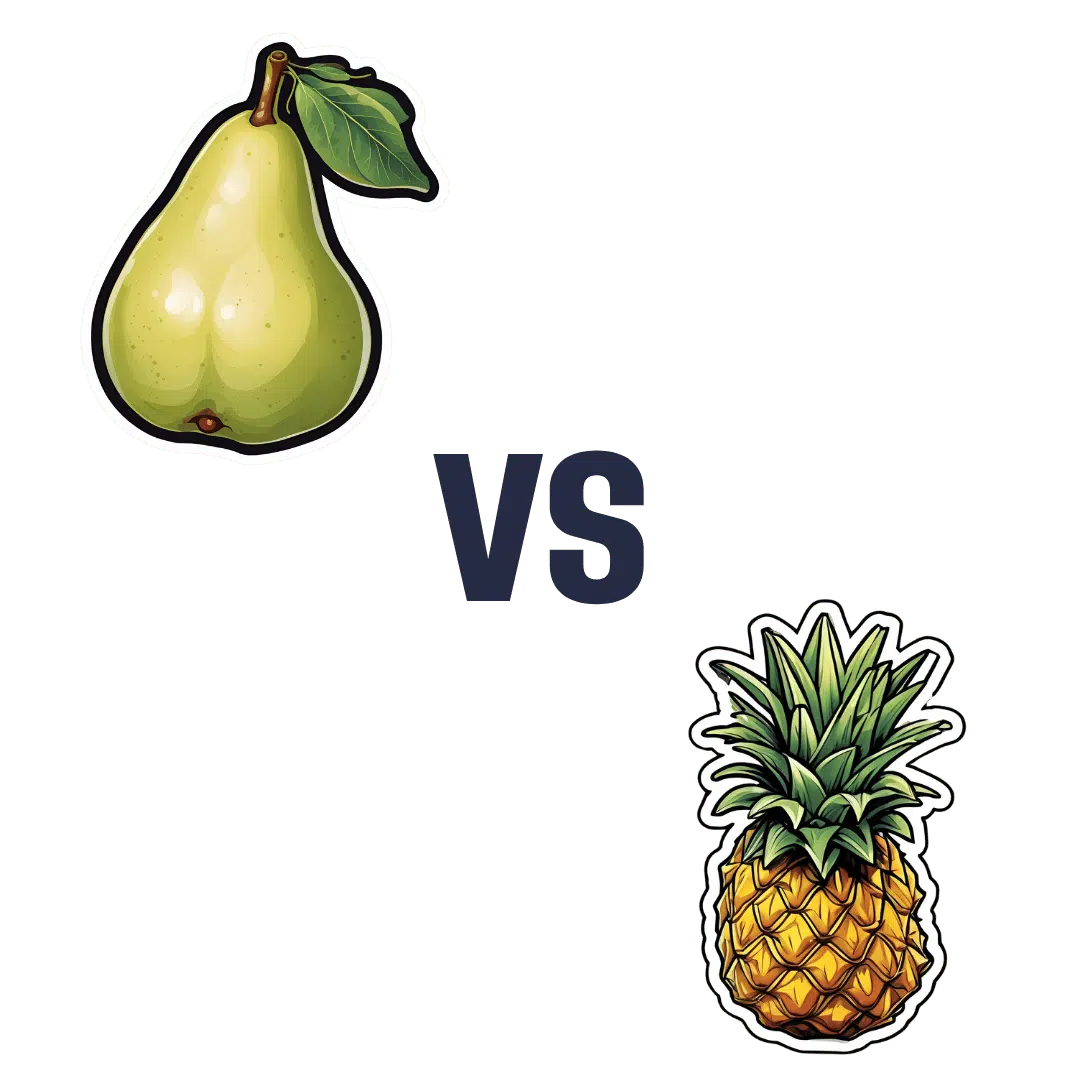
Pear vs Pineapple – Which is Healthier?
10almonds is reader-supported. We may, at no cost to you, receive a portion of sales if you purchase a product through a link in this article.
Our Verdict
When comparing pear to pineapple, we picked the pineapple.
Why?
They do both have their merits, and pear started off strong!
In terms of macros, pears have 2x the fiber, for approximately the same carbs and protein, winning in this category.
In the category of vitamins, pear has more of vitamins E and K, while pineapple has more of vitamins A, B1, B2, B3, B5, B6, B7, B9, C, and choline, winning easily.
Looking at minerals, pear has more phosphorus and potassium, while pineapple has more calcium, copper, iron, magnesium, manganese, and zinc, scoring another win for pineapple.
In other considerations, pineapple gives a lot of extra benefits because it contains bromelain, an enzymatic mixture that is unique to it—you can read all about that in the link below!
Adding up the sections makes for a clear overall win for pineapple, but by all means enjoy either or both; diversity is good!
Want to learn more?
You might like:
Bromelain vs Inflammation & Much More
Enjoy!
Don’t Forget…
Did you arrive here from our newsletter? Don’t forget to return to the email to continue learning!
Recommended
Learn to Age Gracefully
Join the 98k+ American women taking control of their health & aging with our 100% free (and fun!) daily emails:
-
Chickpeas vs Peas – Which is Healthier?
10almonds is reader-supported. We may, at no cost to you, receive a portion of sales if you purchase a product through a link in this article.
Our Verdict
When comparing chickpeas to peas, we picked the chickpeas.
Why?
Both are great! But…
In terms of macros, chickpeas have more protein, fiber, and carbs, the ratio of which latter two also gives them the lower glycemic index. It’s worth noting that peas are not far behind chickpeas here, but by the numbers, it’s a win for chickpeas in this category.
In the category of vitamins, chickpeas have more of vitamins B9, E, and choline, while peas have more of vitamins A, B1, B2, B3, B5, B6, C, and K. So, a win for peas this time!
When it comes to minerals, however, chickpeas have more calcium, copper, iron, magnesium, manganese, phosphorus, potassium, selenium, and zinc, while peas are not higher in any minerals.
Adding up the sections gives a 2:1 victory for chickpeas, but by all means enjoy either or both; diversity is good!
Want to learn more?
You might like:
Plant vs Animal Protein: Head to Head
Enjoy!
Share This Post
-
NAD⁺ vs Long COVID!
10almonds is reader-supported. We may, at no cost to you, receive a portion of sales if you purchase a product through a link in this article.
Before we get to talking about long COVID, a word on nicotinamide adenine dinucleotide (or NAD+ to its friends) itself.
It’s most well-known in the context of healthy aging, and that’s because:
- NAD+ levels decline with age
- The aforementioned decline is a causal factor in aging
- Boosting NAD+ levels can, thus, slow aging
Learn more: Therapeutic Potential of NAD-Boosting Molecules: The In Vivo Evidence
There are actually also other NAD-boosting molecules besides NAD itself and its precursors. For example, the liver will not produce NADᐩ unless it has aminocarboxymuconate-semialdehyde decarboxylase (or “ACMSD”, to its friends), which limits the production of NADᐩ. Why, you ask? The theory is that it is a kind of evolutionary conservativism, much like not lighting a fire without the ability to put it out. In any case, taking ACMSD-blockers will thus result in an increased endogenous production of NADᐩ.
You can read about this here: De novo NAD+ synthesis enhances mitochondrial function and improves health
For these reasons, NAD+ is one of Dr. Greger’s Anti-Aging Eight ← we wrote about NAD+ here
But what about NAD+ vs long COVID?
The latest science
Researchers (Dr. Edmarie Guzmán-Vélez et al.) investigated how boosting NAD⁺ with nicotinamide riboside (NR) can ease long-COVID symptoms such as brain fog, fatigue, executive dysfunction, and sleep problems.
How they tested it:
- They gave one group 2,000 mg/day NR for 20 weeks
- They gave the other group a placebo for 10 weeks before switching to NR for the next 10 weeks.
- They measured NAD⁺ levels and tested fatigue, executive function, sleep, and mood at baseline, week 10, and week 20.
As for how that went:
❝In post-hoc exploratory analysis, examining within-group changes during 5 and 10 weeks of NR intake by grouping all participants during the first 10 weeks of the NR phase, there were significant differences from baseline after 10 weeks of NR in executive functioning, fatigue severity, sleep quality, and symptoms of depression❞
(specifically: the “significant differences” were significant improvements)
Read the paper in full: Effects of nicotinamide riboside on NAD+ levels, cognition, and symptom recovery in long-COVID: a randomized controlled trial
If you’d like to try more things like this, then consider: 12 Most Powerful Supplements and Foods to Increase Energy & Slow Down Aging
And definitely check out: What Can Be Done About Long COVID?
Want to try some?
We don’t sell it, but here for your convenience is an example product on Amazon 😎
Enjoy!
Share This Post
-
Paving The Way To Good Health
10almonds is reader-supported. We may, at no cost to you, receive a portion of sales if you purchase a product through a link in this article.
This is Dr. Michelle Tollefson. She’s a gynecologist, and a menopause and lifestyle medicine expert. She’s also a breast cancer survivor, and, indeed, thriver.
So, what does she want us to know?
A Multivector Approach To Health
There’s a joke that goes: a man is trapped in a flooding area, and as the floodwaters rise, he gets worried and begins to pray, but he is interrupted when some people come by on a raft and offer him to go with them. He looks at the rickety raft and says “No, you go on, God will spare me”. He returns to his prayer, and is further interrupted by a boat and finally a helicopter, and each time he gives the same response. He drowns, and in the afterlife he asks God “why didn’t you spare me from the flood?”, and God replies “I sent a raft, a boat, and a helicopter; what more did you want?!”
People can be a bit the same when it comes to different approaches to cancer and other serious illness. They are offered chemotherapy and say “No, thank you, eating fruit will spare me”.
Now, this is not to trivialize those who decline aggressive cancer treatments for other reasons such as “I am old and would rather not go through that; I’d rather have a shorter life without chemo than a longer life with it”—for many people that’s a valid choice.
But it is to say: lifestyle medicine is, mostly, complementary medicine.
It can be very powerful! It can make the difference between life and death! Especially when it comes to things like cancer, diabetes, heart disease, etc.
But it’s not a reason to decline powerful medical treatments if/when those are appropriate. For example, in Dr. Tollefson’s case…
Synergistic health
Dr. Tollefson, herself a lifestyle medicine practitioner and gynecologist (and having thus done thousands of clinical breast exams for other people, screening for breast cancer), says she owes her breast cancer survival to two things, or rather two categories of things:
- a whole-food, plant predominant diet, daily physical activity, prioritizing sleep, minimizing stress, and a strong social network
- a bilateral mastectomy, 16 rounds of chemotherapy, removal of her ovaries, and several reconstructive surgeries
Now, one may wonder: if the first thing is so good, why need the second?
Or on the flipside: if the second thing was necessary, what was the point of the first?
And the answer she gives is: the first thing was the reason she was able to make it through the second thing.
And on the next level: the second thing was the reason she’s still around to talk about the first thing.
In other words: she couldn’t have done it with just one or the other.
A lot of medicine in general, and lifestyle medicine in particular, is like this. If we note that such-and-such a thing decreases our risk of cancer mortality by 4%, that’s a small decrease, but it can add up (and compound!) if it’s surrounded by other things that also each decrease the risk by 12%, 8%, 15%, and so on.
Nor is this only confined to cancer, nor only to the positives.
Let’s take cardiovascular disease: if a person smokes, drinks, eats red meat, stresses, and has a wild sleep schedule, you can imagine those risk factors add up and compound.
If this person and another with a heart-healthy lifestyle both have a stroke (it can happen to anyone, even if it’s less likely in this case), and both need treatment, then two things are true:
- They are both still going to need treatment (medicines, and possibly a thrombectomy)
- The second person is most likely to recover, and most likely to recover more quickly and easily
The second person can be said to have paved the way to their recovery, with their lifestyle.
Which is really important, because a lot of people think “what’s the point in living so healthily if [disease] strikes anyway?” and the answer is:
A very large portion of your recovery is predicated on how you lived your life before The Bad Thing™ happened, and that can be the difference between bouncing back quickly and a long struggle back to health.
Or the difference between a long struggle back to health, or a short struggle followed by rapid decline and death.
In short:
Play the odds, improve your chances with lifestyle medicine. Enjoy those cancer-fighting fruits:
Top 8 Fruits That Prevent & Kill Cancer
…but also, get your various bits checked when appropriate; we know, mammograms and prostate checks etc are not usually the highlight of most people’s days, but they save lives. And if it turns out you need serious medical interventions, consider them seriously.
And, by all means, enjoy mood-boosting nutraceuticals such as:
12 Foods That Fight Depression & Anxiety
…but also recognize that sometimes, your brain might have an ongoing biochemical problem that a tablespoon of pumpkin seeds isn’t going to fix.
And absolutely, you can make lifestyle adjustments to reduce the risks associated with menopause, for example:
Menopause, & How Lifestyle Continues To Matter “Postmenopause”
…but also be aware that if the problem is “not enough estrogen”, sometimes to solution is “take estrogen”.
And so on.
Want to know Dr. Tollefson’s lifestyle recommendations?
Most of them will not be a surprise to you, and we mentioned some of them above (a whole-food, plant predominant diet, daily physical activity, prioritizing sleep, minimizing stress, and a strong social network), but for more specific recommendations, including numbers etc, enjoy:
Click Here If The Embedded Video Doesn’t Load Automatically!
Take care!
Share This Post
Related Posts
-
The Diets & Supplements That Can Mess Up Your Skin
10almonds is reader-supported. We may, at no cost to you, receive a portion of sales if you purchase a product through a link in this article.
Many health trends are centered around beauty in one way or another, and skin health is a common one. However, sometimes these well-intended efforts can backfire!
Today we’ll be sharing the results of some research into how things can wrong:
Diets that are common culprits
The following are partially-overlapping categories, but we’re going with what was used in the study (which we’ll link at the bottom):
- Keto: amongst many other problems, this commonly leads to keto rash (prurigo pigmentosa), with red, itchy plaques on the neck, trunk, and face; this problem is further compounded because low awareness among clinicians causes frequent misdiagnosis.
- See also: Ketogenic Diet: Burning Fat Or Burning Out? ← it can work for short term fat loss, but long-term, the risks add up quickly
- Carnivore: eliminates plant nutrients and fiber, which omissions are disastrous for the health (especially the gut, heart, and brain), and in the category of skin health specifically, means skin immunity issues due to loss of gut microbiota support, and also inviting scurvy, thus, poor wound healing—unless you’re eating a lot of raw liver every day, in which case, your vitamin C needs will be met, and it’s only all the other problems you’ll need to worry about.
- See also: Do We Need Animal Products To Be Healthy? ← the answer is most of us don’t (but also, most of us can benefit from some), but we sure do need plants
- Paleo: can in principle be done healthily, but based on the data, how people most often do paleo usually leans far too heavily on the meat and scantily on the plants, resulting far too much salt and saturated fat, and not nearly enough of many micronutrients, and usually low on fiber.
- Raw vegan: can in principle be done healthily, but poorly planned versions risk deficiencies in iron, B12, protein, essential fatty acids, and biotin—causing glossitis, dry skin, brittle nails, or hyperpigmentation. Unless you have a specific-to-you medical reason, there’s no reason to skip the (by necessity: cooked) legumes that bring most of these nutrients to most vegans.
- See also: Whole-Food Plant-Based: Better Than The Mediterranean? ← by some metrics yes, but it’s important to do it right
And, applicable for all four of those, which all share a theme of going against the grain, so to speak: Grains: Bread Of Life, Or Cereal Killer?
Supplements that are common culprits
You can, in fact, have too much of a good thing, and supplements make it very easy to overdo it:
- Selenium: has a very narrow safety range, and excess causes hair loss, nail dystrophy, and more—ironically, since it is usually marketed as improving those things (which in small doses, it does)
- Niacin: leads to skin flushing and, if regularly taken excessively, exfoliative dermatitis (itchy flaky skin) and/or erythroderma (reddened scaly skin); commonly seen with high-dose supplements or energy drinks.
- Zinc: zinc is critical for many things, but an excess of it reduces copper absorption, causing skin and hair pigment loss, ulcers, anemia, and neuropathy.
- Protein: whey protein is pro-inflammatory and worsens acne via IGF-1 and androgen stimulation (and also messes with insulin signalling while it’s at it, but that’s more of a whole-body problem than a skin problem); collagen, meanwhile, is fine in the recommended range of 5–20g/day, but can get in the way of the microbiome at high doses, which can in turn cause inflammatory issues.
- Bodybuilding supplements: a broad category here but for a reason—it’s because they often contain unregulated and/or mislabeled ingredients, including steroids and stimulants, leading to cystic acne, hair loss, and stretch marks.
You can read the paper itself, here: When Diet Trends Go Viral: Cutaneous Manifestations of Social Media-Driven Fad Diets and Supplements
Want to learn more?
Here’s one way to do it right:
The Diet That Slows Skin Aging ← just be sure to hit the recommended levels of those nutrients, not the 10x, 100x, 1000x, etc as can be offered in some supplements!
Take care!
Don’t Forget…
Did you arrive here from our newsletter? Don’t forget to return to the email to continue learning!
Learn to Age Gracefully
Join the 98k+ American women taking control of their health & aging with our 100% free (and fun!) daily emails:
- Keto: amongst many other problems, this commonly leads to keto rash (prurigo pigmentosa), with red, itchy plaques on the neck, trunk, and face; this problem is further compounded because low awareness among clinicians causes frequent misdiagnosis.
-
Pear vs Peach – Which is Healthier?
10almonds is reader-supported. We may, at no cost to you, receive a portion of sales if you purchase a product through a link in this article.
Our Verdict
When comparing pears to peaches, we picked the peaches.
Why?
Both are great! But peaches are exceptional in some ways that pears just can’t match up to:
In terms of macros, pears have more carbs and fiber, the ratio of which results in an approximately equal glycemic index. Thus, we’ll say that pears win this round by virtue of being the nutritionally denser option.
Looking at the vitamins, pears have (slightly) more of vitamins B6, B9, and K, while peaches have (much) more of vitamins A, B1, B2, B3, B5, B7, C, E, and choline—thus sweeping this category easily for peaches.
In the category of minerals, pears have more calcium and copper, while peaches have more iron, magnesium, manganese, phosphorus, potassium, and zinc. This time, the margins of difference for each mineral are comparably low (i.e. pears are close behind peaches on all those minerals), but still, by strength of numbers, it’s a clear win for peaches.
When it comes to polyphenols, not only do peaches have more, but also, they have anticancer properties that pears don’t—see our link below for more about that!
Meanwhile, adding up the sections makes for an overall win for peaches, but as ever when it comes to fruits, by all means enjoy either or both; diversity is good!
Want to learn more?
You might like to read:
Top 8 Fruits That Prevent & Kill Cancer ← peaches in the #2 spot! They induce cell death in cancer cells while sparing healthy ones
Enjoy!
Don’t Forget…
Did you arrive here from our newsletter? Don’t forget to return to the email to continue learning!
Learn to Age Gracefully
Join the 98k+ American women taking control of their health & aging with our 100% free (and fun!) daily emails:
-
The 5 Training Rules To Build Your Metabolism (Not Just Lose Weight)
10almonds is reader-supported. We may, at no cost to you, receive a portion of sales if you purchase a product through a link in this article.
Cori Lefkowitz of “Strong At Every Age” shows us how:
Strong body, strong metabolism
Diet is an important factor in whether you lose weight, but strength training determines what you lose—fat versus muscle—and that distinction shapes how lean you actually look.
A mistake that many people make: heavy cardio plus calorie restriction makes your body more efficient (yay) by shedding metabolically expensive muscle (oh no), slowing your metabolism, and stalling fat loss over time, and/or increasing it as soon as you eat more food than is required to survive (at which point, we’re rescinding the “yay”).
In contrast, resistance training preserves and builds muscle, thus supports hormones and insulin sensitivity, raises resting metabolic rate, and pushes your body to burn fat instead of muscle during a deficit. So that’s what we’ll be doing instead.
Five tips to do it right:
- Prioritize compound lifts: base workouts around big movements like squats, deadlifts, presses, rows, lunges, and pull-ups to maximize muscle recruitment and long-term metabolic impact.
- Train the system, not body parts: use full-body or functional splits instead of traditional body-part days to train muscles more frequently, and thus create stronger metabolic signals with less gym time.
- Increase training density: use supersets, circuits, and paired exercises to do more meaningful work per minute—but still without turning strength training into pure cardio!
- Chase stimulus, not just load: muscle growth comes from mechanical tension, metabolic stress, and muscle damage (the body will not adapt if it’s not given a reason to adapt; it’s efficient like that, so we need to give it a compelling reason to adapt, and that compelling reason is (small, manageable!) damage to muscle fibers), so make sure to vary tools, tempos, ranges of motion, and positions, instead of only adding weight.
- Use activation in your warm-up: short activation drills before lifting improve muscle recruitment, stability, and hypertrophy potential, making each workout more effective.
Some myths to not fall for
- “Lifting makes you bulky”: true muscle gain requires years of structured training and sufficient calories; most “bulk” fears are bloat, inflammation, or fat masking muscle.
- “Soreness equals success”: soreness reflects novelty, not effectiveness; consistent, repeatable stimulus drives real progress.
- “The numbers on the scale don’t lie”: fat loss is a body composition change, so measurements, photos, strength gains, and how clothes fit matter more than scale weight.
For more on all of this, enjoy:
Click Here If The Embedded Video Doesn’t Load Automatically!
Want to learn more?
You might also like:
Burn! How To Boost Your Metabolism
Take care!
Don’t Forget…
Did you arrive here from our newsletter? Don’t forget to return to the email to continue learning!
Learn to Age Gracefully
Join the 98k+ American women taking control of their health & aging with our 100% free (and fun!) daily emails:


