
Paving The Way To Good Health
10almonds is reader-supported. We may, at no cost to you, receive a portion of sales if you purchase a product through a link in this article.

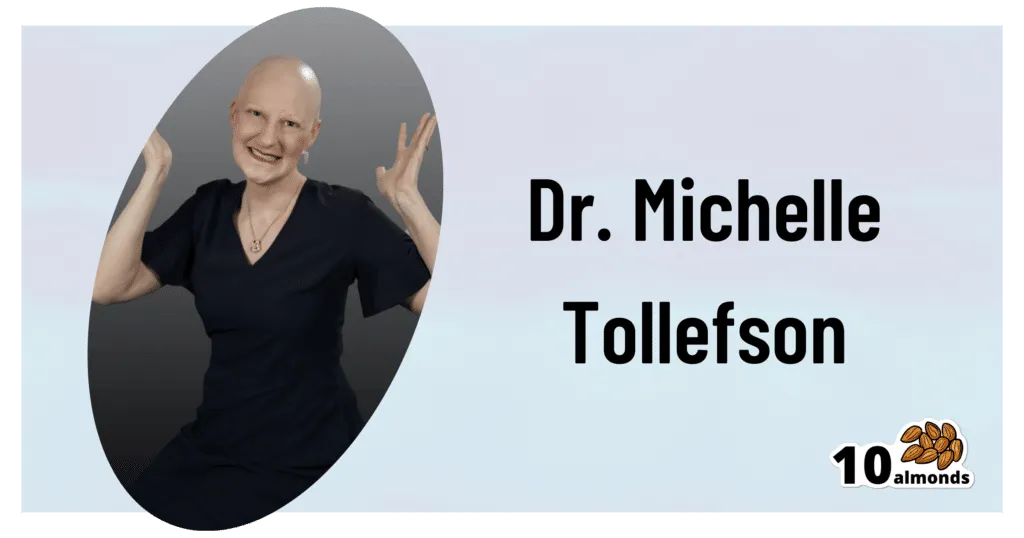
This is Dr. Michelle Tollefson. She’s a gynecologist, and a menopause and lifestyle medicine expert. She’s also a breast cancer survivor, and, indeed, thriver.
So, what does she want us to know?
A Multivector Approach To Health
There’s a joke that goes: a man is trapped in a flooding area, and as the floodwaters rise, he gets worried and begins to pray, but he is interrupted when some people come by on a raft and offer him to go with them. He looks at the rickety raft and says “No, you go on, God will spare me”. He returns to his prayer, and is further interrupted by a boat and finally a helicopter, and each time he gives the same response. He drowns, and in the afterlife he asks God “why didn’t you spare me from the flood?”, and God replies “I sent a raft, a boat, and a helicopter; what more did you want?!”
People can be a bit the same when it comes to different approaches to cancer and other serious illness. They are offered chemotherapy and say “No, thank you, eating fruit will spare me”.
Now, this is not to trivialize those who decline aggressive cancer treatments for other reasons such as “I am old and would rather not go through that; I’d rather have a shorter life without chemo than a longer life with it”—for many people that’s a valid choice.
But it is to say: lifestyle medicine is, mostly, complementary medicine.
It can be very powerful! It can make the difference between life and death! Especially when it comes to things like cancer, diabetes, heart disease, etc.
But it’s not a reason to decline powerful medical treatments if/when those are appropriate. For example, in Dr. Tollefson’s case…
Synergistic health
Dr. Tollefson, herself a lifestyle medicine practitioner and gynecologist (and having thus done thousands of clinical breast exams for other people, screening for breast cancer), says she owes her breast cancer survival to two things, or rather two categories of things:
- a whole-food, plant predominant diet, daily physical activity, prioritizing sleep, minimizing stress, and a strong social network
- a bilateral mastectomy, 16 rounds of chemotherapy, removal of her ovaries, and several reconstructive surgeries
Now, one may wonder: if the first thing is so good, why need the second?
Or on the flipside: if the second thing was necessary, what was the point of the first?
And the answer she gives is: the first thing was the reason she was able to make it through the second thing.
And on the next level: the second thing was the reason she’s still around to talk about the first thing.
In other words: she couldn’t have done it with just one or the other.
A lot of medicine in general, and lifestyle medicine in particular, is like this. If we note that such-and-such a thing decreases our risk of cancer mortality by 4%, that’s a small decrease, but it can add up (and compound!) if it’s surrounded by other things that also each decrease the risk by 12%, 8%, 15%, and so on.
Nor is this only confined to cancer, nor only to the positives.
Let’s take cardiovascular disease: if a person smokes, drinks, eats red meat, stresses, and has a wild sleep schedule, you can imagine those risk factors add up and compound.
If this person and another with a heart-healthy lifestyle both have a stroke (it can happen to anyone, even if it’s less likely in this case), and both need treatment, then two things are true:
- They are both still going to need treatment (medicines, and possibly a thrombectomy)
- The second person is most likely to recover, and most likely to recover more quickly and easily
The second person can be said to have paved the way to their recovery, with their lifestyle.
Which is really important, because a lot of people think “what’s the point in living so healthily if [disease] strikes anyway?” and the answer is:
A very large portion of your recovery is predicated on how you lived your life before The Bad Thing™ happened, and that can be the difference between bouncing back quickly and a long struggle back to health.
Or the difference between a long struggle back to health, or a short struggle followed by rapid decline and death.
In short:
Play the odds, improve your chances with lifestyle medicine. Enjoy those cancer-fighting fruits:
Top 8 Fruits That Prevent & Kill Cancer
…but also, get your various bits checked when appropriate; we know, mammograms and prostate checks etc are not usually the highlight of most people’s days, but they save lives. And if it turns out you need serious medical interventions, consider them seriously.
And, by all means, enjoy mood-boosting nutraceuticals such as:
12 Foods That Fight Depression & Anxiety
…but also recognize that sometimes, your brain might have an ongoing biochemical problem that a tablespoon of pumpkin seeds isn’t going to fix.
And absolutely, you can make lifestyle adjustments to reduce the risks associated with menopause, for example:
Menopause, & How Lifestyle Continues To Matter “Postmenopause”
…but also be aware that if the problem is “not enough estrogen”, sometimes to solution is “take estrogen”.
And so on.
Want to know Dr. Tollefson’s lifestyle recommendations?
Most of them will not be a surprise to you, and we mentioned some of them above (a whole-food, plant predominant diet, daily physical activity, prioritizing sleep, minimizing stress, and a strong social network), but for more specific recommendations, including numbers etc, enjoy:
Click Here If The Embedded Video Doesn’t Load Automatically!
Take care!
Don’t Forget…
Did you arrive here from our newsletter? Don’t forget to return to the email to continue learning!
Recommended

Learn to Age Gracefully
Join the 98k+ American women taking control of their health & aging with our 100% free (and fun!) daily emails:
-
Lies I Taught in Medical School – by Dr. Robert Lufkin
10almonds is reader-supported. We may, at no cost to you, receive a portion of sales if you purchase a product through a link in this article.
There seems to be a pattern of doctors who practice medicine one way, get a serious disease personally, and then completely change their practice of medicine afterwards. This is one of those cases.
Dr. Lufkin here presents, on a chapter-by-chapter basis, the titularly promised “lies” or, in more legally compliant speak (as he acknowledges in his preface), flawed hypotheses that are generally taught as truths. In many cases, the “lie” is some manner of “xyz is normal and nothing to worry about”, and/or “there is nothing to be done about xyz; suck it up”.
The end result of the information is not complicated—enjoy a plants-forward whole foods low-carb diet to avoid metabolic diseases and all the other things to branch off from same (Dr. Lufkin makes a fair case for metabolic disease leading to a lot of secondary diseases that aren’t considered metabolic diseases per se). But, the journey there is actually important, as it answers a lot of questions that are much less commonly understood, and often not even especially talked-about, despite their great import and how they may affect health decisions beyond the dietary. Things like understanding the downsides of statins, or the statistical models that can be used to skew studies, per relative risk reduction and so forth.
Bottom line: this book gives the ins and outs of what can go right or wrong with metabolic health and why, and how to make sure you don’t sabotage your health through missing information.
Click here to check out Lies I Taught In Medical School, and arm yourself with knowledge!
Share This Post
-
Why Getting Lean Is Hard… But Staying Lean Gets Easier
10almonds is reader-supported. We may, at no cost to you, receive a portion of sales if you purchase a product through a link in this article.
Cori Lefkowitz, of “Strong at Every Age”, shares the light at the end of the tunnel:
Do less 🙂
This is because the real challenge of getting lean is… the closer you get to your goal, the slower progress becomes, and trying to do more by cutting calories further or training harder often backfires by causing burnout and rebound.
Three key ideas to keep in mind here;
- Consistency beats intensity: long-term leanness comes from doing slightly less but more consistently, adapting effort to your current season of life rather than forcing extremes.
- Fat loss and maintenance are different: what you do to reach a lean state is not what you do to maintain it, but you also can’t return to old habits without losing results.
- Habit change takes time: habits take 3–4 months to build, lifestyles take 16–18 months, and identity-level change can take 3–4 years, so early discomfort doesn’t mean failure.
“Set points” matter a lot too, both ways: yes, your body resists fat loss at first, but (if you’re keeping your habits steady) also later resists regain, which is why maintenance becomes easier over time.
That said, no single routine works forever, and training, nutrition, and structure may need to shift across seasons, travel, work demands, and life changes. A key part of that adaptability is remembering that when perfection isn’t possible, doing something imperfectly is far more effective than doing nothing and starting over later.
Lastly, remember that time is the real catalyst: the leaner you get, the slower any further fat loss is, and doubling your expected timeline makes consistency easier and results better.
For more on all of this, enjoy:
Click Here If The Embedded Video Doesn’t Load Automatically!
Want to learn more?
You might also like:
Mid-Life Weight Loss’s Hidden Cost To The Brain ← another reason for favoring steady near-maintenance over rushed weight loss
Take care!
Share This Post
-
We Hope This Email Blows Your Tits Clean Off
10almonds is reader-supported. We may, at no cost to you, receive a portion of sales if you purchase a product through a link in this article.
The Right Kind Of “Email Hacks”!
Are you a Gmailer or an Outlookista? Whatever your preference, you’re probably facing many of the same challenges that most of us face in our work and personal lives:
Email’s greatest strength (its ease of accessibility) brings about its greatest problem (our inboxes are cluttered and chaotic), not to mention that each of us are usually managing a whole flock of email addresses.
Sometimes we put productivity resources up against each other; that’s not what we’re going to do today! Each of these can play a role alongside each other; grab as many as will make your life easier:
ProtonMail: this is an email client; it’s the nicest, simplest, easiest, free email client that doesn’t track, let alone share, everything you do.
Bonus: there also exists ProtonCalendar (it’s a calendar that doesn’t share your data), ProtonDrive (it’s a cloud storage provider that doesn’t share your data) and, because they’re indeed serious about your privacy, ProtonVPN (it’s a VPN that, of course, doesn’t share your data).
Clean Email: maybe you’re stuck with the email provider you have. It happens. But it doesn’t have to be a chaotic mess. This tool will make tidying your email (and keeping it tidy!) a simplified dream.
See How Clean Your Email Can Get With Just A Few Clicks!
Right Inbox: a Gmail extension with many useful features, including read receipts, emails scheduled for later (e.g: time your email to send at 7am to look like a morning lark when in fact you’re peacefully snoozing), add unforwardable “For Your Eyes Only” notes to emails, and more.
Power Up Your Gmail With The Right Inbox Extension!
Email Finder: find the verified work email address of any person, so long as you know what company you’re looking for them in! No more “I thought it was lastname.firstname@ and it was firstname.lastname@”, no more “the wrong John Smith”, no more “undelivered” bounceback notices. Just: your email delivered.
Never Hear From The Mailer Daemon Again, With Email Finder!
Unroll.me: love your subscriptions, but hate the clutter? Unroll.me aggregates them for you in a virtual roll-up, with an “unroll” button to read them.
Get What You Really Want From Your Subscriptions, With Unroll.Me!
On which note, anything you’d like to hear more of from us? Let us know! You can always just hit reply, or use the feedback widget at the bottom of this email
Share This Post
Related Posts
-
Why is migraine more common in women than men?
10almonds is reader-supported. We may, at no cost to you, receive a portion of sales if you purchase a product through a link in this article.
We’ve known for a long time that women are more likely than men to have migraine attacks.
As children, girls and boys experience migraine equally. But after puberty, women are two to three times more likely to experience this potentially debilitating condition.
Recently, an Australian study showed it may be even more common than we previously thought – as many as one in three women live with migraine.
For comparison, migraine affects roughly one in 15 men in Australia.
So, what’s behind the difference? Here’s what we know.
More than a headache
Migraine is not just a bad headache – it is a complex disorder that causes the brain to process sensory information abnormally.
This means “migraine brains” can have difficulty processing information from any of the five senses:
- sight (leading to problems with light sensitivity and glare)
- sound (leading to noise sensitivity)
- smell (certain smells can trigger headaches)
- touch (leading to face or scalp tenderness)
- taste (causing distorted taste, nausea and vomiting).
Migraine attacks typically last anywhere from four hours to three days – but can be longer.
In addition to the symptoms above, attacks can include throbbing head pain, dizziness, fatigue and difficulty concentrating. It is these extra symptoms that help diagnose migraine – not the location of head pain or pain severity.
Why are attacks more frequent in women?
Puberty is when the difference between men and women emerges. This is when our bodies massively increase the production of sex hormones.
People are often surprised to learn that both men and women produce oestrogen, progesterone and testosterone. Testosterone levels are higher in men, whereas women have higher levels of oestrogen and progesterone.
However, it is not just the type of hormone that makes a difference, but the way they fluctuate over time.
For many women, there are certain “milestone moments” when their migraine tends to worsen due to hormonal fluctuations – puberty, menstruation, pregnancy and perimenopause (the lead-up to your final period).
For example, some women notice migraine flare-ups every month, linked to phases in their monthly menstrual cycle when oestrogen levels drop.
They might even be able to predict when their period will start, as migraine attacks typically start a few days before the bleeding.
How hormones affect the brain
Women with migraine can be more sensitive to hormonal changes. This is particularly the case for sudden decreases in oestrogen. But even more subtle changes to hormone levels can cause migraine attacks.
These hormonal changes can activate brain processes that trigger migraine, such as cortical spreading depression. This is a very slow wave of electrical activity that spreads in the brain, causing some areas to function more slowly than others after it passes.
Decrease in oestrogen can also affect how we receive and process information through the trigeminal nerve. This plays a key role in the onset and maintenance of migraine pain.
Oestrogen can affect how we process information through the trigeminal nerve. ttsz/Getty All kinds of fluctuations can be a trigger
Pregnancy can often destabilise migraine again and make attacks more likely, even when someone has previously enjoyed a period of good migraine control.
Migraine symptoms often become uncontrolled in the first trimester in particular, due to rapid hormonal changes needed to sustain a pregnancy. This usually settles in the second and third trimesters, when hormonal changes stabilise.
However, giving birth is yet another change.
Towards the end of pregnancy, oestrogen levels can be 30 times higher than pre-pregnancy levels, and progesterone can be 20 times higher. When these hormones plummet back to normal after giving birth, migraine attacks can often sharply worsen again.
Perimenopause can also involve random surges of oestrogen from the dwindling supplies of eggs within the ovaries – which previously produced these hormones cyclically and in abundance. This irregular hormone production can cause random spikes in migraine attacks. It can be extra challenging when combined with other symptoms of menopause such as hot flushes or mood changes.
Hormonal contraceptives and menopause hormone therapy can also affect migraine control. Sometimes, supplementing hormones at a regular, steady daily dose can help manage the hormone-sensitive headaches and other symptoms. However, for others, adding extra hormones can cause head pain to flare up.
Does migraine run in the family?
Genes also play a role. It’s not a coincidence that migraine is passed down in families through the maternal side.
This is because mothers pass on mitochondria to children (while fathers do not). Mitochondria are parts inside the cell that control energy.
People with migraine have fewer functional enzymes within their mitochondria, meaning their brains are in an energy-deficient state. This worsens with migraine attacks as there is even more stress to the system.
This is also why extra stress (such as sleep deprivation, missed meals, or emotional stress) can trigger a migraine and worsen pain.
There is also a strong link between migraine in women and anxiety and depression – conditions women are more likely to develop in response to stressful life events.
Knowing your own patterns
If you suspect hormones may be affecting your migraine attacks, it is helpful to keep a diary of symptoms, including headaches. Mark each day per month where you get migraine symptoms, as well as your period, to find patterns.
Identifying patterns in pain flares helps doctors guide you to a personalised medication plan, which may include hormone therapies or non-hormonal therapies.
Lakshini Gunasekera, PhD Candidate in Neurology, Monash University; Caroline Gurvich, Associate Professor and Clinical Neuropsychologist, Monash University; Eveline Mu, Research Fellow in Women’s Mental Health, Monash University, and Jayashri Kulkarni, Professor of Psychiatry, Monash University
This article is republished from The Conversation under a Creative Commons license. Read the original article.
Don’t Forget…
Did you arrive here from our newsletter? Don’t forget to return to the email to continue learning!
Learn to Age Gracefully
Join the 98k+ American women taking control of their health & aging with our 100% free (and fun!) daily emails:
-
The New Optimum Nutrition Bible – by Patrick Holford
10almonds is reader-supported. We may, at no cost to you, receive a portion of sales if you purchase a product through a link in this article.
While the author is not “Dr. Patrick Holford”, it’s worth mentioning that he is a career nutritionist with half the alphabet after his name, and decades of experience in the field.
Next, before getting into the real review of the book, we’ll also mention that his career has not been without controversy, but this has mostly been when he has strayed out of his field, such as when he bought into the (since not only soundly refuted, but outright demonstrated to be fraudulent) claim that the MMR vaccine causes autism.
In this book, he focuses on nutrition, and as such, the only nutritional advice that hasn’t stood the test of time was that he errantly claimed vitamin C could outperform the antiviral drugs of the day in beating HIV (a claim that would have killed anyone with HIV who believed it and swapped their AVT for vitamin C).
But the rest? Honestly, he was prescient in many respects. Arguably, this meant he came to conclusions for which the science was quite new at the time of writing, so perhaps indicative of the same person who believed the aforementioned false claims, but fact is, there he was, in the 90s, arguing for what has since come to be known as nutritional psychiatry and is now backed by decades more science, as well as championing phytochemicals that back then were little-known and/or ignored, but that we now know to have very potent beneficial effects; he talked about antinutrients that hardly anyone was talking about then, and more and more and more.
Bottom line: 49 chapters, each on a different nutrition-related health topic, and one of them had an overly bold nutritional claim that didn’t stand the test of time? We think that’s pretty good.
Click here to check out The New Optimum Nutrition Bible, and see how comprehensive it is!
Don’t Forget…
Did you arrive here from our newsletter? Don’t forget to return to the email to continue learning!
Learn to Age Gracefully
Join the 98k+ American women taking control of their health & aging with our 100% free (and fun!) daily emails:
-
The Worst Halloween Candy For Teeth?
10almonds is reader-supported. We may, at no cost to you, receive a portion of sales if you purchase a product through a link in this article.
…and other items from this week in the health science world:
More than a sour taste in your mouth
Everyone knows that sugar is bad for teeth; mostly only know that this is because it feeds harmful bacteria in the mouth, though.
People also know that acid isn’t good for the teeth, either! And after eating sugary foods, your mouth becomes more acidic and starts pulling minerals like calcium and potassium from your teeth.
So, guess what makes it worst of all? Food that’s sugary and acidic! Consequently, sour candies are the absolute worst, since they combine sugar with high acidity from ingredients like citric, malic, tartaric, and fumaric acids. that acidic mix rapidly lowers mouth pH and weakens tooth enamel.
And on a population level, it’s getting worse: sales of sour treats have surged by about 70% over the past decade, driven by viral “sour candy challenges”, and it’s not only kids: around 1 in 8 adults now seek intensely sour sensations too.
Two quick tips in this regard:
- Do not brush your teeth right away! It only spreads the acid and worsens enamel damage. Instead, rinse with water, floss if needed, and wait at least 30 minutes before brushing with your usual toothpaste.
- If (like this writer) you love sour foods: naturally sour foods like pickles, sauerkraut, and kombucha can benefit gut health, and unlike sour candies, they aren’t sugary, and thus are much less harmful to your teeth. You should still drink plenty of water with them though, as a) it rinses the acid b) fermented foods are often a bit high in salt, so hydration keeps things balanced.
Read in full: This common Halloween candy might be the scariest thing you eat
Related: From Apples to Bees, and High-Fructose Cs: Which Sugars Are Healthier, And Which Are Just The Same?
The blood of long life
Researchers (Dr. Motohiro Sekiya et al.) at the University of Tsukuba have discovered that a molecule found in the blood (known to its friends as CtBP2), appears to act as a master regulator of aging across the body.
How it works: it functions as a metabolic sensor, adjusting to changes in energy balance. When active, it supports healthy metabolism and cellular communication; when it declines, systemic aging accelerates.
This is quite big news, as it means aging is coordinated throughout the body rather than occurring in isolated organs—when CtBP2 activity drops, multiple systems appear to age together. Definitely another argument for tackling our health holistically!
Read in full: A hidden blood molecule may hold the secret to healthy aging and long life
Related: Blood Labs Demystified – by Dr. Ken Berry & Kim Howerton
The witch doctor is in
Fun fact: before the 14th century, women folk healers were accepted as essential community medical providers, but the rise of university-trained male physicians and church power led to their demonization as “witches”.
Ok, maybe that latter part isn’t so fun. And to add insult to injury, this also meant that as women were persecuted from the 14th to mid-18th centuries, a remarkable lot of traditional herbal knowledge was suppressed or outright lost.
Modern researchers are now reassessing the plants once used in “witches’ brews” for their pharmacological value. Many “magical ingredients” are erstwhile common names for certain plants, for example:
- Eye of newt: mustard seed (Sinapis alba)—shown to have anti-inflammatory, cardioprotective, and anti-tumour effects.
- Wool of bat: holly leaves—can lower blood fats and cholesterol, though toxic in large doses.
- Tongue of dog: hound’s tongue—historically used for malaria and hepatitis but contains liver-toxic pyrrolizidine alkaloids.
- Adder’s fork: adder’s-tongue fern—used for wound healing and circulation, now also found in cosmetic formulations.
There were also psychoactive phytochemicals that saw use, for example:
- Flying ointments: made from tropane alkaloid plants like deadly nightshade and henbane, absorbed through skin to cause hallucinations and sensations of flight—essentially an early form of transdermal delivery.
- Furthermore, the idea of witches flying with broomsticks between their legs likely came from this, too. Transdermal absorption is strongest places with thin skin and a lot of capillaries, making the armpits and groin amongst the most effective application sites to brush the ointment onto, and the other best sites are places with an accessible mucus membrane, which means bodily orifices. Add these two facts together, and there’s one very obvious most potent application site.
- Sleep potions: included foxglove (source of cardiac glycosides) and Indian snakeroot (source of reserpine, later rediscovered as a blood-pressure drug).
- Love potions: used mandrake, Ephedra sinica, and betel nut, all stimulant or euphoric agents; at higher doses they became poisonous though.
We don’t recommend these!
Read in full: Women folk healers were branded as witches, but their treatments may have been medically sound
Related: Herbs For Evidence-Based Health & Healing
Take care!
Don’t Forget…
Did you arrive here from our newsletter? Don’t forget to return to the email to continue learning!
Learn to Age Gracefully
Join the 98k+ American women taking control of their health & aging with our 100% free (and fun!) daily emails:


