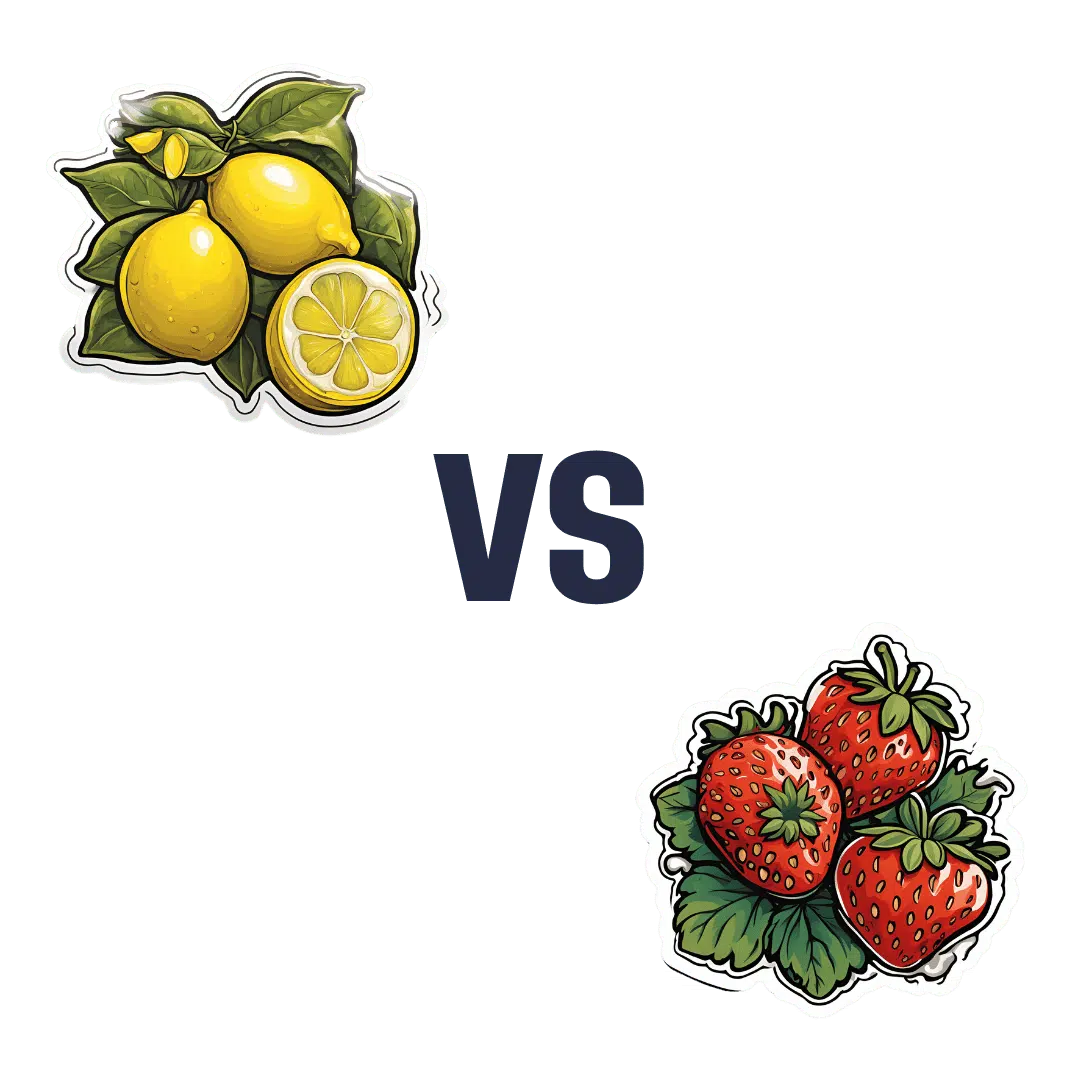
Lemons vs Strawberries – Which is Healthier?

10almonds is reader-supported. We may, at no cost to you, receive a portion of sales if you purchase a product through a link in this article.

Our Verdict

When comparing lemons to strawberries, we picked the strawberries.

Why?

Both have their merits!

In terms of macros, the only meaningful difference is that lemons have 50% more fiber, scoring a slender first-round victory.

In the category of vitamins, however, lemons have more of vitamins B1, B5, and B6, while strawberries have more of vitamins B2, B3, B7, B9, C, E, and K, winning by a fair margin in this round.

Looking at minerals next, lemons boast only (slightly) more calcium and iron, while strawberries have more copper, magnesium, manganese, phosphorus, potassium, and zinc, winning another round easily.

In other considerations, strawberries are much higher in polyphenols, as can be expected of most berries, so that’s another point in strawberries’ favor.

Adding up the section makes for a clear overall win for strawberries, but by all means enjoy either or both, as diversity is good!

Want to learn more?

You might like:

Eat These 8 Anti-Inflammatory Foods for Healthy, Glowing Skin!

Enjoy!

Don’t Forget…

Did you arrive here from our newsletter? Don’t forget to return to the email to continue learning!

Learn to Age Gracefully

Join the 98k+ American women taking control of their health & aging with our 100% free (and fun!) daily emails:

  • Top 10 Unhealthy Foods: How Many Do You Eat?

    10almonds is reader-supported. We may, at no cost to you, receive a portion of sales if you purchase a product through a link in this article.

    The items on this list won’t come as a shocking surprise to you, but it can be a good opportunity to do a quick tally and see how many of these have snuck into your diet:

    The things that take away health instead of adding it

    Without further ado, they are…

    • Alcohol: not only is it high in empty calories, but also it’s bad for pretty much everything, especially increasing the risks of liver disease, high blood pressure, and stroke.
    • Processed snacks: low in nutrition; contain unhealthy fats, refined sugars, and artificial additives that often aren’t great.
    • Potato chips: get their own category for being especially high in fat, sodium, and empty calories; contribute to heart disease and weight gain.
    • Processed cheese: some kinds of cheese are gut-healthy in moderation, but this isn’t. Instead, it’s just loaded with saturated fats, sodium, and sugars, and is pretty much heart disease in a slice.
    • Donuts: deep-fried, sugary, and made with refined flour; cause blood sugar spikes and crashes, and what’s bad for your blood sugars is bad for almost everything else.
    • French fries & similar deep-fried foods: high in saturated fats and sodium; contribute to obesity and heart issues, are not great for blood sugars either.
    • White bread: made with refined flour; cause blood sugar spikes and metabolic woes.
    • Sodas: high in sugar or artificial sweeteners; can easily lead to weight gain, diabetes, and tooth decay.
    • Processed meats: high in calories and salt; strongly associated with heart disease and cancer.
    • Hot dogs & fast food burgers: get their own category for being the absolute worst of the above-mentioned processed meats.

    This writer scored: no / rarely / no / no / no / rarely / rarely / rarely / no / no

    How about you?

    Click Here If The Embedded Video Doesn’t Load Automatically!

    Want to learn more?

    You might also like to read:

    Beat Food Addictions!

    Take care!

    Share This Post

  • What You Don’t Know Can Kill You

    10almonds is reader-supported. We may, at no cost to you, receive a portion of sales if you purchase a product through a link in this article.

    Knowledge Is Power!

    This is Dr. Simran Malhotra. She’s triple board-certified (in lifestyle medicine, internal medicine, and palliative care), and is also a health and wellness coach.

    What does she want us to know?

    Three things:

    Wellness starts with your mindset

    Dr. Malhotra shifted her priorities a lot during the initial and perhaps most chaotic phase of the COVID pandemic:

    ❝My husband, a critical care physician, was consumed in the trenches of caring for COVID patients in the ICU. I found myself knee-deep in virtual meetings with families whose loved ones were dying of severe COVID-related illnesses. Between the two of us, we saw more trauma, suffering, and death, than we could have imagined.

    The COVID-19 pandemic opened my eyes to how quickly life can change our plans and reinforced the importance of being mindful of each day. Harnessing the power to make informed decisions is important, but perhaps even more important is focusing on what is in our control and taking action, even if it is the tiniest step in the direction we want to go!❞

    ~ Dr. Simran Malhotra

    We can only make informed decisions if we have good information. That’s one of the reasons we try to share as much information as we can each day at 10almonds! But a lot will always depend on personalized information.

    There are one-off (and sometimes potentially life-saving) things like health genomics:

    The Real Benefit Of Genetic Testing

    …but also smaller things that are informative on an ongoing basis, such as keeping track of your weight, your blood pressure, your hormones, and other metrics. You can even get fancy:

    Track Your Blood Sugars For Better Personalized Health

    Lifestyle is medicine

    It’s often said that “food is medicine”. But also, movement is medicine. Sleep is medicine. In short, your lifestyle is the most powerful medicine that has ever existed.

    Lifestyle encompasses very many things, but fortunately, there’s an “80:20 rule” in play that simplifies it a lot because if you take care of the top few things, the rest will tend to look after themselves:

    These Top Few Things Make The Biggest Difference To Overall Health

    Gratitude is better than fear

    If we receive an unfavorable diagnosis (and let’s face it, most diagnoses are unfavorable), it might not seem like something to be grateful for.

    But it is, insofar as it allows us to then take action! The information itself is what gives us our best chance of staying safe. And if that’s not possible e.g. in the worst case scenario, a terminal diagnosis, (bearing in mind that one of Dr. Malhotra’s three board certifications is in palliative care, so she sees this a lot), it at least gives us the information that allows us to make the best use of whatever remains to us.

    See also: Managing Your Mortality

    Which is very important!

    …and/but possibly not the cheeriest note on which to end, so when you’ve read that, let’s finish today’s main feature on a happier kind of gratitude:

    How To Get Your Brain On A More Positive Track (Without Toxic Positivity)

    Want to hear more from Dr. Malhotra?

    Showing how serious she is about how our genes do not determine our destiny and knowledge is power, here she talks about her “previvor’s journey”, as she puts it, with regard to why she decided to have preventative cancer surgery in light of discovering her BRCA1 genetic mutation:

    Click Here If The Embedded Video Doesn’t Load Automatically

    Take care!

    Share This Post

  • Spirulina vs Nori – Which is Healthier?

    10almonds is reader-supported. We may, at no cost to you, receive a portion of sales if you purchase a product through a link in this article.

    Our Verdict

    When comparing spirulina to nori, we picked the nori.

    Why?

    In the battle of the seaweeds, if spirulina is a superfood (and it is), then nori is a super-dooperfood. So today is one of those “a very nutritious food making another very nutritious food look bad by standing next to it” days. With that in mind…

    In terms of macros, they’re close to identical. They’re both mostly water with protein, carbs, and fiber. Technically nori is higher in carbs, but we’re talking about 2.5g/100g difference.

    In the category of vitamins, spirulina has more vitamin B1, while nori has a lot more of vitamins A, B2, B3, B5, B6, B9, C, E, K, and choline.

    When it comes to minerals, it’s a little closer but still a clear win for nori; spirulina has more copper, iron, and magnesium, while nori has more calcium, manganese, phosphorus, potassium, and zinc.

    Want to try some nori? Here’s an example product on Amazon 😎

    Want to learn more?

    You might like to read:

    21% Stronger Bones in a Year at 62? Yes, It’s Possible (No Calcium Supplements Needed!) ← nori was an important part of the diet enjoyed here

    Take care!

    Share This Post

  • Is owning a dog good for your health?

    10almonds is reader-supported. We may, at no cost to you, receive a portion of sales if you purchase a product through a link in this article.

    Australia loves dogs. We have one of the highest rates of pet ownership in the world, and one in two households has at least one dog.

    But are they good for our health?

    Mental health is the second-most common reason cited for getting a dog, after companionship. And many of us say we “feel healthier” for having a dog – and let them sleep in our bedroom.

    Here’s what it means for our physical and mental health to share our homes (and doonas) with our canine companions.

    Pogodina Natalia/Shutterstock

    Are there physical health benefits to having a dog?

    Having a dog is linked to lower risk of death over the long term. In 2019, a systematic review gathered evidence published over 70 years, involving nearly four million individual medical cases. It found people who owned a dog had a 24% lower risk of dying from any cause compared to those who did not own a dog.

    A golden retriever pants on the grass next to a ball.
    Having a dog may help lower your blood pressure through more physical activity. Barnabas Davoti/Pexels

    Dog ownership was linked to increased physical activity. This lowered blood pressure and helped reduce the risk of stroke and heart disease.

    The review found for those with previous heart-related medical issues (such as heart attack), living with a dog reduced their subsequent risk of dying by 35%, compared to people with the same history but no dog.

    Another recent UK study found adult dog owners were almost four times as likely to meet daily physical activity targets as non-owners. Children in households with a dog were also more active and engaged in more unstructured play, compared to children whose family didn’t have a dog.

    Exposure to dirt and microbes carried in from outdoors may also strengthen immune systems and lead to less use of antibiotics in young children who grow up with dogs.

    A boy in sunglasses talks to his jack russell terrier on a beach.
    Children in households with a dog were often more active. Maryshot/Shutterstock

    Health risks

    However, dogs can also pose risks to our physical health. One of the most common health issues for pet owners is allergies.

    Dogs’ saliva, urine and dander (the skin cells they shed) can trigger allergic reactions resulting in a range of symptoms, from itchy eyes and runny nose to breathing difficulties.

    A recent meta-analysis pooled data from nearly two million children. Findings suggested early exposure to dogs may increase the risk of developing asthma (although not quite as much as having a cat does). The child’s age, how much contact they have with the dog and their individual risk all play a part.

    Slips, trips and falls are another risk – more people fall over due to dogs than cats.

    Having a dog can also expose you to bites and scratches which may become infected and pose a risk for those with compromised immune systems. And they can introduce zoonotic diseases into your home, including ring worm and Campylobacter, a disease that causes diarrhoea.

    For those sharing the bed there is an elevated the risk of allergies and picking up ringworm. It may result in lost sleep, as dogs move around at night.

    On the other hand some owners report feeling more secure while co-sleeping with their dogs, with the emotional benefit outweighing the possibility of sleep disturbance or waking up with flea bites.

    Proper veterinary care and hygiene practices are essential to minimise these risks.

    A dog peers out from under a doona while a man sleeps.
    Many of us don’t just share a home with a dog – we let them sleep in our beds. Claudia Mañas/Unsplash

    What about mental health?

    Many people know the benefits of having a dog are not only physical.

    As companions, dogs can provide significant emotional support helping to alleviate symptoms of anxiety, depression and post-traumatic stress. Their presence may offer comfort and a sense of purpose to individuals facing mental health challenges.

    Loneliness is a significant and growing public health issue in Australia.

    In the dog park and your neighbourhood, dogs can make it easier to strike up conversations with strangers and make new friends. These social interactions can help build a sense of community belonging and reduce feelings of social isolation.

    For older adults, dog walking can be a valuable loneliness intervention that encourages social interaction with neighbours, while also combating declining physical activity.

    However, if you’re experiencing chronic loneliness, it may be hard to engage with other people during walks. An Australian study found simply getting a dog was linked to decreased loneliness. People reported an improved mood – possibly due to the benefits of strengthening bonds with their dog.

    Three dogs on leash sniff each other.
    Walking a dog can make it easier to talk to people in your neighbourhood. KPegg/Shutterstock

    What are the drawbacks?

    While dogs can bring immense joy and numerous health benefits, there are also downsides and challenges. The responsibility of caring for a dog, especially one with behavioural issues or health problems, can be overwhelming and create financial stress.

    Dogs have shorter lifespans than humans, and the loss of a beloved companion can lead to depression or exacerbate existing mental health conditions.

    Lifestyle compatibility and housing conditions also play a significant role in whether having a dog is a good fit.

    The so-called pet effect suggests that pets, often dogs, improve human physical and mental health in all situations and for all people. The reality is more nuanced. For some, having a pet may be more stressful than beneficial.

    Importantly, the animals that share our homes are not just “tools” for human health. Owners and dogs can mutually benefit when the welfare and wellbeing of both are maintained.

    Tania Signal, Professor of Psychology, School of Health, Medical and Applied Sciences, CQUniversity Australia

    This article is republished from The Conversation under a Creative Commons license. Read the original article.

    Don’t Forget…

    Did you arrive here from our newsletter? Don’t forget to return to the email to continue learning!

    Learn to Age Gracefully

    Join the 98k+ American women taking control of their health & aging with our 100% free (and fun!) daily emails:

  • Dioscorea Villosa: Hormones, Arthritis, & Skin

    10almonds is reader-supported. We may, at no cost to you, receive a portion of sales if you purchase a product through a link in this article.

    On A Wild Yam Chase?

    We recently came across a supplement blend that had wild yam extract as a minor ingredient. Our plucky (and usually very knowledgable) researcher had never heard of its use before, so she set about doing her thing. This is what she found…

    What health claims are made?

    Wild yam extract (Dioscorea villosa) is traditionally sold and used for:

    • Balancing hormones
    • Combating arthritis
    • Anti-aging effects for the skin

    Does it balance hormones?

    First, as a quick catch-up, we’ll drop a previous article of ours for your convenience:

    What Does “Balance Your Hormones” Even Mean?

    We couldn’t find almost any studies into wild yam extract’s hormone-balancing effects, but we did find one study, and:

    ❝Symptom scores showed a minor effect of both placebo and active treatment on diurnal flushing number and severity and total non-flushing symptom scores, and on nocturnal sweating after placebo, but no statistical difference between placebo and active creams.

    This study suggests that short-term treatment with topical wild yam extract in women suffering from menopausal symptoms is free of side-effects, but appears to have little effect on menopausal symptoms❞

    …which is a very thorough, polite, sciencey way of saying “wow, this does so many different kinds of nothing”

    Source: Effects of wild yam extract on menopausal symptoms, lipids and sex hormones in healthy menopausal women

    On the one hand, this was a small study (n=23). On the other hand, it was also literally the only study we could find.

    Does it combat arthritis?

    Maybe! We again didn’t find much research into this but we did find two in vitro studies that suggests that diosgenin (which can be derived from wild yam extract) helps:

    And we also found a rodent study that found that wild yam extract specifically helped against “acetic acid-induced writhing and formalin-induced pain“, and put that down to anti-inflammatory properties:

    Read: Bioassay-guided evaluation of Dioscorea villosa – an acute and subchronic toxicity, antinociceptive and anti-inflammatory approach

    So, none of these studies tell us much about whether it would be helpful for humans—with or without arthritis, and hopefully without “acetic acid-induced writhing and formalin-induced pain”.

    However, they do suggest that it would be reasonable to test in humans next.

    You might prefer:

    Does it keep skin young?

    Again, research is thin on the ground, but we did find some! A study with wild-yam-derived diosgenin found that it didn’t make anything worse, and otherwise performed a similar role to vitamin A:

    Read: Novel effects of diosgenin on skin aging

    That was on rats with breast cancer though, so its applicability to healthy humans may be tenuous (while in contrast, simply getting vitamin A instead is a known deal).

    Summary

    • Does it balance hormones? It probably does little to nothing in this regard
    • Does it combat arthritis? It probably has anti-inflammatory effects, but we know of no studies in humans. There are much more well-established anti-inflammatories out there.
    • Does it keep the skin young? We know that it performs a role similar to vitamin A for rats with breast cancer, and didn’t make anything worse for them. That’s the extent of what we know.

    Where can I get some?

    In the unlikely event that the above research review has inspired you with an urge to buy wild yam extract, here is an example product for your convenience.

    Some final words…

    If you are surprised that we’re really not making any effort to persuade you of its merits, please know that (outside of the clearly-marked sponsor section, which helps us keep the lights on, so please do visit those) we have no interest in selling you anything. We’re genuinely just here to inform 🙂

    If you are wondering why we ran this article at all if the supplement has negligible merits, it’s because science is science, knowledge is knowledge, and knowing that something has negligible merit can be good knowledge to have!

    Also, running articles like this from time to time helps you to know that when we do sing the praises of something, it’s with good reason

    Take care!

    Don’t Forget…

    Did you arrive here from our newsletter? Don’t forget to return to the email to continue learning!

    Learn to Age Gracefully

    Join the 98k+ American women taking control of their health & aging with our 100% free (and fun!) daily emails:

  • Eat For Energy – by Ari Whitten & Alex Leaf

    10almonds is reader-supported. We may, at no cost to you, receive a portion of sales if you purchase a product through a link in this article.

    The authors, a nutritionist and a kinesiologist, set out to combat the “hidden epidemic” of fatigue. The main cause, they argue, is mitochondrial dysfunction. And the fix? Well, that’s multivector, but as you may guess from the title, nutrition is an important component.

    First though, they make the case for sorting out our sleep and stress management, because mitochondrial function will only be as good as the situation that our body perceives us to be in. In other words, our body needs to know it’s ok to rest and reset, otherwise it won’t.

    After that, it’s time to tackle what’s on the table (and when), to stabilize blood sugars, rebuild the gut barrier, boost the brain, and nourish the body’s systems in their entirety (here we get into a lot of superfoods and such).

    The style is… Well, it seems to have been written as mid-range pop-science and then edited down to read as light pop-science for readability/accessibility. Which makes for a quirky style choice, but works well as a very good compromise. When it comes to how evidence-based something is, we like bibliographies and we cannot lie, so the 1,000-strong bibliography in this work is a welcome sight.

    Bottom line: if you have been struggling with fatigue, then this book can help you perk yourself up and then maintain that higher energy level, barring external things that might still bring it down sometimes.

    Click here to check out Eat For Energy, and indeed eat for (sustainable) energy!

    Don’t Forget…

    Did you arrive here from our newsletter? Don’t forget to return to the email to continue learning!

    Learn to Age Gracefully

    Join the 98k+ American women taking control of their health & aging with our 100% free (and fun!) daily emails: