
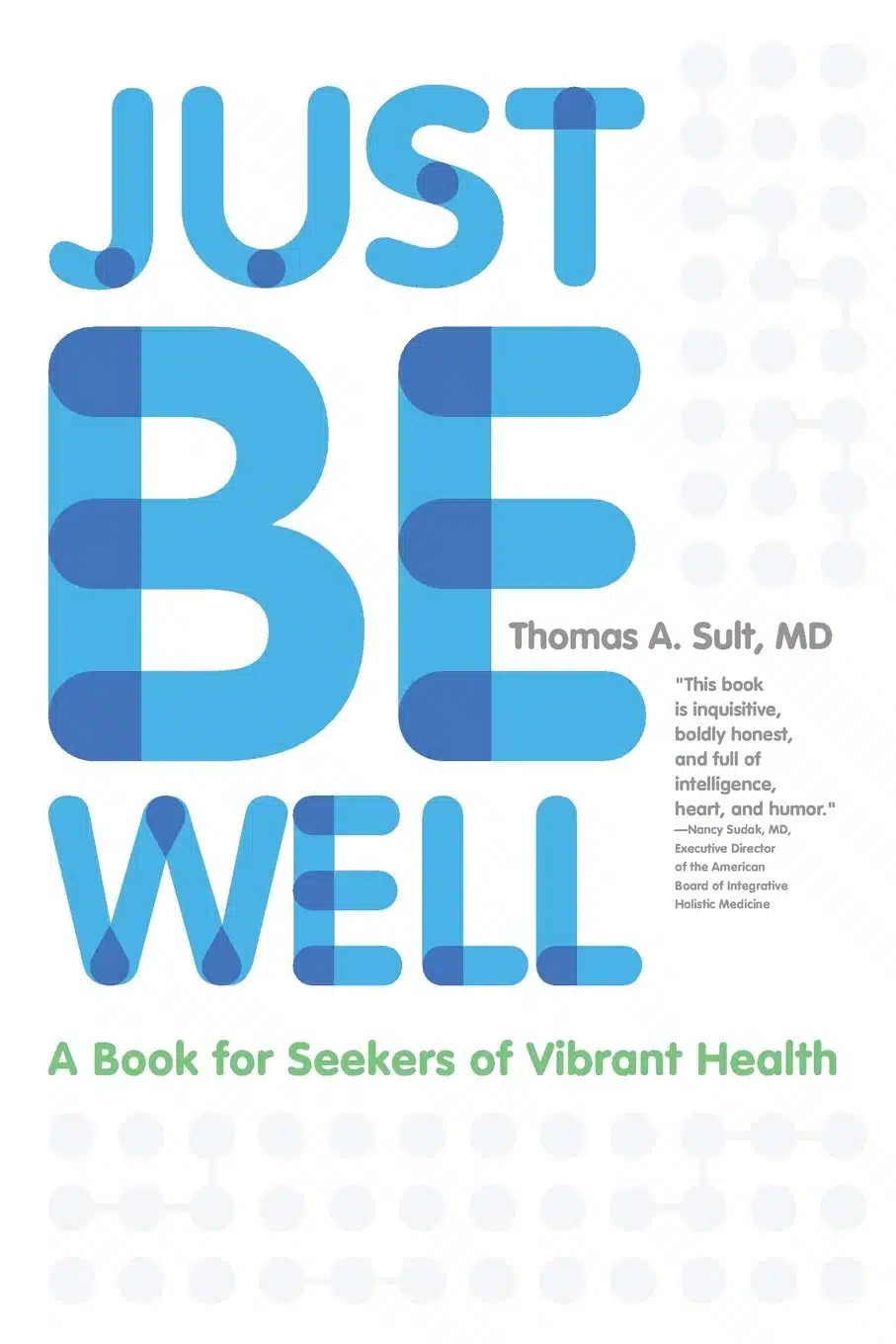
Just Be Well – by Dr. Thomas Sult
10almonds is reader-supported. We may, at no cost to you, receive a portion of sales if you purchase a product through a link in this article.
Firstly, what this is not: a “think yourself well” book. It’s not about just deciding to be well.
Rather, it’s about ensuring the foundations of wellness, from which the rest of good health can spring, and notably, an absence of chronic illness. In essence: enjoying chronic good health.
The prescription here is functional medicine, which stands on the shoulders of lifestyle medicine. This latter is thus briefly covered and the basics presented, but most of the book is about identifying the root causes of disease and eliminating them one by one, by taking into account the functions of the body’s processes, both in terms of pathogenesis (and thus, seeking to undermine that) and in terms of correct functioning (i.e., good health).
While the main focus of the book is on health rather than disease, he does cover a number of very common chronic illnesses, and how even in those cases where they cannot yet be outright cured, there’s a lot more that can be done for them than “take two of these and call your insurance company in the morning”, when the goal is less about management of symptoms (though that is also covered) and more about undercutting causes, and ensuring that even if one thing goes wrong, it doesn’t bring the entire rest of the system down with it (something that often happens without functional medicine).
The style is clear, simple, and written for the layperson without unduly dumbing things down.
Bottom line: if you would like glowingly good health regardless of any potential setbacks, this book can help your body do what it needs to for you.
Don’t Forget…
Did you arrive here from our newsletter? Don’t forget to return to the email to continue learning!
Recommended
Learn to Age Gracefully
Join the 98k+ American women taking control of their health & aging with our 100% free (and fun!) daily emails:
-
Should I take vitamin C to ward off colds, lower blood pressure or reduce cancer risk?
10almonds is reader-supported. We may, at no cost to you, receive a portion of sales if you purchase a product through a link in this article.
Vitamin C is one of the most iconic nutrients in popular health culture, often credited with preventing colds, boosting immunity and even fighting serious diseases.
But while it’s essential for our bodies to function, its benefits are often misunderstood or overstated. Before you stock up on supplements, here’s what to consider.
Sean Anthony Eddy/Getty Images What is vitamin C and why does my body need it?
Vitamin C, also known as ascorbic acid, plays several essential roles in the body.
It is a powerful antioxidant, protecting cells from damage. Vitamin C supports the immune functions of the body, aids in absorption of iron, and is involved in wound healing.
Vitamin C also helps in the synthesis of collagen, which holds together tissues and is a structural component of gums and skin. A severe deficiency of vitamin C leads to a health condition called scurvy, where the body produces insufficient collagen and can’t hold tissue together. Eventually, the gums cannot hold onto teeth and they fall out, and blood vessels break down, causing internal bleeding.
Humans cannot synthesise vitamin C. We must take it in through our diet. Most of our vitamin C comes from vegetables (about 40%), fruits (19%) and from vegetable or fruit juices (29%).
Chemically, the vitamin C in supplements is identical to the vitamin C in food. Your body cannot tell the difference.
Vitamin C in supplements and food are identical. Diana Polekhina/Unsplash What is missing in supplement forms of vitamin C is the fibre, flavonoids, other vitamins, minerals and phytochemicals that come with food, and that may work together with vitamin C.
These other compounds help with absorption, provide complementary antioxidants, and together with vitamin C, provide health benefits that the vitamin by itself does not.
Historically, sailors often had a very limited diet and were often struck down with scurvy. But if you have a balanced diet, you don’t need vitamin C supplements.
What does vitamin C treat and not treat?
Common cold
Vitamin C has been promoted as a way to boost the immune system. It’s widely considered as a way to prevent and treat the common cold and flu.
However, results from a review of all the evidence has shown regular supplementation of 200 mg or more vitamin C does not reduce the incidence of the common cold.
Regular vitamin C supplement does reduce the duration, and at doses greater than 1,000 mg or more, could reduce the severity of common cold symptoms.
When vitamin C is used for treating common colds and only taken at the start of cold symptoms, it does not affect the duration and severity. Some studies have a shown very limited benefit when taken daily before getting sick, but the benefit was very small. Overall, the authors concluded routine supplementation with vitamin C is not worthwhile.
Heart disease and stroke
Research has shown vitamin C supplementation does not change the risk of a range of cardiovascular diseases including heart attack (myocardial infraction), stroke or angina.
One study found vitamin C supplementation at more than 200 mg daily may lower systolic blood pressure (the top number in a reading) by around 4 mmHg and diastolic blood pressure (the lower number) by around 2 mmHg. These are very small changes.
These effects are comparable to regular aerobic exercise and may not be clinically meaningful compared to treatment with conventional medicine, which generally lowers systolic blood pressure by at least 12 mmHg.
Cancer
There are consistent results from multiple studies that show vitamin C supplementation is unable to prevent cancer, including for gastrointestinal, lung, breast, prostate and colorectal cancers.
Is it possible to take too much vitamin C?
The Recommended Daily Intake (RDI) of vitamin C for adults is 45 mg per day. You can get that from a single small glass of orange juice.
The tolerable upper intake level of vitamin C is 2,000 mg daily for adults.
Vitamin C is water-soluble and gets excreted in urine, so the body cannot store it. This means mega-dosing does not provide any benefit, and may in fact cause health problems.
At high doses (above 2,000 mg daily), vitamin C may cause mild to serious side effects. Too much is known to cause diarrhoea, nausea and abdominal cramps. It can also contribute to the formation of kidney stones in men, but not women.
For people who have chronic kidney disease, vitamin C can be especially problematic because vitamin C is flushed from the body by the kidneys. But when the kidneys don’t work properly, it can build up and cause kidney stones.
Should you take a vitamin C supplement?
For most people, a vitamin C tablet is unnecessary. You will get enough from a good balanced diet, from foods such as citrus fruits, berries, tomatoes, capsicum, broccoli and kale.
The evidence doesn’t support claims that vitamin C supplements prevent colds, heart disease or cancer. In fact, the risks may outweigh the benefits.
Nial Wheate, Professor, School of Natural Sciences, Macquarie University; Ian Jamie, Senior Lecturer, School of Natural Sciences, Macquarie University, and Wai-Jo Jocelin Chan, Pharmacist and Lecturer, UNSW Sydney; University of Sydney
This article is republished from The Conversation under a Creative Commons license. Read the original article.
Share This Post
-
One More Way Exercise Improves Mental Health
10almonds is reader-supported. We may, at no cost to you, receive a portion of sales if you purchase a product through a link in this article.
“Exercise improves mental health” is itself not a new idea. For example,
We talk often about “what’s good for your heart is good for your brain“, and it goes not just for reducing risk factors (see: What’s Your Vascular Dementia Risk?), but also for improving cognitive function, e.g: How Your Exercise Today Gives A Brain Boost Tomorrow
But it’s not just cognitive function! It boosts mood too: Running or yoga can help beat depression, research shows, even if exercise is the last thing you feel like
…and, for that matter, Behavioral Activation Against Depression & Anxiety ← of which, exercise is not a definitionally required component, but it’s one of the most common ones
It even goes for quite specific forms of depression, such as: Dancing vs Parkinson’s Depression
But, what’s new?
Fitness & emotional resilience
In few words: researchers (Dr. Katja Weiss et al.) found that that higher cardiorespiratory fitness was linked to lower anxiety, lower anger, and greater emotional resilience under stress.
Indeed, the paper got titled: Cardiorespiratory fitness is associated with lower anger and anxiety and higher emotional resilience
What they did: healthy adults were split into above average and below average fitness groups based on exercise used to estimate VO₂Max, then viewed 69 neutral or unpleasant images across two 30-minute sessions, with anger and anxiety measured before and after.
The findings were as follows:
- For anxiety: VO₂Max predicted lower trait anxiety (β = −0.456, p = 0.001), and participants below average in fitness had a 775% greater risk of shifting from intermediate to high anxiety after unpleasant images (OR = 8.754, 95% CI [1.202; 63.759]).
- For anger: lower VO₂Max predicted greater increases in state anger during unpleasant image exposure (β = −0.241, p = 0.003), and higher anger-out scores also predicted anger increases (β = 0.333, p = 0.040), with less fit individuals showing poorer anger control.
Limitations: small sample size (n=40), estimated VO₂Max, questionnaire-based self-reports of some data.
Nevertheless, it is consistent with the idea that physical health and emotional resilience are closely tied together, in what’s most likely a bidirectional relationship (e.g. either one being strong supports the other being strong, whereas either one being weak weakens the other).
See for example: The Stress Prescription (Against Aging!) ← this is about the work of the remarkable Dr. Elissa Epel, who has for the past 20 years specialized in the effect of stress on aging. She’s led groundbreaking research on cortisol, telomeres, and telomerase, all in the context of aging, especially in women, as well as the relationship between stress and weight gain. She was elected member of the National Academy of Medicine for her work on stress pathways, and has been recognized as a key “Influencer in Aging” by the Alliance for Aging Research. Indeed, she’s also been named in the top 0.1% of researchers globally, in terms of publication impact.
So you can tackle this one from both sides! As for what you can do from the psychological side, see: Building Psychological Resilience (Without Undue Hardship)
Want to improve your VO₂Max?
We’ve got you covered:
53 Studies Later: The Best Way To Improve Your VO₂Max
Take care!
Share This Post
-
Water Water Everywhere, But Which Is Best To Drink?
10almonds is reader-supported. We may, at no cost to you, receive a portion of sales if you purchase a product through a link in this article.
Well Well Well…
In Tuesday’s newsletter, we asked you for your (health-related) opinion on drinking water—with the understanding that this may vary from place to place. We got the above-depicted, below-described, set of responses:
- About 65% said “Filtered is best”
- About 20% said “From the mains is best”
- About 8% said “Bottled is best”
- About 3% said “Distilled is best”
- About 3% said “Some other source is best”
Of those who said “some other source is best”, one clarified that their preferred source was well water.
So what does the science say?
Fluoridated water is bad for you: True or False?
False, assuming a normal level of consumption. Rather than take up more space today though, we’ll link to what we previously wrote on this topic:
You may be wondering: but what if my level of consumption is higher than normal?
Let’s quickly look at some stats:
- The maximum permitted safety level varies from place to place, but is (for example) 2mg/l in the US, 1.5mg/l in Canada & the UK.
- The minimum recommended amount also varies from place to place, but is (for example) 0.7mg/l in Canada and the US, and 1mg/l in the UK.
It doesn’t take grabbing a calculator to realize that if you drink twice as much water as someone else, then depending on where you are, water fluoridated to the minimum may give you more than the recommended maximum.
However… Those safety margins are set so much lower than the actual toxicity levels of fluoride, that it doesn’t make a difference.
For example: your writer here takes a medication that has the side effect of causing dryness of the mouth, and consequently she drinks at least 3l of water per day in a climate that could not be described as hot (except perhaps for about 2 weeks of the year). She weighs 72kg (that’s about 158 pounds), and the toxicity of fluoride (for ill symptoms, not death) is 0.2mg/kg. So, she’d need 14.4mg of fluoride, which even if the water fluoridation here were 2mg/l (it’s not; it’s lower here, but let’s go with the highest figure to make a point), would require drinking more than 7l of water faster than the body can process it (i.e., not “per day”, but “faster than it can go through the kidneys”; we’re talking about 7 liters at once here)
For more about the numbers, check out:
Acute Fluoride Poisoning from a Public Water System
Bottled water is the best: True or False?
False, if we consider “best” to be “healthiest”, which in turn we consider to be “most nutrients, with highest safety”.
Bottled water generally does have higher levels of minerals than most local mains supply water does. That’s good!
But you know what else is generally has? Microplastics and nanoplastics. That’s bad!
We don’t like to be alarmist in tone; it’s not what we’re about here, but the stats on bottled water are simply not good; see:
We Are Such Stuff As Bottles Are Made Of
You may be wondering: “but what about bottled water that comes in glass bottles?”
Indeed, water that comes in glass bottles can be expected to have lower levels of plastic than water that comes in plastic bottles, for obvious reasons.
However, we invite you to consider how likely you believe it to be that the water wasn’t stored in plastic while being processed, shipped and stored, before being portioned into its final store-ready glass bottles for end-consumer use.
Distilled water is the best: True or False?
False, generally, with caveats:
Distilled water is surely the safest water anywhere, because you know that you’ve removed any nasties.
However, it’s also devoid of nutrients, because you also removed any minerals it contained. Indeed, if you use a still, you’ll be accustomed to the build-up of these minerals (generally simplified and referenced as “limescale”, but it’s a whole collection of minerals).
Furthermore, that loss of nutrients can be more than just a “something good is missing”, because having removed certain ions, that water could now potentially strip minerals from your teeth. In practice, however, you’d probably have to swill it excessively to cause this damage.
Nevertheless, if you have the misfortune of living somewhere like Flint, Michigan, then a water still may be a fair necessity of life. In other places, it can simply be useful to have in case of emergency, of course.
Here’s an example product on Amazon if you’d like to invest in a water still for such cases.
PS: distilled water is also tasteless, and is generally considered bad, tastewise, for making tea and coffee. So we really don’t recommend distilling your water unless you have a good reason to do so.
Filtered water is the best: True or False?
True for most people in most places.
Let’s put it this way: it can’t logically be worse than whatever source of water you put into it…
Provided you change the filter regularly, of course.
Otherwise, after overusing a filter, at best it won’t be working, and at worst it’ll be adding in bacteria that have multiplied in the filter over however long you left it there.
You may be wondering: can water filters remove microplastics, and can they remove minerals?
The answer in both cases is: sometimes.
- For microplastics it depends on the filter size and the microplastic size (see our previous article for details on that).
- For minerals, it depends on the filter type. Check out:
The H2O Chronicles | 5 Water Filters That Remove Minerals
One other thing to think about: while most water filtration jugs are made of PFAS-free BPA-free plastics for obvious reasons, for greater peace of mind, you might consider investing in a glass filtration jug, like this one ← this is just one example product on Amazon; by all means shop around and find one you like
Take care!
Share This Post
Related Posts
-
Lymphatic Drainage Massage vs Bloating
10almonds is reader-supported. We may, at no cost to you, receive a portion of sales if you purchase a product through a link in this article.
Sometimes, the solution can be as simple as moving the bad stuff away:
A massage that’s flush with benefits
Preparation: apply oil or moisturizer (she uses coconut oil in the video) to help your hands glide smoothly over your skin. This is not just for comfort; it also help the process, since you want to be moving lymph (and some other fluids and even a little soft tissue) under the skin; you will gain no benefits from simply moving the skin itself (as will happen if there is too much friction to glide).
Then…
- Lightly press the lymph nodes located between the hips about 20 times.
- Draw a rainbow-shaped motion from one lymph node to the next, repeating about 20 times to get things moving.
- Use the outside edge of your hand to slide downwards 20 times, moving everything toward the lymph nodes.
- Push fluid from each side of the waist downward towards the lymph nodes 20 times on each side.
For more on all of this plus a visual demonstration, enjoy:
Click Here If The Embedded Video Doesn’t Load Automatically!
Want to learn more?
You might also like:
Take care!
Don’t Forget…
Did you arrive here from our newsletter? Don’t forget to return to the email to continue learning!
Learn to Age Gracefully
Join the 98k+ American women taking control of their health & aging with our 100% free (and fun!) daily emails:
-
How Most People Use Nasal Sprays Incorrectly
10almonds is reader-supported. We may, at no cost to you, receive a portion of sales if you purchase a product through a link in this article.
Is this how you’ve been doing it? Here’s the right way:
Like a professional
5 key points to know:
- Proper position: sit upright with your head slightly forwards, not tipped backwards.
- Prime it first: when you first open a new bottle, pump it once or twice until it produces a fine mist; you do not need to prime it again while using that bottle.
- Aim at an angle: place the nozzle well into the nostril, aim backwards and slightly to the side (the nasal cavity goes back, not up).
- Spray correctly: press to release a spray, feel the medicine inside your nasal cavity, and let it sit there. Avoid strong sniffing because that sends the medicine down your throat; a gentle sniff is fine if it starts to run.
- Actually absorb it: keep your head in a neutral position for a few seconds so the spray can absorb, then repeat on the other nostril.
For more on this plus a visual demonstration, enjoy:
Click Here If The Embedded Video Doesn’t Load Automatically!
Want to learn more?
You might also like:
Tips For Putting In Eye Drops (3 Techniques That Work!)
Take care!
Don’t Forget…
Did you arrive here from our newsletter? Don’t forget to return to the email to continue learning!
Learn to Age Gracefully
Join the 98k+ American women taking control of their health & aging with our 100% free (and fun!) daily emails:
-
Psychedelics: Yes Even Once?
10almonds is reader-supported. We may, at no cost to you, receive a portion of sales if you purchase a product through a link in this article.
We’ve broadly covered psychedelics before, in one of our mythbusting editions, which was necessarily a little broad and non-specific, because as we noted:
There are some moderately-well established [usually moderate] clinical benefits from some psychedelics for some people.
If that sounds like a very guarded statement, it is. Part of this is because “psychedelics” is an umbrella term.
Read in full: Taking A Trip Through The Evidence On Psychedelics
And to give some examples of those benefits being evidenced:
- Psilocybin as a New Approach to Treat Depression and Anxiety in the Context of Life-Threatening Diseases—A Systematic Review and Meta-Analysis of Clinical Trials
- Therapeutic Use of LSD in Psychiatry: A Systematic Review of Randomized-Controlled Clinical Trials
- Efficacy of Psychoactive Drugs for the Treatment of Posttraumatic Stress Disorder: A Systematic Review of MDMA, Ketamine, LSD and Psilocybin
- Changes in self-rumination and self-compassion mediate the effect of psychedelic experiences on decreases in depression, anxiety, and stress.
- Psychedelic Treatments for Psychiatric Disorders: A Systematic Review and Thematic Synthesis of Patient Experiences in Qualitative Studies
- Repeated lysergic acid diethylamide (LSD) reverses stress-induced anxiety-like behavior, cortical synaptogenesis deficits and serotonergic neurotransmission decline
Today we’re going to talk about the potential of psychedelics to improve…
*drumroll please*
Cognitive flexibility
So first we’ll mention what that actually is: cognitive flexibility is the ability of the brain to adapt to changing circumstances—which is not only a potential measure of general intelligence, but also, cognitive inflexibility is commonly seen as a harbinger of age-related cognitive decline.
In short, that scenario of an older person who “can’t be doing with all these new-fangled things” but the new-fangled things have been the norm for a long time now.
Fun fact: first-generation iPhones are now old enough to vote, having been initially released in January 2007, making them a little over 18 years old now.
Chances are quite high that you’re reading this on on iPhone or similar device, but chances alos are that there are other more recent changes in the world that baffle you. And maybe sometimes it really is the world (there sure are things that baffle this writer, too); sometimes, however, it would be good to at least have the option of jumping on the latest bandwagon, rather than always trying to live in decades past.
That’s where cognitive flexibility comes in; the ability to say “you know what, I can roll with this”, or the ability to switch tracks if new information comes to light contradicting some previously-held belief, things like that.
And as for where psychedelics come in?
A recent study by Dr. Elizabeth Brouns et al. has shown that a single dose of a psychedelic compound can significantly enhance cognitive flexibility in mice for weeks after treatment.
Yes, it’s just a mouse study so far, but generally squeaking, mammalian brains are mammalian brains, so we can expect this to carry over to humans when human trials are conducted next.
They (the researchers, not the mice) found that the psychedelic compound 25CN-NBOH, a selective serotonin 2A receptor agonist that honestly does not have a snappier name than that or else we’d use it, led to improved performance in tasks that required mice to rapidly adapt to changing rules, and that these benefits persisted for 20 days* after administration. This suggests long-lasting changes in brain function, with potential implications for treating conditions like depression, PTSD, and neurodegenerative diseases.
*About that “20 days”, though…
Do you remember the whole “the brain doesn’t finishing maturing until the age of 25” debacle? If not: the short version is that researchers measured brain development at various ages, from childhood until the age of 25, and found that it didn’t stop developing. Importantly, the age of 25 was simply the cut-off for the experiment, because at some point they have to publish results. It wasn’t that the brains stopped developing at 25, but when the popular press got hold of the headlines, they reported it as though that were the case, and 25 is the great landmark age at which the brain is finished developing. Now, we know from other more recent studies that the brain continues changing throughout life, and indeed even neurogenesis continues into old age, with no known stopping point (during life, anyway).
We did a mythbusting edition about that, by the way: The Brain As A Work-In-Progress
And for further reading about that neurogenesis in old age, see: How To Grow New Brain Cells (At Any Age)
The reason we’re mentioning this because in this experiment with the psychedelics, the claim of “the benefits persisted for 20 days after administration” can make it sound a lot like “and on day 21, the benefits vanished”.
The reality is, there was no day 21; the experiment ran for 20 days and that was that. It is not known how long the benefits would have persisted, only that in the first 20 days, they showed no signs of disappearing.
You can read the paper in full (and see graphs!) here:
Nevertheless, the most well-researched popular psychedelic recently isn’t 25CN-NBOH, but rather, psilocybin, the psychedelic compound that gives “magic mushrooms” their psychoactive properties.
And when we say “popular”: Psilocybin use surges across all age groups since 2019
Not a fan of drugs?
If for whatever reason, psychedelics aren’t your cup of tea, there are other ways to improve cognitive flexibility.
See for example: How (And Why) To Train Your Pre-Frontal Cortex
Take care!
Don’t Forget…
Did you arrive here from our newsletter? Don’t forget to return to the email to continue learning!
Learn to Age Gracefully
Join the 98k+ American women taking control of their health & aging with our 100% free (and fun!) daily emails:


