
Is TikTok right? Are there health benefits to eating sea moss?
10almonds is reader-supported. We may, at no cost to you, receive a portion of sales if you purchase a product through a link in this article.
Sea moss is the latest “superfood” wellness influencers are swearing by. They claim sea moss products – usually in gel form – have multiple health benefits. These include supporting brain and immune function, or protecting against viruses and other microbes.
But do these health claims stack up? Let’s take a look.
What is sea moss?
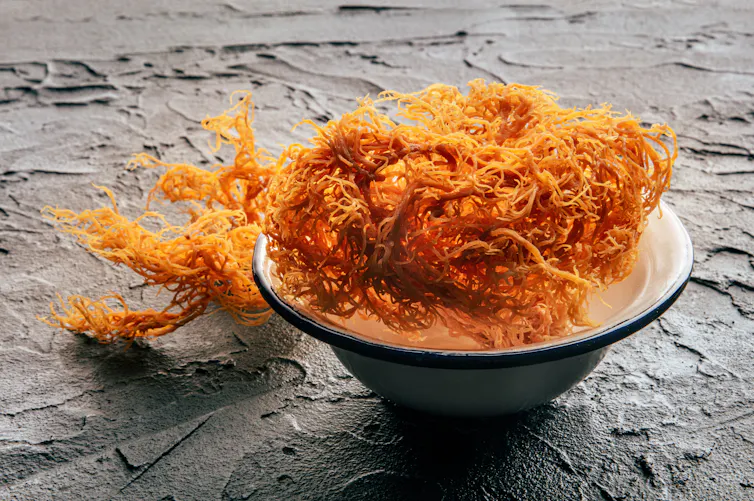
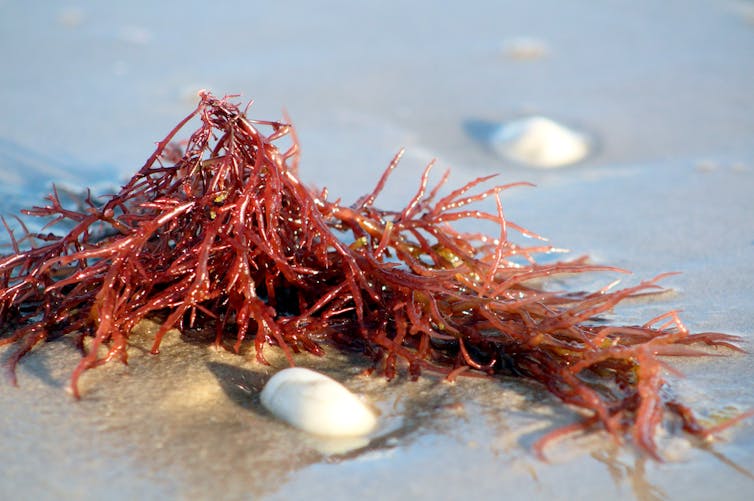
Sea moss is produced using a kind of seaweed – particularly red algae – that grow in various locations all around the world. Three main species are used in sea moss products:
- Chondrus crispus (known as Irish moss or carrageenan moss)
- Eucheuma cottonii (sea moss or seabird’s nest)
- Gracilaria (Irish moss or ogonori).
Some products also contain the brown algae Fucus vesiculosus (commonly known as bladderwrack, black tang, rockweed, sea grapes, bladder fucus, sea oak, cut weed, dyers fucus, red fucus or rock wrack).
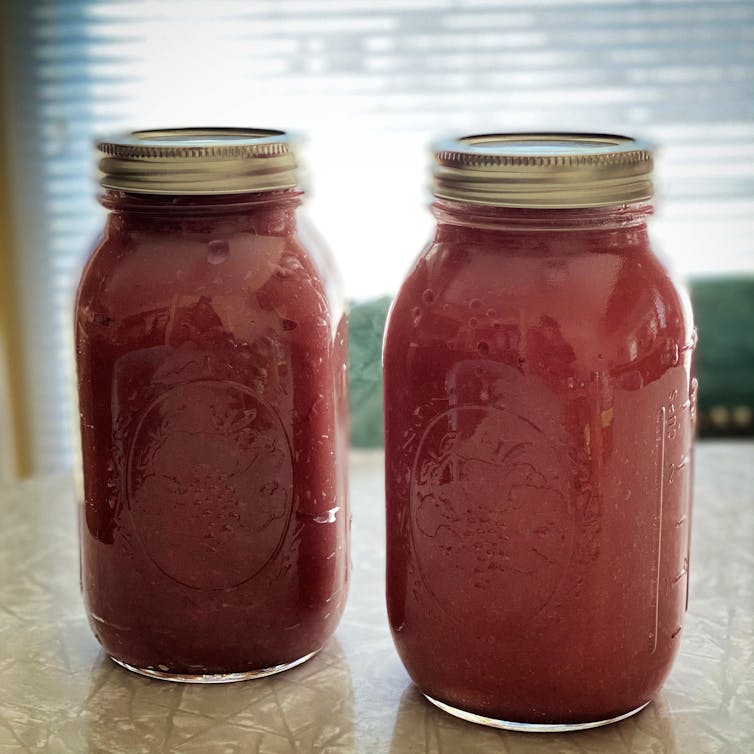
Most sea moss products are sold as a gel that can be added to recipes, used in smoothies, frozen into ice cubes or eaten on its own. The products also come in capsule form or can be purchased “raw” and used to make your own gels at home.
What’s the evidence?
Sea moss products claim a host of potential health benefits, from supporting immunity, to promoting skin health and enhancing mood and focus, among many others.
But is there any evidence supporting these claims?
Recent studies have reviewed the biological properties of the main sea moss species (Chondrus crispus, Eucheuma cottonii, Gracilaria and Fucus vesiculosus).
They suggest these species may have anti-inflammatory, antioxidant, anticancer, antidiabetic and probiotic properties.
However, the vast majority of research relating to Chondrus crispus, Gracilaria and Fucus vesiculosus – and all of the research on Eucheuma cottonii – comes from studies done in test tubes or using cell and animal models. We should not assume the health effects seen would be the same in humans.
In cell and animal studies, researchers usually administer algae in a laboratory and use specific extracts rich in bioactive compounds rather than commercially available sea moss products.
They also use very different – often relatively larger – amounts compared to what someone would typically consume when they eat sea moss products.
This means the existing studies can’t tell us about the human body’s processes when eating and digesting sea moss.
Sea moss may have similar effects in humans. But so far there is very little evidence people who consume sea moss will experience any of the claimed health benefits.
Nutritional value
Eating sea moss does not replace the need for a balanced diet, including a variety of fruits and vegetables.
Chondrus crispus, Eucheuma cottonii and Gracilaria, like many seaweeds, are rich sources of nutrients such as fatty acids, amino acids, vitamin C and minerals. These nutrients are also likely to be present in sea moss, although some may be lost during the preparation of the product (for example, soaking may reduce vitamin C content), and those that remain could be present in relatively low quantities.
There are claims that sea moss may be harmful for people with thyroid problems. This relates to the relationship between thyroid function and iodine. The algae used to make sea moss are notable sources of iodine and excess iodine intake can contribute to thyroid problems, particularly for people with pre-existing conditions. That is why these products often carry disclaimers related to iodine sensitivity or thyroid health.
Is it worth it?
So you may be wondering if it’s worth trying sea moss. Here are a few things to consider before you decide whether to start scooping sea moss into your smoothies.
A 375mL jar costs around $A25–$30 and lasts about seven to ten days, if you follow the recommended serving suggestion of two tablespoons per day. This makes it a relatively expensive source of nutrients.
Sea moss is often hyped for containing 92 different minerals. While there may be 92 minerals present, the amount of minerals in the algae will vary depending on growing location and conditions.
The efficiency with which minerals from algae can be absorbed and used by the body also varies for different minerals. For example, sodium is absorbed well, while only about 50% of iodine is absorbed.
But sea moss has also been shown to contain lead, mercury and other heavy metals – as well as radioactive elements (such as radon) that can be harmful to humans. Seaweeds are known for their ability to accumulate minerals from their environment, regardless of whether these are beneficial or harmful for human nutrition. Remember, more doesn’t always mean better.
What else am I eating?
While you won’t get a full nutritional breakdown on the jar, it is always wise to check what other ingredients you may be eating. Sea moss products can contain a range of other ingredients, such as lime, monk fruit powder, spirulina and ginger, among many others.
These ingredients differ between brands and products, so be aware of your needs and always check.
Despite their health claims, most sea moss products also carry disclaimers indicating that the products are not intended to diagnose, treat, cure or prevent any disease.
If you have concerns about your health, always speak to a health professional for accurate and personalised medical advice.
Margaret Murray, Senior Lecturer, Nutrition, Swinburne University of Technology
This article is republished from The Conversation under a Creative Commons license. Read the original article.
Don’t Forget…
Did you arrive here from our newsletter? Don’t forget to return to the email to continue learning!

Recommended
Learn to Age Gracefully
Join the 98k+ American women taking control of their health & aging with our 100% free (and fun!) daily emails:
-
5 Vaginal Estrogen Myths
10almonds is reader-supported. We may, at no cost to you, receive a portion of sales if you purchase a product through a link in this article.
Dr. Jennifer Roelands, gynecologist, explains:
Let’s get down to business
Here are the 5 myths busted:
- Vaginal estrogen causes cancer: vaginal estrogen does not increase cancer risk, including breast cancer; it doesn’t raise systemic hormone levels so your breasts won’t even know you’re taking it; even people with a history of breast cancer or blood clots can usually use it safely.
- Vaginal estrogen is only for older women: it’s useful for a wide range of people—including those who are postpartum, perimenopausal, those on certain medications, or with autoimmune or vulvar conditions—not just those in menopause.
- Vaginal estrogen is dangerous for your heart: vaginal estrogen doesn’t raise the risk of blood clots, stroke, or heart attack because it has minimal systemic absorption.
- Vaginal estrogen is hard to use: it comes in various user-friendly forms (e.g. cream, suppositories, ring, etc), and many can be applied easily without mess or complicated devices.
- You have to stop vaginal estrogen at a certain age: there’s no age limit; it can be safely used indefinitely to maintain vaginal and urinary health, including preventing infections and dryness.
Note: in some of these cases, Dr. Roelands compares the effects of topical vaginal estrogen with those of systemic HRT, mentioning multiple times that it’s safer because it’s not systemic. Now, that is true, but it’s worth noting that systemic HRT also does not increase cancer risk in most people, and it reduces (not increases) the risk of heart attack. Nothing is perfect though, and we will concede that it does increase thrombosis risk.
You can enjoy the video here:
Click Here If The Embedded Video Doesn’t Load Automatically!
Want to learn more?
You might also like:
- HRT: A Tale Of Two Approaches ← explains how the “HRT causes cancer” myth came from a single methodologically flawed, since-refuted study that, as an extra consideration against it, didn’t even use modern bioidentical HRT that is even safer than ye olde Premarin and similar animal-derived estrogens.
- HRT & Your Heart ← explains how estrogen is, on balance, cardioprotective (including by improved lipids and vascular function), while still increasing thrombosis risk
- How Old Is Too Old For HRT? ← includes a simple test you can do to know whether it is too late for you or not
Take care!
Share This Post
-
Most People Over 50 Don’t Know This Core Activation Trick
10almonds is reader-supported. We may, at no cost to you, receive a portion of sales if you purchase a product through a link in this article.
Here’s a simple and effective trick to activate your core muscles, without the confusion created by a lot of more complicated explanations:
Prepare for a poking
The core includes up to 29 muscles (depending on how we count them) around the spine, pelvis, and torso. Activating these muscles improves stability and reduces injury risk during movement, but common advices about how to do so can be a bit overcomplicated and unhelpful, leading to confusion and/or incorrectly-done exercises.
Instead, he says: imagine someone poking your side—your natural reaction is to tense your tummy and glutes. This instinctive tension effectively activates your core, without you having to think about the various muscles involved or whether to push or pull your stomach this way or that.
Once you’ve got that, practice maintaining the core tension while breathing steadily in and out (don’t hold your breath!). Start by feeling the tension with your fingers. Then keep that contraction while breathing to build awareness and control.
Next, you can bring that into other positions and movements, to master it fully and make it a part of your natural way of holding yourself.
For more on all of this, plus visual demonstrations, enjoy:
Click Here If The Embedded Video Doesn’t Load Automatically!
Want to learn more?
You might also like:
Is A Visible Six-Pack Obtainable Regardless Of Genetic Predisposition?
Take care!
Share This Post
-
Health Simplified – by Daniel Cottmeyer
10almonds is reader-supported. We may, at no cost to you, receive a portion of sales if you purchase a product through a link in this article.
Health Simplified – by Daniel Cottmeyer
A lot of books focus on the most marketable aspects of health, such as fat loss or muscle gain. Instead, Cottmeyer takes a “birds-eye-view” of health in all its aspects, and then boils it down to the most critical key parts.
Rather than giving a science-dense tome that nobody reads, or a light motivational piece that everyone reads but it amounts to “you can do it!”, here we get substance… but in a digestible form.
Which we at 10almonds love.
The book presents a simple action plan to:
- Improve your relationship with food/exercise
- Actually get better sleep
- Understand how nutrition really works
- Set up helpful habits that are workable and sustainable
- Bring these components together synergistically
Bottom line: if you’re going to buy only one health/fitness book, this is a fine contender.
Share This Post
Related Posts
-
Another Reason To Enjoy The Mediterranean Diet!
10almonds is reader-supported. We may, at no cost to you, receive a portion of sales if you purchase a product through a link in this article.
The Mediterranean Diet is considered by many to be the current “gold standard” of healthy eating, and with good reason. With 10,000+ studies underpinning it and counting, it has a pretty hefty weight of evidence.
Wondering what the Mediterranean Diet consists of? We outlined it in a previous main feature, so here it is for your convenience:
The Mediterranean Diet: What Is It Good For? ← also covers which foods actually go into it, and which don’t 😎
To get us started today, we’ll quickly drop some links to a few of those Mediterranean Diet studies from the top:
- Definition of the Mediterranean Diet; a Literature Review
- Mediterranean Diet In Healthy Aging
- Cancer and Mediterranean Diet: A Review
- Impact of Mediterranean Diet on Chronic Non-Communicable Diseases and Longevity
- Mediterranean diet and cardiovascular disease: a systematic review and meta-analysis of observational studies
- Adherence to Mediterranean diet and health status: meta-analysis
The short version is: it glows, in a good way.
So… What’s new?
Give yourself a Mediterranean mitochondrial boost
Researchers (Dr. Vittoria Cammisotto et al.) found that eating in a manner consistent with the Mediterranean diet is associated with increased levels of mitochondrial microproteins (namely: humanin, and small human mitochondrial ORF over serine tRNA, known as “SHMOOSE” to its friends) linked to healthier aging.
Specifically, these microproteins go well above and beyond the job of being “mere” nutrients, and rather act directly as molecular messengers translating diet into cellular function, which means that they influence aging, cardiovascular health, and brain health.
Which really is quite a reminder that at the end of the day, our body is one big organism of countless tiny parts that just do what they’re told.
As for these molecular messengers specifically:
- Humanin is associated with improved insulin sensitivity, cardiovascular protection, longevity, and preservation of cognitive function.
- SHMOOSE appears to protect brain cells in general, although certain genetic variants affect Alzheimer’s disease risk too.
- Both sets of higher microprotein levels were associated with lower oxidative stress markers, which is invariably good news, especially vs chronic diseases.
The study even highlighted which components of the Mediterranean diet were responsible for which benefits:
- Humanin: olive oil, fish, and legumes
- SMOOSE: olive oil and lower refined carbohydrate
So, olive oil scores twice! And by a completely different mechanism to that which we described in How Olives Can Help Protect Your Brain!
Before you go shopping though, do first swing by: Type Of Olive Oil Does Matter, For Brain & Gut Health!
And to read this study in full, you can find it here: Mediterranean diet adherence is associated with mitochondrial microproteins Humanin and SHMOOSE; potential role of the Humanin–Nox2 interaction in cardioprotection
Want to learn more?
You have options:
- Want to make it even better? See: Better Than The Mediterranean?
- Want to do it with much less effort? See: Mediterranean Diet… In A Pill?
- Want to expand your culinary repertoire? See: More Mediterranean – by American’s Test Kitchen
Enjoy!
Don’t Forget…
Did you arrive here from our newsletter? Don’t forget to return to the email to continue learning!
Learn to Age Gracefully
Join the 98k+ American women taking control of their health & aging with our 100% free (and fun!) daily emails:
-
Intermittent Fasting for Women Over 50 – by Emma Sanchez
10almonds is reader-supported. We may, at no cost to you, receive a portion of sales if you purchase a product through a link in this article.
Intermittent fasting is promoted as a very healthful (evidence-based!) way to trim the fat and slow aging, along with other health benefits. But, physiologically and especially metabolically, the average woman is quite different from the average man! And most resources are aimed at men. So, what’s the difference?
Emma Sanchez gives an overview not just of intermittent fasting, but also, how it goes with specifically female physiology. From hormonal cycles, to different body composition and fat distribution, to how we simply retain energy better—which can be a mixed blessing!
We’re given advice about how to optimize all those things and more.
She also covers issues that many writers on the topic of intermittent fasting will tend to shy away from, such as:
- mood swings
- risk of eating disorder
- impact on cognitive thinking
…and she does this evenly and fairly, making the case for intermittent fasting while acknowledging potential pitfalls that need to be recognized in order to be managed.
Lastly, the “over 50” thing. This is covered in detail quite late in the book, but there are a lot of changes that occur (beyond the obvious!), and once again, Sanchez has tips and tricks for holding back the clock where possible, and working with it rather than against it, when appropriate.
All in all, a great book for any woman over 50, or really also for women under 50, especially if that particular milestone is on the horizon.
Get your copy of Intermittent Fasting for Women over 50 from Amazon today!
Don’t Forget…
Did you arrive here from our newsletter? Don’t forget to return to the email to continue learning!
Learn to Age Gracefully
Join the 98k+ American women taking control of their health & aging with our 100% free (and fun!) daily emails:
-
Blueberries vs Pomegranate – Which is Healthier?
10almonds is reader-supported. We may, at no cost to you, receive a portion of sales if you purchase a product through a link in this article.
Our Verdict
When comparing blueberries to pomegranate, we picked the pomegranate.
Why?
It wasn’t close:
In terms of macros, pomegranate has nearly 2x the fiber for very slightly more carbs, and more than 2x the protein (it’s the seeds), winning this category easily.
In the category of vitamins, blueberries have more of vitamins A, B3, and K, while pomegranate has more of vitamins B1, B2, B5, B6, B7, B9, C, and E, winning another round easily.
Looking at minerals, blueberries have more manganese, while pomegranate has more calcium, copper, magnesium, phosphorus, potassium, selenium, and zinc, winning its third round in a row.
When it comes to other considerations, blueberries have more polyphenols, while pomegranate has some unique health benefits of its own, albeit mostly in the peel (which is quite tough, sufficiently so to defy convenient eating, but it can be brewed into a tea or dried and ground into a powder and used as a supplement). So, we call this round either a win for blueberries based on the easier access of the phytochemical benefits, or else there’s a weak argument for a tie.
Either way, adding up the sections makes for a clear overall win for pomegranate, but by all means enjoy either or both, as diversity is good, and those polyphenols aren’t to be underestimated!
Want to learn more?
You might like:
Pomegranate’s Health Gifts Are Mostly In Its Peel
Enjoy!
Don’t Forget…
Did you arrive here from our newsletter? Don’t forget to return to the email to continue learning!
Learn to Age Gracefully
Join the 98k+ American women taking control of their health & aging with our 100% free (and fun!) daily emails:


