
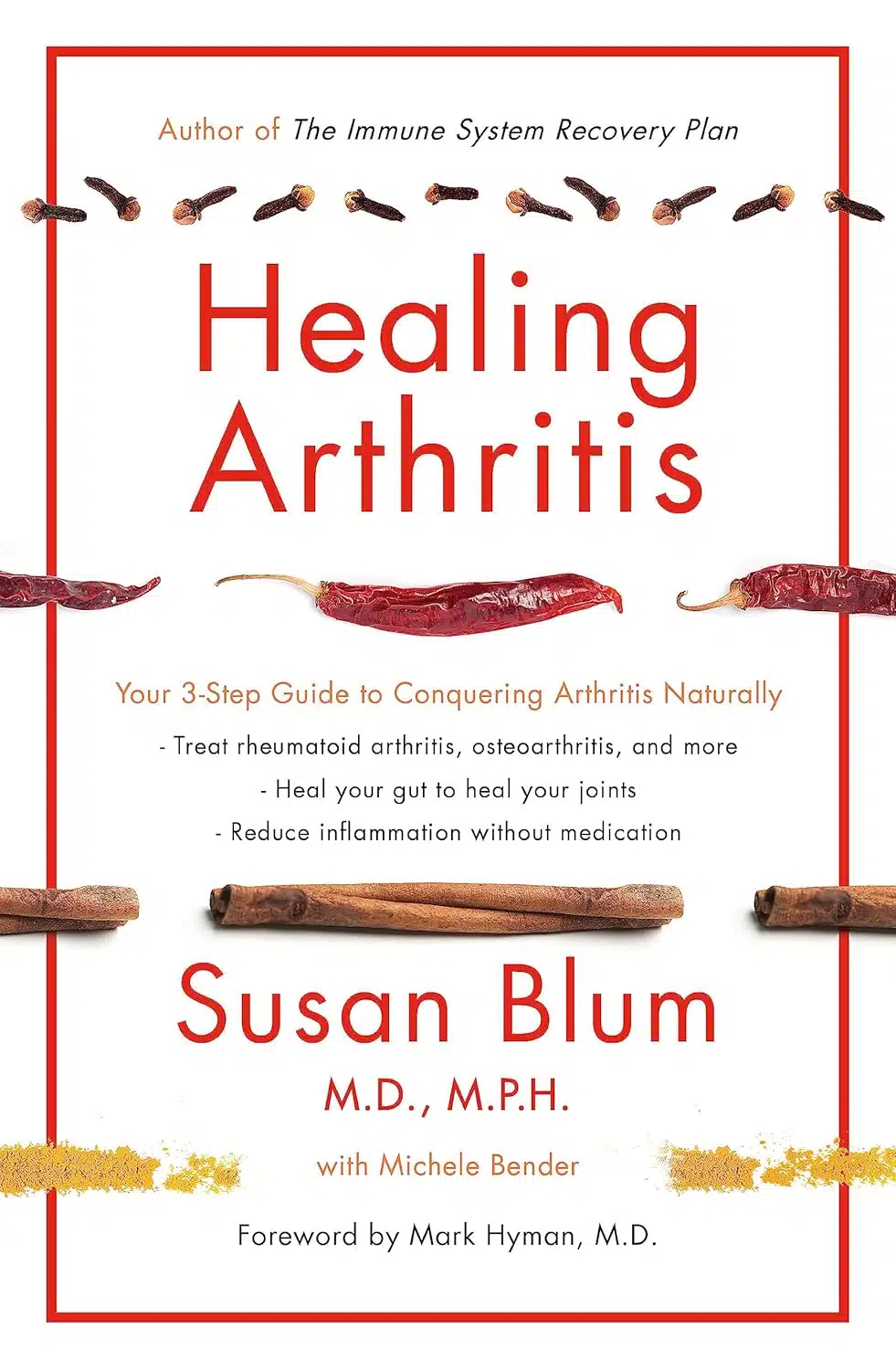
Healing Arthritis – by Dr. Susan Blum
10almonds is reader-supported. We may, at no cost to you, receive a portion of sales if you purchase a product through a link in this article.
We previously reviewed another book by this author, her Immune System Recovery Plan, and today it’s more specific: healing arthritis
Of course, not all arthritis is rooted in immune dysfunction, but a) all of it is made worse by immune dysfunction and b) rheumatoid arthritis, which is an autoimmune disease, affects 1% of the population.
This book tackles all kinds of arthritis, by focusing on addressing the underlying causes and treating those, and (whether it was the cause or not) reducing inflammation without medication, because that will always help.
The “3 steps” mentioned in the subtitle are three stages of a plan to improve the gut microbiome in such a way that it not only stops worsening your arthritis, but starts making it better.
The style here is on the hard end of pop-science, so if you want something more conversational/personable, then this won’t be so much for you, but if you just want the information and explanation, then this does it just fine, and it has frequent references to the science to back it up, with a reassuringly extensive bibliography.
Bottom line: if you have arthritis and want a book that will help you to get either symptom-free or as close to that as is possible from your current condition (bearing in mind that arthritis is generally degenerative), then this is a great book for that.
Don’t Forget…
Did you arrive here from our newsletter? Don’t forget to return to the email to continue learning!
Recommended
Learn to Age Gracefully
Join the 98k+ American women taking control of their health & aging with our 100% free (and fun!) daily emails:
-
Digestive Wellness – by Dr. Elizabeth Lipski
10almonds is reader-supported. We may, at no cost to you, receive a portion of sales if you purchase a product through a link in this article.
First of all, beyond just digestive wellness, this book can help strengthen your arms. At 560 pages and several pounds of weight, this is a comprehensive tome, and covers a lot more than “eat a vegetable once in a while and maybe a probiotic”.
Dr. Lipski takes us on a tour through the digestive system, discussing all of the ins and outs in great detail—not just physically, but physiologically, taking a holistic approach to gut health, examining all aspects of “what affects what”.
Since gut health affects most other kinds of health, there’s a lot to cover there, and when it comes to input, she explains not only the default “these things are good/bad for gut health”, but also the many small impacts (often in and of themselves neutral in value) that can end up making a big difference to how we experience our health on a day-to-day basis.
As such, you can expect to learn a lot about many topics ranging from systemic health to acute pathologies, from thrush and dyspepsia to Behçet’s disease and ankylosing spondylitis.
The style is surprisingly readable for such a lot of science, often conversational in tone, and yet unafraid of diving into clinical topics in a way that’ll be comprehensible to the lay reader. As another point in its favor, it’s all well-referenced with 44 pages of bibliography.
Bottom line: this book can go into that category of books that get called “The Bible of…”, and in this case, it’s digestive wellness.
Click here to check out Digestive Wellness, and boost (almost?) every aspect of your health!
Share This Post
-
A Cold Shower A Day Keeps The Doctor Away?
10almonds is reader-supported. We may, at no cost to you, receive a portion of sales if you purchase a product through a link in this article.
A Cold Shower A Day Keeps The Doctor Away?
This is Dutch extreme athlete Wim Hof, also known as “The Iceman”! He’s broken many world records mostly relating to the enduring the cold, for example:
- climbing Mount Kilimanjaro in shorts
- running a half-marathon above the Arctic Circle barefoot
- standing in a container completely covered with ice cubes for more than 112 minutes
You might not want to do yoga in your pyjamas on an iceberg, but you might like…
- better circulatory health
- reduced risk of stroke
- a boosted immune system
- healthier skin
- more energy and alertness
…and things like that. Wim Hof’s method is not just about extreme athletic achievements; most of what he does, the stuff that can benefit the rest of us, is much more prosaic.
The Wim Hof Method
For Wim Hof, three things are key:
- Breathing (See: Wim Hof Method Breathing Exercises)
- Commitment (See: How to Increase Willpower)
- Cold therapy (See: Benefits of Cold Therapy)
Today, we’re going to be focusing on the last one there.
What are the benefits of Cold Therapy?
Once upon a time, we didn’t have central heating, electric blankets, thermal underwear, and hot showers. In fact, once upon a time, we didn’t have houses or clothes. We used to be a lot more used to the elements! And while it’s all well and good to enjoy modern comforts, it has left our bodies lacking practice.
Practice at what? Most notably: vasodilation and vasoconstriction, in response to temperature changes. Either:
- vasodilation, because part of our body needs more blood to keep it warm and nourished, or
- vasoconstriction, because part of our body needs less blood running through it to get cooled down.
Switching between the two gives the blood vessels practice at doing it, and improves vascular muscle tone. If your body doesn’t get that practice, your blood vessels will be sluggish at making the change. This can cause circulation problems, which in turn have a big impact in many other areas of health, including:
- cardiovascular disease
- stroke risk
- mood instability
- nerve damage in extremities
On the flipside, if the blood vessels do get regular practice at dilating and constricting, you might enjoy lower risk of those things, and instead:
- improved immune response
- healthier skin
- better quality sleep
- more energy and alertness
- improved sexual performance/responsiveness
So, how to get that, without getting extreme?
As today’s title suggests, “a cold shower a day” is a great practice.
You don’t have to jump straight in, especially if you think your circulation and vascular responses might be a bit sluggish in the first instance. In fact, Wim Hof recommends:
- Week 1: Thirty seconds of cold water at the end of a warm shower each morning
- Week 2: One minute of cold water at the end of a warm shower each morning
- Week 3: A minute and a half of cold water at the end of a warm shower each morning
- Week 4: Two minutes of cold water at the end of a warm shower each morning
How cold is cold?
The benefits of cold exposure begin at around 16ºC / 60ºF, so in most places, water from the cold water mains is sufficiently cold.
As your body becomes more used to making the quick-change on a vascular level, the cold water will seem less shocking to your system. In other words, on day 30 it won’t hit you like it did on day one.
At that point, you can either continue with your two-minutes daily cold shower, and reap the benefits, or if you’re curious to push it further, that’s where ice baths come in!
Can anyone do it, or are any conditions contraindicated?
As ever, we’re a health and productivity newsletter, not doctors, let alone your doctors. Nothing here is medical advice. However, Wim Hof himself says:
❝Listen to your body, and never force the practices. We advise against doing Wim Hof Method if you are dealing with any of the following:
- Epilepsy
- High blood pressure
- Coronary heart disease
- A history of serious healthy issues like heart failure or stroke
- Pregnancy*
- Childhood*❞
*There is simply not enough science regarding the effects of cold exposure on people who are pregnant, or children. Obviously, we don’t expect this to be remedied anytime soon, because the study insitutions’ ethics boards would (rightly!) hold up the study.
As for the other conditions, and just generally if unsure, consult a doctor.
As you can see, this does mean that a limitation of Cold Therapy is that it appears to be far better as a preventative, since it helps guard against the very conditions that could otherwise become contraindications.
We haven’t peppered today’s main feature with study papers, partly because Wim Hof’s own website has kindly collated a collection of them (with links and summaries!) onto one page:
Further reading: The Science Behind The Wim Hof Method
Share This Post
-
The Fat That Fuels Alzheimer’s Disease
10almonds is reader-supported. We may, at no cost to you, receive a portion of sales if you purchase a product through a link in this article.
This is not about trans fats, or super-processed hydrogenated vegetable oils, or butter.
Although, you might want to check out: Can Saturated Fats Be Healthy? and, for that matter, A Word About Trans-Fatty Acids (TFAs) ← when you click this one, you’ll need to scroll down slightly for the bit about trans fats.
No, it’s about adipose tissue.
The Adipose-Brain Crosstalk
Body fat is blamed for many things, often unfairly.
By this we mean: there are many adverse health conditions that are associated with being in the “obese” category of a BMI scale, but this is very misleading if we don’t look at the actual causes at hand. It would be like saying that since black people die in the US at a higher rate than white people do, blackness itself is to blame, instead of looking at the systemic issues at hand, ranging from higher association with poverty due to generational disprivilege, to receiving lower quality medical care. We wrote previously about Fat’s Real Barriers To Health, shining a similar light on the actual problems at hand, often including such things as:
- medication dosages being tailored to thin people rather than calculated on a per-kg basis and guess what, now it doesn’t work and you might die
- surgeons being untrained and/or unwilling to operate on people unless they lose weight first (often resulting in a denial of essential surgery)
- hospital equipment that was built with smaller sizes in mind, ranging from blood pressure cuffs to MRI machines, resulting again in skipped (or substandard) medical care
You can read more about this kind of thing in: Shedding Some Obesity Myths
So, all that shows how in many cases, fat isn’t the real problem; it’s just a bodily attribute that people either see and decide to hand it problems, or else simply do not care enough to address a need going unmet.
However, this today is not one of those instances.
Researchers (Dr. Li Yang et al.) used a combination of human patient fat samples, mouse models, and lab tests of amyloid clumping, to discover that fat tissue releases extracellular vesicles that can cross the blood–brain barrier and accelerate amyloid-β plaque buildup, a hallmark of Alzheimer’s disease.
Furthermore, the more adipose (fat) tissue you have, the worse this seems to be.
Limitation: the researchers did not distinguish between different types of adipose tissue. We may hypothesize that white adipose tissue will be the worst, yellow adipose tissue not so bad, and we wouldn’t be surprised if brown adipose tissue turned out to be protective. For why we make that latter prediction, see: The BAT-pause! ← the title here refers to the production of highly beneficial brown adipose tissue (BAT) slowing down during the menopause, if we’re not careful—but there are things we can do to convert white adipose tissue to yellow and brown.
You can read the paper in full, here: Decoding adipose–brain crosstalk: Distinct lipid cargo in human adipose-derived extracellular vesicles modulates amyloid aggregation in Alzheimer’s disease
Before you decide on your next weight-loss plan, though, please be aware that over the age of 65, a BMI in the “overweight” category is protective against all-cause mortality
Thus, a potentially sensible plan if you’re already in a weight range you’re happy with (and an adiposity range you’re happy with, for that matter, since of course weight can come from more things than just fat, e.g. water weight, muscle mass), is to use what we talked about in the “BAT-pause” article linked above, to convert adipose tissue into its healthiest form. However, as a caveat, that’s just us doing a 2+2=4 on the evidence, and not a matter of interventional RCTs having been done to confirm the hypothesis. We’d love to see such studies, though, and will definitely keep an eye out for them!
Want to nourish your brain without fueling Alzheimer’s?
Check out:
A New Contender For “Best Diet For Heart & Brain” In Aging
Enjoy!
Share This Post
Related Posts
-
Age Later – by Dr. Nir Barzilai
10almonds is reader-supported. We may, at no cost to you, receive a portion of sales if you purchase a product through a link in this article.
Dr. Barzilai discusses why we age, why supercentenarians age more slowly, and even, why it is so often the case that supercentenarians outside of Blue Zones have poor lifestyles (their longevity is because of protective genes that mitigate the harmful effects of those poor lifestyles—the ultimate in “survivorship bias”).
He also talks not just genetics, but also epigenetics, and thus gene expression. Bearing in mind, there’s a scale of modifiability there: with current tech, we can’t easily change a bad gene… But we often can just switch it off (or at least downregulate its expression). This is where studies in supercentenarians are helpful even for those who don’t have such fortunate genes—the supercentenarian studies show us which genes we want on or off, what gene expressions to aim for, etc. Further clinical studies can then show us what lifestyle interventions (exercise, diet, nutraceuticals, etc) can do that for us.
With regard to those lifestyle interventions, he does cover many, and that’s where a lot of the practical value of the book comes from. But it’s not just “do this, do that”; understanding the reasons behind why things work the way they do is important, so as to be more likely to do it right, and also to enjoy greater adherence (we tend to do things we understand more readily than things we have just been told to do).
There are areas definitely within the author’s blind spots—for example, when talking about menopausal HRT, he discusses at great length the results of the discredited WHI study, and considers it the only study of relevance. So, this is a reminder to not believe everything said by someone who sounds confident (Dr. Barzilai’s professional background is mostly in treating diabetes).
In terms of style, it is very much narrative; somewhat pop-science, but more “this doctor wants to tell stories”. So many stories. Now, the stories all have informational value, so this isn’t padding, but it is the style, so we mention it as such. As for citations, there aren’t any, so if you want to look up the science he mentions, you’re going to need a bit of digital sleuthery to find the papers from the clues in the stories.
Bottom line: if you’re interested in the science of aging and how that has been progressing for the past decades and where we’re at, this book will give you so many jumping-off points, and is an engaging read.
Don’t Forget…
Did you arrive here from our newsletter? Don’t forget to return to the email to continue learning!
Learn to Age Gracefully
Join the 98k+ American women taking control of their health & aging with our 100% free (and fun!) daily emails:
-
Peace Is Every Step – by Thích Nhất Hạnh
10almonds is reader-supported. We may, at no cost to you, receive a portion of sales if you purchase a product through a link in this article.
Mindfulness is one of the few practices to make its way from religion (in this case, Buddhism) into hard science. We’ve written before about its many evidence-based benefits, and many national health information outlets recommend it. So, what does this book have to add?
Thích Nhất Hạnh spent most of his 95 years devoted to the practice and teaching of mindfulness and compassion. In this book, the focus is on bringing mindfulness off the meditation mat and into general life.
After all, what if we could extend that “unflappability” into situations that pressure and antagonize us? That would be some superpower!
The author offers techniques to do just that, simple exercises to transform negative emotions, and to make us more likely to remember to do so.
After all, “in the heat of the moment” is rarely when many of us are at our best, this book gives way to allow those moments themselves to serve as immediate triggers to be our best.
The title “Peace Is Every Step” is not a random collection of words; the goal of this book is to enable to reader to indeed carry peace with us as we go.
Not just “peace is always available to us”, but if we do it right: “we have now arranged for our own peace to automatically step in and help us when we need it most”.
Bottom line: if you’d like to practice mindfulness, or practice it more consistently, this book offers some powerful tools.
Click here to check out Peace Is Every Step, and carry yours with you!
Don’t Forget…
Did you arrive here from our newsletter? Don’t forget to return to the email to continue learning!
Learn to Age Gracefully
Join the 98k+ American women taking control of their health & aging with our 100% free (and fun!) daily emails:
-
Saturated Fats & Lymphedema
10almonds is reader-supported. We may, at no cost to you, receive a portion of sales if you purchase a product through a link in this article.
When it comes to lymphedema, what’s better than compression than compression garments and lymphatic drainage?
If you guessed “saturated fats”, then here is where we must disappoint you, because no, it’s rather the opposite—a diet low in saturated fats will ease lymphedema symptoms, while a diet high in saturated fats can bring on or worsen lymphedema.
But first, what is lymphedema?
More than one way to lymphedema
Lymphedema’s name literally means “lymphatic swelling”, and that’s exactly what it is.
First, know that lymphedema can be divided into primary and secondary lymphedema:
- Primary lymphedema = if you have a congenital genetic mutation that results in a malformed, and thus dysfunctional, lymphatic system
- Secondary lymphedema = you originally had a nicely working lymphatic system, which was then damaged by something else
The former is definitionally congenital.
Note: it’s not beyond the realm of possibility that such a genetic mutation could be acquired later by something that affects the genes (retrovirus, genotoxic substances, radiation, cancer, etc), but if this occurs, it would still be definitionally secondary lymphedema, because it occurred as a result of something damaging an initially normal, functional lymphatic system.
Secondary lymphedema usually comes about as a result of such things as cancer treatment, infection, or injury, including the typical progress of untreated lipedema.
Lipedema occurs mostly in women, mostly in times of hormonal change, with increasing risk as time goes by (so for example, puberty yields a lower risk than pregnancy, which yields a lower risk than menopause).
Lipedema’s name literally means “fat swelling”, and can easily be mistaken for obesity or, in its earlier stages, just pain old cellulite.
Rather than derail this article by going more deeply into lipedema, we’ll drop a link to our previous article on such: Watch Out For Lipedema
FABP4: a protein that’s sometimes not so fab after all
FABP4 is short for “fatty-acid-binding protein 4”.
You can probably guess what its job is.
Now, while this is a job that does need to be done, people with lymphedema (either kind) have nearly 3x as much of this protein, and inhibiting it (with a chemical inhibitor) results in a 50% reduction in lymphedema.
If you don’t have such chemical inhibitors in your kitchen, don’t worry, because a dietary intervention achieves very similar results—at least, in animal experiments so far, but in this case it’s highly unlikely that the results won’t translate to human patients, it’s just that that science has yet to be done, to be sure.
Specifically, per the most recent research by Dr. Karina Gomes et al., switching to a diet high in saturated fats brought on or worsened lymphedema (as mentioned up top), and/but importantly, switching to a diet low in saturated fats reversed these effects.
You can read this study in full, here: Saturated fatty acids induce lipotoxicity in lymphatic endothelial cells contributing to secondary lymphedema development
Want to learn more?
Check out:
- Nutrition To Combat Lymphedema & Lipedema ← this is a bit older, so it doesn’t mention the saturated fat connection, but has some other good pointers
- Can Saturated Fats Be Healthy? ← yes, albeit in very small portions, and only certain kinds, and certainly not butter, cream, or fatty meat (fish have their place, though!)
- Butter vs Plant Oils: What The Latest Evidence Shows ← this was a topic of some debate in the US earlier this year (2025, at time of writing), but the science quite clear
Enjoy!
Don’t Forget…
Did you arrive here from our newsletter? Don’t forget to return to the email to continue learning!
Learn to Age Gracefully
Join the 98k+ American women taking control of their health & aging with our 100% free (and fun!) daily emails:


