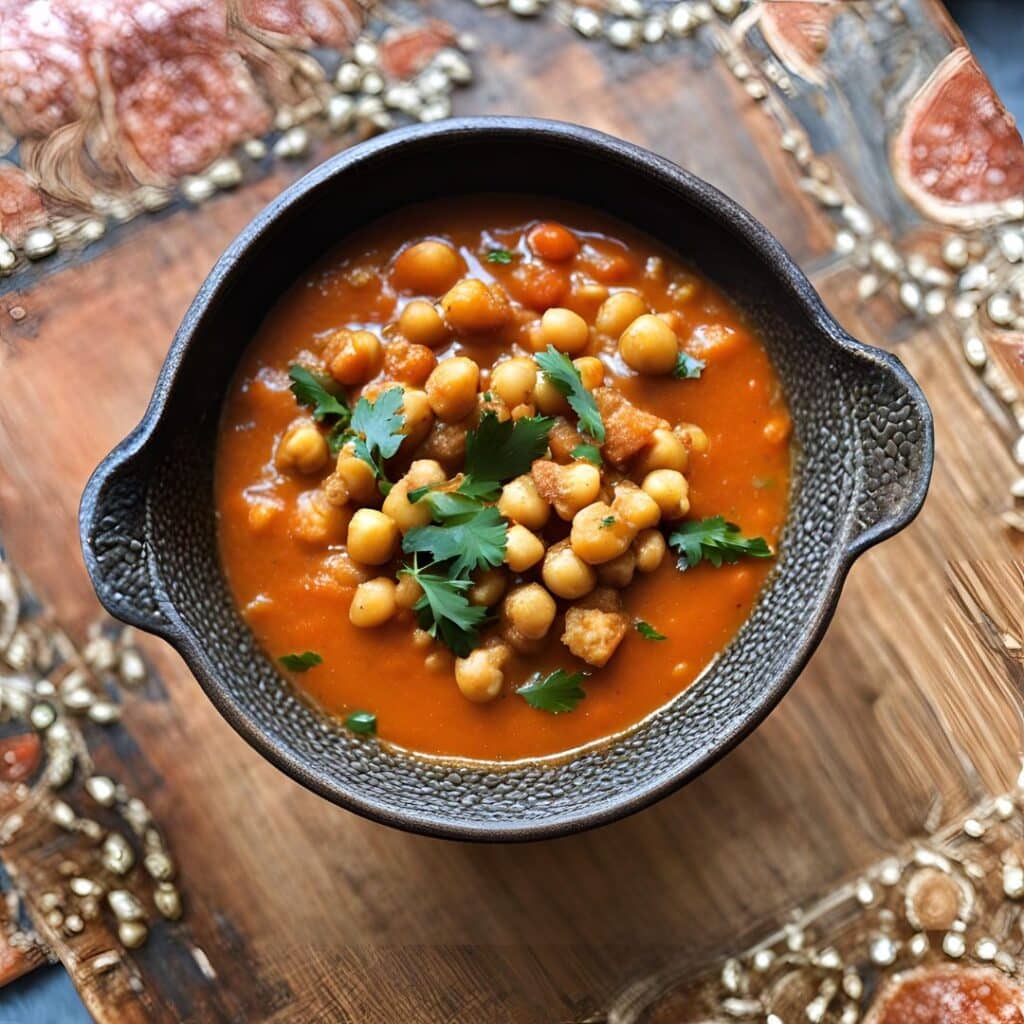
Gut-Healthy Sunset Soup

10almonds is reader-supported. We may, at no cost to you, receive a portion of sales if you purchase a product through a link in this article.

So-called for its gut-healthy ingredients, and its flavor profile being from the Maghreb (“Sunset”) region, the western half of the N. African coast.

You will need

  • 1 can chickpeas (do not drain)
  • 1 cup low-sodium vegetable stock
  • 1 small onion, finely chopped
  • 1 carrot, finely chopped
  • 2 tbsp sauerkraut, drained and chopped (yes, it is already chopped, but we want it chopped smaller so it can disperse evenly in the soup)
  • 2 tbsp tomato paste
  • 1 tbsp harissa paste (adjust per your heat preference)
  • 1 tbsp ras el-hanout
  • ¼ bulb garlic, crushed
  • Juice of ½ lemon
  • ¼ tsp MSG or ½ tsp low-sodium salt
  • Extra virgin olive oil
  • Optional: herb garnish; we recommend cilantro or flat-leaf parsley

Method

(we suggest you read everything at least once before doing anything)

1) Heat a little oil in a sauté pan or similar (something suitable for combination cooking, as we’ll be frying first and then adding liquids), and fry the onion and carrot until the onion is soft and translucent; about 5 minutes.

2) Stir in the garlic, tomato paste, harissa paste, and ras el-hanout, and fry for a further 1 minute.

3) Add the remaining ingredients* except the lemon juice. Bring to the boil and then simmer for 5 minutes.

*So yes, this includes adding the “chickpea water” also called “aquafaba”; it adds flavor and also gut-healthy fiber in the form of oligosaccharides and resistant starches, which your gut microbiota can use to make short-chain fatty acids, which improve immune function and benefit the health in more ways than we can reasonably mention as a by-the-way in a recipe.

4) Stir in the lemon juice, and serve, adding a herb garnish if you wish.
Enjoy!

Want to learn more?

For those interested in some of the science of what we have going on today:

Take care!

Don’t Forget…

Did you arrive here from our newsletter? Don’t forget to return to the email to continue learning!

Learn to Age Gracefully

Join the 98k+ American women taking control of their health & aging with our 100% free (and fun!) daily emails:

  • Mini Cuts: How To Lose Fat Quickly & Safely

    10almonds is reader-supported. We may, at no cost to you, receive a portion of sales if you purchase a product through a link in this article.

    No, one cannot healthily do this long-term. But for a few weeks to quickly drop fat while preserving lean muscle, yes:

    Briefly does it

    Step by step, the process goes like this:

    1. prep before starting: eat at maintenance for 1–2 weeks; set a clear goal (perhaps you have a vacation or event in mind that you want to look a certain way for).
    2. set calorie target: calculate maintenance calories; and subtract 300–500 for your mini cut. If unsure, use goal bodyweight in pounds ×10.
    3. set macro ratios: week 1 use 45% protein, 25% carbs, 30% fat; week 2 use 50% protein, 30% carbs, 20% fat; track as accurately as you reasonably can.
    4. plan and prep meals: batch-prep simple, repetitive meals (this makes tracking easier), with a focus on lean proteins, vegetables, fruits, and other high-volume foods to improve satiety.
    5. training adjustments: keep your strength training consistent; consider a small carb snack pre-workout if you usually train fasted, and avoid excessive cardio.
    6. remember to end the mini cut: per the first step, the duration should be 7–14 days (absolute maximum 30).
    7. reverse out: increase calories gradually by around 100 kcal per day until it’s back to the maintenance levels; you can reduce protein to 30–40% as carbs and fats normalize. then stay at maintenance for at least another 1–2 weeks before considering another deficit phase if you still want to lose more fat.
    8. reflect and reset: assess your results (body composition, energy, performance); treat mini cuts as a tool, not a lifestyle; returning to balanced eating is important for sustainability and general health.

    For more on all of this, enjoy:

    Click Here If The Embedded Video Doesn’t Load Automatically!

    Want to learn more?

    You might also like:

    How To Lose Weight (Healthily!) ← for a more sustainable approach; honestly we recommend this much more

    Take care!

    Share This Post

  • Heart Healthy Diet Plan – by Stephen William

    10almonds is reader-supported. We may, at no cost to you, receive a portion of sales if you purchase a product through a link in this article.

    We’ve covered heart-healthy cooking books before, but variety is good, and boredom is an enemy of health, so let’s shake it up with a fresh stack of recipes!

    After a brief overview of the relevant science (which if you’re a regular 10almonds reader, probably won’t be new to you), the author takes the reader on a 28-day journey. Yes, we know the subtitle says 30 days, but unless they carefully hid the other two days somewhere we didn’t find, there are “only” 28 inside. Perhaps the publisher heard it was a month and took creative license. Or maybe there’s a different edition. Either way…

    Rather than merely giving a diet plan (though yes, he also does that), he gives a wide range of “spotlight ingredients”, such that many of the recipes, while great in and of themselves, can also be jumping-off points for those of us who like to take recipes and immediately do our own things to them.

    Each day gets a breakfast, lunch, dinner, and he also covers drinks, desserts, and such like.

    Notwithstanding the cover art being a lot of plants, the recipes are not entirely plant-based; there are a selection of fish dishes (and other seafood, e.g. shrimp) and also some dairy products (e.g. Greek yoghurt). The recipes are certainly very “plant-forward” though and many are just plants. If you’re a strict vegan though, this probably isn’t the book for you.

    Bottom line: if you’d like to cook heart-healthy but are often stuck wondering “aaah, what to cook again today?”, then this is the book to get you out of any culinary creative block!

    Click here to check out the Heart Healthy Diet Plan, and widen your heart-healthy repertoire!

    Share This Post

  • Saffron For The Brain (& More)

    10almonds is reader-supported. We may, at no cost to you, receive a portion of sales if you purchase a product through a link in this article.

    Saffron For The Brain (& More)

    In yesterday’s edition of 10almonds, one of the items in the “health news from around the world” section was:

    Clinical trial finds herbal medicine Sailuotong effective for brain health in older people

    But, what is it?

    ❝SaiLuoTong (SLT) is a modern compound Chinese herbal medicine preparation in capsule form containing standardized extracts of Panax ginseng, Ginkgo biloba, and Crocus sativus L❞

    Source: A randomized, double-blind, placebo-controlled, parallel-group 12-week pilot phase II trial of SaiLuoTong (SLT) for cognitive function in older adults with mild cognitive impairment

    We’ve written previously about ginseng and ginkgo biloba:

    So, what’s this about Crocus sativus L.?

    That is the plant better known as saffron. And, for all its wide availability (your local supermarket probably has at least a tiny amount in the spice section), there’s a reason we don’t see much of it:

    ❝Saffron blooms only once a year and should be collected within a very short duration. It is picked during 3–4 weeks in October-November. The method for the cultivation of saffron contributes greatly to its high price. According to some reports, this species is a sterile triploid and so does not produce fertile seeds. Germination can take 1–6 months at 18°C. It takes 3 years for plants to flower from seed.❞

    Source: Crocus sativus L.: A comprehensive review

    That’s fascinating, but what does it do for us?

    Well, in the words of El Midaoui et al. (2022):

    ❝In the frame of a double-blind-placebo-controlled study, 30 mg per day supplementation with saffron for 16 weeks resulted in improved cognitive function in patients suffering from mild to moderate Alzheimer’s disease.

    Moreover, the follow-up of this study in which the authors evaluated the effects of saffron (30 mg/day) for 22 weeks showed that saffron was as effective as donepezil in the treatment of mild-to-moderate Alzheimer’s disease❞

    Read the full review: Saffron (Crocus sativus L.): A Source of Nutrients for Health and for the Treatment of Neuropsychiatric and Age-Related Diseases

    Not just that, but it also has powerful antioxidant and anti-inflammatory properties beyond the brain (though the brain is where research has been most focused, due to its neuroprotective effects).

    See: Antioxidant Properties of Crocus Sativus L. and Its Constituents and Relevance to Neurodegenerative Diseases; Focus on Alzheimer’s and Parkinson’s Disease

    (this, too, is a full research review in its own right; we’re getting a lot of “bang for buck” on papers today)

    And more?

    Yes, and more. Lots more. To bullet-pointify even just the abstract from another research review:

    • Saffron has been suggested to be effective in the treatment of a wide range of disorders including coronary artery diseases, hypertension, stomach disorders, dysmenorrhea and learning and memory impairments.
    • In addition, different studies have indicated that saffron has anti-inflammatory, anti-atherosclerotic, antigenotoxic and cytotoxic activities. (This is all good; the cytotoxic activities are about killing cancer cells)
    • Antitussive effects of stigmas and petals of C. sativus and its components, safranal and crocin have also been demonstrated.
    • The anticonvulsant and anti-Alzheimer properties of saffron extract were shown in human and animal studies.
    • The efficacy of C. sativus in the treatment of mild to moderate depression was also reported in clinical trial.
    • Administration of C. sativus and its constituents increased glutamate and dopamine levels in the brain in a dose-dependent manner.
    • It also interacts with the opioid system to reduce withdrawal syndrome.
    • C. sativus and its components can be considered as promising agents in the treatment of nervous system disorders.

    For more details on any of those items, see:

    The effects of Crocus sativus (saffron) and its constituents on nervous system: a review

    Is it safe?

    The effective dose is 30mg/kg and the LD50 is more than 20g/kg, so yes, it’s very safe. Given the price of it, this also means that if you’re the size of this writer (a little over 70kg, or a little over 150lbs) to poison yourself effectively you’d need to consume about 1.4kg of saffron at a time, which would cost well over $6,000.

    Where can I get it?

    Your local supermarket probably has a tiny amount in the spice section, or you can get better prices buying it in “bulk” online. Here’s an example product on Amazon, for your convenience

    Enjoy!

    Share This Post

  • Food Expiration Dates Don’t Mean What Most People Think They Mean

    10almonds is reader-supported. We may, at no cost to you, receive a portion of sales if you purchase a product through a link in this article.

    Have you ever wondered why rock salt that formed during the Precambrian era has a label on it saying that it expires next month? To take something more delicate, how about eggs that expire next Thursday; isn’t that oddly specific for something that is surely affected by many variables? What matters, and what doesn’t?

    Covering their assets

    The US in particular wastes huge amounts of food, with 37% of food waste coming from households. Confusion over date labels is a major contributor, accounting for 20% of household food waste. Many people misinterpret these labels, often discarding food that is still safe to eat—which is good for the companies selling the food, because then they get to sell you more.

    Date labels were introduced in the 70s with the “open dating” system to indicate optimal freshness, not safety. These dates are often conservative, set by manufacturers to ensure food is consumed at its best quality and encourage repeat purchases. However, many foods remain safe well past their labeled dates, including shelf-stable items like pasta, rice, and canned goods, as well as frozen foods stored properly.

    Some foods do pose safety risks, especially meat and dairy products, as well as many grain-based foods, all of which which can harbor harmful bacteria. Infant formula labels are strictly regulated for safety. However, most date labels are not linked to health risks, leading to unnecessary waste.

    When it comes down to it, our senses of sight, smell, and taste are more reliable than dates on packaging. Some quick pointers and caveats:

    • If it has changed color in some way that’s not associated with a healthily ripening fruit or vegetable, that’s probably bad
    • If it is moldy, that’s probably bad (but the degree of badness varies from food to food; see the link beneath today’s video for more on that)
    • If a container has developed droplets of water on the inside when it didn’t have those before, that’s probably bad (it means something is respiring, and is thus alive, that probably shouldn’t be)
    • If it smells bad, that’s probably bad—however this is not a good safety test, because a bad smell may often mean you are inhaling mold spores, which are not good for your lungs.
    • If it tastes different than that food usually does, that’s probably bad (especially if it became bitter, pungent, tangy, sour, or cheesy, and does nor normally taste that way).

    Some places have trialled clearer labelling, for example a distinction between “expires” and merely “best before”, but public awareness about the distinction is low. Some places have trialled removing dates entirely, to oblige the consumer to use their own senses instead. This is good for the seller in a different way than household food waste is, because it means the seller will have less in-store waste (because they can still sell something that might previously have been labelled as expired).

    For more on all of this, enjoy:

    Click Here If The Embedded Video Doesn’t Load Automatically!

    Want to learn more?

    You might also like to read:

    Mythbusting Moldy Food

    Take care!

    Don’t Forget…

    Did you arrive here from our newsletter? Don’t forget to return to the email to continue learning!

    Learn to Age Gracefully

    Join the 98k+ American women taking control of their health & aging with our 100% free (and fun!) daily emails:

  • How Artery Widening (Not Just Narrowing) Can Also Cause Strokes

    10almonds is reader-supported. We may, at no cost to you, receive a portion of sales if you purchase a product through a link in this article.

    We’ve written about stroke before; most centrally, our “how to” article, Reduce Your Stroke Risk ← so definitely do check this one out and do those things!

    All that remains valid, but a new risk factor has been identified, and, paradoxically, it’s the widening of arteries:

    Too wide!

    Researchers (Dr. Joanna Wardlaw et al.) have done a study whose results challenge the long-standing idea that lacunar ischemic stroke (a common small vessel stroke) is mainly caused by fatty plaque narrowing in larger arteries; instead, Dr. Wardlaw and her team found that widened, enlarged brain arteries (arterial dolichoectasia) were much more strongly linked to lacunar stroke and cerebral small vessel disease (with 4x greater risk thereof).

    As to how this problem arises when logically a wider blood vessel should mean better blood flow, the paper (that we’ll link shortly) discusses how “nonatheromatous intrinsic microvascular pathology” is to blame, which translating from sciences, means the structural disorganization of small brain arterioles, rather than the cholesterol plaque buildup in larger vessels.

    In other words, imagine if your house were built quite a bit larger but with only the same building materials; you see how it’d have problems? Same deal for your blood vessels.

    This means that antiplatelet drugs such as aspirin mainly target clotting and atherosclerotic plaque-related events, but if lacunar stroke is primarily driven by intrinsic small vessel structural damage rather than plaque blockage, then antiplatelet approaches are not likely to be a lot of help in this case!

    Important note: this does not mean that arterial narrowing (let alone blockage) is fine. It’s not. It just causes different strokes for different folks, so to speak. And, by consequence, this also doesn’t mean cholesterol, plaque, or antiplatelet therapy are unimportant for all stroke types (indeed, atherosclerosis remains a major cause of many other strokes) but simply that lacunar stroke will require other approaches:

    ❝This study provides strong evidence that lacunar stroke is not caused by fatty blockage of larger arteries, but by disease of the small vessels within the brain itself.

    Recognizing this distinction is crucial, because it explains why conventional treatments like antiplatelet drugs are not as effective for this type of stroke and highlights the urgent need to develop new therapies that target the underlying microvascular damage❞

    ~ Dr. Joanna Wardlaw

    So, research in this regard will now be focusing on protecting or restoring small vessel integrity rather than just on (the also worthy goal of) preventing clot formation; the same team’s LACI-3 trial is already testing whether drugs such as cilostazol and isosorbide mononitrate will better target these mechanisms.

    You can read the paper in full, here: Implications of Cranial Arterial Stenosis and Dolichoectasia for Cerebral Small-Vessel Disease Etiopathogenesis: Findings From a Prospective Mild Stroke Cohort

    But what if you do have a stroke?

    All is not necessarily lost; there are options! For example: What To Do If Having A Stroke Alone? ← with the caveat that, if you have a stroke, there’s a good chance you’ll forget all this. However, this is good to know anyway, in case someone else is having a stroke (and if you don’t live alone, it can be good for whoever is with you to know this too).

    There are also such resources as: Reverse Stroke Damage (Within A 6-Hour Window) ← there is a drug that does this now, but time is of the essence

    Want to learn more?

    Everyone even vaguely health-conscious knows that prevention is better than cure, but many still don’t think about a lot of things until they’re too late, and stroke definitely falls all-too-often into that category:

    Each year in the US, over half a million people have a first stroke; however, up to 80% of strokes may be preventable.❞

    ~ American Stroke Association

    Source: New guideline: Preventing a first stroke may be possible with screening, lifestyle changes

    To be ahead of that curve, check out:

    Don’t Get Caught Out By These “Nontraditional” Stroke Risk Factors

    And, for that matter,

    6 Signs Of Stroke (One Month In Advance)

    Take care!

    Don’t Forget…

    Did you arrive here from our newsletter? Don’t forget to return to the email to continue learning!

    Learn to Age Gracefully

    Join the 98k+ American women taking control of their health & aging with our 100% free (and fun!) daily emails:

  • The first pig kidney has been transplanted into a living person. But we’re still a long way from solving organ shortages

    10almonds is reader-supported. We may, at no cost to you, receive a portion of sales if you purchase a product through a link in this article.

    In a world first, we heard last week that US surgeons had transplanted a kidney from a gene-edited pig into a living human. News reports said the procedure was a breakthrough in xenotransplantation – when an organ, cells or tissues are transplanted from one species to another. https://www.youtube.com/embed/cisOFfBPZk0?wmode=transparent&start=0 The world’s first transplant of a gene-edited pig kidney into a live human was announced last week.

    Champions of xenotransplantation regard it as the solution to organ shortages across the world. In December 2023, 1,445 people in Australia were on the waiting list for donor kidneys. In the United States, more than 89,000 are waiting for kidneys.

    One biotech CEO says gene-edited pigs promise “an unlimited supply of transplantable organs”.

    Not, everyone, though, is convinced transplanting animal organs into humans is really the answer to organ shortages, or even if it’s right to use organs from other animals this way.

    There are two critical barriers to the procedure’s success: organ rejection and the transmission of animal viruses to recipients.

    But in the past decade, a new platform and technique known as CRISPR/Cas9 – often shortened to CRISPR – has promised to mitigate these issues.

    What is CRISPR?

    CRISPR gene editing takes advantage of a system already found in nature. CRISPR’s “genetic scissors” evolved in bacteria and other microbes to help them fend off viruses. Their cellular machinery allows them to integrate and ultimately destroy viral DNA by cutting it.

    In 2012, two teams of scientists discovered how to harness this bacterial immune system. This is made up of repeating arrays of DNA and associated proteins, known as “Cas” (CRISPR-associated) proteins.

    When they used a particular Cas protein (Cas9) with a “guide RNA” made up of a singular molecule, they found they could program the CRISPR/Cas9 complex to break and repair DNA at precise locations as they desired. The system could even “knock in” new genes at the repair site.

    In 2020, the two scientists leading these teams were awarded a Nobel prize for their work.

    In the case of the latest xenotransplantation, CRISPR technology was used to edit 69 genes in the donor pig to inactivate viral genes, “humanise” the pig with human genes, and knock out harmful pig genes. https://www.youtube.com/embed/UKbrwPL3wXE?wmode=transparent&start=0 How does CRISPR work?

    A busy time for gene-edited xenotransplantation

    While CRISPR editing has brought new hope to the possibility of xenotransplantation, even recent trials show great caution is still warranted.

    In 2022 and 2023, two patients with terminal heart diseases, who were ineligible for traditional heart transplants, were granted regulatory permission to receive a gene-edited pig heart. These pig hearts had ten genome edits to make them more suitable for transplanting into humans. However, both patients died within several weeks of the procedures.

    Earlier this month, we heard a team of surgeons in China transplanted a gene-edited pig liver into a clinically dead man (with family consent). The liver functioned well up until the ten-day limit of the trial.

    How is this latest example different?

    The gene-edited pig kidney was transplanted into a relatively young, living, legally competent and consenting adult.

    The total number of gene edits edits made to the donor pig is very high. The researchers report making 69 edits to inactivate viral genes, “humanise” the pig with human genes, and to knockout harmful pig genes.

    Clearly, the race to transform these organs into viable products for transplantation is ramping up.

    From biotech dream to clinical reality

    Only a few months ago, CRISPR gene editing made its debut in mainstream medicine.

    In November, drug regulators in the United Kingdom and US approved the world’s first CRISPR-based genome-editing therapy for human use – a treatment for life-threatening forms of sickle-cell disease.

    The treatment, known as Casgevy, uses CRISPR/Cas-9 to edit the patient’s own blood (bone-marrow) stem cells. By disrupting the unhealthy gene that gives red blood cells their “sickle” shape, the aim is to produce red blood cells with a healthy spherical shape.

    Although the treatment uses the patient’s own cells, the same underlying principle applies to recent clinical xenotransplants: unsuitable cellular materials may be edited to make them therapeutically beneficial in the patient.

    Sickle cells have a different shape to healthy round red blood cells
    CRISPR technology is aiming to restore diseased red blood cells to their healthy round shape. Sebastian Kaulitzki/Shutterstock

    We’ll be talking more about gene-editing

    Medicine and gene technology regulators are increasingly asked to approve new experimental trials using gene editing and CRISPR.

    However, neither xenotransplantation nor the therapeutic applications of this technology lead to changes to the genome that can be inherited.

    For this to occur, CRISPR edits would need to be applied to the cells at the earliest stages of their life, such as to early-stage embryonic cells in vitro (in the lab).

    In Australia, intentionally creating heritable alterations to the human genome is a criminal offence carrying 15 years’ imprisonment.

    No jurisdiction in the world has laws that expressly permits heritable human genome editing. However, some countries lack specific regulations about the procedure.

    Is this the future?

    Even without creating inheritable gene changes, however, xenotransplantation using CRISPR is in its infancy.

    For all the promise of the headlines, there is not yet one example of a stable xenotransplantation in a living human lasting beyond seven months.

    While authorisation for this recent US transplant has been granted under the so-called “compassionate use” exemption, conventional clinical trials of pig-human xenotransplantation have yet to commence.

    But the prospect of such trials would likely require significant improvements in current outcomes to gain regulatory approval in the US or elsewhere.

    By the same token, regulatory approval of any “off-the-shelf” xenotransplantation organs, including gene-edited kidneys, would seem some way off.

    Christopher Rudge, Law lecturer, University of Sydney

    This article is republished from The Conversation under a Creative Commons license. Read the original article.

    Don’t Forget…

    Did you arrive here from our newsletter? Don’t forget to return to the email to continue learning!

    Learn to Age Gracefully

    Join the 98k+ American women taking control of their health & aging with our 100% free (and fun!) daily emails: