
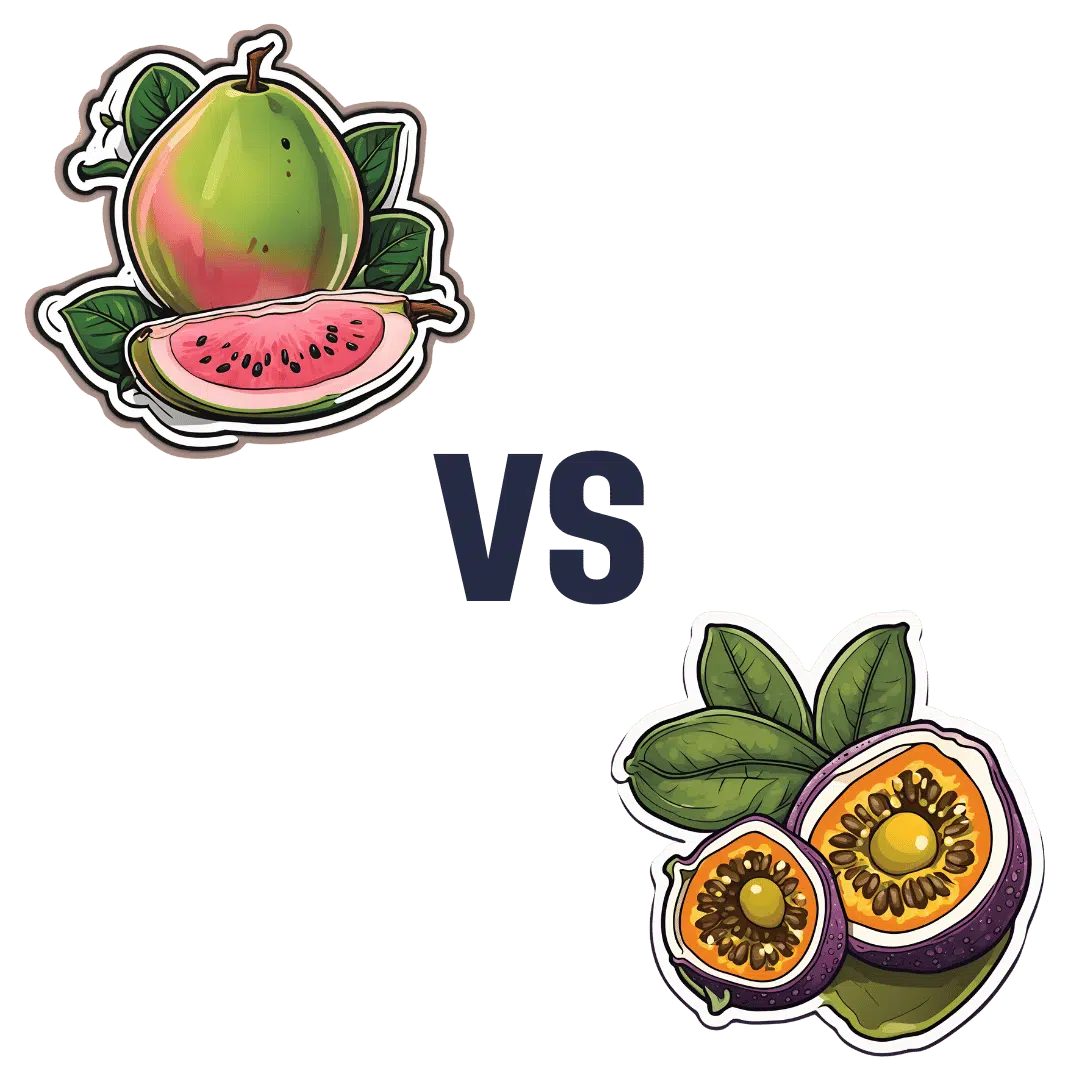
Guava vs Passion Fruit – Which is Healthier?
10almonds is reader-supported. We may, at no cost to you, receive a portion of sales if you purchase a product through a link in this article.
Our Verdict
When comparing guava to passion fruit, we picked the guava.
Why?
There aren’t many fruits that can beat passion fruit for nutritional density! And even in this case, it wasn’t completely so in every category:
In terms of macros, passion fruit has more carbs and fiber, the ratio of which give it the slightly lower glycemic index. Thus, a modest win for passion fruit in this category.
In the category of vitamins, guava has more of vitamins B1, B5, B6, B9, C, E, and K, while passion fruit has more of vitamins A, B2, and B3. A clear win for guava this time.
When it comes to minerals, it’s a little closer, but: guava has more calcium, copper, manganese, potassium, and zinc, while passion fruit has more iron, magnesium, and phosphorus. So, another win for guava.
Adding up the sections makes for guava winning the day, but by all means enjoy either or both; diversity is good!
Want to learn more?
You might like to read:
Fruit Is Healthy; Juice Isn’t (Here’s Why)
Enjoy!
Don’t Forget…
Did you arrive here from our newsletter? Don’t forget to return to the email to continue learning!
Recommended
Learn to Age Gracefully
Join the 98k+ American women taking control of their health & aging with our 100% free (and fun!) daily emails:
-
We Hope This Email Blows Your Tits Clean Off
10almonds is reader-supported. We may, at no cost to you, receive a portion of sales if you purchase a product through a link in this article.
The Right Kind Of “Email Hacks”!
Are you a Gmailer or an Outlookista? Whatever your preference, you’re probably facing many of the same challenges that most of us face in our work and personal lives:
Email’s greatest strength (its ease of accessibility) brings about its greatest problem (our inboxes are cluttered and chaotic), not to mention that each of us are usually managing a whole flock of email addresses.
Sometimes we put productivity resources up against each other; that’s not what we’re going to do today! Each of these can play a role alongside each other; grab as many as will make your life easier:
ProtonMail: this is an email client; it’s the nicest, simplest, easiest, free email client that doesn’t track, let alone share, everything you do.
Bonus: there also exists ProtonCalendar (it’s a calendar that doesn’t share your data), ProtonDrive (it’s a cloud storage provider that doesn’t share your data) and, because they’re indeed serious about your privacy, ProtonVPN (it’s a VPN that, of course, doesn’t share your data).
Clean Email: maybe you’re stuck with the email provider you have. It happens. But it doesn’t have to be a chaotic mess. This tool will make tidying your email (and keeping it tidy!) a simplified dream.
See How Clean Your Email Can Get With Just A Few Clicks!
Right Inbox: a Gmail extension with many useful features, including read receipts, emails scheduled for later (e.g: time your email to send at 7am to look like a morning lark when in fact you’re peacefully snoozing), add unforwardable “For Your Eyes Only” notes to emails, and more.
Power Up Your Gmail With The Right Inbox Extension!
Email Finder: find the verified work email address of any person, so long as you know what company you’re looking for them in! No more “I thought it was lastname.firstname@ and it was firstname.lastname@”, no more “the wrong John Smith”, no more “undelivered” bounceback notices. Just: your email delivered.
Never Hear From The Mailer Daemon Again, With Email Finder!
Unroll.me: love your subscriptions, but hate the clutter? Unroll.me aggregates them for you in a virtual roll-up, with an “unroll” button to read them.
Get What You Really Want From Your Subscriptions, With Unroll.Me!
On which note, anything you’d like to hear more of from us? Let us know! You can always just hit reply, or use the feedback widget at the bottom of this email
Share This Post
-
Apricot vs Kiwi – Which is Healthier?
10almonds is reader-supported. We may, at no cost to you, receive a portion of sales if you purchase a product through a link in this article.
Our Verdict
When comparing apricots to kiwi, we picked the kiwi.
Why?
Both are great! But…
In terms of macros, kiwi has more fiber and carbs, as well as the better ratio of fiber:carbs, and so wins this round.
In the category of vitamins, apricot has more of vitamins A, B1, B2, B3, and B5, while kiwi has more of vitamins B6, B7, B9, C, E, K, and choline. Yes, it’s a little unusual the distribution of vitamins were divided alphanumerically like that (from A to B5 for apricots, then B6 onwards for kiwi, as though they were neighboring sections in a library), but nature can be strange like that sometimes. It’s also fun apricots are a really good source of vitamin A (24x more) and kiwis are a really good source of vitamin K (12x more), but when all the vitamins are added up, kiwi has a clear numerical advantage over all, and wins this round.
When it comes to minerals, things are no longer distributed alphabetically, because apricots have more iron and zinc, while kiwis have more calcium, copper, magnesium, manganese, phosphorus, potassium, and selenium. Another win for kiwis.
Both of these fruits have abundant polyphenols and specific anticancer properties, so there’s nothing between them here in that regard.
Adding up the sections makes for a clear overall win for kiwis, but by all means enjoy either or both; diversity is good!
Want to learn more?
You might like:
Top 8 Fruits That Prevent & Kill Cancer
Enjoy!
Share This Post
-
Becoming a Supple Leopard – by Dr. Kelly Starrett and Glen Cordoza
10almonds is reader-supported. We may, at no cost to you, receive a portion of sales if you purchase a product through a link in this article.
We’ve previously reviewed Dr. Starrett’s other book, “Built To Move“, and now today we’ll review his more famous book!
Why is this one so famous? It’s popularly considered “the Bible of Cross-Fit”, even though it’s not at all marketed as such, and nor does it talk about Cross Fit directly. But: people who are interested in being fit, fast, strong, mobile, stable, and so forth, tend to invest in this book at some point if they are serious.
The book is big, heavy, and textbook-like. This isn’t a quick light read. This is a “study over the course of a year or more while doing your physiotherapy degree” book. And yet, it’s written for the widest audience, and as such, everything is explained from the ground up, so no prior knowledge is expected.
It does have pictures, which are clear and helpful, though the print version is better for this than the Kindle edition.
The subtitle of the book is no lie; it does indeed cover all those things, deeply and at length, for everything musculoskeletal.
Bottom line: this book will seriously improve your knowledge and understanding of all things body mechanics and related body maintenance. If you care to get/remain fit/strong/mobile/etc, this book is a fine cornerstone for such endeavors.
Click here to check out Becoming A Supple Leopard, and become a supple leopard!*
*Metaphorically. Furry metamorphosis is not a side-effect. Suppleness, however, is on offer. Yes, even for you, dear reader!
Share This Post
Related Posts
-
5 types of ‘wellness woo’ that borrow from mainstream medicine
10almonds is reader-supported. We may, at no cost to you, receive a portion of sales if you purchase a product through a link in this article.
What we consider “fringe” or “mainstream” changes over time. That applies to health and medicine too.
For instance, massage was once considered a fringe therapy but in the 19th century it morphed into what we know today as physiotherapy.
Likewise, Swiss doctor Maximilian Bircher-Benner wasn’t taken seriously when he said we should eat oats and fruit for breakfast. But he was onto something: he invented muesli.
There has also been traffic in the other direction. Legitimate medical therapies have turned up in the weird health borderland of beauty and “wellness”.
When untrained or barely trained people use these therapies, they can do real harm.
Here are five examples of wellness trends that borrow from mainstream medicine.
SimpleImages/Getty 1. Ozone therapy
Ozone (O₃) is a form of oxygen. Ordinary oxygen (O₂), sometimes with ozone added, can be applied to wounds via a bag or sealed chamber to help them heal. It does this by helping the body fight infection and form collagen.
But “ozone therapy” – the weird, unlicensed version – puts ozone, or ozone and oxygen, directly into the person’s body. It can go in via the lungs, or via intravenous injection, or it can be pumped into the rectum or vagina.
Practitioners claim it can reduce inflammation, or even treat cancer or HIV/AIDS, despite no evidence for such health benefits.
It can also cause fatal air embolisms – bubbles of gas in the bloodstream that can block blood flow to vital organs.
2. Vitamin drips
If you don’t get enough of a certain vitamin or mineral through your diet, you can take a supplement. But if that doesn’t work, in some cases, you might need to go to hospital or a doctor’s surgery to get a medically supervised infusion that’s delivered into the vein (an IV infusion).
For instance, iron infusions help people with serious iron deficiencies.
But celebrity endorsements have helped fuel the rise of “vitamin drips” at wellness centres and therapy lounges. These drips promise all sorts of outcomes, from boosting your immune system, to treating pain or depression.
IV needles in untrained hands can be dangerous. They can cause phlebitis (inflammation of the vein) and infiltration (when the IV fluid or medication leaks into the surrounding areas). They can also lead to infection.
And unlike therapeutic vitamin IV infusions administered in hospital, these non-traditional treatments are not regulated by Australia’s Therapeutic Goods Administration. So you might also not be getting the magic IV potion you’re paying for.
3. Botox
The bacterium Clostridium botulinum produces a neurotoxin – a poison that affects nerves. For decades, it’s been used therapeutically to treat excess sweating and migraine, among other conditions. Today, we call this neurotoxin Botox.
Since about the 1990s, health professionals have been injecting it into people’s faces to temporarily paralyse the muscles that cause wrinkles.
It’s legal, it’s a registered product, and in trained hands it’s safe to use.
But as of September 2 this year, it’s been wrapped in an extra layer of regulation.
People who deliver any non-surgical cosmetic procedures – including Botox – will now be required to demonstrate higher skill levels under tougher policies.
This comes after several cases where nurses allegedly imported injectables from overseas. But these products weren’t registered for use in Australia and may not have been safe to use.
4. Apheresis
Apheresis is the process of separating blood into its component parts by spinning it at high speed in a special machine.
Clinicians use this process to separate out and remove specific molecules or antibodies in some diseases – what’s called “selective apheresis”.
For example, if a person has very high cholesterol that doesn’t respond to normal treatments, they can undergo lipid apheresis to “wash out” harmful lipoproteins from their blood.
It’s easy to see how the idea of “washing” your blood could be misunderstood and misapplied.
English actor Orlando Bloom announced earlier this year that he’d undergone apheresis to remove microplastics from his blood.
Microplastics in the body are a cause for concern – but there’s no evidence to suggest apheresis can cleanse human blood of them.
5. Hyperbaric therapy
When a diver gets “the bends” from too much nitrogen forming in their body, they can be treated in a hyperbaric oxygen chamber, where they receive 100% oxygen in a pressurised chamber.
But hyperbaric therapy is also touted as a treatment for autism, Alzheimer’s disease, cancer, strokes, and post-traumatic stress disorder.
There isn’t enough good science to back up any of these claims. There also isn’t enough science to suggest it makes your skin look younger.
The key message?
The history of medicine is full of stories about when mainstream forms of medicine have harmed instead of healed.
Humans have also always wanted to manage their own health. This has been going on for centuries, with both risks and benefits.
But just because a therapy has been used in a hospital for one reason doesn’t necessarily mean it works in a wellness clinic for another.
People can be easily convinced by aggressively marketed wellness therapies, which can be magnified by social media and celebrity endorsements.
However these therapies can come with a lack of evidence to support their wider uses, and they may harm.
Caveat emptor – let the buyer beware.
Philippa Martyr, Lecturer, Pharmacology, Women’s Health, School of Biomedical Sciences, The University of Western Australia
This article is republished from The Conversation under a Creative Commons license. Read the original article.
Don’t Forget…
Did you arrive here from our newsletter? Don’t forget to return to the email to continue learning!
Learn to Age Gracefully
Join the 98k+ American women taking control of their health & aging with our 100% free (and fun!) daily emails:
-
How Healthy Are Afternoon Naps?
10almonds is reader-supported. We may, at no cost to you, receive a portion of sales if you purchase a product through a link in this article.
It’s Q&A Day at 10almonds!
Have a question or a request? We love to hear from you!
In cases where we’ve already covered something, we might link to what we wrote before, but will always be happy to revisit any of our topics again in the future too—there’s always more to say!
No question/request too big or small 😎
❝Is it good for the health to take afternoon naps? Or is it better to just sleep at night?❞
It depends on you! There are potential benefits to napping, for example:
- Increased alertness
- Helps with learning
- Improved memory
- Boost to immunity
- Enhance athletic performance
Generally considered best is simply the famous 7–9 hours at night (yes, including at older ages): Why You Probably Need More Sleep
…and sleep efficiency does matter too: Why 7 Hours Sleep Is Not Enough
…which in turn, is influenced by factors other than just length and depth: The 6 Dimensions Of Sleep (And Why They Matter)
However, as we’ve said before elsewhere, often what is best is not necessarily what is attainable, so if you struggle to get the aforementioned sleep quantity and quality, then you might want to consider: How To Nap Like A Pro (No More “Sleep Hangovers”!)
There are more considerations, though, for example:
- How Regularity Of Sleep Can Be Even More Important Than Duration ← here’s why you should still get up at the same regular (and ideally, early) hour, even if you didn’t sleep well
- Early Bird Or Night Owl? Genes vs Environment ← and here’s why that regular hour should ideally be early, even if it’s not your genetic predisposition to be a “morning lark”; see also the study linked there that mentions “Gene distinguishes early birds from night owls and helps predict time of death”
One important thing to bear in mind: naps are not special
By this we mean: it might feel special to you at the time, taking a little slice of time for yourself, but scientifically speaking, it’s no more special than longer sleep, and in fact, it’s often less restorative, minute for minute, if you don’t time it perfectly.
The reason we mention this is because there is a sizeable (albeit revolving door) subculture of enthusiasts of polyphasic sleeping (i.e. sleeping more than once per day, by napping one or more times) with the goal of sleeping fewer hours in total by making sleep more efficient.
It does not work, except insofar as it can allow you to survive a crisis that is stopping you from sleeping properly. But this is sleep’s equivalent of “fight or flight”, it’s the body’s admittedly very impressive “emergency mode” that is not good to use on a daily basis!
(if you want to know just how bad it is… the top-listed “similar article” is entitled “Suicidal Ideation”)
For more on the woes of trying to force one’s body into polyphasic sleeping in order to sleep less in total, we covered this some years ago: Polyphasic Sleep… Super-Schedule Or An Idea Best Put To Rest?
One last thing: if you’re finding you need to nap a lot, then:
- You probably should indeed nap
- That is probably something you should get checked out, though
For example, researchers (Dr. Ruixue Cai et al.) tracked 1,338 older adults (aged 56+) for up to 19 years using wearable devices to objectively measure daytime napping patterns, and found that longer naps, more frequent naps, and naps taken in the morning were all linked to higher all-cause mortality in later life.
Specifically, each extra hour of daytime napping was associated with a 13% higher mortality risk, each additional daily nap with a 7% increase, and morning nappers had a 30% higher risk compared to afternoon nappers.
Now, these findings show correlation, not causation, meaning excessive napping likely reflects underlying issues such as neurodegeneration, cardiovascular disease, or circadian rhythm disruption, rather than being a case of the naps being the culprit causing death.
So to recap the main point of this last bit: if you’re finding you have to nap a lot, you should probably get that checked out, because while not itself dangerous so far as best current science can say, it may be a sign that “something wrong is not right”.
You can read this paper here: Objectively Measured Daytime Napping Patterns and All-Cause Mortality in Older Adults
Want to learn more?
This is the book on sleep:
Why We Sleep – by Dr. Matthew Walker
Enjoy!
Don’t Forget…
Did you arrive here from our newsletter? Don’t forget to return to the email to continue learning!
Learn to Age Gracefully
Join the 98k+ American women taking control of their health & aging with our 100% free (and fun!) daily emails:
-
Outlive – by Dr. Peter Attia
10almonds is reader-supported. We may, at no cost to you, receive a portion of sales if you purchase a product through a link in this article.
We know, we know; this diet, that exercise, don’t smoke or drink, get decent sleep”—a lot of books don’t go beyond this level of advice!
What Dr. Attia offers is a multi-vector approach that covers the above and a lot more.
Themes of the book include:
- The above-mentioned things, of course
- Rethinking medicine for the age of chronic disease
- The pros and cons of…
- caloric restriction
- dietary restriction
- intermittent fasting
- Pre-emptive interventions for…
- specific common cause-of-death conditions
- specific common age-related degenerative conditions
- The oft-forgotten extra pillar of longevity: mental health
The last one in the list there is covered mostly in the last chapter of the book, but it’s there as a matter of importance, not as an afterthought. As Dr. Attia puts it, not only are you less likely to take care of your physical health if you are (for example) depressed, but also… “Longevity is meaningless if your life sucks!”
So, it’s important to do things that promote and maintain good physical and mental health.
Bottom line: if you’re interested in happy, healthy, longevity, this is a book for you.
Click here to check out Dr. Attia’s “Outlive” on Amazon today!
Don’t Forget…
Did you arrive here from our newsletter? Don’t forget to return to the email to continue learning!
Learn to Age Gracefully
Join the 98k+ American women taking control of their health & aging with our 100% free (and fun!) daily emails:


